Google, major breakthrough in quantum computing
Google has verified a technology called "magic state cultivation" on its Willow processor, which has drastically reduced the quantum error rate.
Quantum computers are expected to deliver exponential computing power by processing multiple possibilities simultaneously. However, under current technical conditions, we are still far from reaching this ideal state.
It is understood that in quantum computing, photons (or light particles) are used as qubits. When connected together, they deliver stronger processing capabilities than the binary 0 and 1 used by traditional computers. Qubits can be both 0 and 1 at the same time, in a superposition state, which enables them to process information much faster.
However, qubits are prone to frequent errors, so quantum computers still have limitations at present. To overcome these errors, the machines need to leverage so-called "magic states" — scientists at Google Research believe that the quantum chips they have developed may help achieve this goal.
The relevant study was published in the journal Science on Thursday. It is reported that Google verified a technology named "magic state cultivation" on its Willow processor, reducing the quantum error rate by about 40 times: without cultivation, around 4 out of every 1000 magic states are defective; after applying cultivation, only about 1 out of every 10,000 magic states is defective. The logical fidelity of the T state reaches 99.99%. This is the highest record in this field so far.
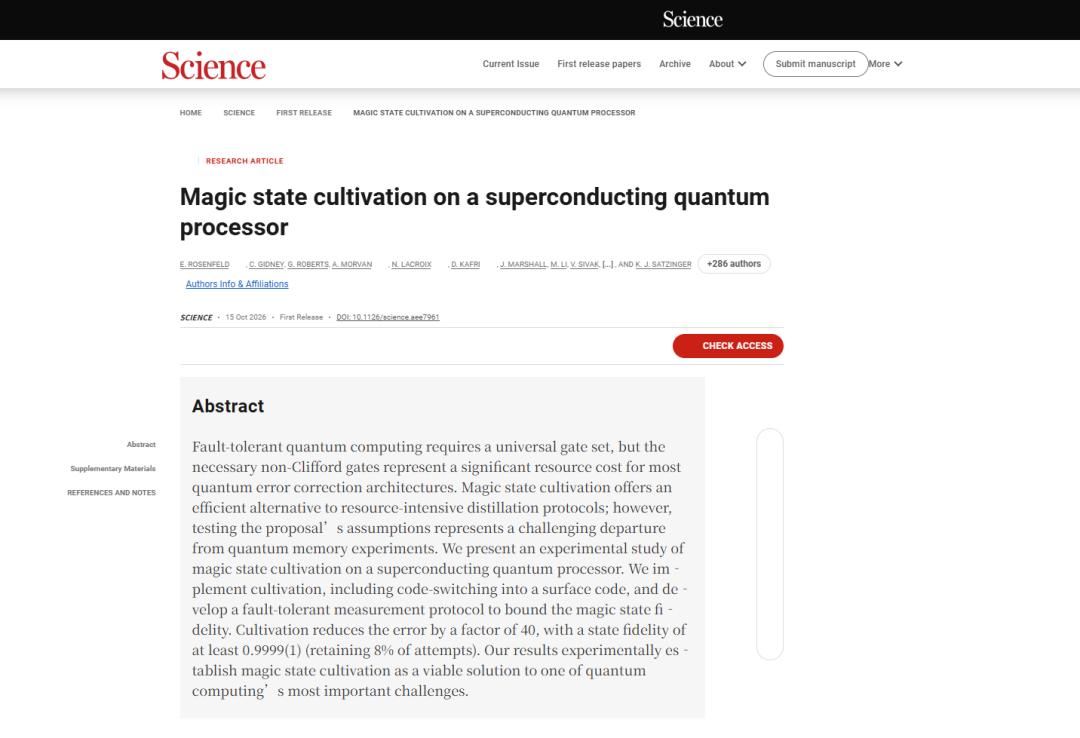
"Magic states" are the key element to realize universal quantum computing. If a quantum processor wants to perform complex operations that outperform classical computers, it must rely on magic states to generate the required set of quantum operations. However, magic states cannot be reused once used, making them a scarce resource. Moreover, generating magic states with a sufficiently low error rate has long been a major challenge in building practical large-scale systems.
Furthermore, an even greater challenge lies in production cost. Some research estimates show that quantum computers may need to devote up to 95% of their total computing power to magic state production, leaving extremely scarce resources for actual computing tasks. This bottleneck was foreseen by researchers as early as 2004. In the following two decades, the academic community has continuously explored methods to reduce the production cost of magic states, but progress has been slow.
In the aforementioned new study, researchers demonstrated how to use a horticulture-inspired technique called "cultivation" to deliver magic states at lower costs.
The research results provide experimental verification for the theoretical method proposed in 2024. At that time, Google Quantum AI researchers Craig Gidney, Noah Shutty and Cody Jones proposed the magic state cultivation scheme on the basis of existing literature.
Its core idea is to design the magic state production process as a set of "filtering mechanism": Google uses synergistic measurement to detect errors and filter out invalid attempts, so as to generate higher-quality quantum states with fewer resources.
And the latest research confirms that on the Willow supercomputer, this method achieves a logical fidelity of 99.99% for the T state (a special quantum state used in quantum computing), setting a new record in this field.
Besides reducing errors, Google's researchers also proved that purified quantum states can be transferred between two different error correction methods, which marks the progress of this technology in terms of integration into Google's existing architecture.
However, despite the above progress, Google also made it clear that further research is needed to extend this technology to the field of practical quantum computing, but these findings provide a potential way to reduce the hardware resources required to build a fault-tolerant quantum system.
This article is from the WeChat official account "Sci-Tech Innovation Board Daily", written by Huang Junzhi, and published with authorization by 36Kr.