Foreign investors are flocking to China to conduct on-site factory visits.
If a foreigner plans to spend 100,000 yuan to stay in China for a week, which cities do you think he will visit?
I raised this question to Claude, and it gave me a typical foreign tourist itinerary: visiting Beijing, Xi'an and Shanghai. The reason is simple: the Great Wall, the Terracotta Army and the Bund are almost the standard answers for foreigners traveling to China in the traditional perception. As for the budget, it is allocated to five-star hotels, private guides and Michelin-starred restaurants.
This answer is certainly not wrong, but it seems a little unimaginative in the current context. The fact is that in addition to traditional scenic spots, China's emerging technology companies have now become destinations that many foreigners specifically come to investigate and study.
More and more foreign investors and corporate executives choose to pay tens of thousands or even hundreds of thousands of yuan as "tuition fees" to join tour groups to China, so as to get the opportunity to visit and have in-depth exchanges with Chinese technology enterprises. The investigation scope of such groups mainly covers cities where emerging technology enterprises gather, such as Beijing, Shenzhen, Shanghai and Hangzhou.
In recent years, China's development progress in fields such as large AI models, embodied intelligence, and consumer hardware has been so fast that the world cannot ignore it. The FOMO sentiment has also spread overseas — foreign executives and investors are also worried about missing out on opportunities in China.
Behind this, the world's perception of China's technology industry is quietly changing.
Monica Wang, who has long worked in the fields of science and innovation and global expansion, is the initiator of AGI Villa & BridgingChina, an organization that provides global investors, enterprises and entrepreneurs with insights into China's technology ecosystem and industry, as well as project cooperation services.
Monica Wang told me that in the past, when overseas investors or corporate executives talked about China, the most frequent questions they asked were: What manufacturing capabilities does China have? What is the cost? Where is the supply chain? But now when they come to China, they care about several more in-depth questions: Why is China developing so fast? How on earth is this cost achieved? Can these technologies go global?
"In the past, many foreigners came to China to look for supply chains. Now more and more people come to China to look for answers," said Monica Wang.
Foreign Investors Flock to China for Factory Visits
In the past one or two years, news of foreign leaders visiting technology enterprises during their trips to China has emerged in an endless stream. However, if we only infer the international appeal of China's technology industry based on the schedules of top government officials, it would be a hasty generalization — after all, the elements of "saving face" and "going through the motions" in state visits are difficult to quantify and separate.
The real business volume in the private sector may better illustrate the situation.
Liz, co-founder of the technology research institution "Nofuture", told me that since the beginning of this year, Nofuture has received 5 technology research delegations, with 10 to 12 members in each group, and there are 3 more groups to be received within the year.
Nofuture mainly organizes corporate executives, investors and students from the UK and the US to conduct in-depth visits to hard technology enterprises and incubation institutions in the Greater Bay Area, such as XPeng, UBTECH, DJI, and Shenzhen Institute of Technology and Innovation. The itinerary of the research delegation usually lasts for 7 days, and the fee for corporate executives and investors is 8,000 pounds (equivalent to about 70,000 yuan). The main content of the itinerary is to visit the products and production lines of the enterprises, and hold closed-door exchanges with relevant executives.
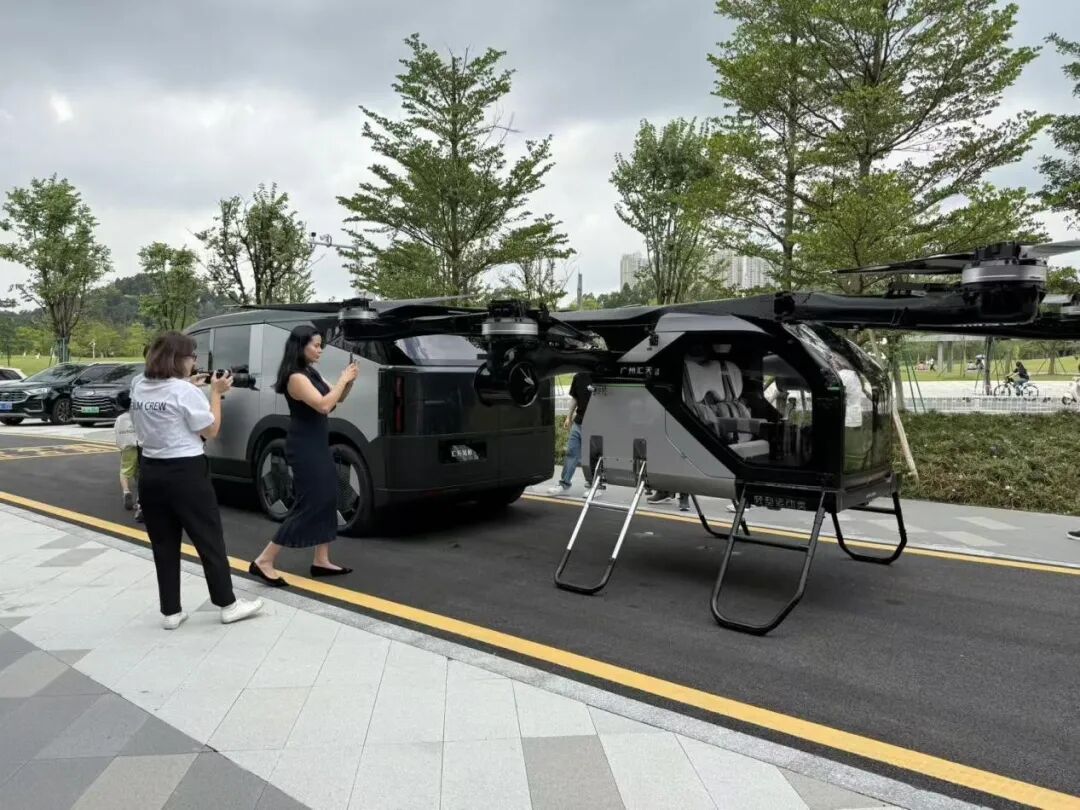
Foreign visitors organized by Nofuture are experiencing the products of the enterprises they visit
Due to the relatively high fee threshold and the requirements for visiting projects, technology research groups like Nofuture are still an under-the-radar business at present. However, a quick search on LinkedIn, where foreign executives and investors are highly concentrated, can already find several technology research products similar to Nofuture.
The itinerary of such products usually lasts 5 to 7 days, with a fee ranging from 4,000 US dollars (equivalent to about 27,000 yuan) to 15,000 US dollars (equivalent to about 100,000 yuan). In addition to the hard technology enterprises in the Greater Bay Area, the research scope may also include companies such as Fourier Intelligence, ByteDance, and MINIMAX, covering the core areas of China's electric vehicle, battery, AI and embodied intelligence industries.
According to information previously disclosed by a Shanghai-based technology research institution, the institution received nearly 1,000 technology visitors in 2025, and this number will double this year. At present, the institution organizes more than 100 one-day enterprise visit activities every month.
Combining information from multiple sources, most of the participants in such technology research groups are corporate executives from Southeast Asia, the Middle East, Europe and Latin America, investment institutions, and heads of universities and industrial ecological institutions. According to public reports, those who have participated in such investigations also include US investment firms Dimension, Capital Group and Thrive Capital, as well as the American technology podcast host Lex Fridman.
In addition to these large-scale technology research groups, a large number of foreign executives and investors have long been conducting targeted research on Chinese technology enterprises.
Linda (pseudonym), who works at an innovative drug company in Shenzhen, told me that the company basically receives top foreign pharmaceutical companies and investment institutions every day. "Enterprises and investors mainly come to learn about what new technologies we have." Jennifer (pseudonym), who once worked as a conference receptionist at a leading large communication manufacturer in Shenzhen, is also used to receiving foreign visitors. She told me that the number of foreign visitors to the company is very large every year, including some foreign investors, "They want to come to China to see what investment opportunities there are."
"Seize the Opportunities in China"
Where does the appeal of China's technology industry come from? Several figures may illustrate the reason: Up to now, the global download volume of China's open-source large AI models has exceeded 10 billion times; in the first half of this year, China's industrial robot exports increased by 18.6%; the transaction value of out-licensing of innovative drugs was about 110 billion US dollars, and Chinese pharmaceutical companies occupied 8 seats in the top 10 global pharmaceutical transaction rankings.
The rapid development of China's technology industry has spread the FOMO sentiment overseas. A Chinese investor told me that since 2025, he has successively received inquiries from European and Southeast Asian investors on overseas social media, "These investors are very interested in new energy, consumer hardware, and embodied intelligence. They want to know the current situation of China's venture capital industry, and what suggestions there are if they want to participate in the investment."
Although they all come to China to "seek experience", visitors from different countries and regions have different focuses. Monica Wang shared her observations with me:
Middle Eastern investors tend to pay more attention to AI, robots, infrastructure and industrial investment opportunities, because the local area now has very strong capital capabilities and is also building its own technology industry ecosystem.
Entrepreneurs from emerging markets such as Latin America and Southeast Asia are often particularly interested in the product capabilities, supply chains and business models of Chinese companies, because many of the problems they face — population size, infrastructure, payment, logistics, urbanization — are very different from those in mature European and American markets, and China's development experience in the past two decades is more valuable for reference for them.
European companies usually pay more attention to the implementation of technical solutions, industrial scenarios, robots, energy and compliance issues.
Among the visiting groups, European visitors' anxiety and restlessness are particularly prominent. In recent years, China and the United States have been advancing rapidly in cutting-edge fields such as AI and embodied intelligence, while Europe has shown relatively slow development.
Nofuture's original product positioning was actually to organize Chinese-heritage junior and senior high school students in the UK to come to China for study tours. However, when visiting the headquarters of a technology enterprise in the Greater Bay Area, a parent of one of the students quickly realized the technological gap between China and the UK. After buying a robot and taking it apart for research, this parent, who works as a manufacturing executive in the UK, immediately pulled other peers together and asked Liz to organize a special embodied intelligence research group in China. Since then, Nofuture has received a steady stream of visit requests from executives and investors.
Liz told me that most of the executives in the group come from industries such as manufacturing and real estate. Affected by the geographical environment, the development progress of their domestic industries and the media environment, they lacked awareness of the development of China's technology industry in the past. "They always thought that the content about China's technological development on social media was pure propaganda. But after actually riding a low-altitude aircraft and seeing humanoid robots with their own eyes, the questions these executives care about have become: What opportunities can I seize? How can I change the industry in my country?" Liz said.
Andrea Fenn, CEO of the Chinese branch of Italian digital service company Adiacent, recently accompanied a visiting group composed of Italian entrepreneurs and investors to visit Chinese AI and embodied intelligence enterprises.
Fenn, who has lived in China for many years, has noticed that Europeans' perception of "Made in China" is undergoing earth-shaking changes.
"In the past, 'Made in China' was often a byword for cheap goods. Today, most foreign visitors are full of admiration and praise for Chinese technology. Even in Europe, many people worry that Chinese electric vehicles will impact the local market and affect the local economy, but people have to admit that China's manufacturing strength has been on a par with the top Western economies, and at the same time, China also has strong technological innovation and R&D capabilities," Fenn told me.
The sudden surge of interest from European visitors in Chinese technology is also related to their declining trust in the United States. Fenn said that affected by the current US government, the relationship between Europe and the United States is currently tense, and European companies are seeking various solutions to reduce their dependence on US technology and diversify their technology sources. "For companies that want to deploy AI solutions at a competitive cost, China's open-source large language models (LLMs) are extremely attractive."
Regardless of the starting point of each research group, one thing is undeniable: in the current global technology industry landscape, China has occupied an important ecological niche.
"China is evolving from the 'world factory' to one of the most important technology commercialization laboratories in the world. China may not produce the earliest scientific breakthroughs in every field, but it can quickly turn technology into products, turn products into industries, and then drive down the cost of the industries. AI will eventually enter various physical devices such as automobiles, robots, and smart glasses. When AI enters the physical world, software capabilities, hardware capabilities, supply chain capabilities and manufacturing capabilities will be recombined. That's why today global investors, entrepreneurs and innovators are coming back to China to see what China has to offer," said Monica Wang.
This article is from the WeChat Official Account "Dongsi Shitiao Capital" (ID: DsstCapital), written by Li Xinting, and published with authorization from 36Kr.