YouTube mini-games have expanded to over 50 markets, and the in-app purchase feature is coming soon? The rise of AI creation platforms: mini-games are ushering in a new battlefield
The overseas casual game market is witnessing a notable wave of platform-oriented exploration that deserves close attention.
In September 2026, YouTube Playables quietly announced that its available launch markets have expanded to more than 50, with cumulative play counts for some games exceeding 100 million. Almost at the same time, Google officially launched Playground, an AI game creation platform, while Meta also unveiled Horizon Create and Horizon Studio designed for mobile devices and browsers.
On the other side, the monthly active users of AI game creation platform Astrocade have reached 10 million, and the platform generates about 220 million play sessions per month.
These seemingly independent news stories actually point to the same trend: Overseas tech giants are re-exploring the distribution models of casual games, and AI has further lowered the threshold for game content production.
For casual game developers and publishers who are seeking overseas growth opportunities, new traffic entry points mean opportunities, but the expansion of content supply brought by AI may also make competition more complex.
YouTube Casual Game Expansion: Market Coverage and Commercialization Progress Advance Simultaneously
As early as 2023, Google began testing instant-play web games within YouTube. In May 2024, YouTube officially announced the launch of Playables, initially offering more than 75 free games, and making them available in markets including the United States, the United Kingdom, Canada, Australia, India, Malaysia, and Turkey.
These games do not require users to download separate applications, and can be launched directly on YouTube's web page or mobile app. Classic IP works such as Angry Birds: Duel, Cut the Rope, and Masked Tomb have all appeared in the platform's game lineup.
However, it was not until recently that this business showed more obvious signs of expansion.
In September 2026, Joel Jansson, Head of Game Partnerships at YouTube, stated on LinkedIn that YouTube Playables now covers more than 50 markets, with its scope extended to Europe and the Nordic regions. On the platform, a number of products provided or ported by mobile game developers have also achieved considerable cumulative play counts.
For example, Supersonic's Tall Man Run has accumulated about 106 million play sessions; games such as Build A Queen, Snake Clash, and Stealth Master have each exceeded 90 million play sessions.
It should be noted that these figures reflect cumulative play counts, which do not equal the number of unique players or revenue. But at the very least, it proves that distributing lightweight games relying on large content platforms does not have zero user base.
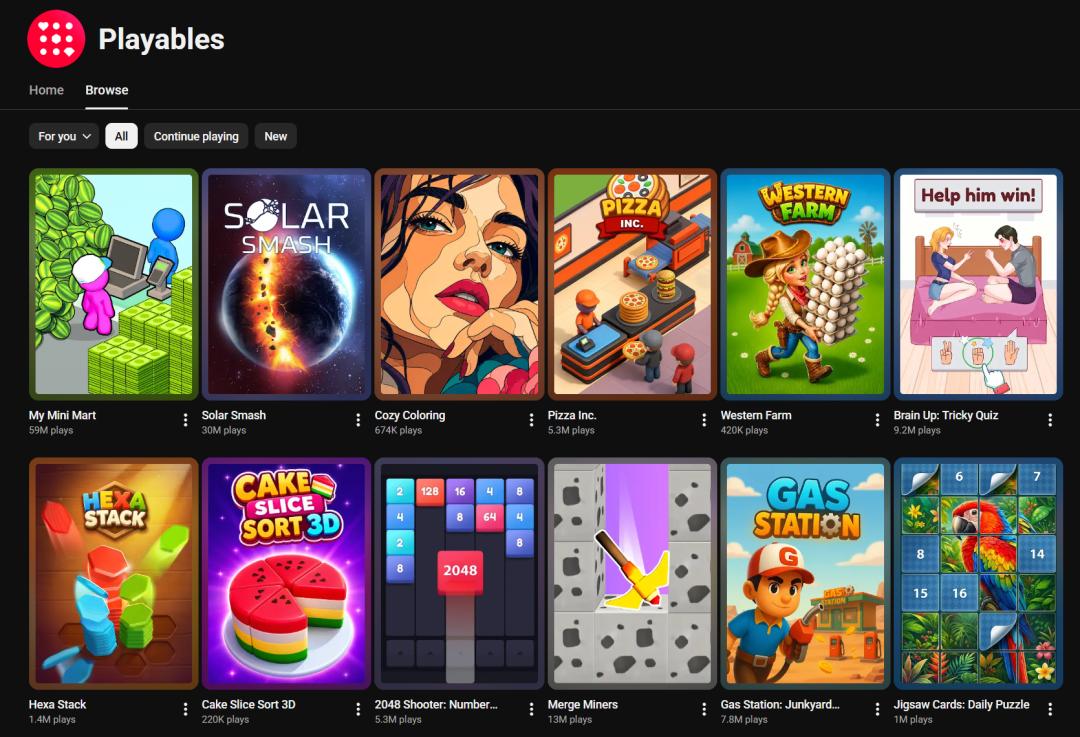
The current main interface of YouTube casual games, where play counts are displayed below each game
What deserves more attention is the progress of commercialization.
Many developers are concerned about when YouTube casual games will add the in-app purchase feature. In response to comments on LinkedIn, Joel Jansson said Google plans to test the in-app purchase solution for Playables in 2027. At present, this is still a plan, not an implemented commercial policy.
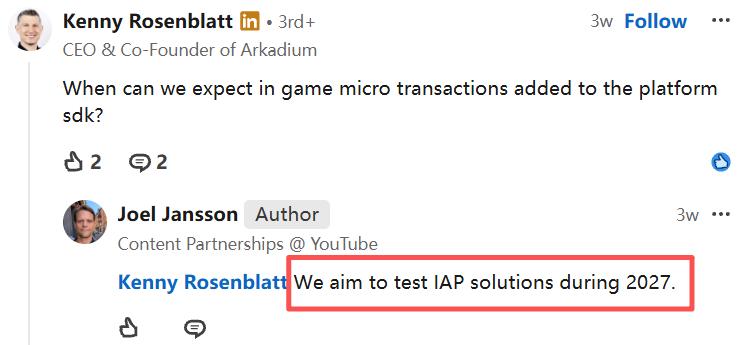
If this feature is realized in the future, Playables will have the opportunity to evolve from a free game distribution scenario to a game platform with direct monetization capabilities.
For overseas-bound casual game developers, the potential of YouTube Playables may not only lie in adding a new distribution channel for existing products, but in the mature content dissemination and creator ecosystem behind it.
YouTube's most prominent advantage is obviously that games can be connected with videos, live streams and creator channels. According to Google's developer documentation, Playables can appear on YouTube's homepage, search results, game zone and developer channel pages; after entering the game, users can also subscribe to the developer's channel through associated links. Developers can also set up a dedicated Playables page on their own channel to centrally display their games.
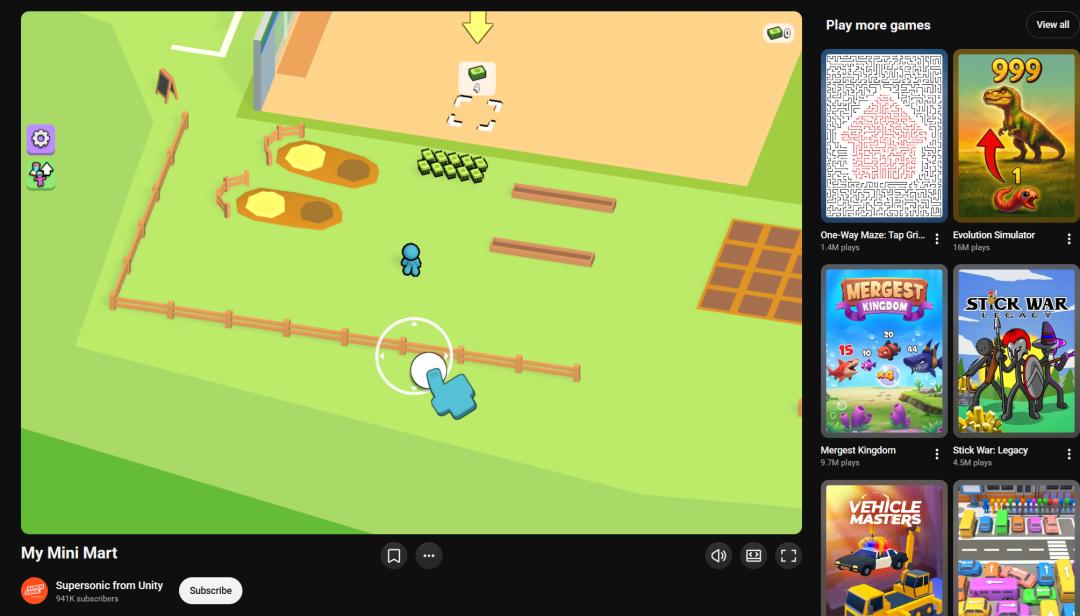
Under the YouTube casual game interface, users can directly enter the developer's main channel page
This means that games and developers' YouTube channels are no longer two completely independent assets. For game developers that already have certain channel operation capabilities, games can not only carry the instant traffic brought by platform recommendations, but also have the opportunity to convert one-time play experiences into longer-term user relationships through channel subscriptions.
In September 2026, Playgama, a game development and distribution platform, revealed in an interview that some of its Playables products have participated in YouTube's ad monetization tests. These signals show that the commercial exploration of Playables is not entirely stuck in future planning, but the current open scope and revenue performance still cannot represent the entire ecosystem.
Of course, the platform has a huge user base, which does not mean that every game can get equal exposure. Developer access, recommendation mechanism, user retention and actual monetization capabilities will still determine whether this path can become a sustainable growth channel. At this stage, what is really worth paying attention to is whether YouTube can further convert its existing content and creator advantages into the casual game discovery, play and commercialization capabilities.
Astrocade's Monthly Active Users Exceed 10 Million: The Leader in AI Casual Game Platforms?
Around the same period, another notable move in the overseas casual game platform space came from Astrocade, which has been online for one year.
In October, Astrocade announced in an interview that its monthly active users grew from 5 million to 10 million in the past four months. The platform generates about 220 million play sessions per month, and has more than 100,000 playable games created by third-party creators.
Compared with simply providing AI creation tools, what makes Astrocade more noteworthy is that it tries to integrate game production, content distribution and creator incentives into one single platform.
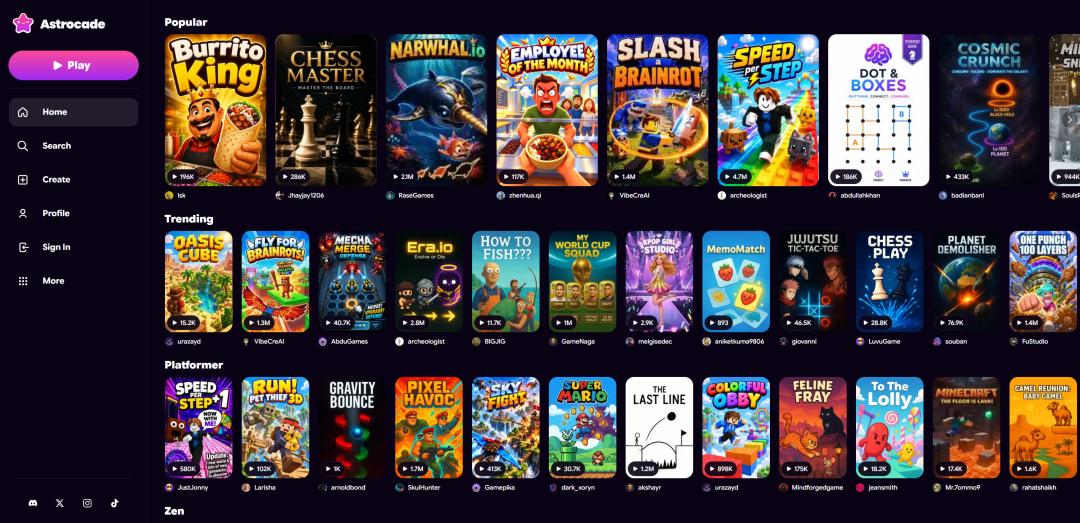
Users can browse games made by others and play them instantly, create their own works through AI tools, and modify existing content. The platform then guides games from the production stage to the consumption stage through content recommendation, social interaction and creator incentives.
This design is very similar to the content logic of short video platforms: users do not necessarily enter the platform with a clear demand for games, but may just want to find something interesting to kill time. If a game is not attractive enough, users can quickly switch to the next one.
The role AI plays here is to expand the possibilities of content production; the recommendation and distribution system is responsible for finding works that users may be interested in from a large amount of content.
The Astrocade official is also advancing creator monetization. Its creator page discloses that the platform is investing a 10 million USD creator fund, and effective play performance is one of the conditions for creators to obtain revenue. The official page also states that creators collectively earned more than 70,000 USD in revenue last month.
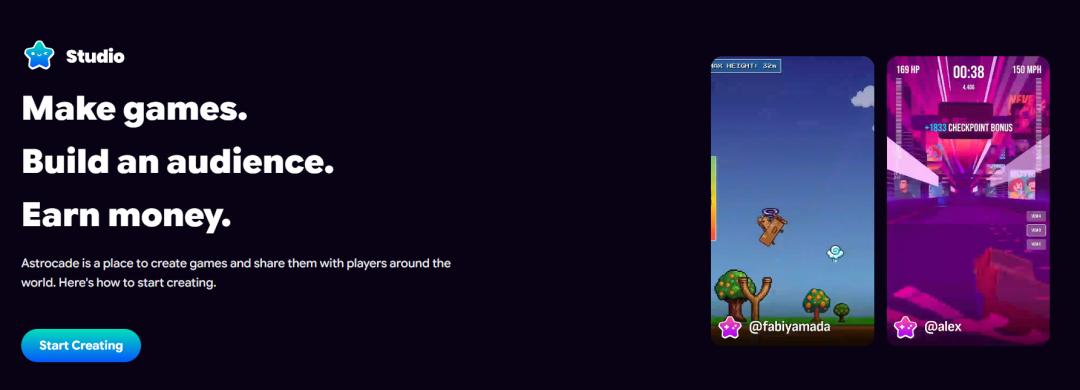
These pieces of information show that the platform is trying to establish a content incentive mechanism. But the total revenue of creators does not equal the platform's profit, nor can it directly prove that ordinary creators can obtain stable income.
AI is changing the supply mode of game content. When the creation threshold is lowered, the platform will have the opportunity to attract more users who do not originally have professional development capabilities to participate in creation, enriching the types and quantity of game content.
For the platform, a broader creator group means more gameplay experiments and content supply, and also provides space for discovering niche demands and cultivating emerging creators. If the recommendation mechanism can filter out high-quality works from a large amount of content, and creator incentives can further promote content updates, the platform will have the opportunity to form a positive cycle of "creation-distribution-consumption-re-creation".
Of course, the growth of content quantity does not naturally equal the improvement of content quality. When generation tools become easier to use, the platform may quickly accumulate a large number of games with similar gameplay, rough production and lack of long-term goals. Users' willingness to try new things does not mean they are willing to come back continuously; users' willingness to play does not mean they are willing to pay.
Therefore, what is really worth studying about Astrocade is not just the figure of 10 million monthly active users, but whether it can use AI to expand content supply, and at the same time continuously screen and cultivate attractive works through recommendation mechanisms and creator incentives. If this set of mechanisms can run successfully, what AI brings will not only be a lower game production threshold, but also a new platform model that can continuously produce and distribute interactive entertainment content.
Google Enters the Market: Following Up with a Full-Link AI Casual Game Platform
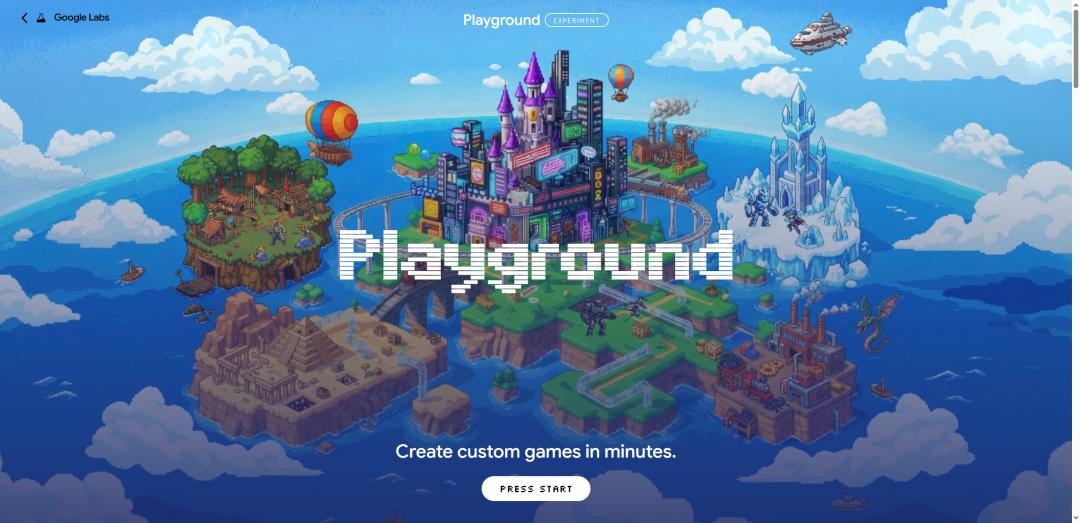
At the beginning of October, Google also officially released Playground, an experimental game creation platform with very similar gameplay to Astrocade. Google's approach is more "big enterprise resource-oriented".
According to the description, users can describe their game ideas in natural language on Playground to generate playable games, modify them through prompts, and finally share them with friends or publish them to the community work library. The platform also supports some types of multiplayer games and leaderboard functions, and allows users to log in with their Google Play Games accounts.

The AI game creation process demonstrated by Google official
Of course, lowering the production threshold does not mean that all development links have been automated. AI-generated games still need to face problems such as gameplay polishing, numerical balance, performance and user experience.
Google's cooperation with Unity is trying to further expand this path.
The two sides announced Unity Spark on the same day, planning to provide creators with more professional game mechanics, high-fidelity 3D capabilities and Unity runtime support. According to the officially disclosed plan, Spark will further expand the creation capabilities of Playground, but it is still in the testing and gradual opening stage as of now.
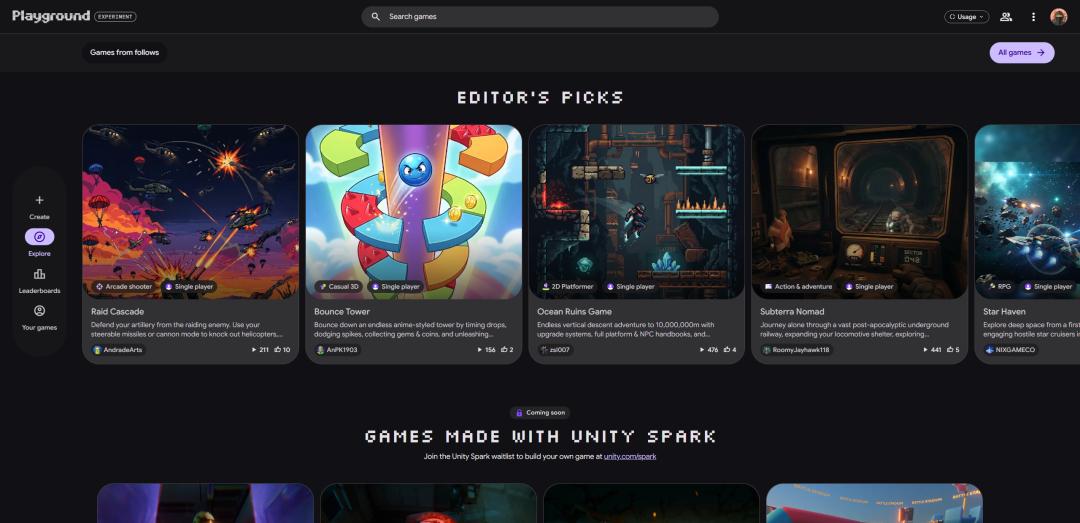
On the Playground homepage, below the editor's recommendations is "Games made with Unity Spark"
The potential of Google Playground lies not only in that users can generate games through prompts, but also in that Google is trying to integrate AI creation, content distribution and player community into one single platform.
First of all, Playground is not an AI tool that finishes its task after generating a game. Users can create games from scratch, or modify based on existing templates; after completion, they can share through links, or publish to the Playground Explore community for other users to discover and play. The platform also introduces content discovery mechanisms such as player ratings and game activity data, and supports leaderboards and multiplayer gameplay for some game types.
Secondly, Google is trying to bring its existing game community capabilities into this new platform. Playground supports login with Google Play Games accounts, where players can participate in leaderboards through their profiles, follow creators, and interact with other users within the platform.
Furthermore, Google's cooperation with Unity also provides Playground with the possibility to extend to professional development. The current Playground focuses on creating and modifying games through natural language, while the planned Unity Spark access will further provide professional-level game mechanics, high-fidelity 3D capabilities and Unity runtime. This forms a potential upgrade path from lightweight creation to more complex gaming experiences: users can first realize their creativity through simple prompts, and then gradually introduce more professional creation capabilities according to their needs.
Google also wants to build a platform that can continuously produce, share and consume AI casual game content. Compared with Astrocade, the abundant resources of Google and Unity may be its biggest competitive advantage.
Will AI Replace Casual Game Developers? The Real Challenge Lies in Supply and Distribution
In addition to the above platforms, large companies such as Meta and Huya are also making continuous moves in AI game platforms and production tools, and this track has quickly become crowded.
But from a more practical perspective, for overseas-bound casual game developers, there are at least three issues that deserve key attention in the future.
First, whether new platforms can bring real incremental users. If Playables or other casual game platforms can only provide limited exposure but cannot form effective retention and revenue, the new channels may not necessarily improve the operating conditions of developers.
Second, whether AI can substantially reduce the development cost of a complete product. There is still a clear gap between generating a playable prototype and continuously updating, maintaining and operating a commercialized product.
Third, whether the platform can establish a stable commercialization and distribution mechanism. No matter it is in-app purchase, advertising or creator rewards, a balance needs to be struck between user experience, platform revenue and developer earnings.
There are no unified answers to these questions for now.
YouTube Playables is still exploring IAP solutions, Google Playground and Meta's new tools are also in the early stage; although Astrocade has shown user scale, its long-term retention and profitability still need more data verification.
Therefore, it is obviously too early to conclude that AI will subvert the casual game industry now.
But what is certain is that the competition of casual games is extending from single product competition to ecological competition composed of creation tools, content supply, traffic distribution and commercialization mechanisms.
When production costs drop, teams with excellent gameplay ideas are still important; and when content supply continues to increase, platforms that can help works reach users will also become more important.
For overseas-bound developers, new