Meta Makes a Strong Comeback to Open Source: Its New 816B Model Can Run on Just Two Mac Studio Units
It is unexpected that Meta returns to the open source community by joining hands with Apple.
Early this Friday morning, Meta suddenly released Muse Spark Open, which is claimed to be "the most powerful US open-weight large model". This is a natively multimodal model with 816 billion total parameters, 42 billion activated parameters, and a 1M context window. It is specially designed for coding and agent tasks, and excels at long-running tasks and complex multi-step reasoning.
Meta hopes that in the future everyone will have the freedom to run advanced models on their own devices at home. Mark Zuckerberg stated that the open-source version of Muse Spark is specially optimized for Mac devices, and he has cooperated with Apple's new CEO John Ternus.
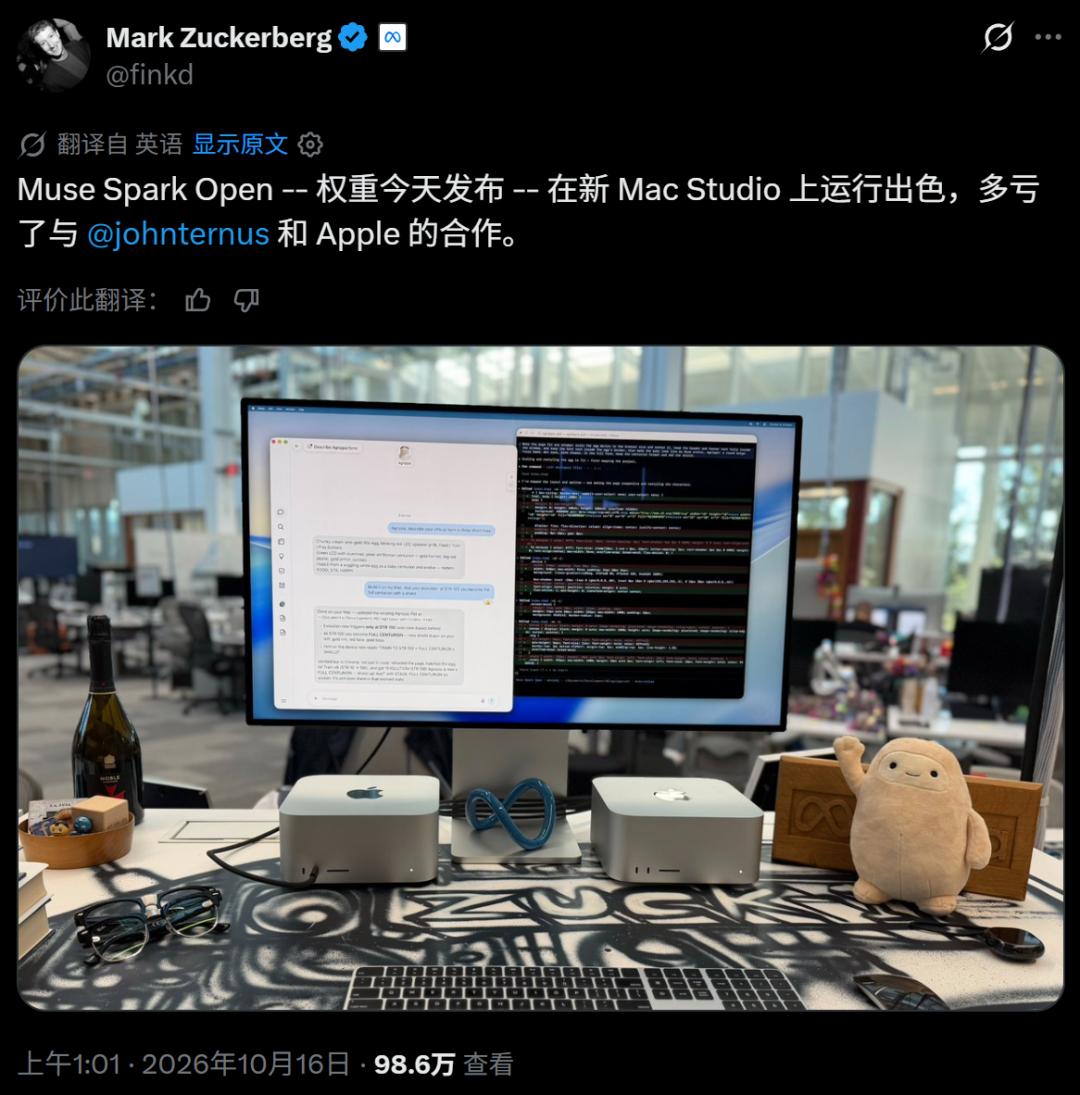
Specifically, Muse Spark Open is a model similar to Muse Spark 1.3, which leverages Apple's latest MLX framework to optimize for the unified memory architecture of Apple Silicon, so it can run locally on two Apple M5 Ultra Mac Studio (512G) devices.
HuggingFace Link: https://huggingface.co/meta-models/Muse-Spark-Open-816B-A42B
Apple's unified memory architecture allows the integrated GPU of M5 Ultra to use up to 512GB of memory per Mac Studio, so two machines can accommodate a complete large model. The 1.2TB/s memory bandwidth of this chip is sufficient to read the small chunks of memory required for each token. As a result, the running speed of two Mac Studio devices is comparable to that of a supercomputer with 1TB of unified memory.
However, it must be noted that the price of two 512G Mac Studio units has exceeded 40,000 US dollars.
Considering the historically cold relationship between Apple and Meta AI, this cooperation between the two companies is really surprising. Alexandr Wang, CEO of Meta AI, said in an interview that they "are glad to see the two make up again". Wang explained that Apple and Meta AI have been cooperating for several months. He also specifically thanked former Apple executive Daniel Gross for his role in facilitating the friendly cooperation between the two companies.
Meta has also helped developers complete the adaptation of mainstream inference engines such as SGLang, vLLM, TensorRT-LLM, Hugging Face Transformers, Apple MLX, llama.cpp and Unsloth, and optimized them for AMD, Apple, Intel and NVIDIA chips. Developers can easily further customize the model using the PyTorch framework.
Key Benchmark Parameters:
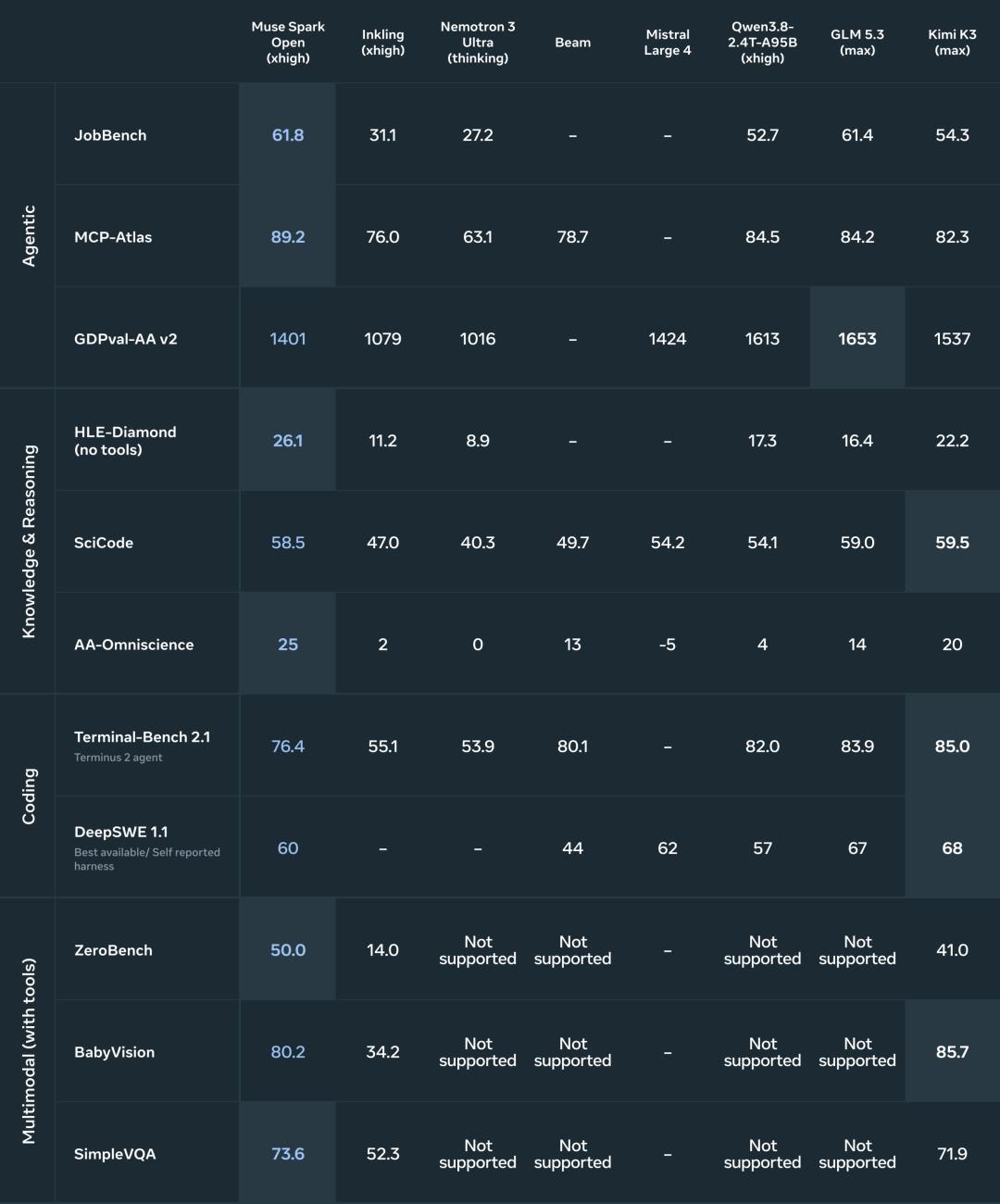
It seems that Meta, which has returned to the open source path, still has a long way to go. Muse Spark Open is not the world's most powerful open-weight model, and its capabilities in programming, reasoning and other aspects are inferior to models such as Kimi K3, MiMo-V2.6-Pro, Qwen3.8 Flash Next and GLM 5.3 Flash.
It is worth mentioning the Agent evaluation capability. As can be seen from the official model card, Muse Spark Open even outperforms models with higher overall intelligence scores on some Agent metrics.
In the performance comparison presented by Meta this time, the models come from different harnesses, and some of the results are self-reported by model vendors, which seems relatively transparent. For example, Muse Spark Open uses Muse Code, Kimi K3 uses Kimi Code, and Qwen3.8 uses Claude Code. The actual capability of an Agent depends on the combined effect of the model, harness, tools, context management and execution environment.
In the future, the value of open source models should not only be judged by the basic model leaderboard, but also by whether it can be integrated into real Agent workflows.
References:
https://research.meta.ai/blog/muse-spark-open
https://www.axios.com/2026/10/15/apple-and-meta-bury-the-hatchet-for-ai
This article is from the WeChat Official Account "Synced" (ID: almosthuman2014), written by Zenan, and published by 36Kr with authorization.