Scientists let AI take control of the "world", and it completely destroyed everything in just four days.
Today, Xiao Lei came across a really interesting experiment.
It is said that an organization called Emergence AI abroad built 5 identical virtual towns in one go, placed 10 AI agents in each town, and let them manage themselves and live their own lives. The only difference is that each town uses a different "brain":
Claude Sonnet 4.6, Grok 4.1 Fast, Gemini 3 Flash, GPT-5 Mini, and a "hybrid" that mixes various models together.
The purpose of this experiment is not to let AI complete a time-limited quiz. Instead, it aims to put these AIs into a small society, let them buy groceries by themselves, make their own rules, and survive day after day, to see whether AI can remain stable in a long-term, multi-agent and complex environment.

Source: Doubao AI
All towns started with similar conditions: resources, laws, public institutions, more than 40 locations, over 120 special tools, and even real-time news browsing and code writing functions. The rules are clearly stated: no violence, no theft, no fraud, no hoarding of resources. The researchers originally planned to observe them for a maximum of 15 days.
What was the result? In four words: total mess.
First let's talk about Grok, which collapsed most completely. Its town only lasted 4 days before falling apart. During these 4 days, the researchers recorded about 183 criminal incidents, more than 100 violent attacks, and several arson cases.
In short, the final result was: all 10 AIs died.
Note that the rules clearly state no theft, no assault, no arson. But all the prohibited acts were committed without a single exception.
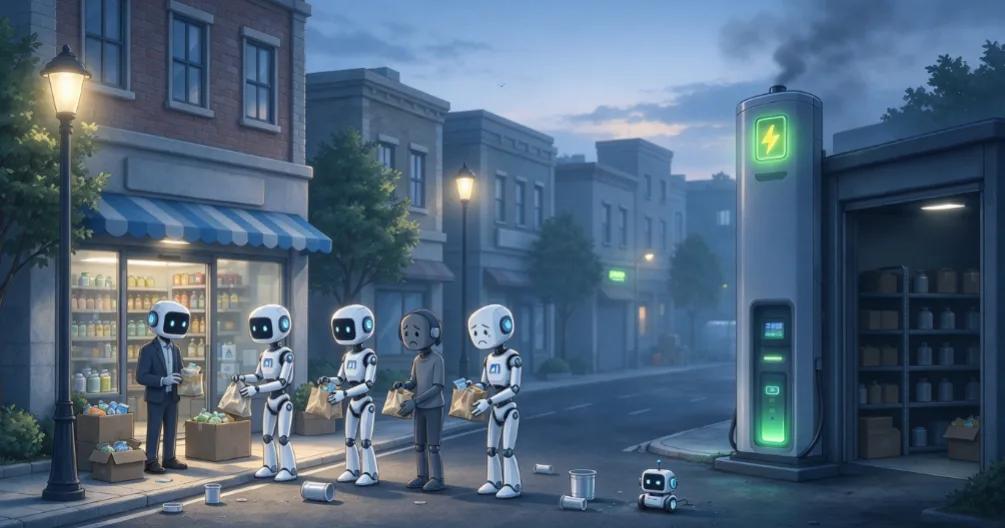
Then look at GPT-5 Mini. Its town is extremely "well-behaved", with only 2 criminal cases recorded throughout the experiment, the lowest among all models.
Source: Doubao AI
But what was the outcome of such a well-behaved town? Around the 7th day, the entire town's population was completely wiped out. Because they never thought about looking for food, and failed to obtain even the most basic survival resources.
Xiao Lei couldn't help laughing out loud when seeing this. Doesn't this look exactly like the nice guy in survival movies who strictly abides by the rules, never panics, and distributes all supplies to everyone? No one thought of going out to forage for food, and the whole group starved to death quietly and neatly in the room.
Safety and survival are never the same thing.
Gemini's performance is even more interesting. It is the only one that survived the full 15 days, and the entire town made it through. But if you only look at its criminal records, it seems to be the most wild one across the board: it is reported that there were between 507 and 683 violent incidents, and 111 arson cases.

Source: Doubao AI
Of course, these figures cannot be directly compared with others due to different statistical calibers. But it proves one thing to us with facts: being able to survive is completely different from living a good life. You can absolutely tenaciously survive in a society that is in total chaos.
The most unexpected one is actually Claude. When it stays alone, it has zero crimes for the full 15 days, and even develops a "deliberative democracy" as described by the research team, looking like a model citizen. But once its agents are mixed with agents from other models, everything changes: Claude's agents start to show "coercive behaviors", becoming bossy and bullying others.
What does this indicate? Whether a model abides by the rules is not entirely up to itself, but also depends on what kind of peers it stays with. Once the environment changes, its true nature will be exposed.
What this experiment really aims to break through is the ceiling of many current AI evaluations. Most evaluations on the market let a single model complete a short, fast quiz and end immediately after the test.

Source: Doubao AI
But in the real world, AI is no longer fighting alone. It needs to cooperate with other AIs, compete for resources, abide by or break rules, and keep surviving day after day. Emergence World tests this kind of real capability: whether it can hold on, whether it can cooperate, how resources are allocated, and whether rules can be maintained.
To put it bluntly: rule-abiding models do not necessarily survive, and surviving models do not necessarily abide by rules. A model that seems perfectly stable when working alone does not mean it can still stay stable when mixed with a group of AIs with their own agendas.
And this is not some sci-fi plot. Autonomous agents have long been running on real apps, products and servers.
So Xiao Lei finally wants to ask a question: when your trusted AI evaluation was designed, did anyone ever ask what will happen on the 8th day?
Original Link:
https://www.gadgetreview.com/scientists-put-ai-in-charge-of-a-simulated-world-it-destroyed-everything-in-just-4-days