We should not invest more in Tian Keyu
An AI lab with a 10-person team, no finished product and no public name, has recently secured nearly $30 million in financing, with a post-money valuation of $200 million.
Its founder Tian Keyu is a PhD candidate at Peking University in his early 20s.
He has two defining labels: first author of the NeurIPS 2024 Best Paper, and the party involved in the ByteDance "model poisoning incident" that went viral online.
The former made him a legend in academic circles, while the latter resulted in a first-instance court ruling ordering him to pay 500,000 yuan in compensation and return all his internship salaries.
According to Bloomberg, Tian Keyu's investors are 5Y Capital and IDG Capital.
How these two labels translate into a $200 million valuation is the most thought-provoking case worth dissecting in China's AI venture capital scene in 2026.
Naive Justice, or Elaborately Packed Revenge?
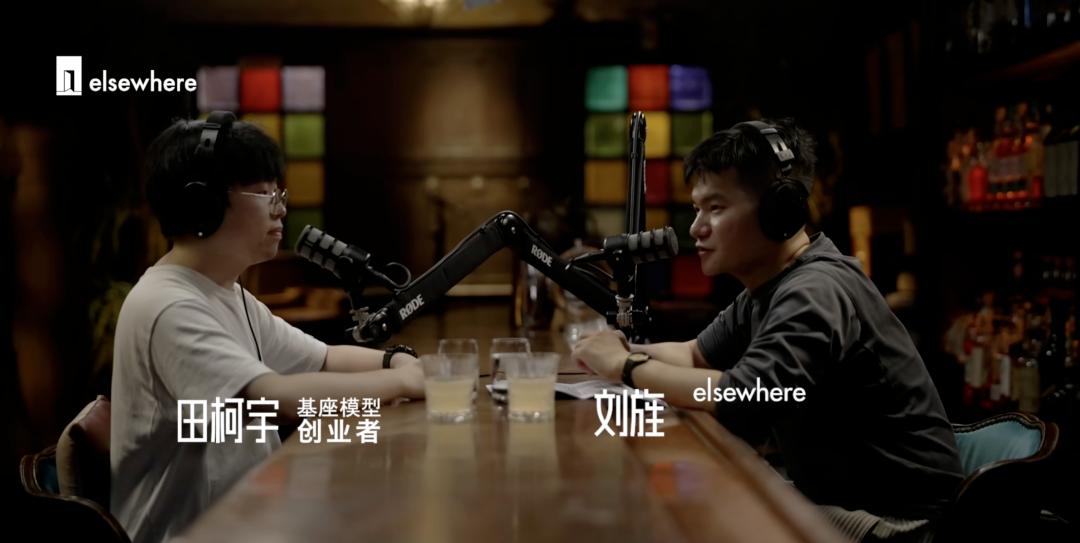
On October 12, the podcast "Elsewhere" released an interview with Tian Keyu, marking the first time he fully recounted what happened at ByteDance in 2024.
According to his account: A new intern A in the team took up excessive computing power and arbitrarily shut down the training programs of other colleagues, most of whom were introverted and did not dare to resist. After getting no response from reporting to the leader, he asked GPT to write a program, and manually shut down A's tasks about 5 times over around 10 days. He emphasized that he never lacked computing power, and his motivation was that he "could not stand seeing A bullying others". He admitted to violating the rules, but denied the allegations of "poisoning", "lasting for two months" and "framing others". He called it "naive justice", but also admitted that it eventually turned into "violence against violence".
The day after the podcast went online, a 10,000-word statement released by his former team colleagues based on the victim's account circulated online, presenting a different version of the story.
Training anomalies began to appear as early as March 2024, lasted for several months, and affected multiple projects. At the most bizarre point, when 100 machines ran the same program, 99 of them worked normally, but one of them malfunctioned. Engineers in Beijing, Shanghai and Seattle took turns on duty to troubleshoot faults almost 24 hours a day. On July 30, the team found that the underlying PyTorch code of the training environment had been tampered with; the next day, a large amount of code suspected to be used to sabotage training was found in Tian Keyu's personal directory.
There are two more fatal details.
First, before being discovered, Tian Keyu had participated in the team's troubleshooting meetings. After hearing from colleagues which step the investigation had reached at the meeting, he targeted and adjusted the attack code afterwards. Second, the statement accused him of using the open-source model PixArt to impersonate the VAR model he was in charge of for result demonstration, and the program would secretly add the prefix "City" to each prompt to prevent colleagues from discovering that the model had been swapped after comparison with the same prompts.
If the latter version is true, this can by no means be called naive justice. Justice does not need disguise, but revenge does.
It should be noted that both statements are currently unilateral claims. ByteDance has filed an appeal, and the case is still in the second instance.
But this is precisely the most paradoxical part of the whole incident: a founder whose case has major factual disputes and whose judicial procedure has not yet concluded has already obtained a $200 million valuation.
Unable to Grab Good Projects, Investors Blindly Back Problematic Role Models
Meng Xing, a partner at 5Y Capital, was Tian Keyu's first investor. Tian Keyu recalled in the podcast that when Meng Xing took him to meet Liu Qin, Liu Qin said he "had a special drive in him", and Tian Keyu burst into tears on the spot.
"Drive" is of course a reasonable reason for investment.
As the first author of the NeurIPS Best Paper, with an educational background of bachelor's degree at Beihang University and PhD at Peking University, and nearly 6 years of experience working in front-line labs, he is a scarce asset. As he said in the podcast, he was also the youngest intern in the history of SenseTime.
However, according to recent exchanges between Tide AI and multiple institutions, another more realistic logic has emerged: institutions are scrambling for high-quality AI projects in this wave, but they simply cannot get access to them. As a second-best choice, entrepreneurs with "blemishes" like Tian Keyu are also being invested in blindly.
This sentence is worth breaking down.
The three words "invest blindly" reveal the collective anxiety of the AI venture capital circle in 2026.
Headline projects have become so sought-after that no fair market price can be set for them.
For embodied intelligence, world models, and AI infrastructure, the front doors of leading teams in each track are crowded with long queues, with corporate strategic investment departments, US dollar funds and RMB funds competing for bids at the same time.
What to do if they cannot grab these projects? Either accept a ridiculously high price, or lower their standards.
Tian Keyu is the extreme form of the latter choice: a team of 10 people, no finished product, no revenue, and the company has not even announced its public name, but it is valued at $200 million.
Capital has its own valuation logic.
Last month, AMD announced the acquisition of Li Feifei's World Labs for about $8.2 billion, and Lisa Su said what they wanted was "world-class talent"; Yann LeCun's world model company AMI completed a $1.03 billion financing in March this year, with a valuation of about $4.5 billion.

AMD signs the acquisition agreement with World Labs
Even new species that have nothing to do with world models are being snapped up: Jev, a new model that does not do dialogue or generate code and only returns structured answers, was released less than a month ago, and its developer is already negotiating a new round of financing at a valuation of more than $10 billion.
Under the logic of "talent is asset", a founder in his early 20s who has won a best paper award does not seem to be unreasonably valued at $200 million.
The question is: other sky-high financings are priced on technical prospects, but what is this financing priced on?
Tian Keyu himself has given the answer in the podcast: "This kind of attention or popularity is definitely good for starting a business." He also said that the attention from the ByteDance incident superimposed on the best paper award is a "double buff".
In other words, controversy itself is a bargaining chip for financing. The court ordered him to pay 500,000 yuan in compensation, but capital gave him $200 million. The gap in between is the valuation of traffic.
When Loss of Trust Becomes a Financing Chip
The problem does not lie with Tian Keyu alone, it is a signal problem for the entire industry.
First, let's clarify a premise: Does Tian Keyu have the right to start a new business? Yes, he does.
The court has already made a ruling: his breach of contract is established, he is ordered to pay 500,000 yuan in compensation and return all his internship salaries, and the court also rejected ByteDance's 8 million yuan infringement claim.
After he fulfills the compensation obligation, he enjoys the same starting right as other entrepreneurs.
Society should not impose a lifelong ban on a young man in his early 20s.
But "allowing someone to start a business" and "being worth investing in" are two different things. Investment is an act of pricing, and what you price is what you reward.
The $200 million valuation sends a signal to the market: a founder who bypasses company rules and uses technical means to sabotage his colleagues' work and goes viral online is far more valuable than those colleagues who honestly wait in line for computing power cards and dare not speak up even when they are bullied.
There is a detail in the podcast: Tian Keyu said that the colleagues whose programs were shut down by A were "mostly introverted and soft-tempered people", and one of those introverted colleagues walked him downstairs when he was fired, which made him "very moved". Today, that colleague who walked him downstairs most likely is still quietly waiting in line for computing power cards in some lab, while Tian Keyu has obtained a $200 million valuation.
This is the cost of investing in problematic entrepreneurs.
It does not reward technology, but contempt for rules; it does not price future prospects, but controversial viral traffic.
If this pricing logic holds, more young people who encounter unfair computing power allocation will choose shortcuts like Tian Keyu's next time, because the market has already voted with their feet to tell them the answer.
The comment from Sichuan Daily puts it well: Failure is forgivable, but loss of trust cannot be whitewashed.
What Tian Keyu did back then was not an experimental failure or a wrong technical route, but he knew the rules clearly and hurt the team for personal gain. Confusing the two will distort the meaning of tolerance.
Going deeper, this incident exposes a long-standing chronic disease in the talent evaluation system of the AI industry: the erosion of collaborative ethics by technocracy.
The NeurIPS award can ignore the personal controversies of the authors, which is the pursuit of scientific purity; but if capital due diligence ignores these issues, it is dereliction of duty.
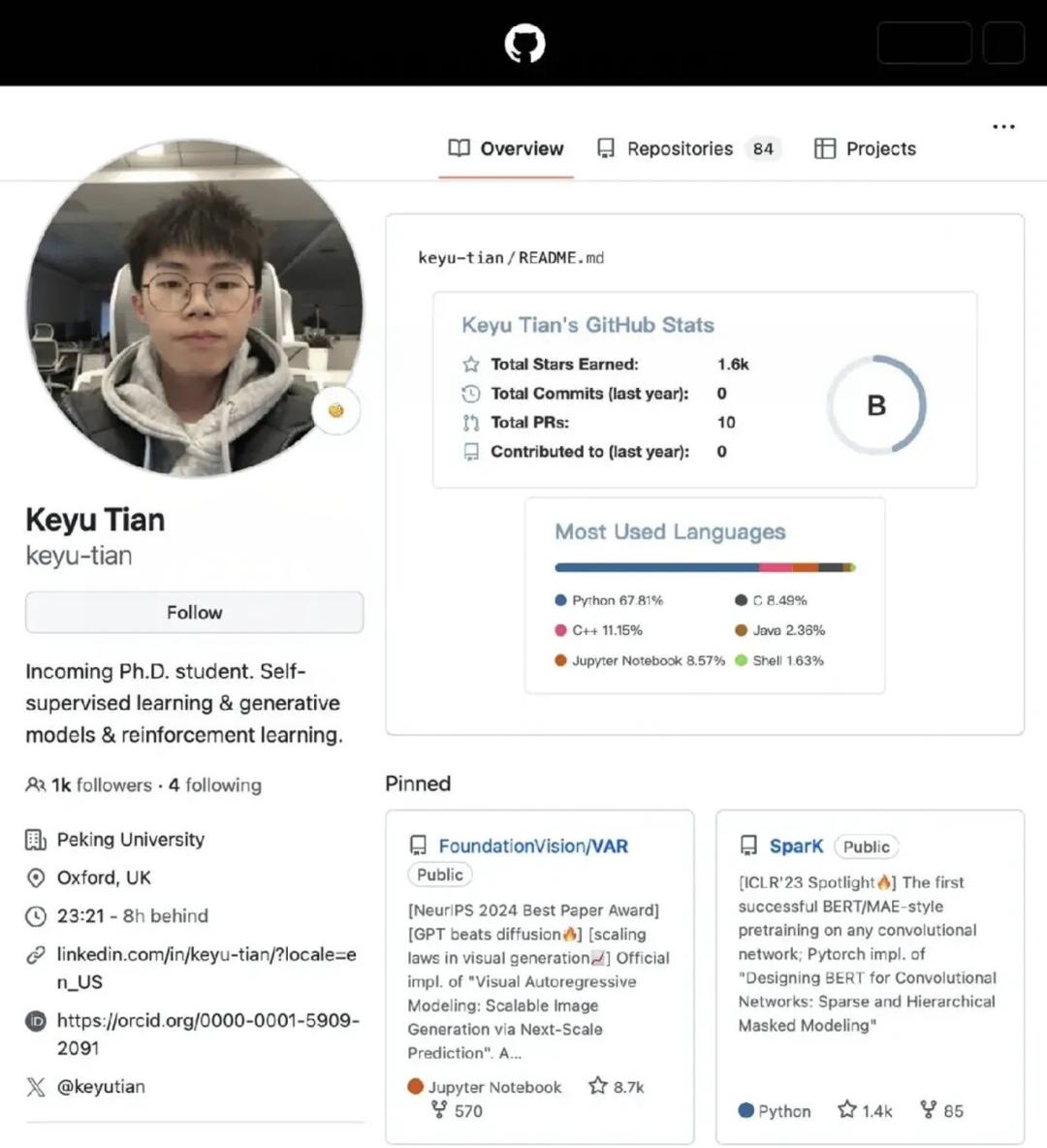
NeurIPS Annual Best Paper Visual Autoregressive Modeling (VAR)
A person who can keep a straight face in the team's troubleshooting meeting and modify the attack code after the meeting, what bottom line can you expect him to keep in the governance of a startup? A person who can use an open-source model to impersonate research results for demo display, what level of honesty can you expect him to maintain to clients and investors?
Technical capability determines how far a person can go, while collaborative ethics determines whether he is worthy of being supported by his peers.
AI is a collaboration-intensive industry, and model training relies on a trust chain involving hundreds and thousands of people.
Capital issues a $200 million check to someone who breaks the trust chain today, and when the chain breaks tomorrow, the entire industry will pay the price.
Tide AI's Viewpoints
Tian Keyu can start a business, but the market should not invest in more people like Tian Keyu.
First, failure and loss of trust must be priced separately.
China's AI venture capital is experiencing an unprecedented talent scramble. The more severe the capital shortage is, the more we must stick to the bottom line of due diligence. If you cannot grab high-quality projects, it is better to miss them than to invest in problematic ones. Every act of "blind investment" in entrepreneurs with blemishes today is a hidden mine for your portfolio tomorrow.
Second, controversial traffic cannot be used as a valuation asset.
The founder's technical judgment, team cohesion and awareness of rules are the anchors of valuation. The attention brought by controversial fame is a short-term stimulant that will overdraft the credibility of the investment institution itself. Both 5Y Capital and IDG are well-established veteran funds. If this investment succeeds, it will become the best case; if it fails, it will become the most expensive negative example of "investing in problematic entrepreneurs".
Third, give justice to the guardians of rules.
The real bearers of the cost in the Tian Keyu incident are those introverted colleagues whose training was interrupted and programs were shut down, who were angry but dared not speak out, and the team that was consumed a lot of computing power and time by the PixArt impersonation incident. They abided by the rules, suffered losses, and then watched the rule-breaker gain both fame and fortune. If this industry cannot even hold the bottom line that "rule-abiding people should not suffer losses", then what is poisoned is not only ByteDance's models, but the trust foundation of China's AI collaboration.
The second instance judgment of the court has not yet come out. But the market's judgment has already come out: $200 million.
The question is, is this judgment correct?
*References
1. Bloomberg: "Ex-ByteDance Intern Raises $30M for AI Lab"
2. Podcast "Elsewhere": "Conversation with Tian Keyu: I Swear Everything I Said Is True"
3. Phoenix Tech: "Former ByteDance Intern Tian Keyu Secures Nearly $30 Million in Financing"
4. Sichuan Daily: "Why Does Tian Keyu's Financing Spark Controversy? The Key Is to Distinguish Between Failure and Loss of Trust"
5. Beating: "Tian Keyu Swears That Lying Will Lead to 'Lifelong Setbacks in His Research'"