Understanding how WorkBuddy integrates with WeCom is just the appetizer, the context provided so far is merely the prelude.
Right after Google announced at the Gemini at Work conference that it could assign independent enterprise accounts for AI, allowing employees to directly @ it and assign tasks to it in chats, Tencent also announced an integration move.
On October 14, WeCom and WorkBuddy jointly released a new version. WorkBuddy officially entered the WeCom contact list as a conversational bot. The two sides have connected their account systems, and opened multiple underlying capabilities including messages, documents, meetings, and cloud disks within the scope of enterprise authorization.
These two events point to the same clear industry inflection point: Agents are shedding the shell of independent applications and directly entering the daily work of enterprises.
I. Agents Start to Enter Work Groups
The mainstream form of AI office work has never been separated from independent apps or dialog boxes mounted in the corner of office software. Employees actively open the interface, manually input instructions, and wait for the results to be generated. Every interaction is forced to explain the task background from scratch.
Under this model, AI can write copy, organize tables, and extract meeting minutes, but it has always been on the edge of business. It does not know what urgent risks are being discussed in the team group, is not aware of the customized requirements proposed by customers last week, and cannot directly dispatch internal business systems.
By 2026, global tech giants have successively brought Agents into existing collaboration networks.
Google deeply embeds Gemini into Gmail, Docs, Sheets and Calendar, and promotes Coworker Agent, assigning independent Workspace accounts for AI to realize task distribution similar to contacting colleagues.
Thomas Kurian, CEO of Google Cloud, revealed that nearly 90% of Fortune 100 companies have become Gemini Enterprise customers; at Japan's SOMPO Insurance, 34,000 employees have built more than 10,000 custom Agents.
Salesforce has vertically integrated Agentforce with Slack, promoting Slackbot to upgrade from a simple chat assistant to an Agent scheduling hub. Employees raise demands in Slack, and the system automatically matches and schedules the corresponding Agent in the background. Internal data from Salesforce shows that this capability saves employees an average of about 90 minutes per day.
Domestic tech giants are also acting quickly and intensively.
Tencent directly integrates WorkBuddy into the WeCom address book. ByteDance launched Doubao Work to promote deep integration with Lark, while Alibaba continues to integrate Qwen Office into the DingTalk ecosystem.
Looking at these moves as a whole, major manufacturers are comprehensively integrating Agents from isolated AI tools into the collaboration platforms where employees flow at high frequencies.
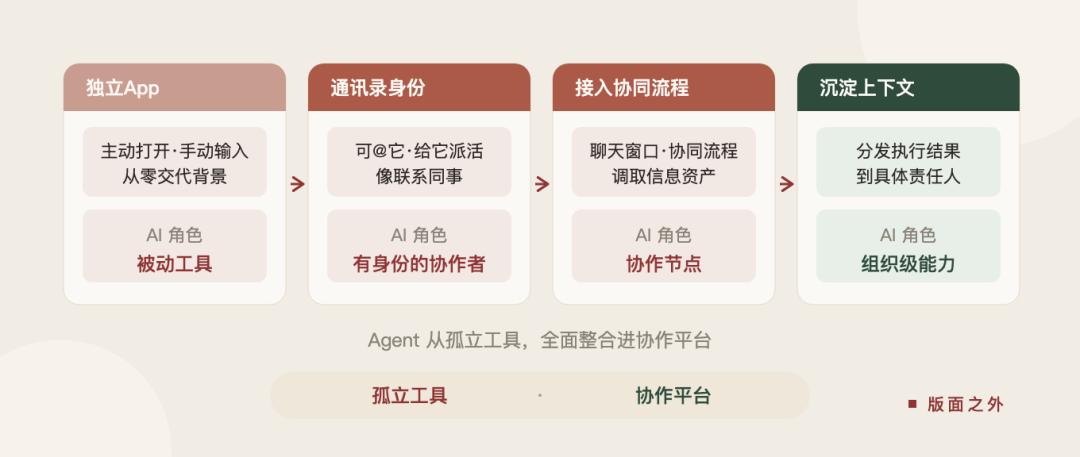
This migration goes far beyond a simple entry change.
When Agents obtain address book identities, access chat windows and collaboration processes, they will have a continuously accumulated work context, can seamlessly call the enterprise's existing information and tool assets, and directly distribute execution results to specific responsible persons.
Agents starting to join work groups is fundamentally changing the way AI participates in organizational work.
II. From Context to Full-domain Context
Why are major manufacturers collectively betting on Agents on collaboration platforms?
Imagine a scenario: a sales manager asks AI to prepare materials for a customer visit the next day.
If AI can only access the customer files in the CRM, what it gets may be basic customer information and past orders. These materials are certainly useful, but employees can also find them in half an hour by themselves.
If AI can also read the customer's previous communication records after obtaining authorization, understand that the customer is evaluating competing products, see the delivery delay being discussed in the internal product group, and find that a receivable marked in the financial system has risks, the final output materials for the same task may be completely different.
This gap does not come from the underlying model becoming smarter, but from AI mastering more context intertwined with real business.
This is exactly the core path for the evolution of AI office competition barriers.
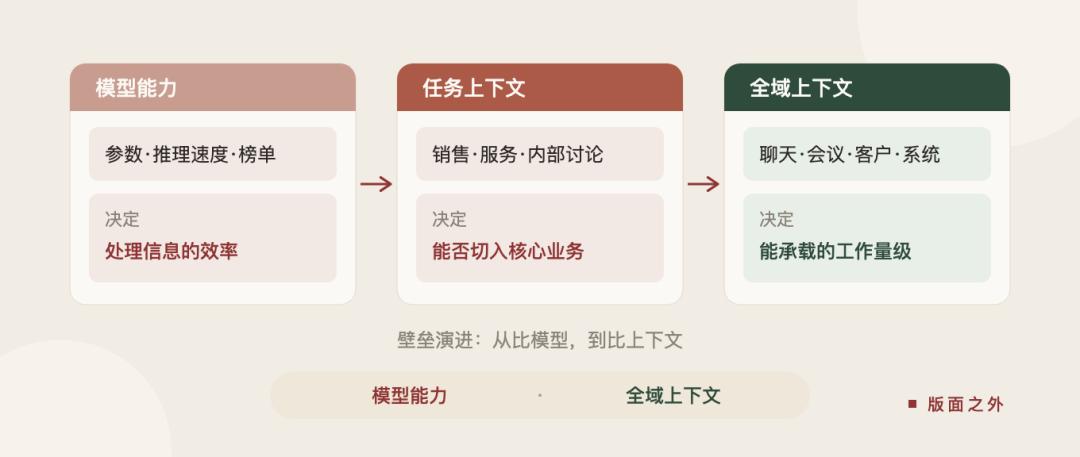
In the past, the industry focused on model parameters, inference speed and ranking performance. These basic capabilities are certainly important, but in real office scenarios, the output quality depends extremely on whether AI can obtain the complete context required for the task.
A customer analysis needs to combine sales records, service history and internal discussions; a project decision may involve meeting minutes, document modification records and cross-departmental communication. Without these backgrounds, even if the model can generate fluent answers, it may not be able to give truly useful results.
Model capabilities determine the efficiency of AI processing information, while context determines whether AI can cut into core businesses.
Google's Agent layout clearly confirms this logic. Placing AI inside Workspace allows it to perform tasks around daily information such as emails, documents, and calendars, and even allows some workflows to call external model capabilities. This shows that at the enterprise implementation level, the simple model itself is not the only competitive barrier.
The source of context always exists in the pipelines of employees' daily interactions: chat records, meeting minutes, document collaboration, customer communication, and data accumulated by business systems.
Rather than asking employees to repeat the work background to AI over and over again, it is better to let AI directly enter the source where information is generated and circulated.
However, the quality of context that different collaboration platforms can provide varies greatly. What kind of nodes the platform connects, what depth of information it accumulates, and how large the business boundary it covers directly determine the workload level that Agents can carry.
This is also the key highlight of Tencent's deep integration of WorkBuddy with WeCom.
III. WeCom: Connecting Internal and External
In China's collaborative office market, DingTalk, Lark and WeCom have formed completely different scenario divisions.
With extensive organizational coverage, DingTalk has a solid foundation in small and medium-sized enterprises and government affairs scenarios, while Lark has accumulated extremely high collaboration stickiness in Internet enterprises and knowledge-intensive organizations.
WeCom has a very unique connection barrier, which spans both internal enterprise collaboration and real C-end customers in the WeChat ecosystem.
Internal group chats, meetings, documents and approvals constitute the internal cycle of the organization, and the other end of WeCom connects to customers who generate real transactions every day.
Retail shopping guides recommend products through WeCom, B2B account managers follow up on contract performance, and after-sales teams handle customer complaints. These communications contain real purchase intentions, service pain points and product feedback, which directly affect the enterprise's sales, R&D and operation decisions.
The differentiation of WeCom lies in that it integrates the internal organizational network of the enterprise with the external customer operation network. Enterprises can reach customers within the WeChat ecosystem, and under the premise of compliance and authorization, precipitate these real interactions into the enterprise's business assets.
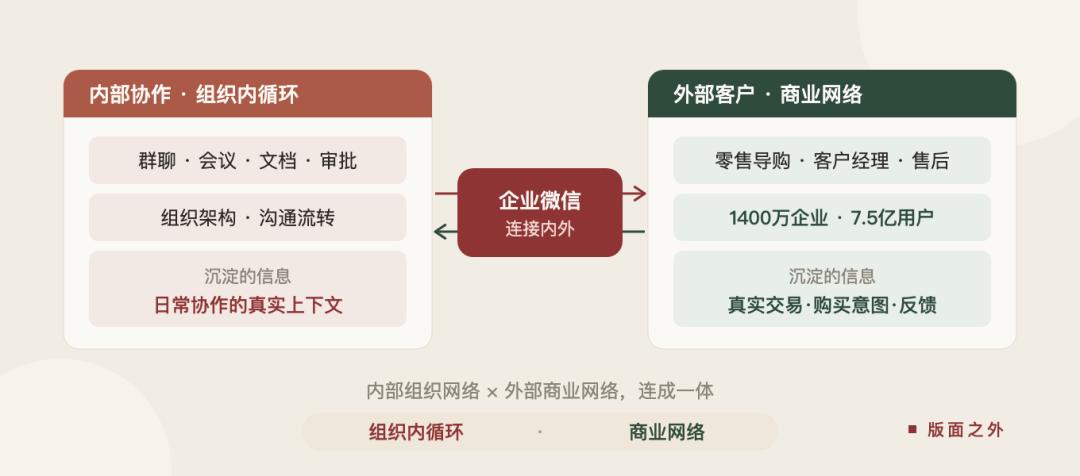
According to the data released by Tencent, WeCom connects 14 million enterprises, and its services cover 750 million WeChat users. Behind these two sets of numbers is the deep interweaving of internal organizational structures and external business networks.
After WorkBuddy accesses WeCom, AI gains the possibility of understanding tasks in a more complete business context.
For example, when a customer feeds back a product defect on the WeChat side, the product team is discussing the repair plan in the WeCom group at the same time. In the past, these two information flows were separated from each other and relied on manual identification and paraphrasing. Within the authorized scope, AI can smoothly associate external feedback with internal progress, automatically connect information and prompt follow-up, thus eliminating the delay and omission in information transmission.
This makes WeCom different from a simple internal office tool, and it has the opportunity to push Agents to the forefront where customer relationships and business processes are intertwined.
Of course, the establishment of the connection pipeline does not mean that AI can automatically understand all business logic, nor does it mean that data can be opened without boundaries. The access permissions of customer information, cross-departmental data isolation, sensitive content filtering and the review mechanism of AI output still require enterprises to formulate clear rigid rules.
WeCom has laid a connection network. Whether WorkBuddy can convert these pipelines into stable business output still depends on the landing test of specific scenarios.
IV. Agents Entering Enterprises Must First Pass the Governance Level
Compared with what tasks Agents can complete, enterprise management is more concerned about how to carry out compliant management of them.
In the past six months, AI office work has mostly been positioned as a personal auxiliary tool. Employees independently select applications, upload materials, and verify results. As the deployment scale expands, enterprises begin to encounter new management problems, such as how to ensure data security, who controls the call cost, and how to uniformly manage different tools used by various departments.
When Agents move from individual trial to organizational-level deployment, enterprises are no longer satisfied with simple execution efficiency, but also require to see clearly and manage the operation process clearly.
On October 13, the day before WeCom and WorkBuddy were connected, the observability center was launched on the WorkBuddy enterprise version management background, which exactly hits the governance pain points in large-scale deployment.
Administrators can globally control the operation track of Agents in the enterprise, and accurately capture call traffic, computing power cost expenditure and response performance through real-time observation, session tracking and execution link analysis, and locate to specific execution nodes.
The essence of this capability is to establish a fault attribution mechanism.
When Agents handle complex tasks, they usually involve multiple model calls, tool scheduling and process connections. Once the execution result deviates from expectations, the enterprise needs to clearly locate the error node, so as to accurately adjust the prompt words, model strategy or tool configuration.
Whether an enterprise can safely hand over core work to Agents depends on whether it can accurately trace when errors occur, whether the whole process is transparent during operation, and whether the automation boundary can be clearly defined in management.
The observability center provides an overall enterprise perspective, but governance itself is a comprehensive project. Log tracking cannot replace identity authentication, dynamic permission control, data isolation, operation audit and manual confirmation processes.
Enterprises need to divide the automation security boundary based on business risks. Low-risk tasks such as data query and document formatting can increase the automation ratio within the authorization scope; for actions involving capital transactions, core business secrets or important decision-making, the manual approval link must be introduced.
At the same time, WorkBuddy's open strategy is also worthy of attention.
In terms of model access, WorkBuddy does not bind a single model. Enterprises can not only choose the advanced open source models provided by the platform, but also access self-developed or customized private models into the Agent workflow. At the connection level, WorkBuddy is also not limited to the Tencent ecosystem, and is compatible with Lark, DingTalk and existing enterprise systems such as ERP, HR and OA. Since the launch of the open platform, it has absorbed more than 100 ecological partners.
This is very consistent with Tencent's consistent pragmatic strategy. For enterprises, since they have built a complex IT infrastructure, few will tear it down and start over just to introduce Agents.
If AI wants to cut into the workflow, it needs to actively adapt to the existing tool chain and run collaboratively under the established permission and data rules.
The open ecosystem broadens the capability boundary, and the governance capability determines whether these capabilities can be safely implemented within the enterprise. For enterprises, governance is by no means an additional function, but precisely a prerequisite for the large-scale application of Agents.
V. Tencent is Playing an Ecological Card
Tencent's connection of WeCom and WorkBuddy at this moment reflects the evolution direction of its overall AI strategy.
At Tencent's Q2 earnings call, Pony Ma mentioned that Tencent is building an "AI-empowered Tencent".
WorkBuddy is undoubtedly the star product of Tencent's AI strategy today.
According to Analysys' Q2 data, WorkBuddy's PC-side visits in June ranked first among similar domestic products, exceeding the sum of the second and third places. In parallel, Tencent continues to increase investment in AI underlying infrastructure, accelerating the transformation of model capabilities into product-level services.
However, competition in AI office is becoming increasingly fierce.
Relying on the model iteration speed of Doubao Work, ByteDance is vigorously promoting desktop automation and task execution; Alibaba integrates Qwen Office and DingTalk, trying to fully integrate AI capabilities into the existing enterprise service system.
The strategic paths of mainstream players are deeply bound to their respective resource cards.
ByteDance's advantages lie in model iteration speed and product exploration, while Lark has accumulated collaboration scenarios in Internet companies and knowledge-intensive organizations. Alibaba's advantages lie in DingTalk's enterprise coverage and e-commerce ecosystem. After product integration, it still needs to further polish the collaboration experience.
Tencent's differentiated conditions are the connection network between WeCom and WeChat, as well as the collaboration capabilities accumulated by products such as Tencent Docs, Tencent Meeting, Tencent Enjoy, and Cloud Disk. After WorkBuddy accesses WeCom, it can connect personal tasks, organizational collaboration and customer operation.
Since its release in March, WorkBuddy has been implemented in multiple industries and continuously iterated products. This fast update rhythm reflects Tencent's hope to bring the iteration method of Internet products into the enterprise-level AI market.
However, the size of the ecosystem is not equivalent to business results.
WeCom connects a large number of organizations and customers, which can provide valuable work context for WorkBuddy. Tencent's existing office products and open platforms also have the opportunity to provide tool and application support for Agents.
The real test is whether WorkBuddy can convert these resources into stable, controllable and continuously deliverable business capabilities.
Tencent is playing an ecological card, but ecological advantages need to be realized through specific work results. After all, the address book is only an entry. The experience behind the entry is the real exam.
Words Beyond the Page:
In the industrial age, assembly lines rearranged the division of labor between humans and machines. The Internet changed the flow of information and also changed the boundaries of organizations.
The changes brought by AI may go deeper. When the cost of performing tasks continues to decrease, the organizational methods formed around information transmission and process connection in the past will also face re-examination.
Technology can change the way work is done, but it cannot replace enterprises in deciding how power is distributed and who takes responsibility.
When AI enters enterprises, what it ultimately needs to answer is not just how fast work can be done, but how enterprises should reorganize their work.
This article is from the WeChat official account "Beyond the Page", author: Huahua, published with authorization from 36Kr.