Tencent has made a forceful entry.
Tencent has officially launched "Green Bubble".
About a month ago, a mini-program named "Green Bubble Short Dramas" was quietly launched within WeChat, with the slogan "Free high-quality dramas, watch with one tap". At this point, Tencent has officially stepped into the free short drama track.
Although there was no official announcement, the market consensus is clear: Green Bubble is a direct competitor to ByteDance's Hongguo Short Dramas. Over the past two years, Hongguo Short Dramas has achieved explosive growth, rolling out numerous hit dramas with national popularity, and its daily active users have soared to 168 million, taking up an increasing amount of users' time.
In the internet industry, users' screen time is the core asset. At any time, businesses that compete for people's attention and time are extremely attractive. This time, Tencent has joined the fray.
Tencent is here, and Green Bubble is born
Different from Hongguo, Green Bubble currently only exists as a WeChat mini-program, with no independent standalone app.
We can roughly sort out the timeline: In July 2026, the WeChat "Short Dramas" mini-program was renamed to "Green Bubble Short Dramas", the gray-scale test was launched in August, and it was officially unveiled to the public under the name "Green Bubble" at the end of September. In October, the original entry of the "Short Dramas" mini-program was fully replaced by Green Bubble Short Dramas.
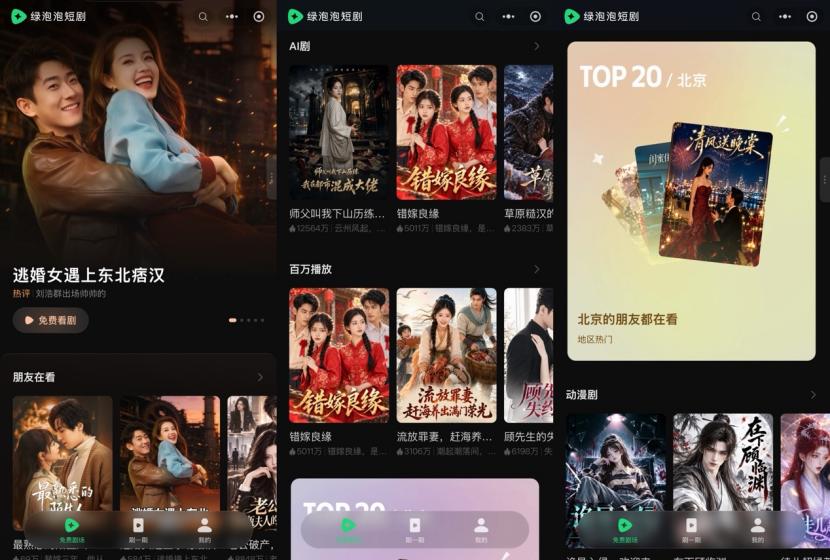
According to public information, the Green Bubble Short Dramas mini-program is launched by the WeChat Short Drama Content Center. Its "Free Theater" content pool includes multiple sections, such as "Dramas Your Friends Are Watching", "AI Dramas", and "Anime Dramas".
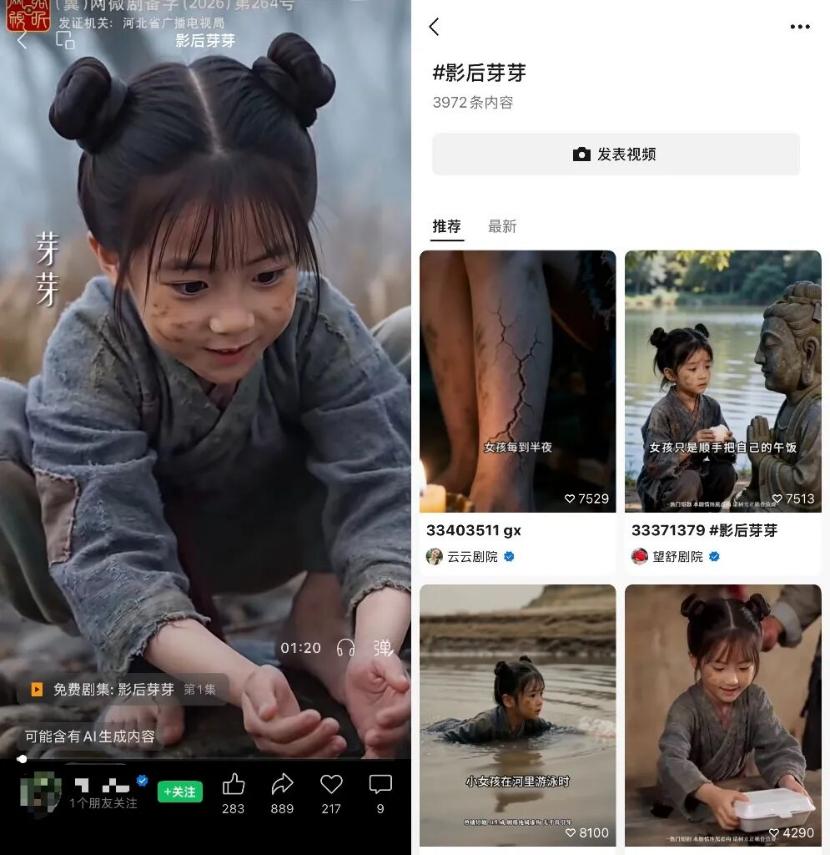
During the gray-scale test period, the AI-generated virtual human time-travel short drama "Yaya the Movie Queen" launched on Green Bubble Short Dramas quickly became a benchmark work. According to official information from the Tencent WeChat Channels Creator Camp, within 3 days of launch, the total views of the mini-program exceeded hundreds of millions, the peak concurrent online users exceeded 2 million, the average viewing duration per user on both the mini-program and Channels exceeded 30 minutes, and it reached 10 million users across both platforms within a few days after launch, with advertising revenue reaching millions of yuan.
As a matter of fact, Tencent has been planning for the short drama sector for a long time.
Back in December 2021, Tencent Video released the industry's first micro-short drama brand "Theater of Moments", which exists as a channel page in the long-video app. In January 2025, WeChat launched Tencent's first independent short drama app "Mars Short Drama Club". In June, the official "Short Dramas" mini-program, the predecessor of Green Bubble, was launched.
During the WeChat version update earlier this year, an independent entry was set up for the "Short Dramas" mini-program — the upward adjustment of the entry level means that its importance within the WeChat ecosystem has increased significantly.
Tencent cannot afford to stand still. After all, short dramas have quietly taken up a large proportion of users' time in recent years.
Ma Huateng has named the short drama track at Tencent's annual meetings for two consecutive years. At the 2025 annual meeting, he said bluntly that "short dramas have a relatively large impact on long-form content", but emphasized that Tencent would adhere to the principle of prioritizing key areas, avoid low-quality short dramas, and only invest in high-quality boutique short dramas.
At the annual meeting in January 2026, Ma Huateng further adjusted his strategic judgment: "Tencent Video was impacted by short dramas last year. In addition to continuing to invest in high-quality long-form videos, we will also develop some ad-driven products in the next stage."
This statement is probably the top-level strategic basis for the birth of the Green Bubble mini-program. In the past, Tencent Video focused on membership-based boutique short dramas; while the "ad-driven product" is targeting the free ad-supported short drama track that Hongguo relied on to rise to prominence.
Now Tencent is accelerating its deployment to recapture the user time that has been taken away by short dramas.
"Half of the time is spent on ByteDance's products"
"China's internet has entered the ByteDance era."
A set of data from Nomura Securities recently went viral. Its released industry research report "China Internet and New Media" shows that in August 2026, among the top 50 apps in China by monthly usage duration, ByteDance's overall duration share reached 41.8%.
Among them, Douyin's duration share was 19.3%, compared with 16.7% in the same period last year; Hongguo Short Dramas' duration share rose to 6%, with a year-on-year growth rate of 182%.
At the same time, the average daily usage duration per user of Douyin is 112-120 minutes, while the average daily usage duration per user of Hongguo Short Dramas is 125 minutes, surpassing Douyin and WeChat, making it the product with the highest per-user stay duration among all top-tier apps.
In contrast, the share of Tencent's product ecosystem has fallen back to 28.6%. Looking back ten years ago, Tencent's apps accounted for more than 45% of the total usage duration of all apps in China's mobile internet, while ByteDance's share was only in single digits at that time. Data from Nomura Securities shows that as of March 2026, Douyin's monthly active users have reached 1.009 billion, becoming the second app after WeChat that has exceeded 1 billion monthly active users.
In this reshuffle of rankings, the biggest dark horse is Hongguo Short Dramas.
In just two or three years, the industry has witnessed the explosive rise of this independent short drama app. ByteDance launched its short drama project in early 2023, and the independent Hongguo Short Dramas app was officially launched in August of the same year. It broke away from the mainstream paid unlock model that was popular in the industry at that time, and chose the route of full free viewing and advertising monetization.
With the support of ByteDance's powerful traffic ecosystem, users watch short drama clips with dense plot twists on Douyin, then jump to Hongguo to continue watching the full story. Coupled with mature recommendation algorithms that accurately push scripts with strong conflicts and high satisfaction, users' stay duration is pulled to an extremely high level — less than one year after launch, Hongguo's daily active users exceeded 4 million.
With traffic diversion from Douyin clips, IP supply from Fanqie, and revenue sharing policies that attract production teams, Hongguo has continued to grow rapidly. In January 2026, its daily active users officially exceeded 100 million, making it the fifth independent product under ByteDance with over 100 million daily active users.
Data from QuestMobile shows that as of July 2026, Hongguo's daily active users have climbed to 168 million, which is reportedly higher than the sum of the four major long-video platforms Tencent Video, iQiyi, Youku and Mango TV, harvesting a large amount of users' leisure time.
Some people joked that the whole nation has now entered the "Hongguo Era".
At the same time, ByteDance began to replicate the "free viewing, ad monetization" model of Hongguo overseas. Its short drama app PineDrama has accumulated more than 100 million downloads about 9 months after its overseas launch, with about 7 million daily active users.
Short dramas have swept into daily life, and a trending search went viral yesterday: "Never download Hongguo Short Dramas" — netizens posted their phone usage records showing that their daily usage duration of Hongguo Short Dramas exceeded 10 hours, sparking widespread discussion. Although the post seems to dissuade people from using the app, it is also a footnote to how addictive short dramas are and how they seize users' attention.
The Battle for Time
No one can turn a blind eye to this "battle for user duration".
From the user duration statistics of Nomura, it is not difficult to see that a large amount of entertainment time that netizens originally reserved for long videos and social networking is continuously flowing to ByteDance products such as Hongguo.
Tencent has its own stock advantages. According to Tencent Holdings' 2026 interim financial report, the combined monthly active users of WeChat and WeChat international version reached 1.439 billion, a year-on-year increase of 2%, still being the most widely covered user infrastructure in China. However, WeChat is mainly focused on tool scenarios such as communication, payment and public services, and user behaviors are fragmented, making it difficult to continuously lock a large block of entertainment time like short dramas and short videos do.
While games and Channels form Tencent's existing defense line for long user duration, Green Bubble Short Dramas has become a new weapon in this battle for time.
For internet giants, the short drama track is far more than just an additional content product. Short dramas break through the fragmentation of time: each episode is only tens of seconds to one or two minutes long, with dense plot hooks and extremely low viewing thresholds, making it very easy for users to binge-watch for a long time. It is one of the content categories with the strongest retention and duration indicators at present.
Duration represents traffic, traffic determines advertising inventory and commercial monetization space, and it is also the key for platforms to maintain user mindshare and consolidate the foundation of their ecosystems. Once there is a strategic absence in the high-stickiness short drama track, it means that a large amount of block leisure time of mid-to-long tail users will be continuously lost.
Therefore, we can see that relying on different resource endowments, ByteDance, Tencent and Kuaishou are staging a "three-way battle" in the short drama sector, kicking off a new round of competition: ByteDance has built a complete closed loop of IP, traffic diversion and monetization; Tencent relies on WeChat's social distribution to embed short dramas into its ecosystem; Kuaishou takes root in the sinking communities and focuses on the industrialized production of AIGC-generated short dramas.
Against the background of the AI era, this battle for short drama user duration is far more than just harvesting dozens of minutes of users' leisure time.
AI has greatly lowered the threshold of short drama creation. Scripts, visuals and dubbing can all be generated in large batches at scale, and content supply is no longer the bottleneck of the industry. The focus of competition has shifted to content distribution rights, user behavior data and the next-generation content industrialization system.
This means that whoever can stably capture users' attention can continuously precipitate user preference data, which in turn can be used to train and optimize AI content models, forming a mutually reinforcing cycle of data, content and traffic.
This is the fight for discourse power in the new era. And internet history shows that winners often take all — the losers, perish.
This article is from the WeChat public account "Investment Place" (ID: pedaily2012), written by Yang Jiyun, authorized for release by 36Kr.