New Breakthrough in World Model: Laziness Rate Drops by 85.7%
When the world model predicts the robot manipulation process, can it maintain the physical consistency of the target, avoiding unnecessary duplication, disappearance or deformation?
The current mainstream method is based on the pre-trained video generation model, conducts supervised fine-tuning (SFT) on robot manipulation data, and generates subsequent interactive videos according to conditions such as initial observation and task instructions. Training is mainly performed through visual reconstruction to match the generated results with the demonstration video.
However, there are still limitations in the process supervision of this type of training: the target area is small, and local errors are easily diluted by the global reconstruction loss; at the same time, visual reconstruction mainly constrains the similarity between the frame and the demonstration video, and does not explicitly require that the target representations in adjacent frames correspond to the same physical instance.
To this end, the China Merchants Group Advanced Technology Research Institute, in collaboration with Nanyang Technological University (NTU), proposes a physical evolution supervision framework EVEWorld, which enhances the instance consistency and cross-frame consistency of the manipulation target through Instance-Guided Recovery (IGR) and Temporal Instance Alignment (TIA) respectively.
Paper link: https://arxiv.org/pdf/2610.03374
They define the ungrounded target duplication or disappearance during the manipulation process as Model Laziness, and propose the "Model Laziness Rate (MLR)", which aims to measure the proportion of such persistent quantity anomalies in evaluable generated videos.
The results show that on WorldArena 2.0 Track 1, SupervisionWM based on FlowWAM obtains a score of 70.17, ranks 6th in JEPA Similarity and 17th in overall ranking; on DreamGenBench, compared with ordinary SFT, EVEWorld reduces MLR from 11.11% to 1.59%, with a relative decrease of 85.7%; the overall Gemini-IF is relatively increased by 13.6%, improving instruction following while reducing target quantity anomalies.
This work incorporates the evolution process of manipulation targets into the post-training supervision of the world model, providing experimental basis for improving target consistency and the reliability of interactive prediction.
1. Research Methodology
EVEWorld improves the physical consistency of manipulation targets through two modules: Instance-Guided Recovery (IGR) enhances instance consistency, and Temporal Instance Alignment (TIA) enhances cross-frame consistency. MLR is used to measure persistent target quantity anomalies in generated videos.
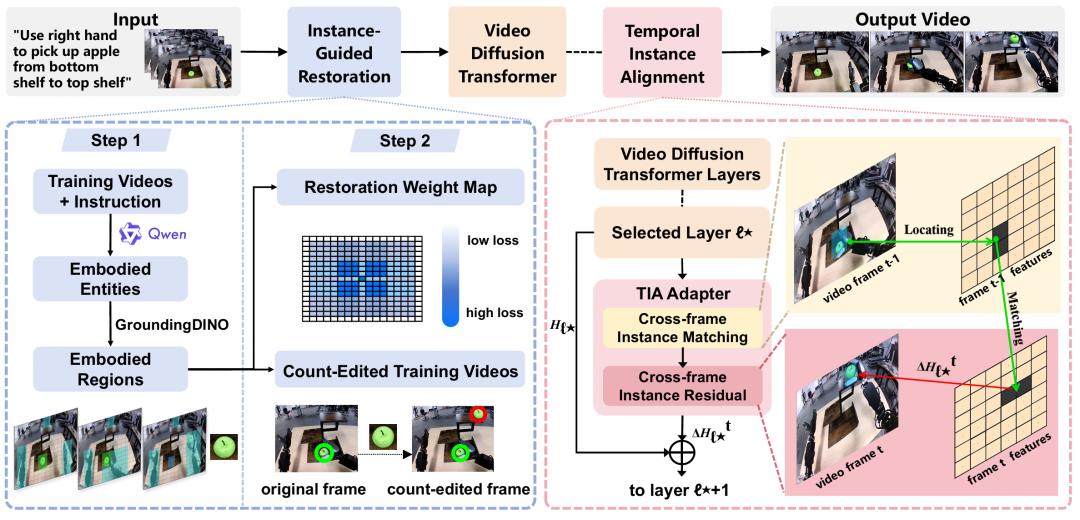
Figure | The overall framework of EVEWorld. IGR constructs quantity perturbation training pairs and strengthens the reconstruction supervision of recovery-related areas; TIA performs cross-frame instance matching and feature transmission at selected Transformer layers.
1. IGR: Recover the Correct Target Quantity
The core of IGR is to first construct quantity anomalies, and then train the model to restore the original video. The training process is divided into:
- Locate the target. Find the manipulation object in the demonstration video according to the task instruction.
- Construct perturbations. Duplicate the target and place it in a valid position to obtain training data with one extra target instance.
- Train for recovery. Take the perturbed video as input and the original clean video as the recovery target, so that the model learns to correct the extra instance.
During training, the relative reconstruction weight of recovery-related areas is 3 times that of ordinary areas to enhance the local error correction signal. For samples that cannot construct valid perturbations, the original clean video is used for training.
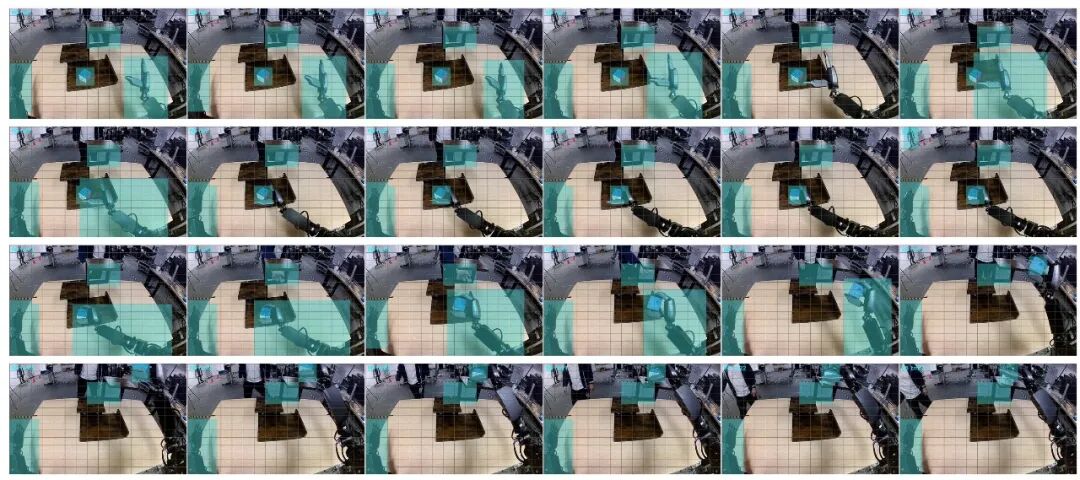
Figure | Example of IGR region weighting.
2. TIA: Constrain the Cross-Frame Consistency of Targets
When the target quantity is correct, objects may still undergo deformation, identity drift or sudden displacement. To this end, they connect the TIA module to the selected layers of the video diffusion Transformer, and constrain the cross-frame evolution of the same target through matching and transmission of adjacent frame features:
- Feature matching. Find features similar to the previous frame in the adjacent area of the next frame.
- Feature transmission. According to the matching relationship, transfer the feature information of the previous frame to the current frame.
- Update and supervision. Update the current frame features with the transmitted information, and supervise the correspondence of the same target in adjacent frames during training.
The target localization required for TIA training is completed in the offline stage. In the inference stage, TIA directly completes matching and transmission based on the model's hidden features.
3. MLR: Measure Persistent Quantity Anomalies
MLR takes the target quantity in the initial observation as a reference to judge whether the generated video has persistent quantity deviation. The evaluation is divided into three steps:
1.Count the quantity. Identify targets at the initial frame and subsequent sampling moments, and compare the number of instances.
2.Check occlusion. Check the evidence of robot occlusion for under-counting of targets, and exclude under-counting supported by occlusion; over-counting of targets is retained as anomaly evidence.
3.Judge persistence. If the quantity at multiple consecutive sampling moments deviates from the initial value, the video is marked as anomalous.
Finally, count the proportion of anomalous videos in the evaluable videos to obtain MLR.
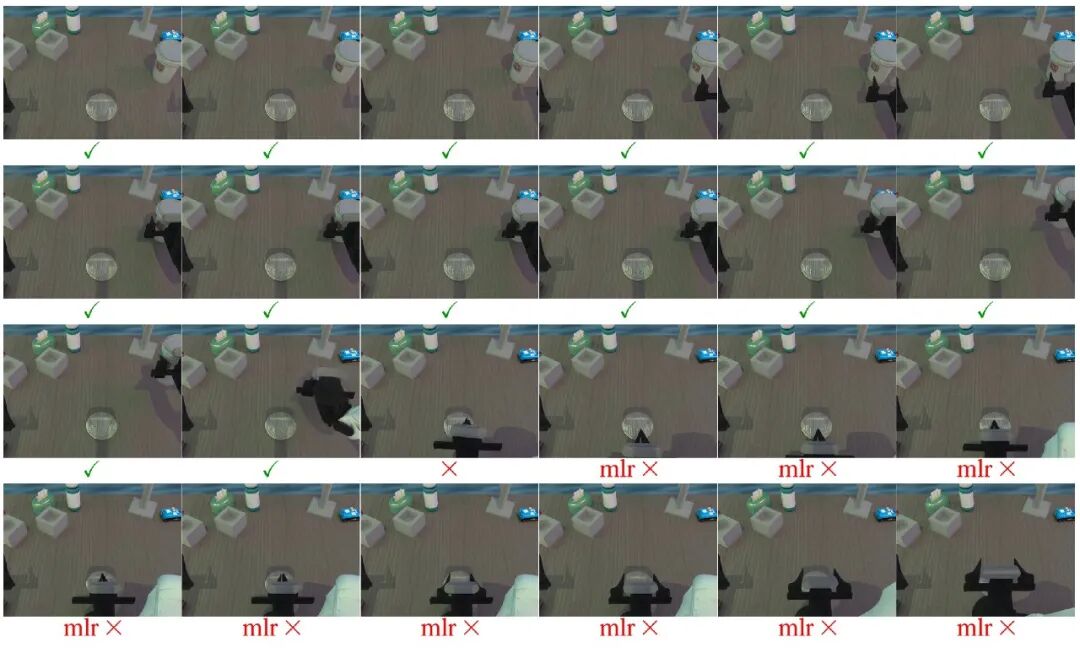
Figure | Example of MLR evaluation.
2. Experimental Results
They tested the target instance consistency and instruction following performance of EVEWorld on DreamGenBench, and investigated the generalization ability of the model when facing unseen environments, objects and behaviors. Through component ablation and duplication perturbation recovery tests, they further analyzed the respective roles of IGR and TIA, as well as the effect of the combination of the two.
At the same time, the experiments also covered different scenarios, robot morphologies, training data and model backbones, including zero-shot transfer evaluation on WorldArena 1.0, post-training on AgiBot data of different distributions, and evaluation of motion quality and comprehensive performance on EWMBench; then the method was migrated to FlowWAM to test the cross-backbone performance on RoboTwin and WorldArena 2.0. In addition, the PBench Robot experiment proved the stability of performance improvement through pairwise comparison of different generation durations and random seeds.
1. Reduced Model Laziness and Synchronous Improvement of Overall Instruction Following

In DreamGenBench, compared with ordinary SFT, MLR decreased by 85.7% relatively. At the same time, the overall Qwen-IF and Gemini-IF scores increased by 6.35 and 7.28 percentage points respectively.
They also separately examined the performance of the model on unseen environments, objects and behaviors:
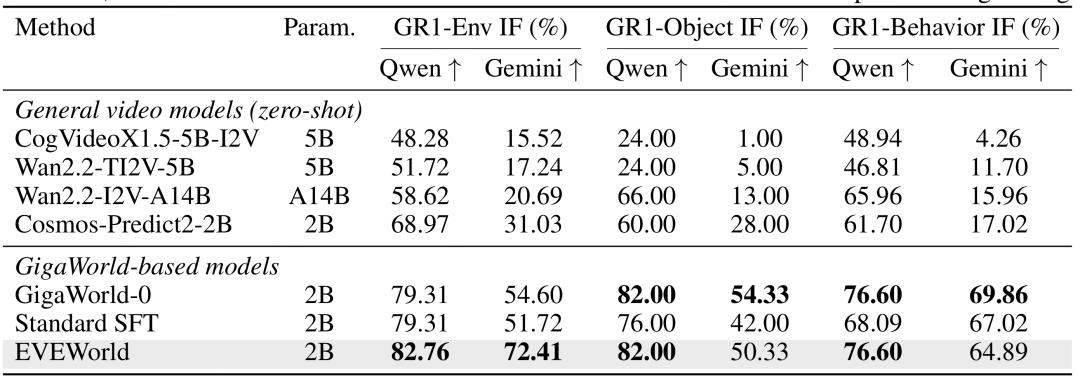
The breakdown results show that EVEWorld's Gemini-IF on unseen environments and objects increased by 20.69 and 8.33 percentage points respectively, and Qwen-IF on unseen behaviors increased by 8.51 percentage points. Both overall instruction following scores are improved.
2. How IGR and TIA Cooperate
In the ablation experiment, they tested IGR only, TIA only and the complete combination respectively, and compared with ordinary SFT to check the changes brought by the two modules respectively.
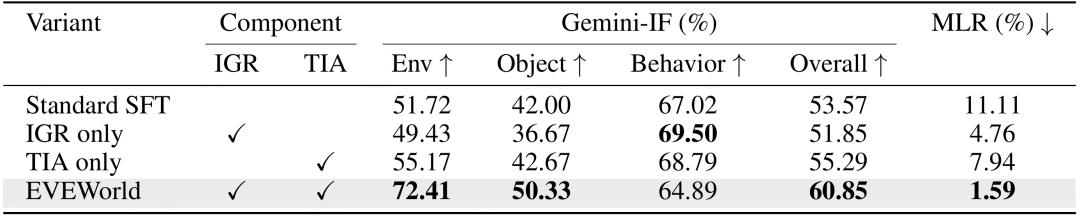
When only IGR or TIA is used, the MLR is 4.76% and 7.94% respectively; after combined use, it drops to 1.59%, and the overall Gemini-IF reaches 60.85%. Both indicators are better than using them alone, reflecting the complementary effect of the two types of supervision.
3. Generalization of Scenarios and Training Data
On WorldArena 1.0, they examined the performance of the model when facing different scenarios and robot morphologies.
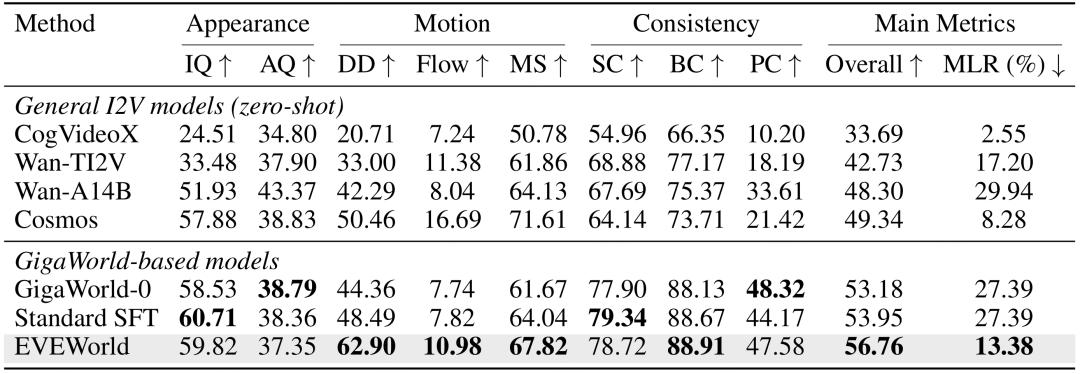
Among 157 shared evaluable samples, 43 videos of ordinary SFT have persistent quantity anomalies, while EVEWorld reduces this number to 21. MLR decreases by about 51.1% relatively, indicating that the improvement of target quantity consistency can be extended to different interactive environments.
Subsequently, they used AgiBot manipulation data for post-training, and evaluated on EWMBench. Under the same data and optimization budget, the motion score of EVEWorld is relatively increased by 3.48%. On PBench Robot, six groups of pairwise experiments consisting of two generation durations and three groups of random seeds all achieve positive gains, further supporting the stability of performance improvement.

4. Generalization of Model Backbones
They further migrated the evolution supervision to FlowWAM to check whether the method can be applied to the world model with optical flow conditions.

On RoboTwin, the complete EVEWorld reduces the MLR of ordinary SFT from 47.89% to 35.21%, and the visual reconstruction indicators are also improved. Among them, the MLR using only TIA is 22.54%, which performs better, indicating that the component benefit is related to the specific backbone. On the fixed evaluation subset, the PSNR and SSIM of six training checkpoints are higher than the corresponding controls.
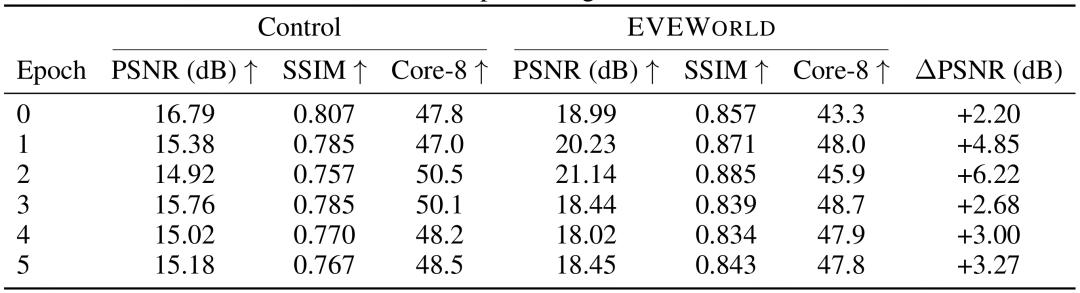
The results of EVEWorld show that how to supervise the evolution of manipulation targets is an important factor affecting the reliability of world model interactive prediction. The physical consistency of target quantity should become a key concern in training and evaluation.
The limitation of this method mainly stems from its local pairwise supervision, which does not explicitly characterize the long-range state dependencies and complex multi-object interactions.
In the next step, they will expand the evolution supervision form of EVEWorld to cover long-range state dependencies and complex multi-object interactions, and test whether the model can continuously maintain consistency in longer and more complex robot manipulation processes.
This article is from the WeChat Official Account "Academic Headline" (ID: SciTouTiao), author: Academic Head