The New Paradigm of Market Capitalization Management Behind AMD's Acquisition of Li Feifei's World Labs
On September 28, 2026, a bombshell hit the global AI industry: AMD announced the acquisition of World Labs in an all-stock transaction valued at approximately $8.2 billion. This is a spatial intelligence company co-founded by Li Fei-Fei, a Stanford University professor known as the "Godmother of AI". Founded only two years ago, it has a team of about 70 people and no large-scale revenue yet. After the transaction is completed, Li Fei-Fei will serve as Executive Vice President and Chief Scientist of AMD, reporting directly to Lisa Su, Chair and Chief Executive Officer. This is AMD's second-largest acquisition in the company's history after the $50 billion acquisition of Xilinx in 2022.
The price signal of this transaction is thought-provoking. When World Labs made its public debut in September 2024, it had already completed financing of over $230 million, jointly led by a16z, NEA, and Radical Ventures, with participation from NVIDIA NVentures, Adobe Ventures, etc. In February 2026, the company completed another $1 billion financing, with AMD, NVIDIA, Autodesk, Fidelity and others among the investors, and the post-money valuation was approximately $5 billion. In other words, AMD's acquisition price represents a premium of about 64% over the valuation seven months ago. What AMD is buying is not current revenue, but the pricing of the future.
The market's reaction is also worth pondering. Just a week earlier, on September 21, driven by the fundamentals of the computing power business and the expectations of the physical AI track, AMD's stock price rose by 9.6%, and its intraday market value exceeded $1 trillion for the first time, becoming the fourth American chip company to join the $1 trillion club after NVIDIA, Broadcom, and Micron. On the day of the merger announcement on September 28, AMD's stock price fell by about 3.6%.
Between the rise and the fall, the question is: What exactly is the capital market pricing for?
From a longer industrial cycle perspective, this is not an isolated transaction. Professor Zhang Junping of Fudan University points out in *A Concise History of Artificial Intelligence* that the development of artificial intelligence is not a straight upward line, but has gone through stages of germination, initial creation, growth and multiple booms, during which there have also been development troughs caused by technical limitations, insufficient computing power and over-optimistic expectations. From a long-cycle perspective, artificial intelligence is gradually moving from scientific concepts to industrial applications, deeply integrating with the digital economy and intelligent manufacturing, laying the foundation for the rise of the intelligent economy. The evolution of artificial intelligence also conforms to the law of technological revolution cycle summarized by Carlota Perez in *Technological Revolutions and Financial Capital*: A round of technological waves usually goes through technological explosion, capital frenzy, bubble clearance, institutional rule reconstruction, and finally moves to a stage of coordinated prosperity where technology adapts to the social and economic system.
At present, the artificial intelligence industry is undergoing a structural paradigm shift: the first stage takes large language models as the core to realize the information processing revolution of the digital world; the second stage takes spatial world models, embodied intelligence, and industrial simulation as the core to open the computing revolution of the physical world. If large models reconstruct the production mode of digital content, then world models will reconstruct the production paradigm of physical scenarios such as robots, high-end manufacturing, autonomous driving, and digital twins, becoming the commanding height of the next-generation AI industry competition.
In this context, the competition logic and market value logic of traditional semiconductor companies are being completely subverted. In the past, the growth and valuation of semiconductor companies were anchored on chip process, shipment scale, revenue profit and market share. In the era of physical AI, chip hardware is no longer an independent profit carrier, but a computing power infrastructure for the implementation of world models and intelligent agents. The integrated capability of software and hardware is becoming a high-weight pricing factor for the long-term value of companies.
However, existing researches mostly focus on the synergy effect, financial performance and risk control of traditional mergers and acquisitions, and few conduct academic analysis on the new M&A model of "exchanging market value for tracks, exchanging equity for intelligence" commonly used by AI tech giants from the perspective of market value management theory in the era of intelligent economy. Based on the original 9-MVM 9-Box Market Value Management Model, this paper systematically deconstructs this M&A, reveals the new laws of corporate value creation, value transmission and value iteration in the era of intelligent economy, and tries to fill the missing link in the research on market value management behind the M&A boom in the era of intelligent economy.
Analytical Framework: 9-MVM 9-Box Market Value Management Model
First, clarify the concept. According to the *Regulatory Guidelines for Listed Companies No. 10 — Market Value Management* issued by the China Securities Regulatory Commission, market value management refers to the strategic management behaviors implemented by listed companies based on improving corporate quality to enhance corporate investment value and shareholder return capability. This paper adopts the self-constructed 9-MVM 9-Box Market Value Management Model as the analytical framework. This model breaks through the narrow cognition of traditional market value management that "emphasizes capital operation and neglects value creation", and establishes a broad market value management system adapted to the intelligent economy, technology companies and innovative assets.
The model constructs a three-row and three-column 9-box structure with two axes. The vertical axis is the longitude of value evolution, including value creation, value transmission and value iteration, which respectively correspond to the full life cycle value logic of the construction of the company's underlying assets, commercial value realization and long-term barrier continuous evolution. The horizontal axis is the corporate management dimension, including strategy, operation and market, which respectively correspond to three levels: top-level strategic layout, internal corporate operation implementation, and capital market consensus management. The intersection of the two axes forms nine analysis units:
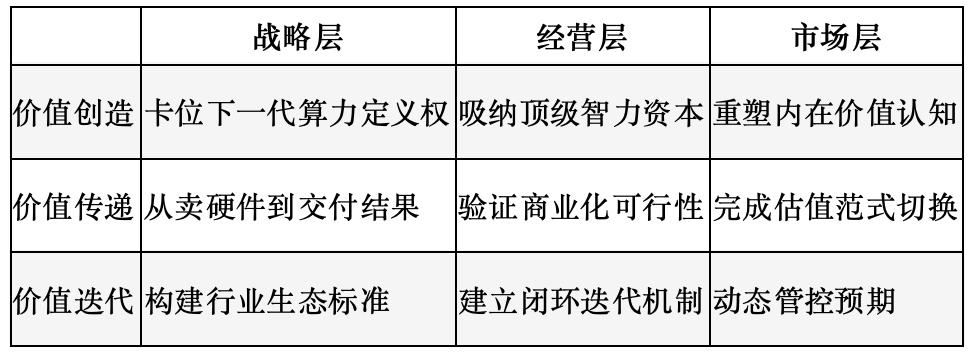
From this, a basic judgment can be extracted: the market value of traditional companies is the cumulative realization of past performance, while the market value of intelligent economy companies is the market consensus on their ability to reconstruct future productivity. For technology companies with no short-term profits and growing relying on technical options and intellectual capital, the core of market value management is no longer profit modification and stock price stability maintenance, but a systematic project of endogenous value capability construction, exogenous value consensus transmission, and long-term value ecological iteration. This is exactly the key to understanding AMD's transaction.
Transaction Overview and Basic Valuation Analysis
Target: A Pure Intellectual Capital Company
World Labs is an American AI company founded in 2024, headquartered in San Francisco, co-founded by Li Fei-Fei, Justin Johnson, Ben Mildenhall, and Christoph Lassner. The company's goal is to enable AI not only to understand text and 2D images, but also to understand, generate, reconstruct and simulate the 3D physical world. If large language models mainly rely on statistical laws in text, World Labs hopes that the model can have the ability to understand objects, space, motion and physical relationships.
The company's core products and models include: Marble, a spatial intelligence product for users, and Atlas, a new generation of multimodal world model released in September 2026. In addition, World Labs acquired SceniX in July 2026 to complement its robot simulation capabilities, and lay out reinforcement learning training environments and Real-to-Sim workflows.
The company has a team of about 70 people, covering computer vision, graphics, large model training, systems and robot simulation and other directions. When it debuted in September 2024, the company had completed financing of over $230 million; in the $1 billion financing in February 2026, AMD, NVIDIA, Autodesk, Emerson Collective, Fidelity and Sea all participated in the investment. It is worth noting that AMD is both an investor and a partner: the two sides have previously cooperated on spatial intelligence model training and inference optimization around Instinct GPUs. This upgrade from investment relationship to full acquisition has far more industrial signals worth studying than the $8.2 billion itself.
Transaction Structure: Dual Implications of All-Stock Consideration
This M&A is an all-stock consideration transaction with a total amount of $8.2 billion, which is expected to be completed by the end of 2026, and still needs to obtain regulatory approval and meet other customary closing conditions. After the transaction is completed, Li Fei-Fei will serve as Executive Vice President and Chief Scientist of AMD, reporting directly to Lisa Su; core members such as Justin Johnson and Ben Mildenhall will continue to lead the team to merge into AMD to promote cutting-edge AI model research.
The all-stock arrangement is meaningful. On the one hand, AMD does not need to pay cash consideration, avoiding the pressure of cash M&A on operating cash flow; on the other hand, the AMD stocks obtained by the World Labs team deeply bind the interests of both parties. In essence, this is using high-level market value to replace future intellectual assets, which is a typical intelligent economy M&A paradigm.
Two-Way Valuation Benchmark
Market value benchmark of the acquirer AMD: At the time of the M&A announcement, AMD's intraday market value in the secondary market was about $992.3 billion, which was at the $1 trillion mark. Its valuation support mainly comes from the stable revenue of data center GPUs and PC terminal chips and the market share in the computing power market, which belongs to the mature core assets of hard technology.
Valuation benchmark of the target World Labs: The consideration of this transaction is $8.2 billion, representing a premium of about 64% over the post-money valuation of about $5 billion in February 2026. Its valuation does not rely on traditional financial indicators such as Price-to-Earnings Ratio (PE) and Price-to-Sales Ratio (PS), but is based on technical option pricing, track consensus pricing and synergy value pricing, which is a typical non-financial valuation model in the era of intelligent economy.
Pricing logic of combined market value: For AMD, this acquisition is not only to obtain a model team, but also to allow chip design to understand new types of workloads such as spatial intelligence, robot simulation, and physical AI earlier, thus reversely affecting the future planning of GPUs, CPUs, interconnections, memory and software stacks. The all-stock M&A brings two effects of equity dilution and new goodwill at the same time. The theoretical combined market value benchmark is at the level of $1 trillion, but the real market value is never a simple arithmetic sum. It is finally determined by four factors: software and hardware synergy premium, integration risk discount, track expectation premium, and goodwill impairment risk.
Full-Dimensional Analysis of M&A Value Under the 9-MVM Model
Value Creation: Reconstruction of Underlying Intrinsic Value
Value creation is the foundation of the company's endogenous value. This M&A systematically complements AMD's value shortcomings in the physical AI era from three dimensions: top-level strategy, internal assets, and market value reserve.
Strategic Level: Seize the Right to Define Next-Generation Computing Power
At present, the global AI computing power competition has fallen into the red ocean of general large model GPUs. NVIDIA relies on the Omniverse ecosystem to lay out the physical simulation track in advance, forming a closed-loop barrier of software and hardware. AMD's traditional advantages are concentrated in the computing power of text large models, and there are strategic gaps in the fields of spatial intelligence, robot simulation, and physical world modeling. This M&A brings two major strategic leaps:
First, upgrade from a hardware supplier to "model-defined hardware". The world model of World Labs has exclusive computing power requirements for high-bandwidth computing power, 3D parallel computing, and real-time simulation architecture. The top algorithm team deeply participates in AMD's next-generation chip architecture design, which can advance software requirements to the hardware R&D link and seize the right to define physical AI computing power standards.
Second, build differentiated track barriers. Break away from the involution of general computing power, cut into trillion-level incremental tracks such as robots, industrial digital twins, and autonomous driving simulation, and form a two-wheel strategic pattern of "general computing power + physical intelligent computing power".
Operational Level: Absorb Top-Level Intellectual Capital
In the era of intelligent economy, the core assets of technology companies have shifted from fixed assets and equipment production capacity to industry knowledge assets, algorithm systems and top scientific research talents. The essence of this M&A is precisely a strategic acquisition of high-end intellectual capital.
On the one hand, AMD incorporates Li Fei-Fei's top global academic influence and a complete spatial intelligence R&D team, forming a talent barrier that cannot be replicated through internal recruitment; on the other hand, all of Marble, Atlas world model algorithms, 3D datasets and simulation workflows are converted into AMD's intangible assets, and the company's asset structure extends from chip design as the main focus to the integration of "software, hardware and intelligence". At the same time, the new organizational structure combining the chip engineering team and the AI basic research team will establish a new R&D system of human-machine collaboration and software-hardware collaboration to adapt to the long-term iteration needs of physical AI.
Market Level: Reshape Intrinsic Value Perception
After the completion of the M&A, AMD is expected to get rid of the single market label of "GPU second echelon follower", and add three major value sectors: physical AI world model, spatial intelligent computing power, and embodied intelligent infrastructure. The company's intrinsic value has been upgraded from traditional chip value to the underlying ecological value of the next-generation AI industry, which reserves the most core material for the capital market to revalue its value.
Value Transmission: Reconstruction of Business Model and Market Consensus
The core of value transmission is to convert endogenous technical capabilities into commercial returns and capital market consensus. This M&A will reconstruct AMD's business realization logic and external value communication system.
Strategic Level: From Selling Hardware to Delivering Results
The traditional semiconductor business model is hardware R&D, production and sales, and hardware iteration to increase revenue, which belongs to the transaction paradigm in the era of industrial economy. After the M&A, AMD opens a new paradigm of intelligent economy: integrated delivery of chip hardware and world model simulation platform. What customers purchase is no longer a single computing power hardware, but the complete business results of physical scenario simulation, 3D intelligent modeling, and robot closed-loop development, which conforms to the new business trend of "result delivery replacing tool sales" in the AGI era. The leap of business model will open up incremental revenue spaces such as software services, ecological authorization, and result sharing beyond hardware.
Operational Level: Verify Commercial Feasibility
The core of short-term operation is scenario pilot verification: relying on the original industrial and intelligent manufacturing customer resources, implement the integrated solution of "chip computing power + world model simulation", and form quantifiable operating indicators of cost reduction, efficiency improvement and speed increase; in the medium and long term, through standardized simulation workflows and general 3D modeling tools, realize large-scale commercial replication and build a new business curve for continuous revenue growth. Compared with pure software AI companies, AMD has the underlying support of chip hardware, which can solve the computing power adaptation, latency optimization and engineering problems in the implementation of world models, with higher certainty of commercial implementation.
Market Level: Complete Valuation Paradigm Switch
This M&A is expected to promote AMD's capital market narrative to complete three levels of upgrade: from AI computing power hardware manufacturer, to general AI infrastructure manufacturer, and then to the leader of the integrated physical AI software and hardware ecosystem. Accordingly, the pricing logic of the company's market value will also iterate: from single pricing of hardware revenue, gross profit margin and shipment volume, to a dual pricing system of "stock hardware performance as the bottom line + incremental physical AI track option premium".
The capital market's sensitivity to the physical AI narrative has been reflected. Since September 2026, AMD's stock price has seen a significant rise: on September 21, it rose by 9.6%, hitting an intraday high of $616.69, closing at $615.52, and its intraday market value exceeded $1 trillion for the first time; on September 25, it continued to rise, hitting an intraday high of $639.00, closing at $630.63, setting a new all-time closing high. The short-term pullback after the announcement on September 28 reflects the market's divergence on M&A premium, technology commercialization cycle and integration risk. This belongs to the pricing game in the narrative reconstruction stage, and does not directly mean the impairment of the enterprise's intrinsic value.
Value Iteration: Long-Term Ecological Barrier and Dynamic Market Value Management
Value iteration determines the company's sustainable growth capability and market value stability, which is the high-level dimension of market value management in the era of intelligent economy.
Strategic Level: Build Industry Ecological Standards
Relying on the technical accumulation of World Labs, AMD will continuously iterate the spatial world model system, jointly build an open physical AI ecosystem with upstream and