The pork price has hit the "freezing point" of 10 yuan.
The hog regulation has been in place for more than a year. Although the number of breeding sows nationwide has decreased to a certain extent, affected by the previously launched production capacity and the overall base, among the A-share listed hog enterprises that have disclosed data, more than half of them still recorded year-on-year growth in slaughter volume in the first three quarters.
Recently, listed hog enterprises have successively released their slaughter volume data for the first three quarters. According to statistics from CLS reporters, the top 14 A-share listed hog enterprises have cumulatively slaughtered 129 million hogs in the first three quarters, a year-on-year increase of about 3%.
Most hog enterprises saw overall year-on-year growth in slaughter volume, only New Hope (000876.SZ), Wens Foodstuff Group (300498.SZ), Jingji Smart Agriculture (000048.SZ), and Da Bei Nong (002385.SZ) recorded year-on-year decline in slaughter volume, while Muyuan Co., Ltd. (002714.SZ) remained flat compared with last year. More than half of the listed hog enterprises still maintained double-digit growth. Among them, the top growing enterprises including Zhengbang Technology (002157.SZ), Aonong Biological (603363.SH), Kemin Foods (002661.SZ), Tekang Biological (002100.SZ), and Jinnong New Industry (002548.SZ) saw year-on-year slaughter volume growth of 41.48%, 37.4%, 36.25%, 32.18% and 32.02% respectively.
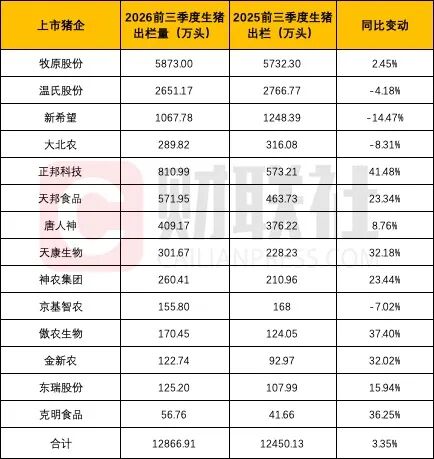
(Data source: company announcements, chart made by CLS reporter)
The national production capacity regulation has been implemented for more than a year. According to the monthly reports disclosed by various listed hog enterprises, the sales unit price in September was around 10.5 yuan per kilogram, down about 20% year-on-year. On October 13, the national average price of external ternary hogs was about 10.07-10.10 yuan per kilogram. After a short rebound before the festival, the price fell below the 10-yuan mark again.
According to data from Zhuochuang Information, by the end of September, the inventory of breeding sows of 196 sample enterprises was 8.4123 million, a year-on-year decrease of 7.18%. Zou Yingji, hog analyst at Zhuochuang Information, told CLS reporters that the de-capacity performance year-on-year is relatively obvious, but the theoretical slaughter volume of hogs at present is determined by the inventory of breeding sows 10-11 months ago. At that time, the decline in the inventory of breeding sows was limited, and the PSY (piglets per sow per year) increased at the same time, corresponding to the abundant hog supply at this stage.
A relevant person in charge of a listed hog enterprise told CLS reporters that from the data of breeding sows, the de-capacity of breeding sows every month from the beginning of the year to now has had certain effects, but the impact on the current supply is still relatively weak. In the past few years, the entire industry has been improving production efficiency, which has partially offset the de-capacity effect. The absolute value of the industry is still relatively high, de-capacity is a gradual process, and hog prices are still in the bottoming stage.
With hog prices staying at the bottom for a long time, the breeding cost of listed hog enterprises has further decreased, and the cost of most hog enterprises has dropped below 13 yuan per kilogram. According to the cost data disclosed by various hog enterprises, the current leading echelon with cost advantages, such as Muyuan Co., Ltd., Wens Foodstuff Group, New Hope, Shennong Group, Da Bei Nong, etc., have reduced their cost below 12.0 yuan per kilogram, while the breeding cost of Zhengbang Technology, Tianbang Food, Tangrenshen and other enterprises is below 13 yuan per kilogram.
It is worth noting that at the bottom of this hog cycle, the self-breeding and self-raising cost of listed hog enterprises has further decreased, and hog enterprises have increased the proportion of self-breeding. According to the data from research reports, by the end of June 2026, the proportion of inventory of New Hope's integrated self-raising and cooperative free-range breeding was about 40:60, and the proportion of self-raising further increased compared with the end of 2025. CLS reporters learned from New Hope that previously, the cost of free-range breeding was 1 yuan per kilogram lower than that of self-breeding and self-raising. With the improvement of the company's feed advantages, seed quality and epidemic prevention and control, the cost of self-breeding and self-raising has been basically close to that of free-range breeding since last year.
The fourth quarter will usher in a consumption peak. Zou Yingji predicts that the market demand for hogs may gradually increase in November. With the improvement of demand for large hogs and rising prices, the price of standard hogs may get support. In addition, farmers may choose to hold back hogs for weight gain and wait for slaughter around the Winter Solstice in December, so the supply in November may narrow temporarily, and there is possibility for hog prices to rise. The demand for hogs in December will usher in the highest peak in the second half of the year. At the same time, large hogs will be continuously released, and groups may have the motivation to rush for sales volume at the end of the year. The increase in supply may be greater than the increase in demand, and hog prices may show a slight downward trend.
This article is from the WeChat official account "CLS", the author is Zhang Chenjing, 36Kr publishes this article with authorization.