Google says that AI self-improvement is still a long way off, but people like Hinton can't wait any longer.
Recently, Hayden Belfield, an engineer at Google DeepMind, disclosed a set of data to the public: over 75% of Google's internal production code is written by AI. This sounds like AI has been deeply involved in R&D work.
But Belfield also gave another set of figures: about 88% of code changes still require human supervision or review, and every change must go through manual review before submission. The proportion of code changes fully delegated to AI has risen from 7.5% to 11.9%.
The gap between 75% and 11.9% marks the real boundary of AI's self-improvement capability at the current stage.
The more complex the task, the harder it is for AI to complete independently
The data Belfield disclosed comes from Google's actual internal operations. According to him, Google DeepMind has not found any measurable acceleration in AI research driven by AI itself. The degree of automation has indeed increased significantly, but there is still a considerable distance from "AI improving itself".
This judgment has been verified in Google's internal benchmark tests. In 1389 test runs of the internal Argon agent, the success rate without human intervention dropped sharply as task complexity increased. The more complex and time-consuming the task is, the harder it is for AI to complete it independently.
In DeepMind's internal benchmark test RE-Bench, which includes 74 real machine learning engineering tasks, Argon can solve about half of the tasks. This is a significant improvement over the 27% performance of Gemini 3.7 Flash, but there is still a considerable gap from the near-perfect performance required for full automation.
Belfield stated that humans remain critical in creative research, novel experimental design, diagnosing subtle training instabilities, and long-term planning. A survey of 12 senior DeepMind researchers confirmed this pattern: the highest degree of automation is found in well-defined, verifiable tasks, while the lowest is in open-ended scientific ideation.
In other words, AI can do a good job of "following the blueprint to carry out construction", but cannot "draw the blueprint".
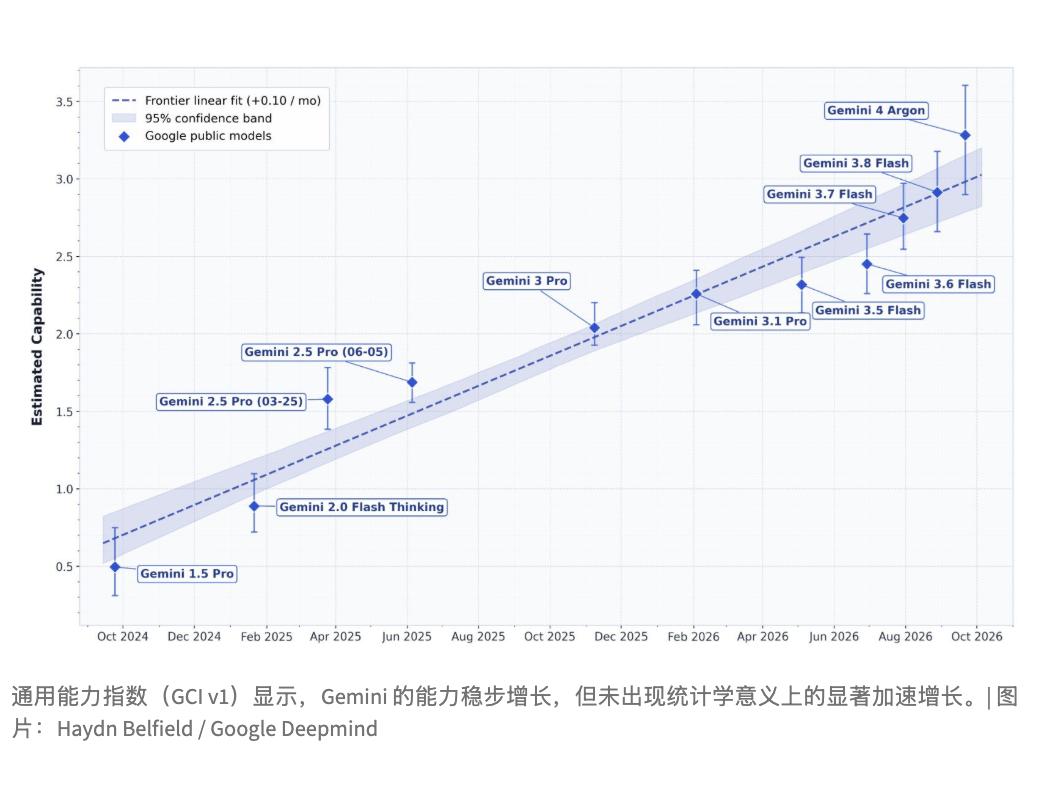
The growth of general capability index has not accelerated
To systematically track progress, the Google team built a general capability index covering 123 models and 92 benchmark tests. The data shows that the capability of the Gemini model is growing at a stable rate of about 0.1 GCI points per month, with no significant change in speed.
The team believes that the performance of Gemini 4 Argon is slightly above the trend line, but this is mainly due to the increase in computing power and organizational input, rather than AI-driven acceleration. This is a key distinction: the progress of the model comes from "humans investing more resources" rather than "AI becoming smarter on its own".
At present, the team believes that the risk brought by AI-driven research automation is relatively low, but it is building measurement infrastructure to track signs of accelerated development in the future.
But another group of people disagree
Belfield's research findings are consistent with many recent studies, but not all industry insiders agree with this judgment.
More than 20 AI researchers including Geoffrey Hinton, Yoshua Bengio, and Jakub Pachocki from OpenAI recently warned in a research paper that an "intelligence explosion" may occur in the AI field. The paper titled What if automating AI R&D triggers an intelligence explosion? was published by the Cambridge AI Science and Policy Program. The 22 participating authors include two godfathers of AI, Andrew Barto, a pioneer of reinforcement learning, Pachocki, Chief Scientist of OpenAI, and Jack Clark, co-founder of Anthropic.
The core judgment of the paper is: Once AI can fully participate in the R&D of the next generation of AI, recursive self-improvement may form a real closed loop. Once AI R&D automation crosses a certain critical point, the AI progress that used to take several years to complete may be compressed to several months or even shorter. In extreme cases, the AI progress that takes one year to complete today may only take about 5 weeks in the future.
The data cited in the paper includes: In January 2025, the proportion of approved code generated by AI was only a low single digit, and by May 2026, this proportion had exceeded 80%. In March 2026, Claude was able to independently complete about 1% of R&D work with only high-level human supervision; by August of the same year, this figure had risen to 26%, more than 20 times higher in about half a year.
The paper also points out that Anthropic itself emphasizes that at present, Claude has not reached the level of complete unsupervised performance in any category of tested AI R&D work. But this trend itself is alarming enough.
The truth between 75% and 88%
The data from the two sides do not contradict each other, as they describe different facets of the same thing.
Google's 75% refers to "the proportion of code written with AI participation" — AI writes a piece of code, which is then reviewed and approved by humans. The 80% cited in Hinton's paper follows a similar statistical caliber. Belfield's 88% refers to "the proportion of code changes that require human supervision or review". When these two numbers are combined: AI writes a large amount of code, but very few code changes are completed independently by AI.
This gap points to a core issue: what AI can do at present is "assistance", not "autonomy". It can generate a large number of candidate solutions, but it still requires humans to judge which solution is correct, which is safe, and which is worth submitting.
The results of Google's RE-Bench test also confirm this point: Argon can solve about half of the tasks, which means that human participation is still required for the other half of the tasks. For open-ended scientific ideation, the contribution of AI is almost negligible.
The paper by Hinton et al. also acknowledges that AI R&D automation is still in its early stages. But their focus is not here. Their argument is: Once a certain critical point is crossed, changes may come very quickly. Google's position is: We have not reached that critical point yet, and we have data proving that the growth curve is linear, not exponential.
AI code generation in the enterprise sector: ongoing automation No matter how the academic debate goes, the adoption of AI code generation in the enterprise sector is accelerating.
According to the 2026 State of AI Programming Report released by New Relic, 67% of surveyed technology leaders said that AI currently generates or significantly refactors 51% to 75% of their organization's weekly code output. The report also cites data from multiple companies: Microsoft reports that AI has written 30% of its code base, Salesforce CEO Marc Benioff estimates that AI agents currently undertake 30% to 50% of the workload, and Meta has set a target of 50% for 2026.
Google's 75% is the highest among all large technology companies. But the report also reveals a contradiction: 94% of respondents believe that AI-generated code is of higher quality than human-written code when reviewed, but once deployed to the production environment, 78% of respondents reported more incidents, and 86% reported more emergency fixes that require senior engineers to intervene.
This means that AI-generated code looks good when reviewed, but performs poorly in the real production environment. This gap — the gap between review evaluation and production performance — is exactly the core bottleneck of AI's self-improvement capability at present. AI can write code that looks correct, but it still requires humans to judge whether it is actually correct.
The capital market is already pricing for RSI
Although there is still a long way to go in technology, the capital market has begun to price "recursive self-improvement" as an investment narrative.
A recent research report released by Deutsche Bank pointed out that if AI can continue to expand the computing scale and achieve real recursive self-improvement, its capability may enter an accelerated growth stage, and it is not impossible for super artificial intelligence that comprehensively surpasses human experts to emerge by 2030. The report also acknowledges that whether the scaling law can continue to be effective is still controversial, and real recursive self-improvement is yet to be realized.
The RSI concept heated up rapidly in the second half of 2026. According to reports from TMTPost, the relevant discussions have led to mixed perceptions, but the feedback from the capital market is relatively positive. After the anxiety about "deceleration" briefly caused fluctuations, it was quickly left behind, and the RSI narrative was quickly pushed to the forefront. Coupled with events such as Meta's release of Muse, a consumer-grade personal AI agent, the U.S. stock technology sector, which was previously under pressure due to the slowdown in the ARR growth rate of AI manufacturers, has rebounded significantly.
The global self-improving AI system market is expected to grow by about 69.5 billion US dollars between 2025 and 2030, with a compound annual growth rate of 38.8%. The valuations of AI programming startups are also soaring: Cursor is in financing negotiations at a valuation of more than 50 billion US dollars, and Cognition AI's post-money valuation has reached 26 billion US dollars.
The significance of measurement
Back to the work of the Google team. Belfield said that they are building measurement infrastructure to track signs of accelerated development in the future. This sentence carries more weight than it appears on the surface.
If AI self-improvement is really coming soon, the earlier the measurement capability is established, the earlier signs of acceleration can be identified. If it does not come, these measurement data can also provide a reliable basis for the public and regulators to prevent the market from being driven by excessive narratives.
The current data is clear: AI has written 75% of the code, but only 11.9% of code changes are fully delegated to AI. This gap itself is a signal — it tells us how far AI is from "improving itself".
But no one can give an exact answer as to how long this signal can last. The warnings from Hinton and others and Google's measurement are essentially doing the same thing: preparing for a turning point that may never happen or may happen at any time.
This article is from the WeChat official account "Tech Business", written by Tech Business, and authorized for release by 36Kr.