The lobster craze has ebbed, and the headless MacBook remains a hot seller.
In the geek community that loves tinkering with computers, the "Headless Knight" has been a popular term for more than five years. If a MacBook's screen breaks down, the cost of repair or screen replacement is too high to be cost-effective. Many users choose to perform a "head amputation" on the MacBook, then connect it to an external display for continued use — back then, people had not yet realized the considerable residual value of the remaining part of these headless devices.
For those who have never come into contact with headless MacBooks, it may be hard to imagine their actual usage scenarios. To sum up in one sentence: It is essentially a Mac mini that comes with a built-in keyboard and trackpad. The most straightforward usage is to connect it to a monitor as a stationary host, and with the original keyboard and trackpad, users can fully experience the macOS system and its entire ecosystem at a price of around 1,000 yuan.
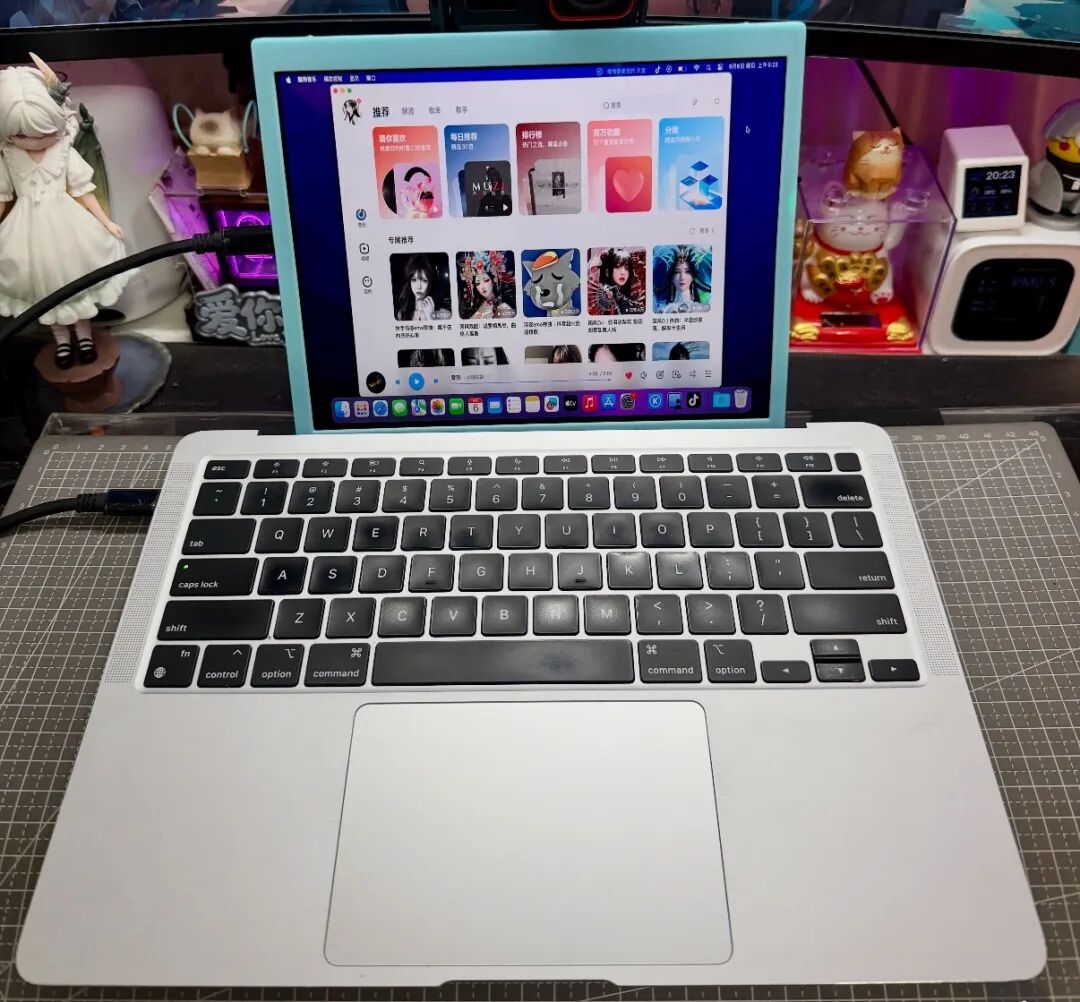
Some netizens used a disassembled screen from an iPad 4 to DIY a 2K 60Hz display for a Headless Knight, with the screen costing only 115 yuan, making it a real perfectly assembled Apple device. Source: Xiaohongshu @Yi Wangxi Buxi
In the first half of this year, headless MacBooks gained a new identity: dedicated hosts for running AI tasks. With the skyrocketing popularity of OpenClaw, the Mac mini M4, the primary workhorse for AI agents, faced supply shortages for quite a long time and was nearly impossible to get, with the maximum premium in the second-hand market reaching 23%. In May, Tim Cook, who is about to step down, once again showed his shrewd business acumen, raising the starting price of the Mac mini from $599 to $799 and cancelling the entry-level configuration.
Against this backdrop, the "Headless Knight" has officially entered the public view and become a more cost-effective alternative hardware solution. Using AI Agents in principle does not require a screen — after deployment is completed, users can remotely access and control the device through other gadgets. Amid the Agent wave, those incomplete old MacBooks have successfully gained a second life, providing "AI prosthetics" for more trend followers with relatively tight budgets.
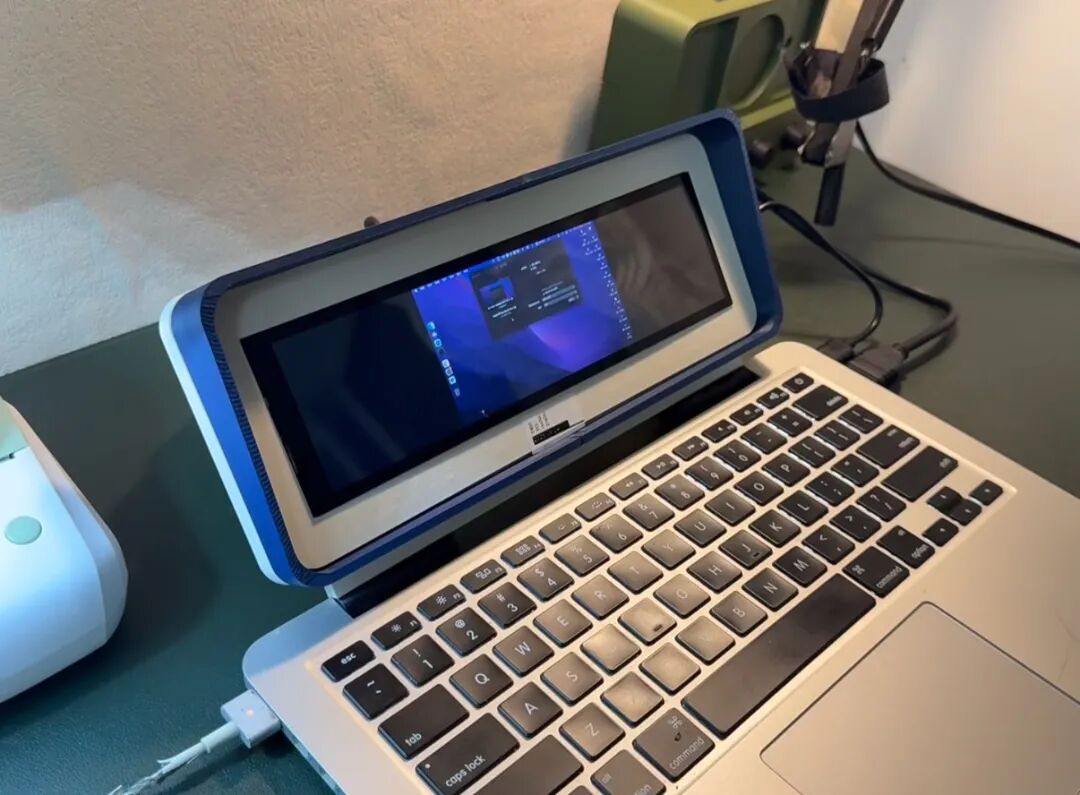
That's to say, it works with even the smallest monitor. Source: Xiaohongshu @Chuang-Wuzhi (3D Printing)
The AI hardware boom quickly faded, but headless MacBooks did not disappear along with it. On second-hand platforms, they continue to circulate and have become a regular hardware category. On Xianyu, there are headless MacBooks sold in bulk by merchants such as "xx Digital" and "xx Master's Home", as well as single units sold by individual sellers as idle second-hand items, which has formed the rudiment of a complete industrial chain.
The upstream supply end of the industrial chain is large batches of old devices phased out by enterprises. A large number of MacBooks with MDM configuration locks flow out from enterprises. The process of removing the management lock is very cumbersome, and it is difficult to sell the whole device at a good price, so a considerable part of these devices are sold in screen-removed form, with the locked version 200-300 yuan cheaper than the unlocked version; consumer devices with accidentally damaged screens are also a stable supply source, and people gradually find that headless MacBooks with screens removed sell better and bring higher profit margins than complete devices.
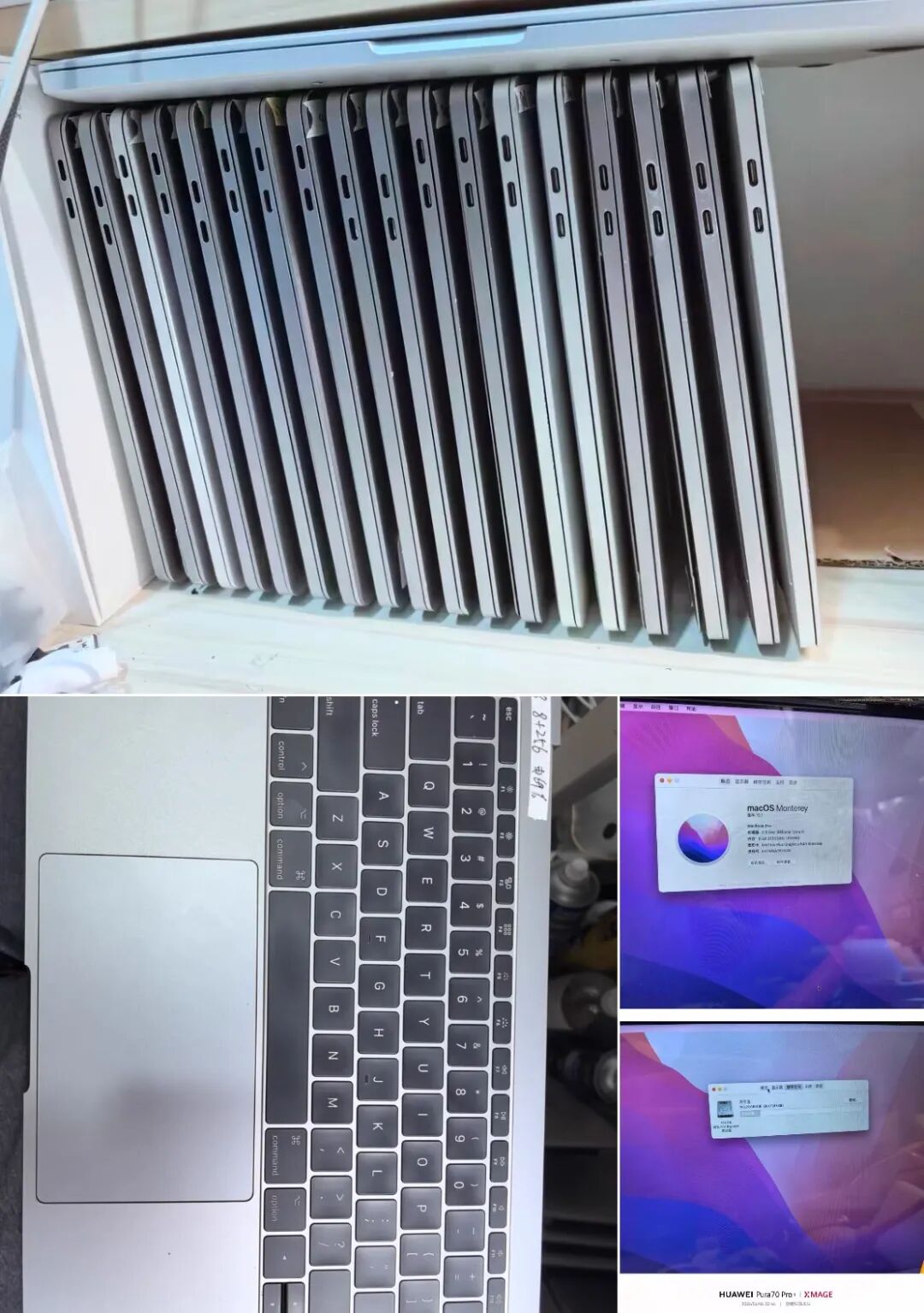
Bulk "Headless Knights" sold by merchants. Source: Xianyu @Mac Space Station
In the community content of the consumer recommendation website SMZDM, you can see that the configurations of headless MacBooks are divided into entry level, mainstream level, advanced level and top level, with prices ranging from more than 300 yuan to more than 6,000 yuan. From the most basic 2015 Intel chip model to the top-tier M1 Max chip model with 32-core GPU, headless MacBooks have already formed a complete hierarchical selection system, with a clear price gradient covering all needs from "as long as it can boot" to a full-featured home computing device.
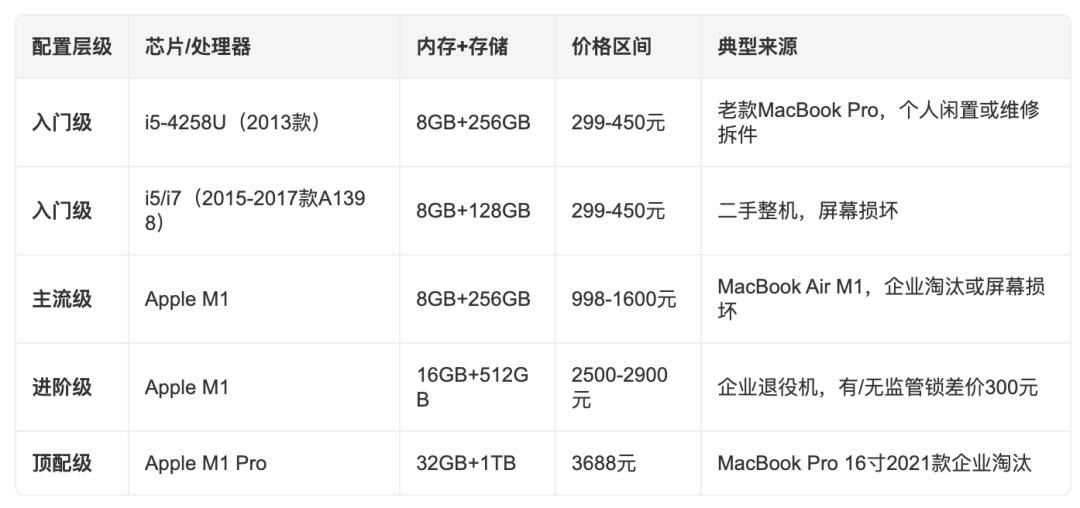
Specific tiered prices of headless MacBooks. Source: SMZDM
In the past, when people bought MacBooks, they were paying for the ultimate experience: top-tier displays, exquisite body, Apple ecosystem and M-series chips. Consumers were willing to pay a premium for the complete experience of Apple products, after all, there were no similar alternatives on the market. After removing the expensive display, the headless MacBook becomes a module with built-in keyboard and trackpad and excellent power consumption ratio. It has inadvertently filled a gap in Apple's product line and formed unique competitiveness in the price range of thousand-yuan devices.
Theoretically, any brand of laptop on the market can be turned into a host connected to an external display once its screen breaks. But why is it only MacBook that has continued to sell hot and formed a complete industrial chain?
In terms of service life, data released by Hoxton Macs, a refurbished device retailer in the UK, in June this year shows that after the launch of M-series chips, the MacBook repair rate has continued to decline. The incidence of motherboard failures and battery failures on Intel-based Macs is about twice that of M-series chip Macs. The Apple Silicon chip architecture reduces battery cycle counts, which means that a MacBook with a broken screen but an intact motherboard has enough remaining hardware lifespan to support several years of high-intensity use.
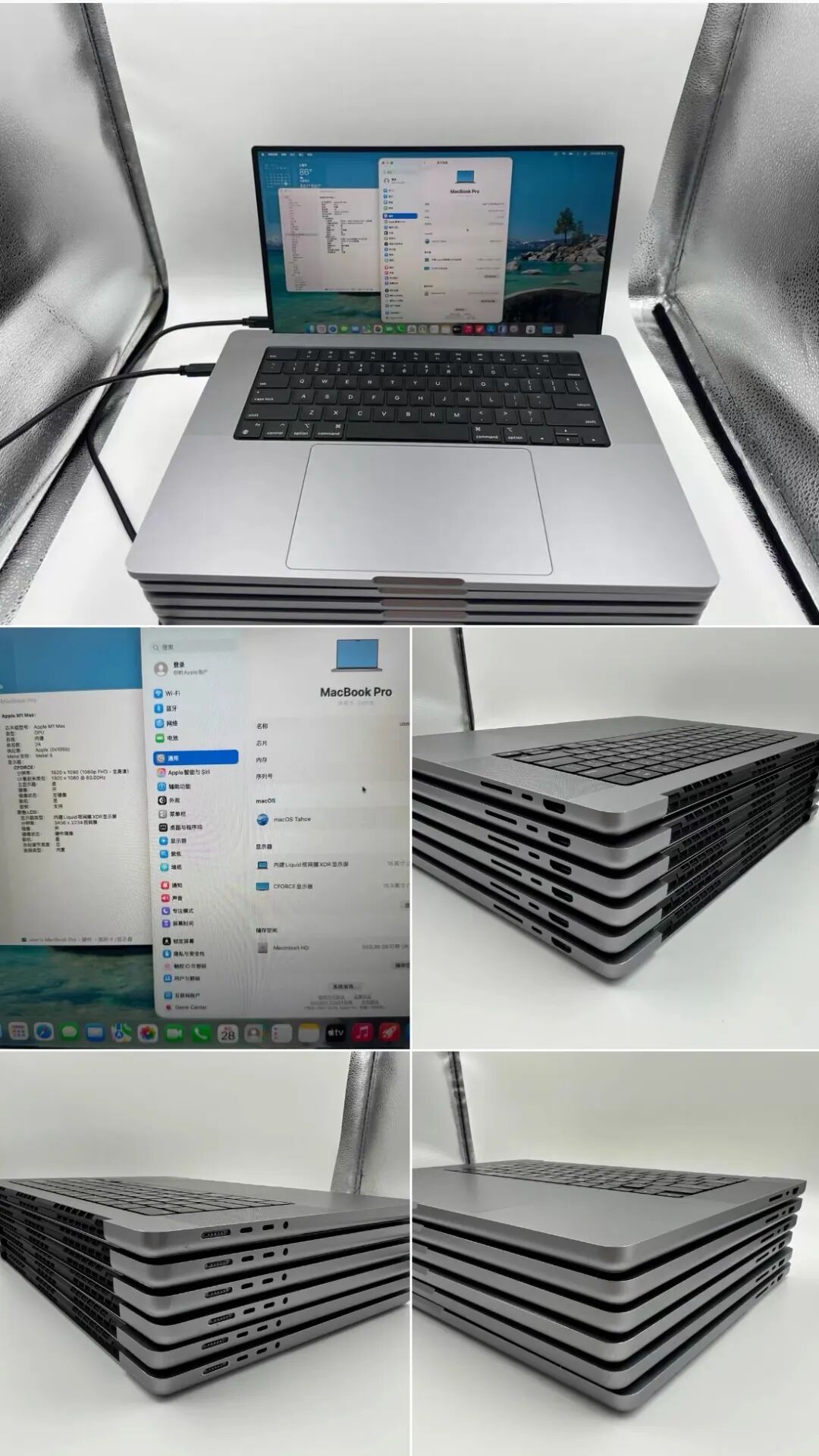
High-priced headless MacBooks are all in good condition, the 2021 model 32G+1TB headless MacBook Pro in the picture is priced at 6560 yuan. Source: Xianyu @Mactop
Due to the high integration of the processor, memory and solid-state drive in the Apple Silicon architecture, the repair difficulty and cost of M-series chip MacBooks are very high, with a repairability score of only 4/10 on the repair platform iFixit. To some extent, this also guarantees the product quality of these "Headless Knights".
Once a Windows laptop is fully disassembled, its motherboard, memory and solid-state drive will likely flow to their respective downstream industrial chains separately. But in the Apple ecosystem, there are almost no unidentifiable replacement parts for MacBooks, the "Headless Knight" is exactly the most complete and cheapest "hardware bundle" in the second-hand market. Precisely because the whole device is difficult to repair, selling it after removing the screen has become the most cost-effective choice, making the quality of headless MacBooks more stable and predictable than headless Windows laptops.
In the pre-AI era, a headless MacBook looked like nothing more than a broken second-hand computer that should have been sent to the digital markets in Huaqiangbei or Zhongguancun. But today, when the prices of graphics cards and memory are skyrocketing, the "Headless Knight" is no longer regarded as a laptop missing a screen, but as a Mac terminal with a built-in keyboard and trackpad.
The Agent scenario just turns the "missing screen" from a flaw into a non-requirement. Even in scenarios where a display is needed, professionals can use two or three huge split screens for work, and the 13-inch small screen in front of them would be more of an obstacle than a help.
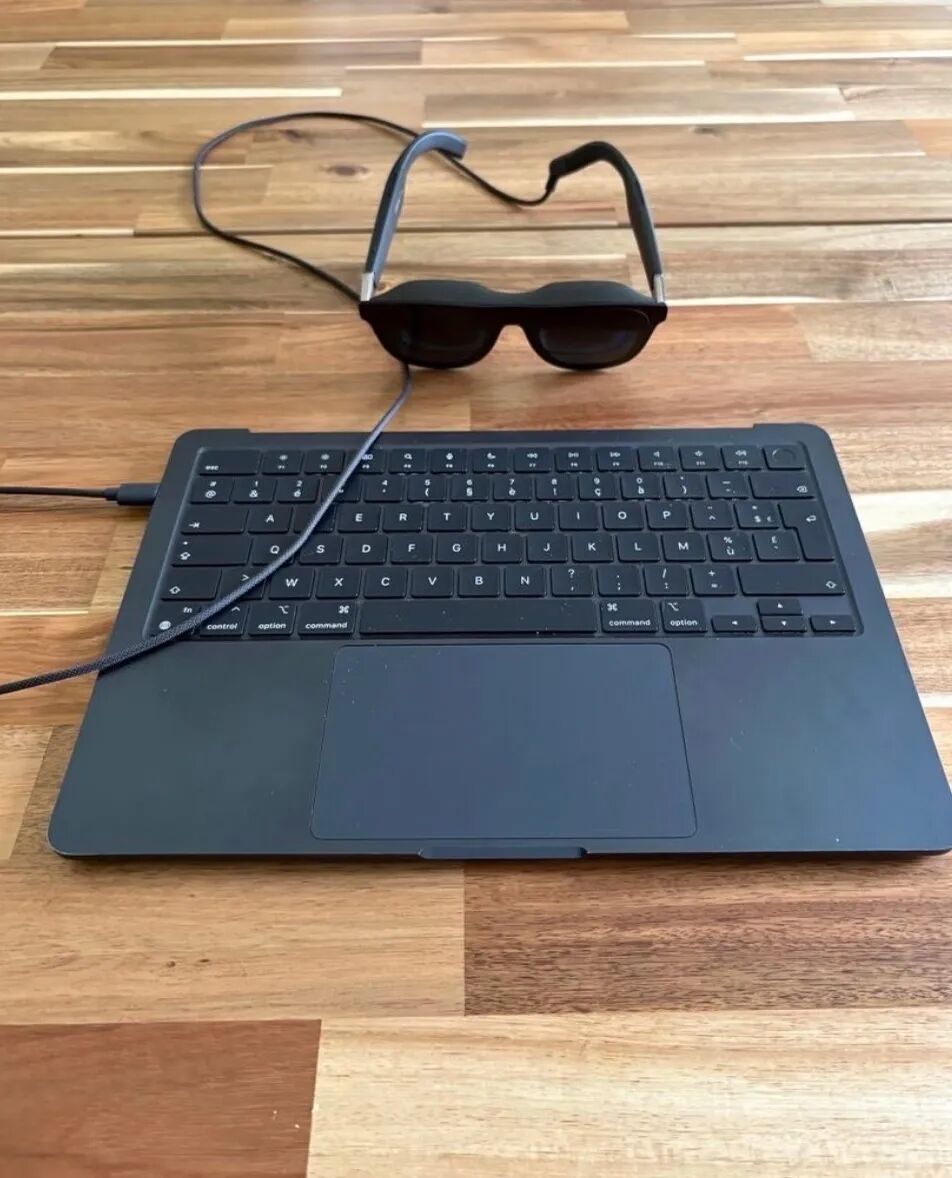
Smart glasses are also a viable option. Source: Xiaohongshu @pluie
The MacBook Neo, which has a slightly plastic feel, as the entry-level model of the MacBook product line, starts at 5,499 yuan at the moment. Similarly, Apple has been running education discounts and trade-in programs for many years to lower the entry threshold of the Apple ecosystem. However, headless MacBooks achieve the same goal just with old devices with screens removed, turning a group of people who would not have paid for new Macs into active users of the macOS ecosystem, without costing Apple a penny, acting like a completely unofficial channel manager.
For a long time, Apple's moat has been built on the closed ecosystem with integrated software and hardware, but the high starting price has made a large number of low-budget users have to give up. Headless MacBooks bypass Apple's official hardware channels, and efficiently tear a cost-effective gap in this walled, well-fortified ecosystem.
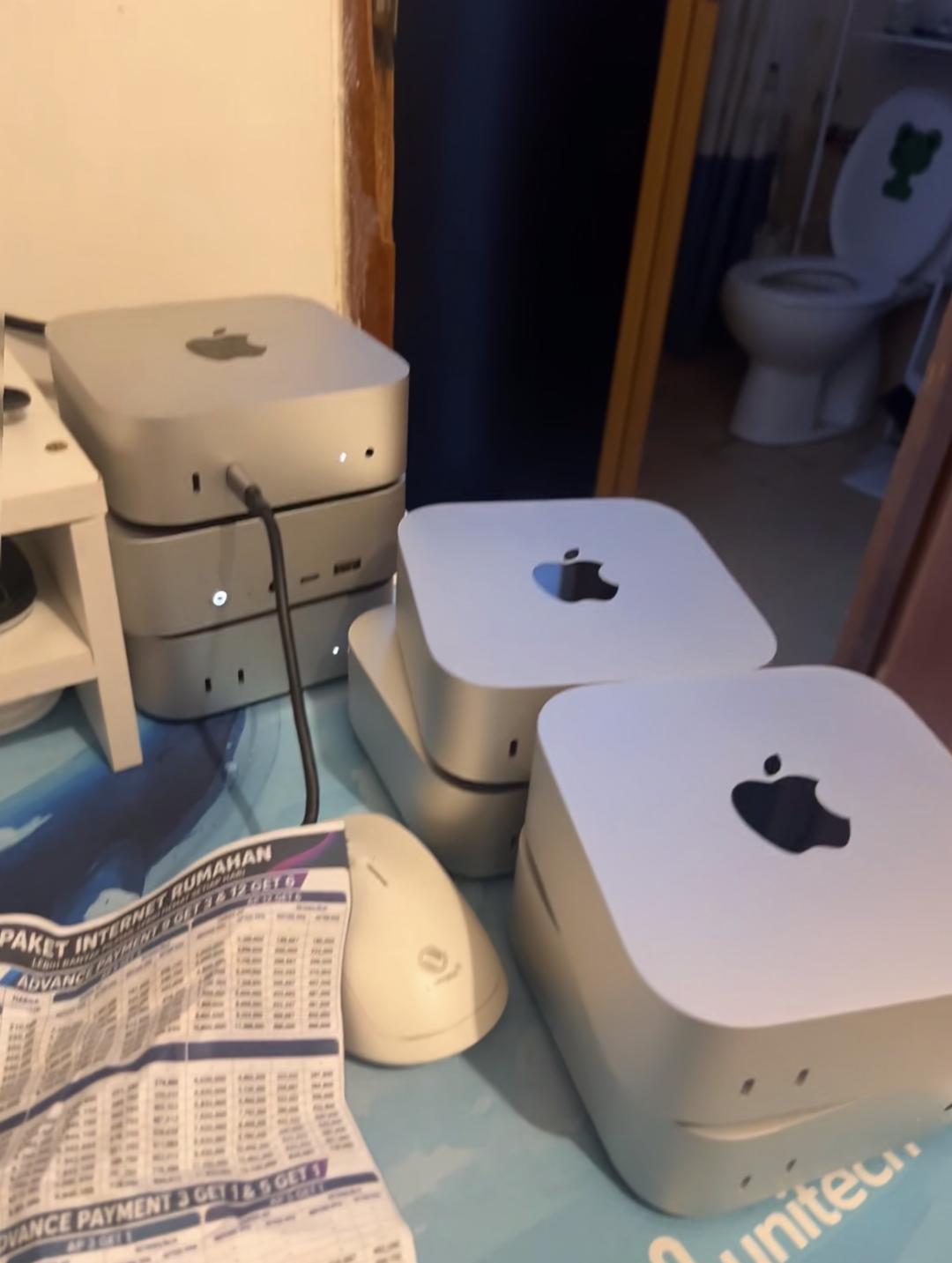
After all, not everyone can afford such a configuration. Source: Xiaohongshu @Ren Kunsile
The term "cost-effectiveness" has been completely reshaped in the technology consumption field in recent years.
In the past, when we talked about cost-effectiveness, we compared the indicators on the parameter list divided by the price: how much memory, what level of processor, what the benchmark score is, how bright the screen is, and so on. This is the typical hardware logic. But when technological iteration hits a bottleneck, the prices of graphics cards and memory remain high, and hardware performance is generally surplus, the cost-effectiveness of technology consumption has shifted to obtaining the most consumption experience and real productivity at the lowest overall cost.
Moreover, there is a serious diminishing marginal effect in the consumption experience of electronic products — to raise the score from 60 to 80 may only cost 1,000 yuan, but to raise it from 90 to 95, you may need to pay several times that price. The enthusiasm for headless MacBooks precisely shows that the public is returning to their real needs. Most users are no longer willing to pay a high premium for the extra 5 points above the excellent standard, but choose to use lower cost to achieve a basic experience that satisfies them.
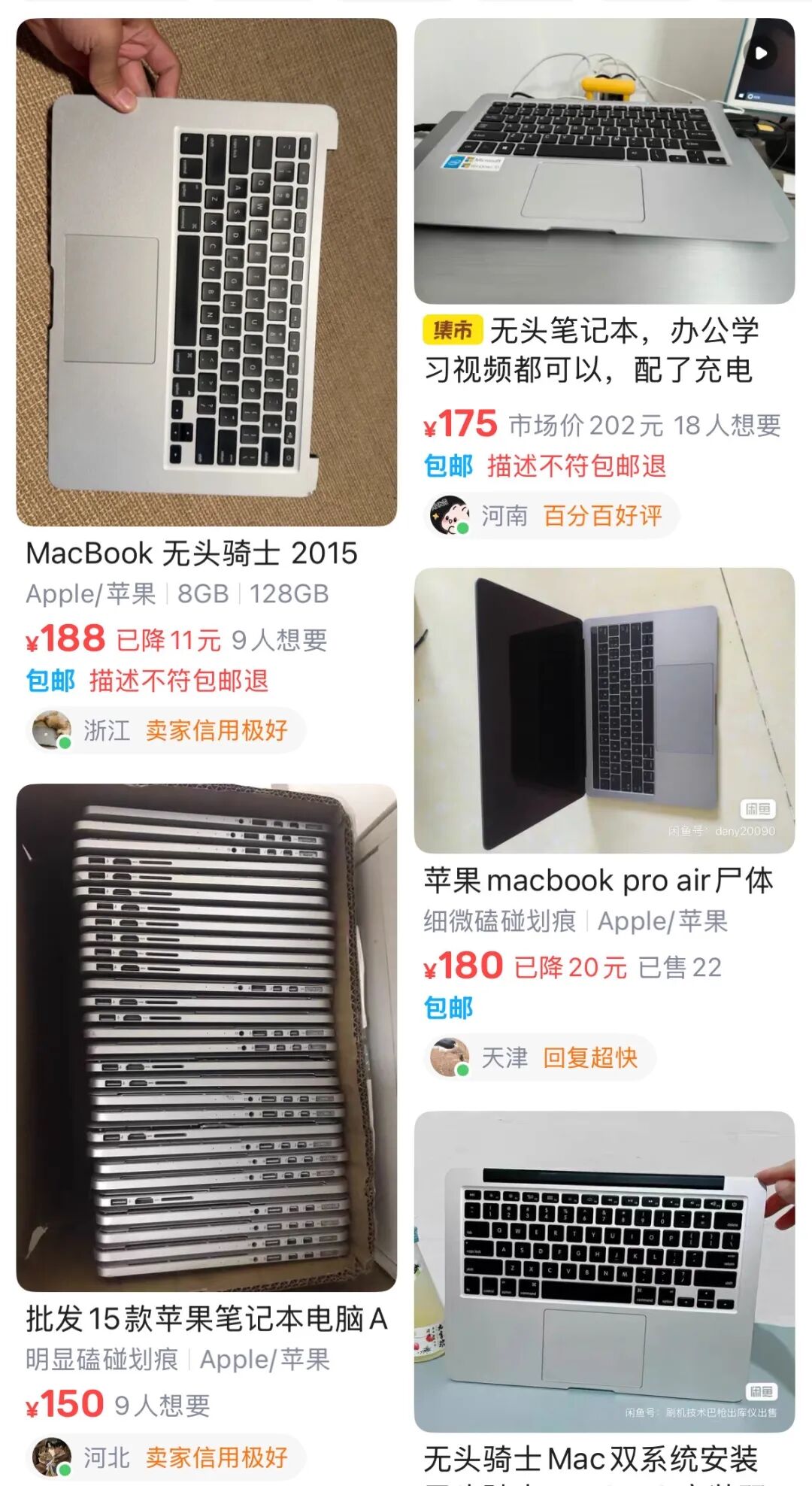
The price to enter the Apple ecosystem is now lower than the membership fee of Sam's Club. Source: Xianyu
Cutting off redundant hardware is a typical victory of pragmatism. In the Night City of *Cyberpunk 2077*, street punks and vagrants rarely visit the spotless Arasaka flagship stores in the city center. The prosthetics there are exquisitely made and fit the skin perfectly, but they carry sky-high prices that are out of reach for ordinary people. The real vitality of Night City grows in the dark alleys of scavengers and the dim underground clinics of cyberdocs.
The "Headless Knight" is no different. The removed Retina screen is nothing but the noble "skin" that Arasaka shows to the middle class. The remaining base with the motherboard carries the neural network that people rely on to make a living. People stripped away the exquisite industrial appearance, abandoned the carefully crafted sense of ritual designed by Apple, and in an almost brutal way, modified and distributed this elegant laptop that was once out of reach for many people, turning it into an AI terminal accessible to all.
In the cyberpunk world, all high-tech products are trying to sell you an illusion of prosperity. Holographic billboards are always full of successful, decent people using the latest gear, as if telling you: if you own it, you will have the nobility and order of a certain social class.
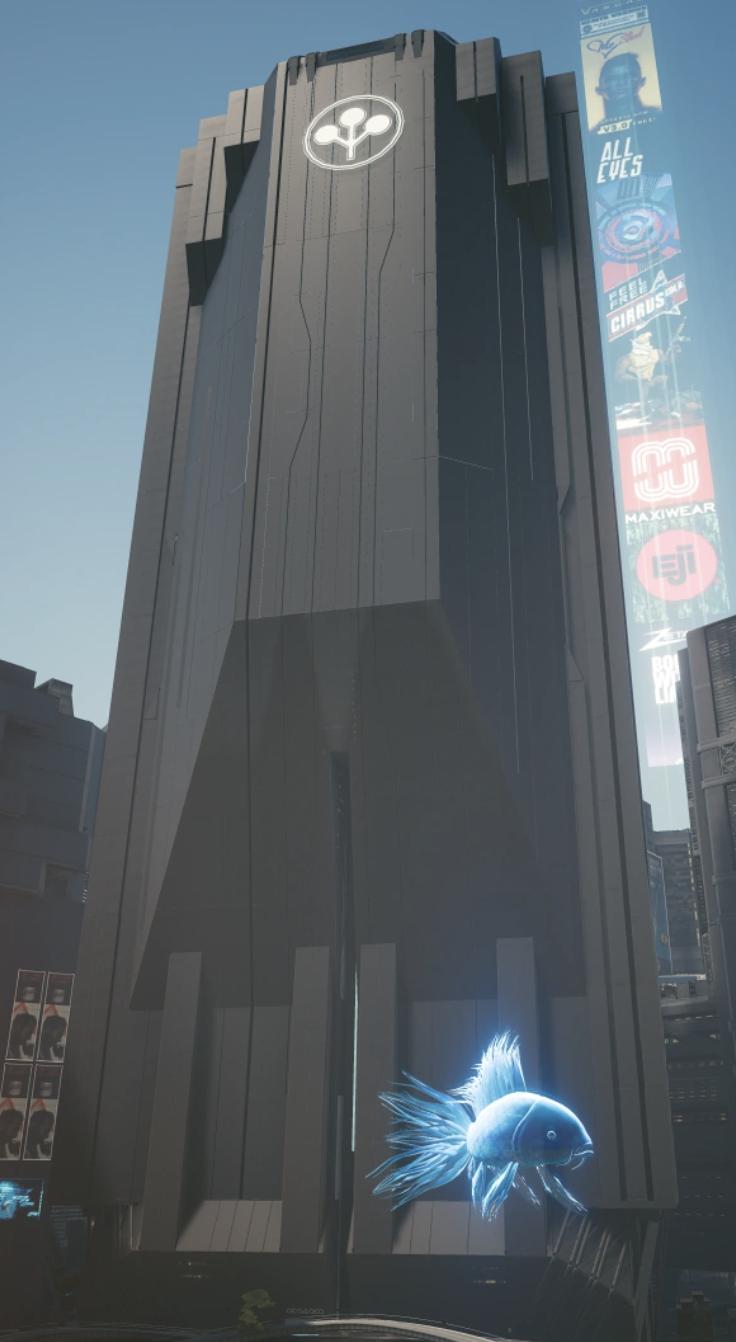
On second thought, who wouldn't want to work in the Arasaka Tower? Source: Cyberpunk Wiki
But people living on the street are about to see through this scam. When the cost of living keeps rising, and computing power and tools have become the rigid demand for individuals not to be eliminated in this era, people start to dismantle these beautifully packaged illusions. The chivalry spirit of the "Headless Knight" lies in that it is a deconstruction of decency and a minimalist return to core functions.
We gradually realize that everything around us has been predefined: the best software ecosystem, the most comprehensive subscription services, the latest large language models, the most cutting-edge Agents, which naturally should be matched with the best production equipment. But in this carefully designed solid golden cage, a group of people who are not too picky but love researching second-hand products have emerged — on the prosperous, highly monopolized tech wasteland, they recombine complete productivity with incomplete parts, and exchange a low cost for a ticket that does not leave them behind by the times.
While people compromise on high prices for a little extra video memory and RAM, today's tech consumers show a poetic yet helpless street survival wisdom, and the name "Headless Knight" is the best metaphor. Lobsters, crabs, whales or dry food, after the waves wash over, no one knows who will still stay on the beach. But whatever, nothing can't run on a broken MacBook base.
It bears scars, strips off all pretense, is imperfect, and even looks a bit makeshift, but at this moment, computing power truly belongs to everyone.