Is the ten-thousand-yuan class humanoid robot merely a "cyber toy"?
In the 2026 consumer electronics market, no category of products is as contradictory as humanoid robots.
Bipedal humanoid devices that used to cost hundreds of thousands of yuan and only appeared on exhibition stages are now being put on shelves on e-commerce platforms in batches, and products priced at the ten-thousand-yuan level have broken the public's price expectation for humanoid robots. Orders are growing, production capacity is climbing, press conferences are being held one after another, and manufacturers are constantly depicting a picture to the public: humanoid robots are about to enter households, taking over housework, companionship and domestic labor.
Yes, in 2026, humanoid robots are really on sale, and the price is indeed unexpected. But when you excitedly carry it home and expect it to help you fold clothes and clear the tableware, you will most likely be disappointed.
Open the e-commerce comment sections, Bilibili review videos and player communities, and the real picture is completely different. Few early adopters who have received their orders expect it to "liberate their hands". More people place the robot in the living room at home for dancing, conversation, programming debugging and shooting short videos.
And manufacturers are well aware of this: what they are selling is not a tool, but a ticket to the future.
The first year of mass production delivery, dominated by "surprisingly low prices"?
2026 is defined by the industry as the "first year of mass production delivery" of humanoid robots, and this judgment has come true.
In the past few years, whether domestic start-ups or overseas tech giants, most of the products were only used for exhibition display, university scientific research and enterprise B-end pilots, and were not retailed to ordinary consumers.
Since the second half of 2025, the situation has begun to undergo fundamental changes. Many domestic manufacturers have successively released mass-produced models that support spot goods or scheduled delivery, and humanoid robots have officially entered the sales stage for individual consumers.
Market data confirms the rapid expansion of delivery scale. According to data from research institution Smart Analytics Global, the global shipment of humanoid robots in the first half of 2026 was about 19,100 units, a year-on-year increase of nearly 3 times. Chinese manufacturers account for more than 97% of the share, and Agibot and Unitree together account for three-quarters of the global shipment.
Another major change is that the price curve is declining rapidly.
Songyan Power's "Bumi" is priced at 9,998 yuan, bringing bipedal humanoid robots into the range below 10,000 yuan for the first time; Unitree Robotics' Unitree R1 was reduced from 39,900 yuan to a starting price of 29,900 yuan for spot sale, and it topped the humanoid robot sales list on JD.com just one week later; Ubtech's U1 series covers a price range from 119,800 yuan to 990,000 yuan, taking the "emotional companionship" route; Agibot Lingxi X2 Youth Edition is priced at 98,000 yuan, and the accelerated evolution Booster K1 Education Edition is 66,900 yuan; even industrial-grade products are exploring the lowest price range. Stardust Intelligence's T1 has a starting price as low as 89,900 yuan, claiming to be the "Chinese version of Figure".
Among them, Unitree Robotics is the landmark player in this round of price cuts for consumer-grade humanoid robots. Its R1 humanoid robot was originally priced at 39,900 yuan, and was lowered to a starting price of 29,900 yuan in June 2026. This robot focuses on lightweight bipedal walking and basic obstacle avoidance, supports secondary development for developers, can complete standing up, walking, jumping, following and basic gesture interaction, and is oriented at individual players, university laboratories and science and innovation enthusiasts.
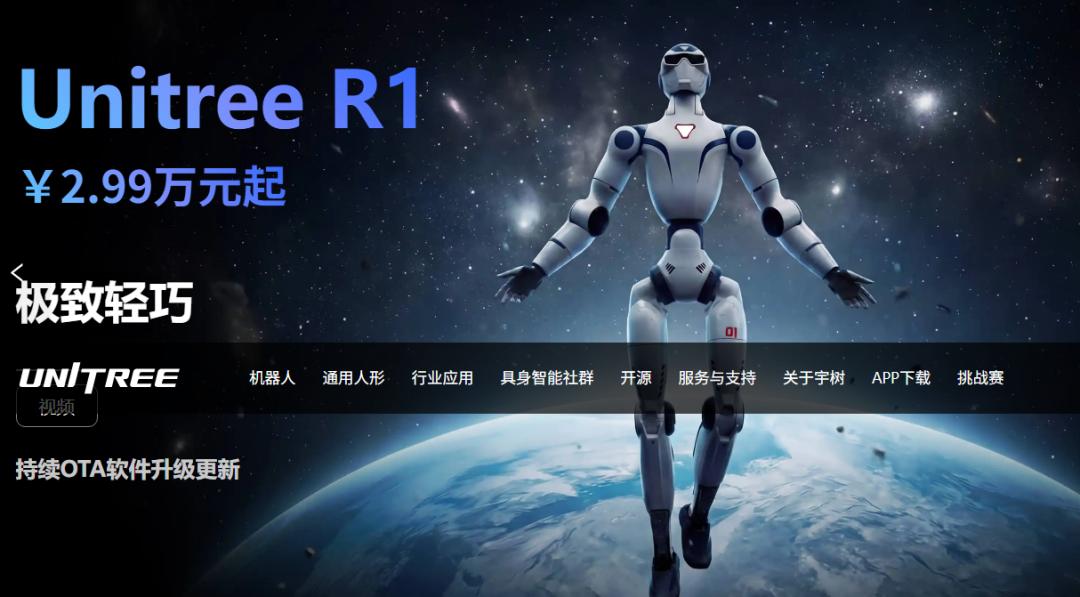
Image source: Unitree Robotics official website
The confidence of manufacturers in collective price cuts also comes from the maturity of the supply chain. According to Unitree Robotics' prospectus, the unit price of its humanoid robot dropped from 5.934 million yuan in 2023 to 166,400 yuan in 2025, shrinking by about 72% in two years. The localization rate of core components has increased to 75%, the localization rate of frameless torque motors exceeds 85%, and the localization rate of harmonic reducers is about 60% to 70%. The localization rate of core technologies of Unitree R1 exceeds 90%, and all motors, reducers and controllers are self-produced.
However, behind the price gap is also the reduction of functions and hardware specifications.
The entry-level R1 AIR version priced at 29,900 yuan, compared with the 39,900 yuan standard version, has the overall joint freedom reduced from 26 to 20, directly cutting 2 degrees of freedom of the head and 2 rotational degrees of freedom of the waist, the single-arm freedom reduced from 5 to 4, completely losing the ability to flexibly rotate the waist, pitch and turn the head at multiple angles, and cannot complete basic housework actions such as sideways picking up objects, bending down to pick up debris on the ground, and observing the environment from multiple angles.
At the same time, R1 AIR cancels the high-precision force control module equipped in the standard version, reducing the grasping fault tolerance rate. More critically, the entry-level model does not support high-level secondary development, cannot unlock fine operation functions through algorithm iteration, and locks the practical potential at the hardware level.
Songyan Power's Bumi, which pushed the industry price to the 10,000-yuan threshold, directly abandoned the configuration of the general dexterous hand, only retaining the minimal structure of thumb + simple two fingers, without complete five-finger joints, and does not have any fine grasping and operation capabilities; at the same time, the machine cuts off the lidar and depth vision perception module, only retaining basic monocular vision, and can only complete walking, dancing and voice dialogue in a flat, open and fixed scene.
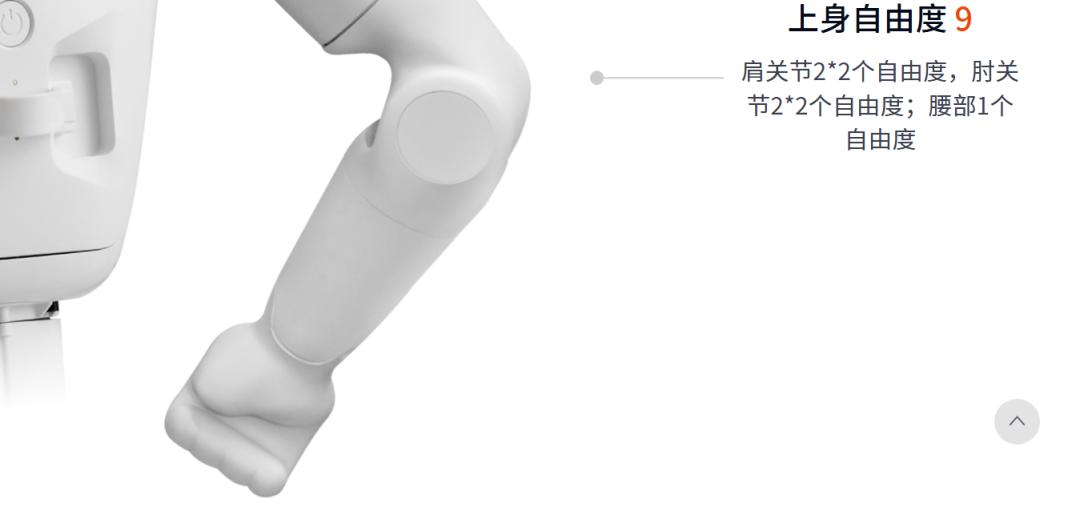
Bumi does not have complete finger joints Image source: Songyan Power official website
Jiang Zheyuan, founder of Songyan Power, once publicly admitted that the 10,000-yuan priced version focuses on educational companionship, scientific and innovative entertainment, and does not design functional modules related to housework operations at all.
Combining the official parameters of various manufacturers, the 2025 humanoid robot consumer market research report of Titanium Media, and the hardware test data of IT Home, the current consumer-grade humanoid robots sold to individuals at a price below 100,000 yuan generally have the problem of greatly reduced hardware specifications: the maximum load of the single arm of the whole machine is concentrated in the range of 1.5-2.5kg, which can only lift light dolls, empty water cups and other items, far lower than the 5kg practical load standard required for daily household storage, handling and sorting; the standard battery life of entry-level models is generally 2-3 hours, and the battery life of some extremely low-priced models is only about 1 hour, and none of the whole series is equipped with intelligent power replenishment and autonomous recharging functions, while the battery life of commercial/flagship models above 100,000 yuan can generally reach 6-8 hours, and the battery life gap is extremely obvious.
It is worth mentioning that when manufacturers turn their sights to the C-end, the industry begins to replicate the gameplay of consumer electronics: dividing basic version, youth version and developer version, launching online pre-sales, deposit-locking orders, offline experience stores, opening official stores on Douyin, Tmall and JD.com, and directly selling to individual consumers.
Obviously, by cutting practical operation hardware and reducing the overall machine specifications to lower the terminal selling price, quickly opening up the C-end mass production sales channels, seizing the public market mindshare, and completing the early brand occupation of the track, this is a typical commercial trade-off for manufacturers. As Pan Helin, member of the Expert Committee of Information and Communication Economy of the Ministry of Industry and Information Technology, said in an interview with China Business Journal, this round of price decline "is not the natural result of the overall maturity of the industry's technology, but an active layout with 'ecological occupancy' as the core".
Who is buying it? What are they using it for?
More people are buying than expected.
Ubtech's U1 series pre-sale orders reached 13,361, and the full-channel orders on the first day of launch exceeded 13,000 units, directly more than 12 times the company's total humanoid robot sales in 2025. Songyan Power's "Bumi" quickly became the number one in the humanoid robot category sales list on JD.com after the Spring Festival Gala. Qiyuan Robotics opened its first global store on Huaihai Middle Road in Shanghai, and the first batch of delivered Q1 and T1 are priced from 19,999 yuan. A tech blogger at the scene used it to feed complementary food to his 7-month-old baby.
But buyers' mindsets are very subtle.
On Xiaohongshu, most netizens who bought Unitree Robotics' R1 mentioned that the purpose is "to buy it for fun". Some netizens said, "I used to watch others play, and today it's my turn to play." In the review area of Unitree Robotics' official flagship store, many consumers also mentioned that they bought this robot as a gift for children.
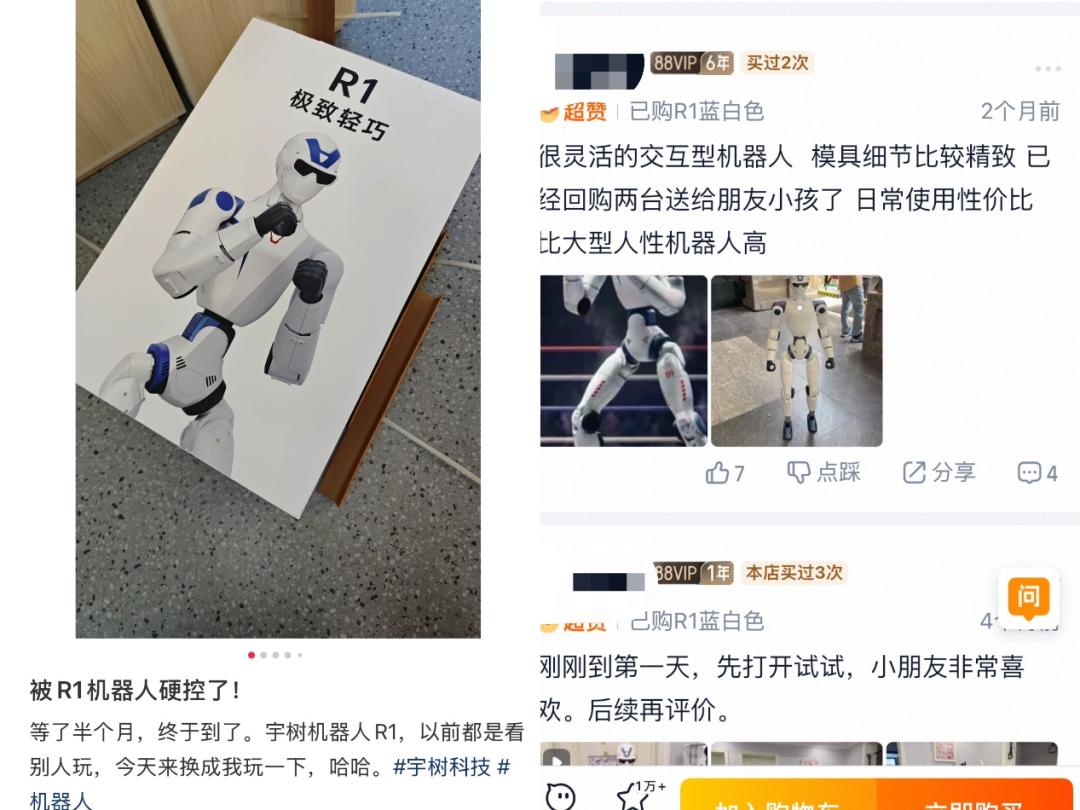
Looking through a large number of measured contents of e-commerce orders, community interviews, Bilibili and Xiaohongshu, the portraits of current C-end buyers are highly concentrated: robot enthusiasts, AI technology fans, university scientific research teams, short video creators, and science and innovation training institutions. Ordinary working-class families are rarely willing to spend tens of thousands of yuan to buy a humanoid device that cannot take on housework.
Simply put, they are "playing" with it, not "using" it.
Many review bloggers, after getting the machine, came to the highly consistent conclusion: this is an expensive smart toy, not a housekeeper. The most simple demand of the public for humanoid robots is to replace cleaners to mop the floor, wipe tables, tidy up sundries, fold clothes and fetch items. But at present, mass-produced models generally cannot stably complete such tasks.
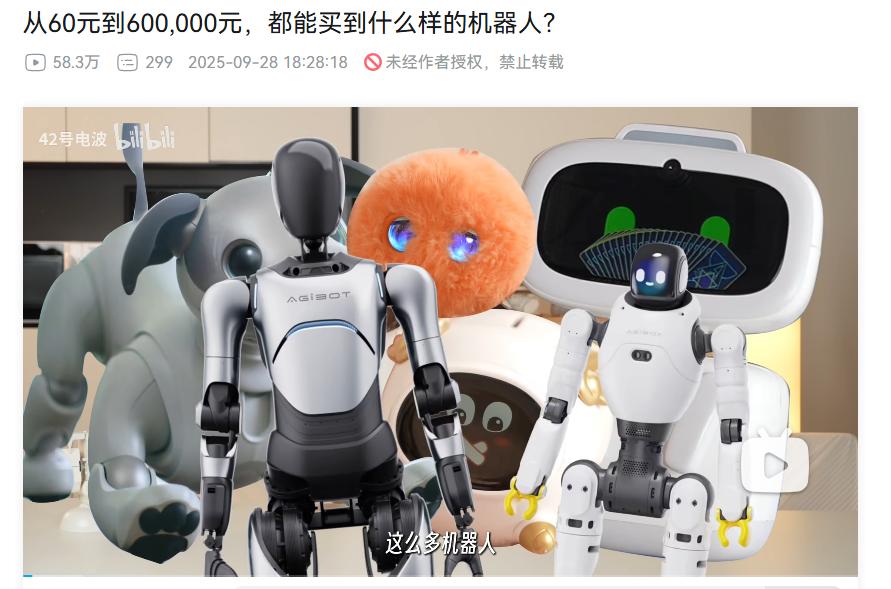
Image source: 42nd Wave, a robot review UP host on Bilibili
The dexterous hand is an obvious short board. A large number of fine operations in the housework scene, such as unscrewing bottle caps, folding clothes, and tidying up scattered sundries, all rely on high-precision and high-reliability dexterous hands. However, many current mass-produced consumer-grade humanoid robots in the price range of 10,000 yuan to 100,000 yuan are not equipped with high-performance dexterous hands as standard, and the grasping load is extremely low. The maximum load at the end of the Mo Yin M1 arm is only 1.5kg, which can only pick up light items. The success rate of grasping action is unstable. If the position of the object is slightly deviated, the grasping will fail, and it is easy to drop and slip.
But the most fundamental obstacle is the "generalization ability". Wang Xingxing, founder of Unitree Robotics, once admitted at the World Robot Conference that in a fully calibrated fixed scene, the task success rate of humanoid robots can be close to 100%; but once the environment or objects change slightly, the execution effect will drop off a cliff, "a physical deviation at the centimeter or even millimeter level is enough to cause task failure".
And the home is exactly the scene with the highest demand for generalization ability. The position of the cup is different every day, the material and shape of the clothes change at any time, the chair may be moved, and the refrigerator door may not be closed properly - these trivial things that are taken for granted for humans are huge technical challenges for robots.
A large number of real user reviews on the Internet clearly expose this expectation gap. A player wrote in the product review area that the robot has good effects in dancing and conversation, and it is very eye-catching for shooting videos, but if you want it to help pass a glass of water, it succeeds two or three times out of ten, and more often it will hit the table.
So many buyers admit that their motivation for purchasing is not to solve housework, but to enjoy debugging robots, writing codes, doing secondary development, or placing them at home as tech ornaments and short video shooting materials. In the player community, the topics that everyone communicates are mostly focused on action programming, gait parameter adjustment, and model deployment, and few people discuss how to make robots take on household labor.
This forms an interesting market reality: the product price has dropped to the range acceptable to some consumers, the product form is the human shape that people expect, but the product capability is completely misaligned with the household helper in the minds of ordinary people. What users buy is an embodied intelligent hardware that can walk, perform and talk; the family laborer depicted in the industry's publicity has so far remained in the concept and demonstration videos.
What is sold is not a tool, but the future
Since the current products are far from practical, why are manufacturers in a hurry to push them to the market?
The answer is "occupancy".
At present, the commercial logic of almost all consumer-grade humanoid robots is not to sell tools, but to seize users, data and ecological niches. "Whoever seizes users and data first will win the next round" - this is the consensus in the industry. The logic of the data flywheel is very clear: the more users use it, the more real scene data is generated, the faster the model iterates, the more mature the product becomes, and then more users are attracted.
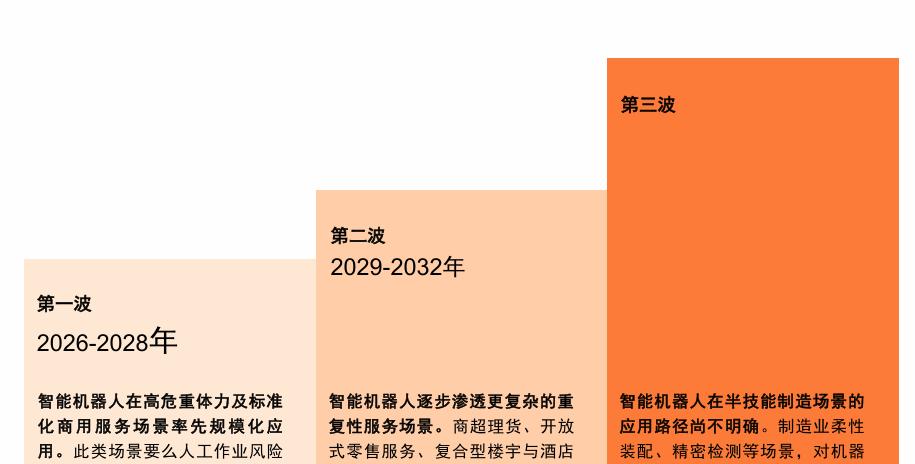
Image source: PwC
Eastmoney Securities predicts that the domestic performance robot leasing market size will exceed 100 billion yuan in 2026. The leasing market has instead become the clearest commercial closed loop at present. PwC gives a more calm judgment in the "2026 Intelligent Robot Industry Development White Paper": the core value of humanoid robots lies in the uniqueness of scenarios, not the comprehensive replacement of other forms. Translating this sentence means that humanoid robots are not universal tools, at least not at this stage.
There is a huge time gap between consumers' expectations and the reality of the industry. What