Tencent has invested 230 million yuan in a Turkish company, making two moves within half a month.
According to overseas gaming media PocketGamer.biz, Turkish mobile game developer Flow Games has secured a $46 million financing round (approximately RMB 320 million), around 75% of which comes from Tencent. Excluding full acquisitions, this is also Tencent's largest single investment in the Turkish gaming market to date.

It is worth noting that just half a month ago, Tencent led the $25 million Series A financing of another Istanbul-based company Circle Games. With two consecutive investments in different companies within half a month, totaling over $70 million (approximately RMB 460 million), what exactly happened in the Turkish gaming market that made Tencent make such frequent moves?
Let's first take a look at the newly invested Flow Games.
Headquartered in Istanbul, the company has a registered capital of only 250,000 Turkish lira. Judging from industrial and commercial registration information, it is a very young, small-scale studio. But if you look at the resumes of its core team members, you will find that it is more like another "restructuring" after the flow of casual gaming talents in Turkey.
01 A new team of seasoned veterans who regrouped
Co-founder and CEO of the company Mehmet Emin Taşcı once worked at Good Job Games; co-founder and CTO Baturay Üstündağ has experience at Peak Games and Fomo Games; Art Director Ayqun Kaplan comes from Dream Games; Senior 3D Artist Şeyma Nur Parlak once worked at Grand Games.
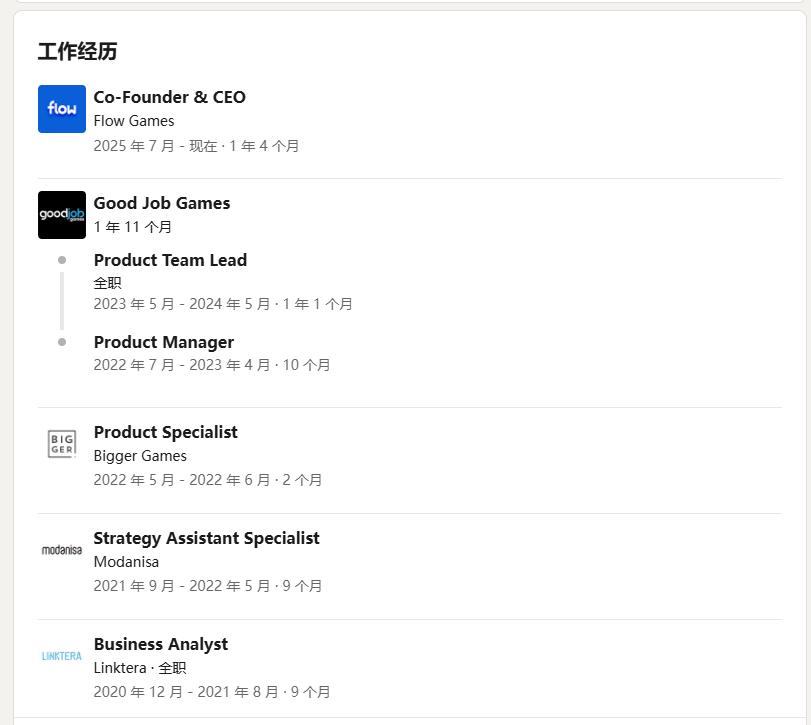
Peak Games, Dream Games and Good Job Games — these three companies almost represent the top level of casual game development in Turkey. Peak Games' *Toon Blast* is a leading product in the global match-3 elimination track, and Dream Games' *Royal Match* is also a star product in the match-3 field. The core members of Flow Games left these companies and re-formed a team with mature experience in casual gameplay verification, user acquisition materials, level rhythm and art style.
This path of "regrouping of seasoned veterans" is not rare in the Turkish gaming circle. After Zynga acquired Peak Games for $1.8 billion, the Turkish casual game industry experienced a large-scale talent flow and incubation of new teams. Experienced talents came out to start their own businesses with proven methodologies, which has become one of the mainstream models of local game entrepreneurship.
Flow Games' first product *Smash Fest* was launched in June this year, which is a physics-based shooting game. The gameplay is not complicated: players adjust the angle and force of the cannon to smash stacked cans, stones and other items on the platform, and clear all items within a limited number of attempts to pass the level.
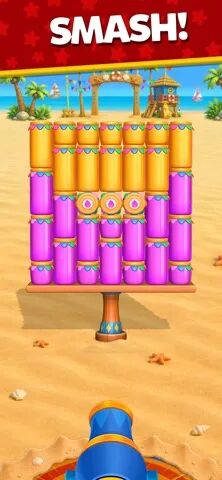
*Smash Fest*
The prototype of this gameplay actually comes from a limited-time event called "Cannon Fest" in *Toon Blast* by Peak Games. Players obtain cannonballs in main levels, then enter a separate event level to clear objects on the platform. This design was originally just a supplementary module in long-term operation, intended to provide extra goals for veteran players.
What Flow Games did is to take out this already player-verified fun experience alone, rebuild levels, visuals and commercialization around the core of "firing, knocking down and clearing the platform", and turn it into a lighter, more direct independent product that is more suitable for user acquisition placement. Instead of winning through complex innovation, it re-launched the gameplay modules that have already been validated in mature products to the global market through art packaging and adjusted level rhythm.
Data proves that this path works. According to AppMagic's estimates, *Smash Fest* recorded more than 2 million downloads in June, and the figure surged to 10.2 million in July, a 343% month-on-month increase. In the same period, its in-app purchase revenue also climbed from $692,000 to $3.4 million. As of the latest available data, the game's cumulative in-app purchase revenue has approached $8.9 million, of which about $8.3 million comes from the App Store and about $526,000 comes from Google Play. Over the past month, the daily in-app purchase revenue has been stable between $35,000 and $50,000.
However, according to sources familiar with the matter cited by PocketGamer.biz, ad monetization is the main revenue source of *Smash Fest*. This means that only looking at in-app purchase revenue is very likely to seriously underestimate the overall commercial performance of this game. For products that take advertising as their main monetization method, download scale, user activity and ad fill rate are the key indicators to measure their real value.
02 Why did Tencent place consecutive bets on Turkey?
This financing round for Flow Games is not Tencent's first move in Turkey, not even its latest one in recent times.
Just half a month ago, Tencent just led the $25 million Series A financing of Istanbul-based company Circle Games. Back in 2019, Tencent's subsidiary Miniclip acquired Turkish studio Masomo. Adding the $46 million investment in Flow Games this time, the total investment of Tencent and its affiliated companies in the Turkish gaming market has easily exceeded $100 million.

From a global perspective, Tencent has long been laying out in the casual game sector. From 2015 to 2016, Tencent successively acquired the majority stake of European casual game developer Miniclip, and took controlling stake in Finnish studio Supercell.
After that, the two companies continued to expand their territory through investment and mergers and acquisitions: Miniclip acquired *Subway Surfers* developer SYBO in 2022, brought *PowerWash Simulator* developer FuturLab under its wing in 2024, and then acquired casual game company Easybrain for $1.2 billion. Supercell has built a relatively independent investment system, continuously investing in overseas teams.
However, these investments and acquisitions mostly cover mature studios and products. Flow Games and Circle Games represent another investment logic — looking for early-stage teams with successful genes in emerging markets, stepping in before the product breaks out, and locking in future production capacity and talents with capital.
As a game development hub connecting Europe and Asia, Turkey has cultivated a large number of casual game talents in recent years. After Peak Games was acquired by Zynga for $1.8 billion, companies including Dream Games and Good Job Games continued to export products to the global market, which also spawned massive talent flow and incubation of new teams. The birth of Flow Games is exactly the continuation of this ecosystem.
For Tencent, this investment is not only a bet on a single product and a team, but also a bet on the long-term value of Turkey as an emerging production center for casual games.
Another detail that cannot be ignored is ad monetization. In the second quarter of 2026, casual game *Arrows: Puzzle Escape* developed by Lessmore, a studio under Miniclip, became one of the most downloaded mobile games in the world, and brought strong in-app advertising revenue. Tencent specifically mentioned in its Q2 financial report that if the revenue of games monetized through in-app ads including *Arrows* is included in the international gaming business for adjustment, the year-on-year growth rate of its international gaming business will be 4 percentage points higher than the disclosed figure.
This means that Tencent's investment logic for casual games is undergoing subtle changes. When evaluating the commercial value of a product, in-app purchase revenue alone cannot be the only criterion. For products that take advertising as their main monetization method, download scale and user activity are core values in themselves. And the breakout of *Smash Fest* just landed at the node of this logical transformation.
03 Conclusion
Launched for only four months, *Smash Fest* has secured a $46 million financing round. Flow Games has proven the monetization efficiency of Turkish casual game talents with one single product. Tencent's two investments within half a month are also sending a clear signal: on the map of the global gaming market, Turkey is becoming a coordinate that cannot be ignored more and more.
For Chinese domestic game manufacturers, this may also be a noteworthy signal. When large game companies turn their sights to overseas emerging markets, Turkey's casual game entrepreneurship ecosystem may be replicating the path that Finland and Israel took in the past.
This article is from the WeChat Official Account "Mobile Game Times" (ID: sykong_com), written by a game-focused author, and published by 36Kr with authorization.