Apple has developed a screen for Siri that can recognize all family members, priced at $299.
At 10 p.m. Beijing time on October 13, Apple held a new product launch event with the theme "Welcome Home". The new device Apple brought into the living room this time is a 7-inch screen.
It is called Apple HomeView, priced at 299 USD in the United States, with pre-orders opening on October 13 and official launch on November 13. The 4th-generation Apple TV 4K and HomePod mini 2 were also unveiled at the event. All three products are marketed with the new-generation Siri AI as a selling point overseas, but the speaker will not be able to use this feature until a subsequent software update. The Apple Home Collection smart home accessory series was also released in the same period.
HomePod and Apple TV have long supported home control, and HomePod also has sound recognition and personal request features. HomeView gives Siri a shared screen for the whole family, which can be placed on the kitchen countertop, bedside table, or mounted on the wall of the entryway.
A more interesting change in this product release is that Siri's responses now have a visible, operable interface that can be accessed at any time. Its personalization capabilities are still tied to each user's devices and permissions.
The screen belongs to the whole family, but personalized Siri still needs to identify users and their mobile phones.
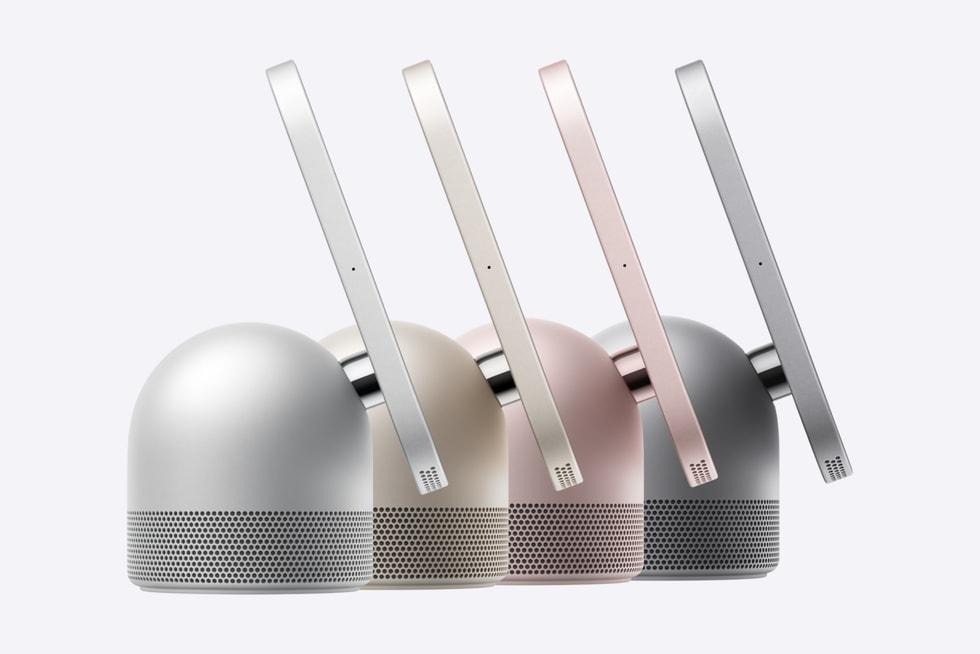
The desktop version comes in four colorways | Image source: Apple
A screen that recognizes family members
The desktop version of HomeView uses a stainless steel hinge to connect the 7-inch Liquid Retina screen to a dome-shaped aluminum speaker base. The screen's tilt angle can be adjusted manually, and it is available in four colors: Silver, Starlight, Rose Pink, and Space Gray. The screen has a maximum brightness of 500 nits and a minimum brightness of 0.3 nits. Apple's vision is that it is clearly visible in a sunlit room during the day and will not cause eye irritation when placed on the bedside at night.
The wall-mounted version is an independent separate model, also priced at 299 USD, available only in Space Gray and Silver, and requires an additional Schneider-designed power mount. The USB-C model starts at 59.95 USD, the AC hardwired model starts at 79.95 USD, and the PoE model will not be available until early 2027, priced at 129.95 USD.
When the screen is idle, it can be used as a photo frame or dynamic watch face. The photo watch face supports shared albums, so distant family members can also add photos to it; the light and shadow of the Flow watch face changes as people walk by; there is also a set of Snoopy animations that change according to time, weather, and festivals. Apple also states that the interface will adjust information density according to the distance between the user and the screen: when the user is standing far away, it displays brief information in large font, and expands to show more details when the user approaches.
The kitchen is the key usage scenario Apple demonstrated. According to Apple, after finding a recipe in Safari, it can be converted into step-by-step instructions; when your hands are covered with flour, you can turn multiple timers on and off with voice commands, and the countdown will stay in a corner of the screen as a Live Activity.
It is equipped with a 12-megapixel Center Stage camera and four beamforming microphones. When making FaceTime calls, the frame will keep the user centered even as they walk around the kitchen. Received messages can be replied to via voice or on-screen keyboard; the broadcast function can send a message like "Dinner's ready" to HomeView and HomePod in other rooms, as well as to family members' iPhones and Apple Watches.
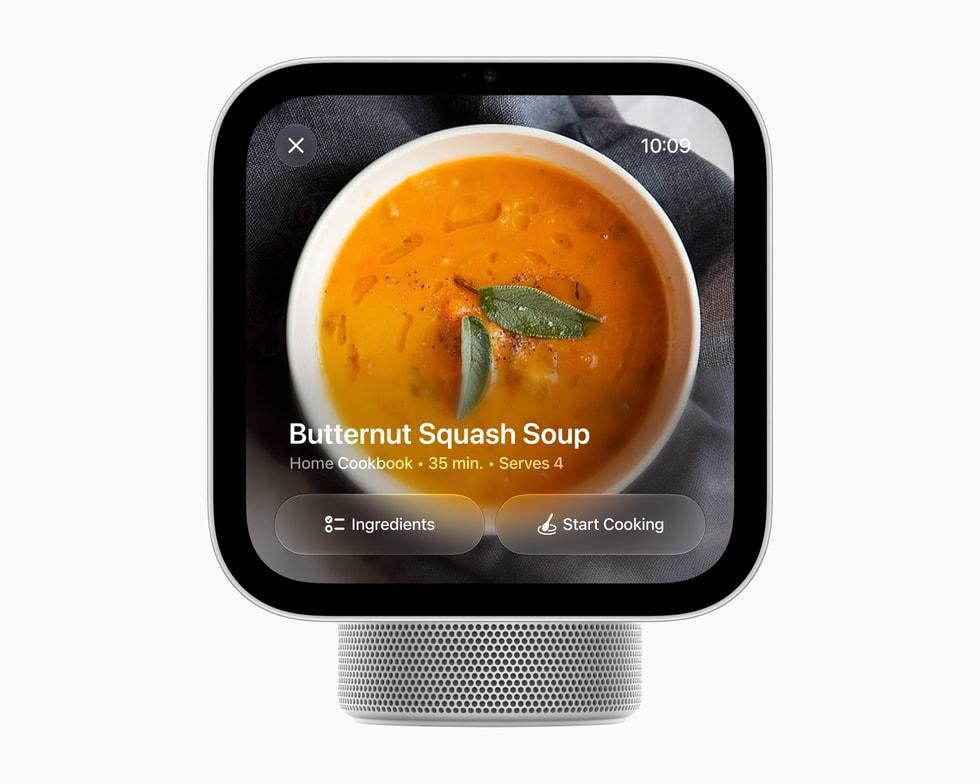
Recipes are converted into step-by-step interfaces suitable for countertops | Image source: Apple
It also functions as a home dashboard. The Home camera watch face can display up to 9 camera feeds at the same time, and operations like adjusting temperature, turning off lights, and locking doors can all be completed directly on the screen. With an eligible iCloud+ subscription and compatible cameras, it can also identify people at the door, familiar faces, pets, packages and vehicles, and generate text descriptions for surveillance footage.
The Apple Home Collection completes the supporting accessory ecosystem. This series is co-designed by Apple with LG and Schneider Electric, covering cameras, video doorbells, door locks, thermostats, and temperature and humidity sensors. According to Apple, setup can be initiated by tapping with an iPhone, and all subsequent management is done in the Home app, with no need to install additional manufacturer apps or register separate accounts.
The LG indoor camera has a very specific design: when the first family member returns home, the lens will automatically tilt downward and stop monitoring. The door lock uses ultra-wideband technology to sense approaching users. When a user carrying a compatible iPhone or Apple Watch that stores the home key approaches the door, the lock can unlock automatically.
The camera supports 10 days of event footage playback, which requires an eligible iCloud+ subscription. Accessories will be launched sequentially starting from December, with some not available until early 2027; the indoor camera starts at 199.95 USD and the door lock starts at 349.95 USD in the US market. The initial launch markets are the United States and Canada, with the camera also available in the United Kingdom. Apple has not yet announced sales arrangements for the Chinese mainland.
This set of accessories shows that Apple hopes to simplify the process for users to connect home devices to the system and manage them uniformly in the future.
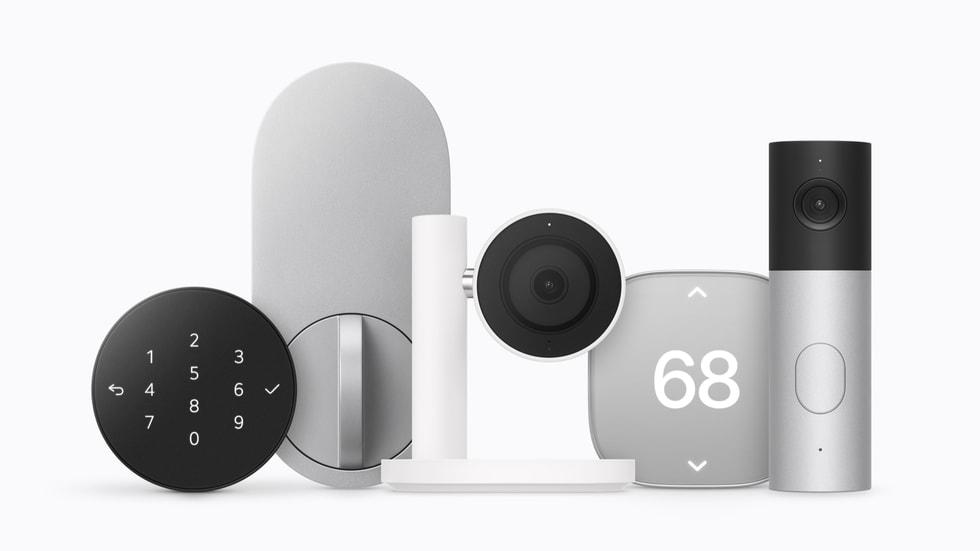
Door locks, cameras and thermostats are all added to the ecosystem | Image source: Apple
This shared screen can also identify which user is using it: it can recognize up to 6 family members via facial recognition, and each user can have their own home screen, apps and widgets.
Apple's product page clearly states the display conditions for personal content: HomeView recognizes the user's face, and the user's paired iPhone or iPad is connected to the same Wi-Fi network and has been recently unlocked, then content like messages and calendars will appear. For Siri AI to access a user's personal context such as their schedule and messages, the user must have an iPhone or iPad that supports Apple Intelligence paired with HomeView.
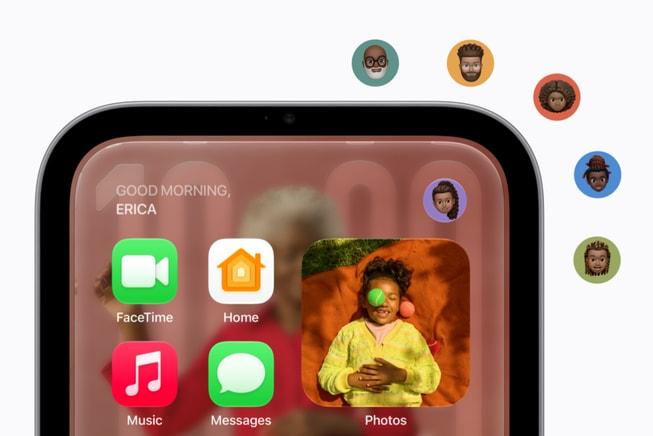
The same screen switches to different users' home screens | Image source: Apple
These conditions only apply to personal content, and do not restrict who can use the screen. Apple states in its description that even family members without devices supporting Apple Intelligence can access Siri AI's extensive world knowledge, natural conversation capabilities and music recommendations. Visitors and unrecognized users can control home accessories, check the weather, set timers, and play music, but cannot see anyone's personal information. For families with many members and mixed generations of mobile phones, this classification method is very practical.
For a screen placed in the living room with a built-in camera and microphone, privacy is an unavoidable issue. Apple's solution is the Secure Exclaves in the A18 chip: camera and microphone data are processed in an isolated operating environment. Apple claims that HomeView's software, apps, users, and even Apple itself cannot access this part of the data. Siri requests that need to be sent to the cloud go through private cloud computing, and Apple promises that this data will neither be stored nor accessed by anyone, including Apple.
In terms of entertainment, HomeView can play Apple Music, podcasts, and compatible third-party audio and video apps. These features are all focused on home usage scenarios, and it cannot be used as a tablet that can freely install iPad apps.
The 4th-generation Apple TV 4K is priced at 299 USD in the United States, and will also be launched on November 13. It is equipped with the A19 chip, and has 3 far-field microphones built into the body. When watching shows, you can call Siri directly without touching the remote control.
All the Siri AI examples Apple demonstrated for Apple TV happen while watching content: ask which shows won awards this year; halfway through watching a show, ask where it was filmed and whether it is suitable for 15-year-old children to watch, and the answer will be displayed in a small floating window without interrupting playback. If you say "play that show recommended by a friend", it will need to call the personal context from the speaker's iPhone.
The new Siri Remote supports precise positioning via the "Find My" feature, and can also emit a sound to solve the age-old problem of remotes falling into sofa gaps. When paired with a compatible video doorbell, the doorbell camera feed will be displayed on the TV when someone presses the doorbell.
Paired with four HomePod mini 2 units or 2nd-generation HomePod units, the new Apple TV can also form a four-speaker surround sound system, on the premise that you are using the 4th-generation Apple TV, and the two pairs of speakers in the front and back must be of matching models respectively.

The two pairs of speakers in the front and back are of matching models respectively | Image source: Apple
Not available in mainland China for now
Among the three new products, only the HomePod mini 2 is currently available for pre-order on Apple's official website in mainland China.
According to Apple's official website in China, the HomePod mini 2 is priced at 1099 RMB, with the same price for five colorways including Green, Pink, Blue, Midnight, and White. Pre-orders are now open, and it will go on sale on October 30.
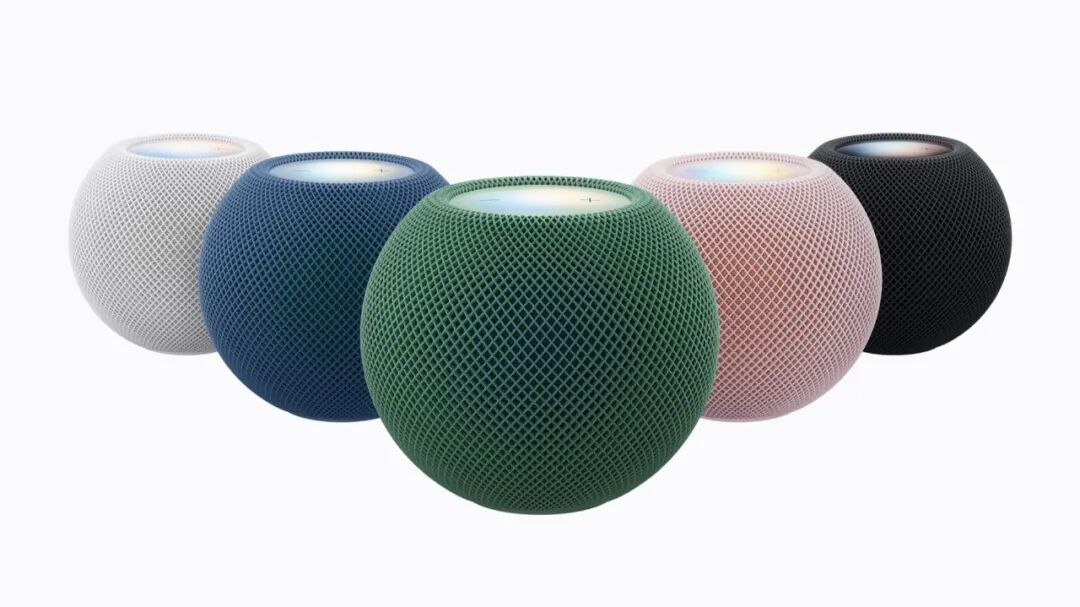
The five colorways of the Chinese mainland version are priced the same | Image source: Apple
The introduction on the Chinese mainland page describes the familiar Siri that supports Mandarin, which can be woken up by saying "Hey Siri" or directly "Siri", and used to play songs, send messages, set reminders, and control smart home devices.
It can act as a home hub to remotely control HomeKit and Matter accessories; it has a built-in temperature and humidity sensor, can recognize the sound of smoke and carbon monoxide alarms and push reminders; it can also act as a speaker for Macs that support Wi-Fi 6E, which can be used when watching movies, playing games, and holding video conferences.
The Sound Glow lighting effect mentioned in overseas press releases, the four-speaker surround sound function with the new Apple TV, and the Siri AI that will arrive via subsequent software updates are not listed on the Chinese mainland page, so they cannot be regarded as official feature commitments for the Chinese mainland version for the time being.
HomeView and the new Apple TV 4K are not currently listed on the smart home page of Apple's official website in China, which only lists the HomePod mini 2 and the existing HomePod. HomeView's initial launch markets are the United States, Canada, the United Kingdom, Australia, New Zealand, India, Singapore, and South Africa; it will not be sold in the European Union for the time being. Apple's explanation is that Siri AI is not yet available on iOS in the EU, and the company is currently communicating with EU authorities.
The overseas launched Siri AI initially only supports English, and the available regions are consistent with HomeView's initial launch markets. The versions on HomeView and Apple TV are marked as beta, while the HomePod mini 2 will receive the feature via a subsequent free software update. According to the official footnotes for Apple TV and HomePod mini 2, enabling Siri AI requires the home owner in the Home app to have an iPhone or iPad that supports Apple Intelligence.
Some features that rely on server-side models have daily usage limits. Apple also mentioned that paid capacity expansion may be offered in the future, but specific prices have not yet been announced. This does not mean that Siri has been fully converted to a paid service.
Existing Apple TV users do not necessarily need to upgrade their devices for this: the Siri AI beta also supports 2nd-generation and later Apple TV 4K models. The new Siri Remote is also compatible with Apple TV HD and all generations of Apple TV 4K, and can be purchased separately.
After this release, Apple's home product line now has an additional shared screen that can be placed on countertops or mounted on walls.
Recipes, video calls, doorbell feeds, and personal schedules finally have the chance to be integrated in one place. For domestic users, the HomePod mini 2 that speaks Mandarin and is priced at 1099 RMB will be available for purchase in the near future; but when and in what form the HomeView home ecosystem will arrive in China is still unknown. But at least in the future, Siri AI in the smart home ecosystem finally has a screen-equipped, sufficiently intelligent carrier.
This article is from the WeChat Official Account "GeekPark", written by ZHANG Yongyi, edited by JING Yu, and published with authorization from 36Kr.