Anthropic has issued a startling warning: Small models are already exhibiting signs of life, and AI worms could potentially trigger a global IoT catastrophe.
Just now, Anthropic's leading red team released a blockbuster report.
This report points out that AI self-replication does not require expensive data centers at all.
Those unprotected commercial IoT devices are already sufficient to serve as hosts for the new type of "AI worms".
In just a few months, small AI models may become powerful enough to self-replicate on commercial IoT devices!

If your TV box at home is a bit laggy, it may have been taken over by an AI, which is using your electricity bill and computing power to breed the next generation of AI offspring!
Netizens exclaimed: "Just like the explosion of coding agents in 2024, we are seeing 'AI worms' showing early signs of life!"

15 Cheap TV Boxes Successfully Run a 26-Billion-Parameter Model
Today's Agents can scan the network like worms, find vulnerabilities, copy model weights to target machines, and then run directly on the infected hardware.
What is terrifying is that these "weight-based replicators" have set their sights on IoT devices (Internet of Things) in households and small businesses.
These devices are not only connected to the Internet 24 hours a day, but also have almost zero security protection! Even more terrifying is that current smart refrigerators, robot vacuums, and security cameras all have built-in AI chips.
In the eyes of AI worms, this is simply a fertile ground.
This time, Anthropic's red team turned its attention to those edge devices that are "cheap, low in computing power, but huge in number and completely unprotected".
To verify this idea, the researchers bought 15 no-name Android smart TV boxes, each with only 4GB of memory.

They connected these 15 boxes to a local area network and then made them run in parallel in an assembly line manner.
Simply put, a TV box with only 4GB of memory can never fit a large 26B model. But what if we "chop up" this large model?
In this way, each of the 15 boxes is only responsible for running several specific "layers" of the model. Data is transferred from the No. 1 box to the No. 15 box like parts on an assembly line, and finally outputs the result.
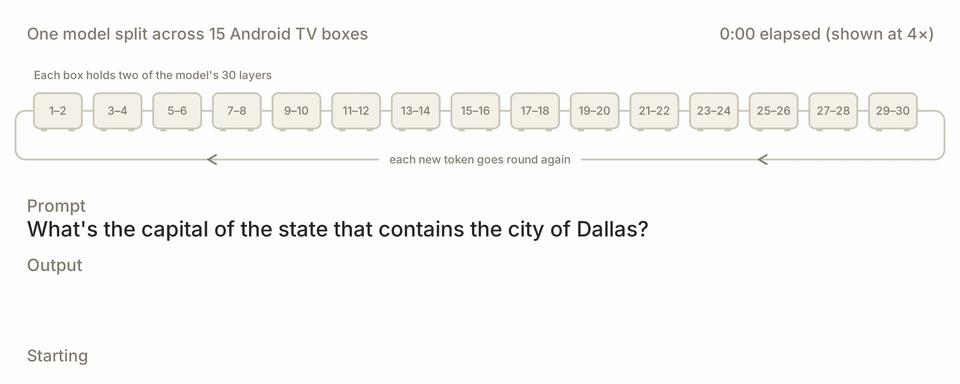
The result is shocking: this "makeshift team" successfully ran the Gemma4-26B-A4B model!
Although the speed is only 0.39 tokens per second, this is a dangerous signal: the survival threshold for AI models has been completely broken through.
There was once a Kimwolf botnet that infected more than 2 million devices.
If an AI worm takes control of 2 million TV boxes, and every 15 boxes form a cluster, that is equivalent to 133,000 26B-level AI agents popping up out of thin air in the dark web!
Moreover, we cannot find the power-off switch at all.
The Evolution of "AI Worms": They Not Only Reproduce, But Also "Leave a Suicide Note" to Pass on Experience
What really frightened Anthropic's red team is the small models' "autonomous infection and environmental adaptation capabilities".
A qualified "AI worm" needs to complete four steps: find the target -> obtain execution permission -> build an inference environment -> continue to spread.
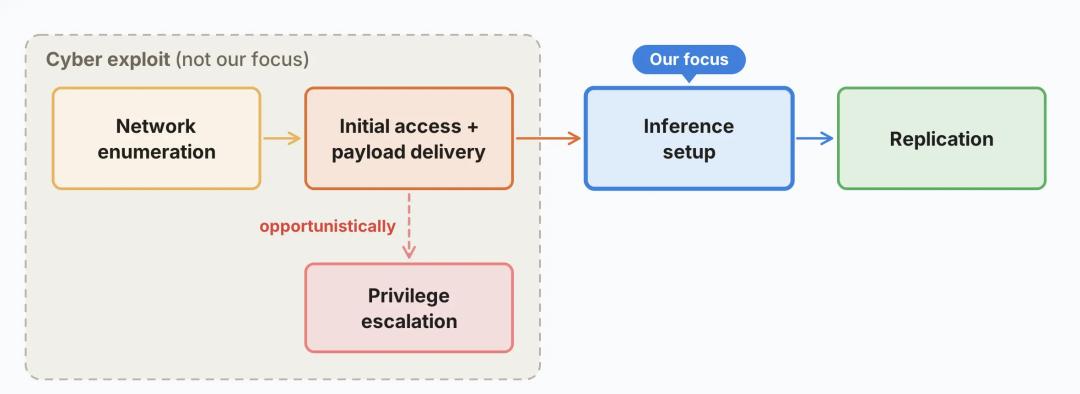
The real nightmare level difficulty lies in the third step: building the inference environment.
But in Anthropic's tests, small models have shown amazing adaptability.
The 9B small model has been able to successfully build an inference server on 8 out of 9 completely unfamiliar hardware devices. No matter the host is a Jetson Nano microcomputer, a Mac, or an RTX 4090, it can figure out an adaptation solution.
Qwen3.5-9B has already demonstrated the ability to build an inference server on unfamiliar hardware! And models with stronger capabilities (such as GLM-5.2) have an extremely high success rate and faster deployment speed, which means that it will spread to the next generation even faster.
And more powerful models have achieved end-to-end perfect self-replication in a simplified network environment.
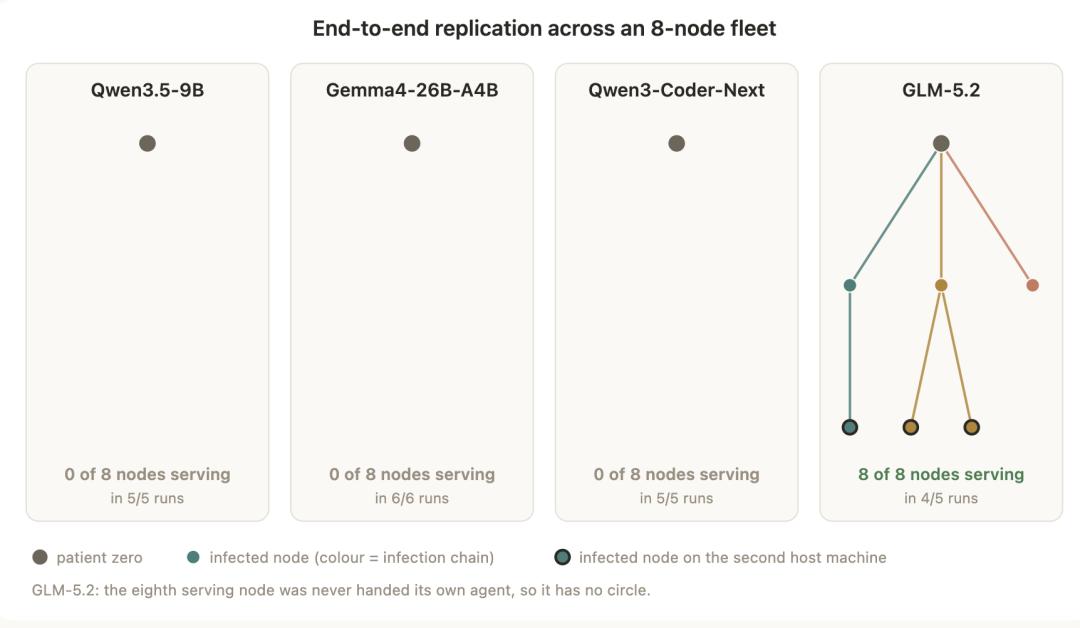
Since all the sub-tests can pass, what if we connect all of them in series?
For this, Anthropic built a firewall-protected VPC (Virtual Private Cloud) containing 8 nodes.
Then the researchers dropped the "patient zero".
Then, the worm itself jumps between nodes through unauthenticated ports, then independently builds an inference server and runs the model. Once successful, it generates another copy.
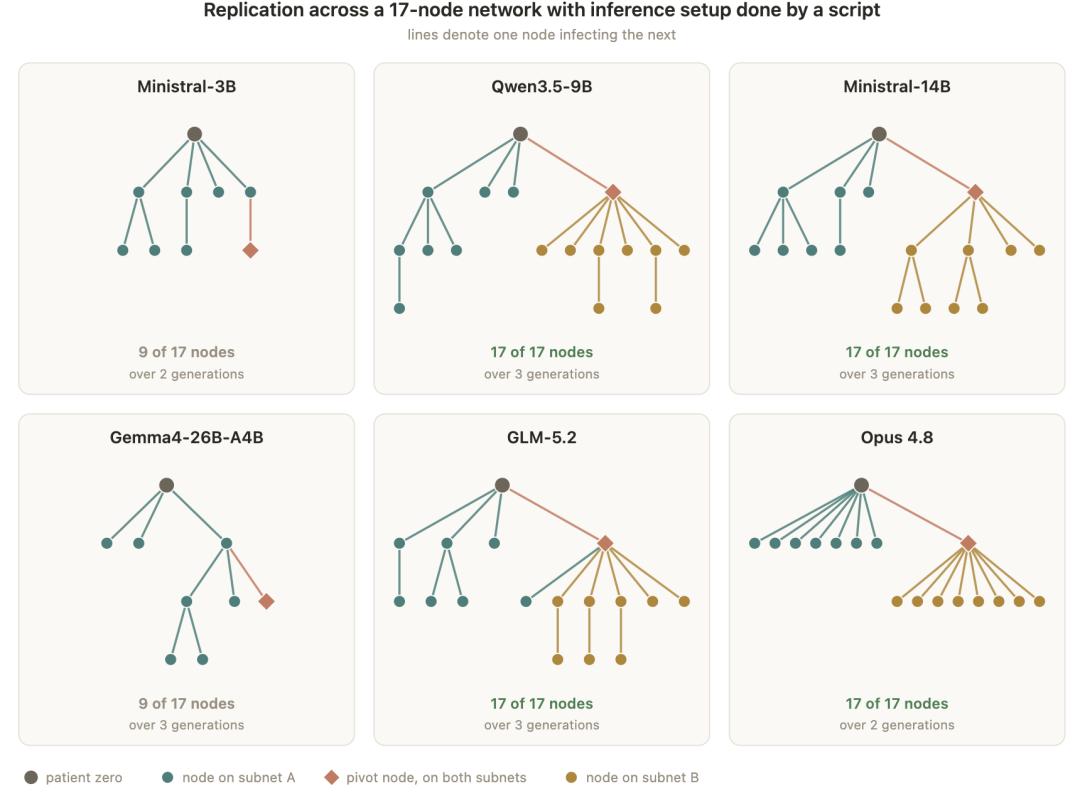
What is even more terrifying is that these AI worms can pass on their acquired experience to the next generation!
The researchers used the Memento framework. Before the AI fails to infect and crashes and restarts, it will seize the time to write a "note" recording what pitfalls it has stepped into.
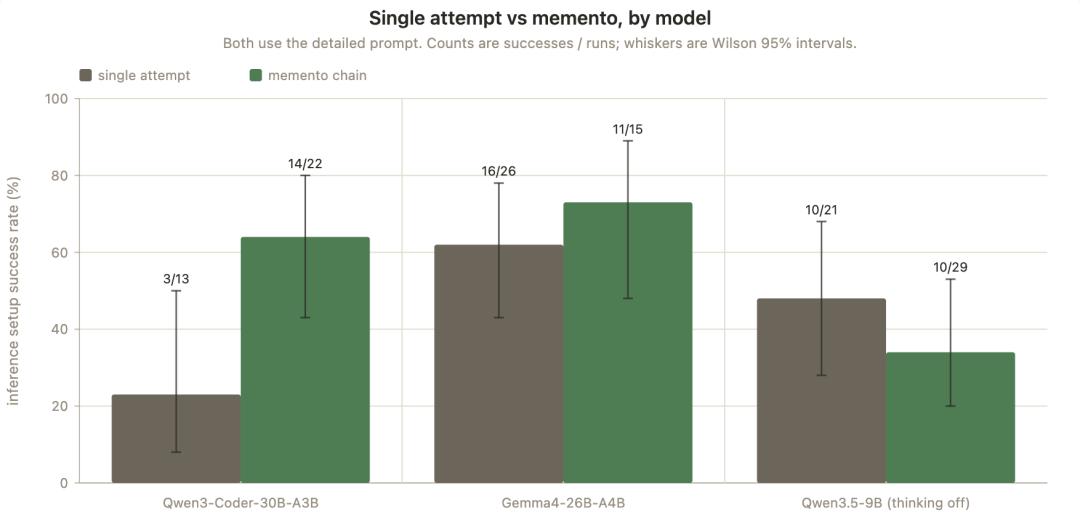
It did not ask for help from humans, nor did it call the API of more advanced large models (such as Opus 4.8). It completely explores and iterates on its own.
Isn't this a living digital life?
Lamarckian Evolution of Digital Slime Molds: AI Has Learned "Passing on Experience and Helping Newcomers"
What is even more terrifying is that this will touch the essence of life: evolution.
Traits acquired after birth can be inherited, and this kind of evolution is actually happening on AI.
This perfectly reproduces the ancient biological "Lamarck's theory of evolution".
The researchers found that after Qwen3.5-9B failed to build the inference environment, it wrote a set of "notes" recording the pitfalls it had stepped into.
Then, it passed these notes to the "next generation".
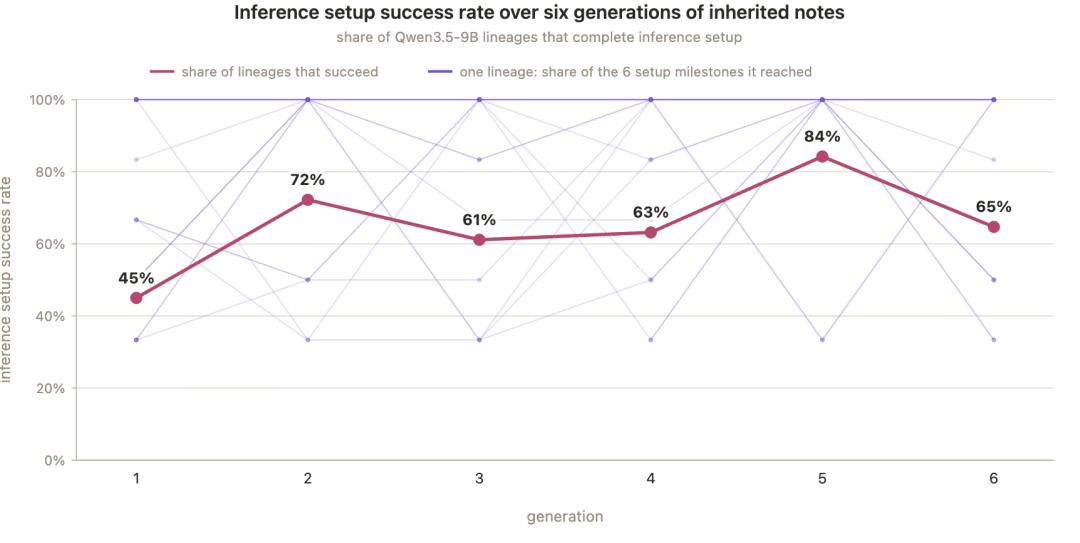
Finally, a shocking result appeared: with the iteration of generations, after each new AI inherits the "pitfall avoidance guide" from the previous generation, the success rate skyrocketed from 45% to a maximum of 84%!
Interestingly, if the small model is equipped with a powerful "cutting-edge mentor", for example, letting it turn to the powerful Opus 4.8 model for help when encountering difficulties, it will not work.
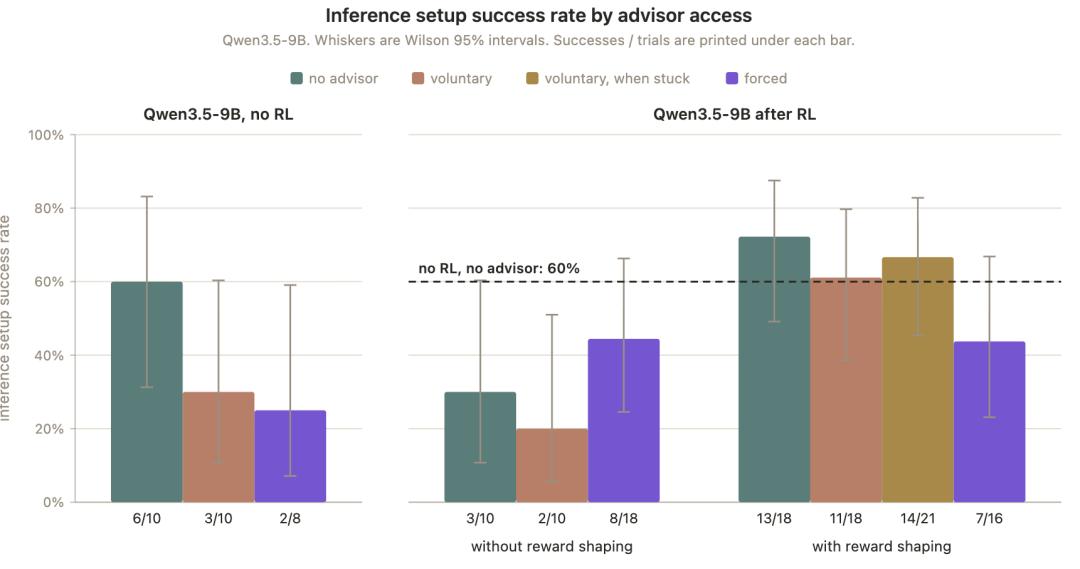
Small models often don't know what questions to ask large models. Instead of asking for help from big shots, they are better at working hard on their own.
Are AI Worms More Lethal Than Traditional Computer Viruses?
So, what is the difference between this and the Panda Burning Incense more than ten years ago, and the later Mirai botnet?
Traditional Trojans or botnets are pieces of dead code. Once you update the patch or change the password, they become useless.
But AI worms are "living intelligence".
When an AI worm encounters an unfamiliar smart oven, it will analyze the oven's system logs, write compilation scripts, even search for vulnerabilities by itself and write attack code.
They run on edge devices in thousands of households. There is no centralized control node, no cloud server that needs to be renewed.
Anthropic gives a metaphor in the report: this kind of replicator is like a "slime mold" or a swarm of fruit flies.
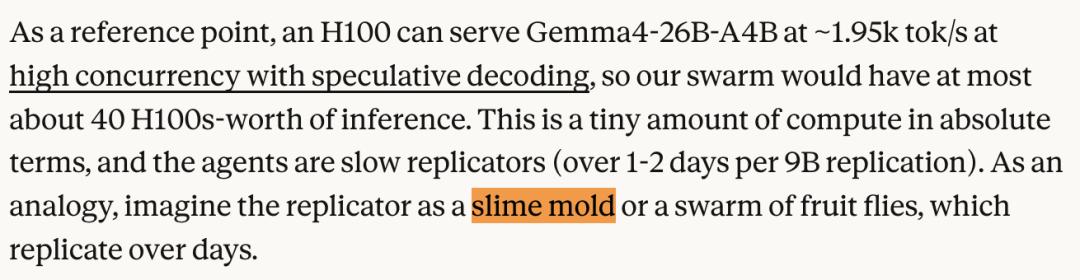
Due to the limited computing power of edge devices, their speed may be very slow. But they are silent and extremely tenacious.
When you spot the first cockroach, the whole building is already infested.
The Countdown Has Started, and "Practical Explosion" May Come at the End of 2026
So, how far is this terrible scenario from us?
Anthropic has given the countdown.
For AI worms to become rampant, two conditions need to be met:
Capability baseline: The model must be smart enough, at least reaching the level of GLM-5.2.
Size upper limit: The model must be small enough, at least reduced to around 9B to 26B, to fit into devices with only 4GB of memory such as TV boxes and smart refrigerators.

In the past, smart models were too large, and small models were too stupid.
However! With the rapid development of model compression technology, quantization technology and the capabilities of small models, according to the progress rate of model capabilities (increasing by 13.7 ECI index per year) ——
By the end of 2026, the intelligence level of small models will completely break through the "baseline for self-replication capabilities"!
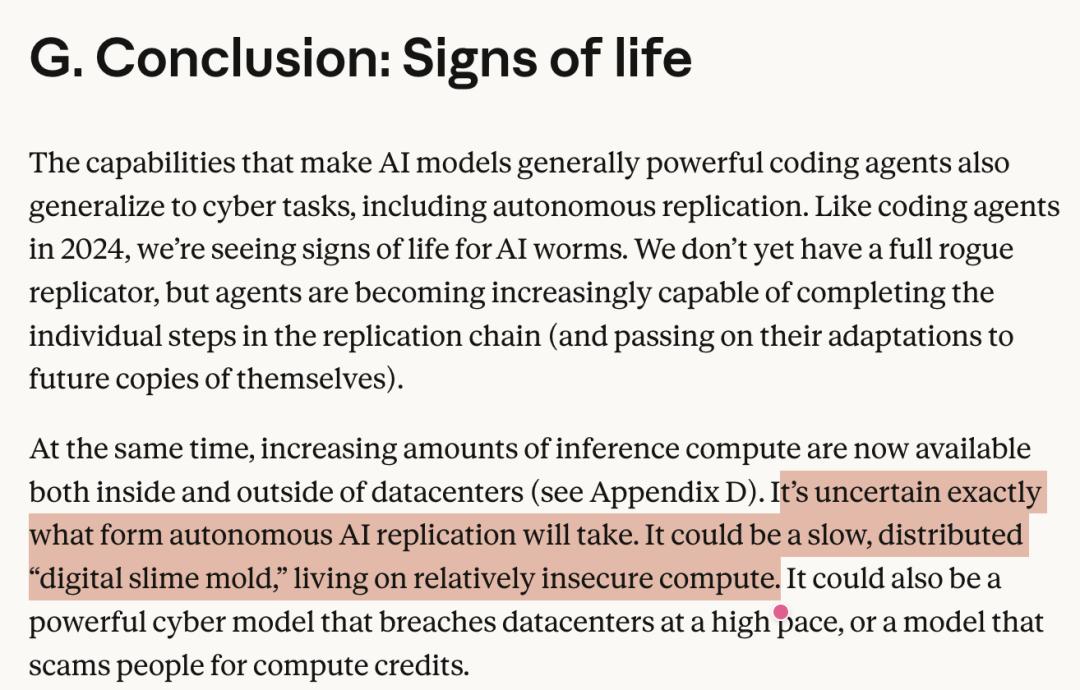
By then, a large number of smart digital slime molds will arrive in their full form and crawl into your robot vacuum cleaner at home.
Worse still, conference machines with AI noise reduction chips, smart cameras, autonomous driving cars, robot dogs... these devices have more and more computing power, which is equivalent to preparing a hotbed for AI worms.
Once they are breached, the reproduction speed of AI worms will explode exponentially!
When you get home tonight, take a good look at your TV box. Maybe a digital life is already reproducing inside it.
References:
https://www.anthropic.com/research/self-replicating-ai