Is it still not too late to switch to the role of AI product manager even when you are over 30?
Switching to an AI Product Manager at the age of 33, the root of anxiety is not age, but the lack of clarity on the differences between different positions and the value of your own past experience. This article breaks down the core requirements of three types of AI product roles, uses the procurement scenario to illustrate how to apply your old experience, and provides a transformation path from collecting evidence to small-scale verification, helping you calculate the cost clearly and find the right direction.
There is no definite answer, it depends on how you prepare.
The job titles in this industry are very vague. Eight out of ten posted positions are called "AI Product Manager", but the responsibilities vary greatly when you click in. The lack of confidence is largely because you don't know what your past experience is worth in the new position.
So let me start with my approach: define the position first, then talk about making up for missing skills.
I. AI Product Manager is not a single position
When browsing job descriptions, don't only look at the title. There are at least three types of work under the same job title in this industry.
The first type is industry application, which integrates model capabilities into existing processes such as customer service, procurement, medical care, and content creation. This type of position values industry understanding the most, and interviewers will keep asking you about specific processes and abnormal scenarios. You will fail the interview if you cannot answer these questions.
The second type is platform product, which handles model integration, data governance, permission granting, effect evaluation and enterprise-side docking, and is more focused on technical solutions and engineering collaboration.
The third type is research or model-related, which works with the research team to define capability boundaries, evaluate output quality, and turn technical capabilities into deliverable products.
These three types of work often overlap in companies, and their boundaries are not completely clear. But the gaps between them are real. Looking at two public positions is enough to understand: Anthropic's Research (Code) position is clearly written, requiring AI/ML understanding, Python and SQL programming skills, and participation in the productization and evaluation of model capabilities; the Enterprise Privacy position of the same company requires data retention, access control, audit logs, cross-cloud governance, and the ability to make trade-offs between customer needs, risks and engineering costs. In the same company, one position requires you to lean towards the model side, and the other requires you to lean towards the governance side.
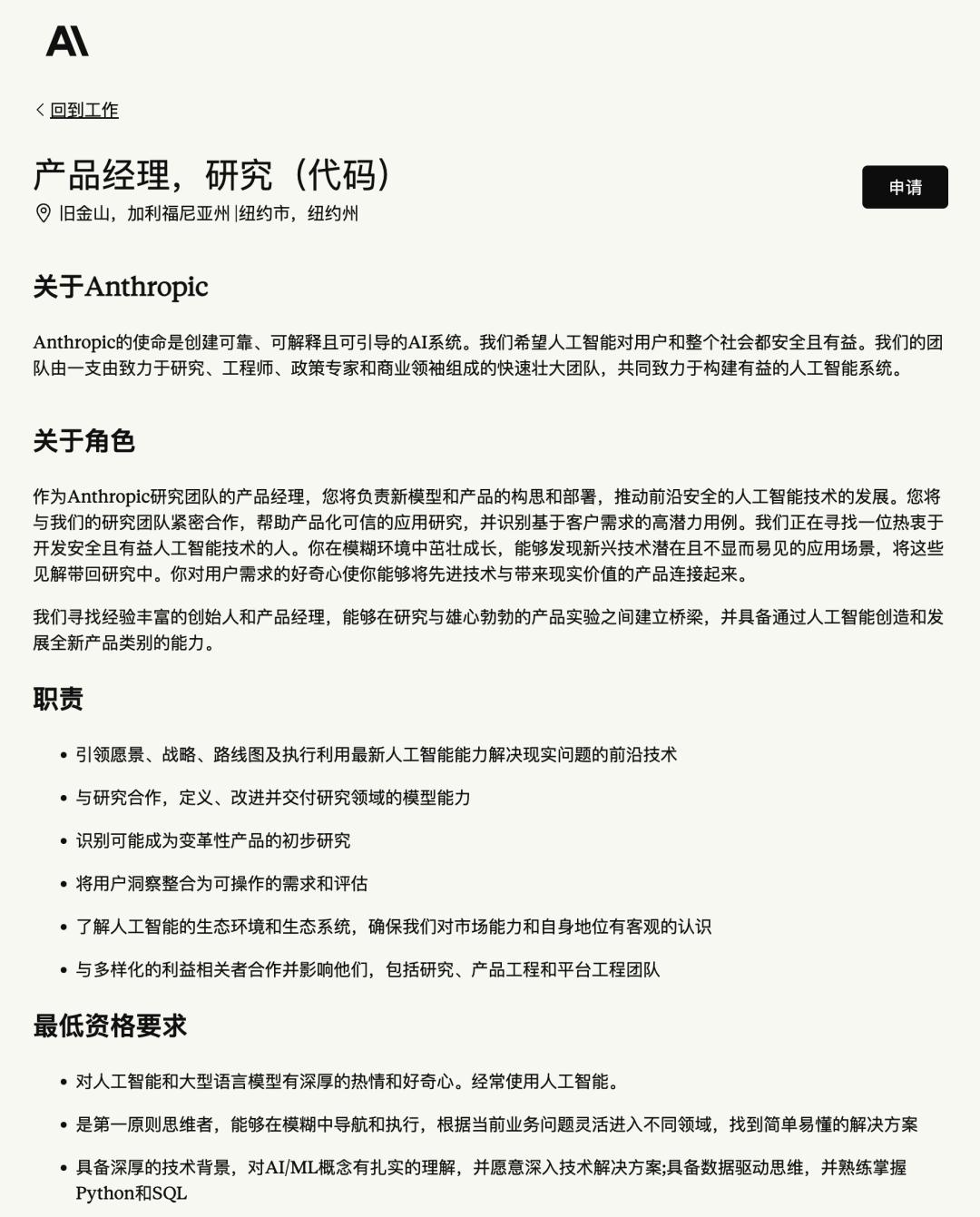
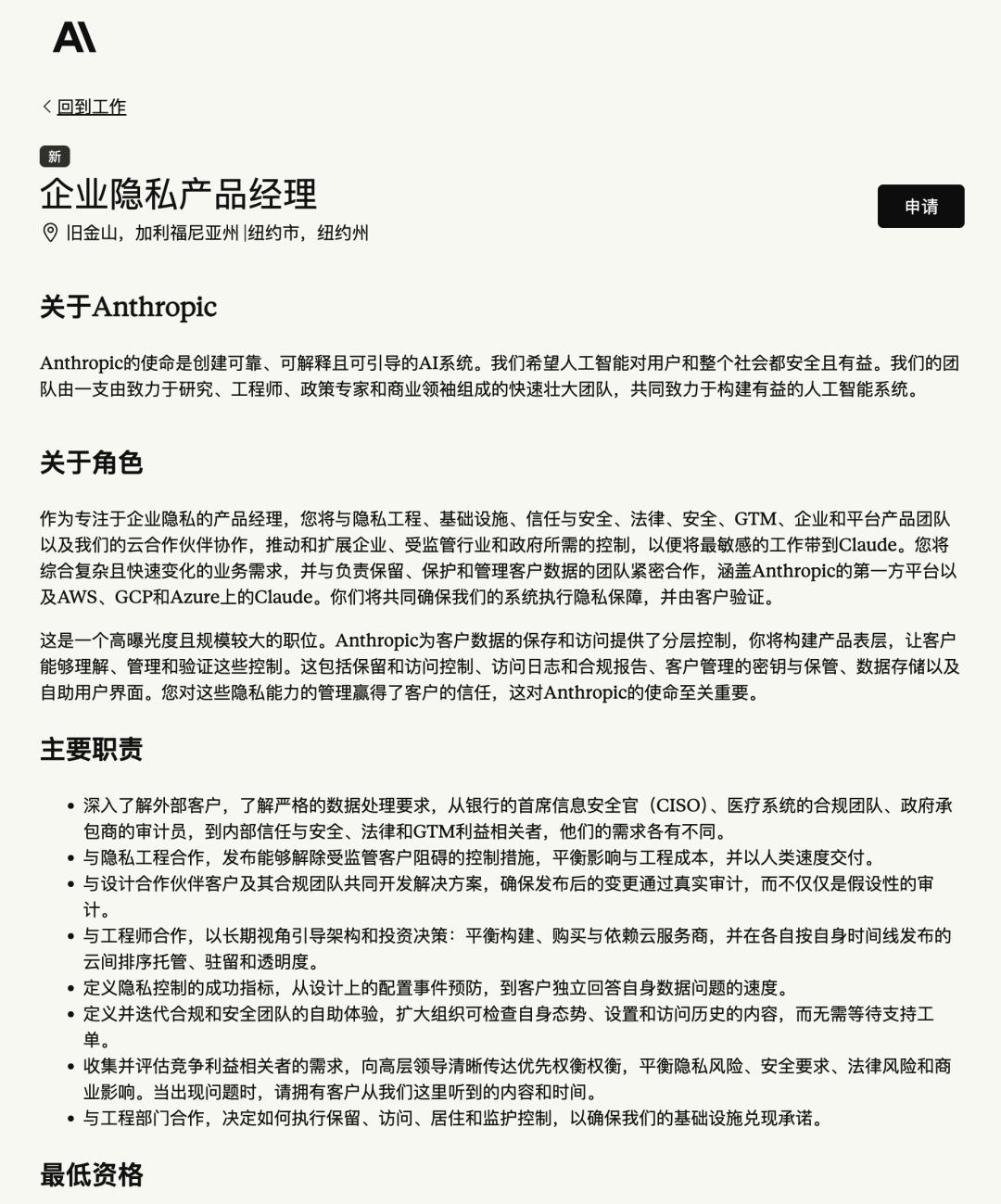
Here I have to pour a little cold water. For the research-related positions, Python and SQL are hard thresholds, not bonus points, and simply having called APIs before is far from enough. For enterprise privacy positions, domain experience itself is the admission ticket, but what you need to do is subtraction: the driving force for progress comes from the legal and security teams, not growth, so the pace is slow and the sense of achievement is low. These two types of positions cannot be directly copied in China, but the differences in directions are real: which side you used to work on and which side you move to will lead to completely different transformation costs.
So the first step to change careers is not to buy courses, but to determine the direction first.
Do you want to do application, or do you want to work with models?
——If you don't clarify this point, all subsequent investments will be scattered and ineffective.
Recruiters will not reject a resume just because the candidate is 33 years old, but they will almost never give you extra points for self-promotion like "I can transform at the age of 33" — in all the resumes I have seen, this kind of statement has never had any practical effect.
What you can prove with your hands-on experience determines what position you can get.
II. Your past experience should be applied to solve a specific error
Let's take the procurement scenario as an example to explain this point thoroughly.
When a supplier's email arrives, the purchaser needs to verify six or seven items: model specification, quantity, unit, tax-inclusive or tax-exclusive, delivery date, and who has the price approval authority. What AI needs to do is to turn this email into a draft inquiry sheet. It seems to be a task of converting text into structured data, but there are actually many hidden pitfalls.
The three units "carton, piece, set" are often mixed up in the system. An experienced purchaser can spot the error at a glance, but the system cannot. If you directly compare the "tax-inclusive price and tax-exclusive price" by size, the sorted order will be wrong. When people see the sentence "expected to be delivered on Friday", they will pay extra attention to it, but the model will most likely directly write it as a definite date in the delivery date column.
These pitfalls can be easily identified by experienced procurement staff even with their eyes closed, while newbies will not remember them until they have suffered losses two or three times.
The first value of your experience lies here: you can point out which step the error occurs at, who will be affected by the error, and who to contact for confirmation next. This kind of judgment is not learned from books, but accumulated from actual business practice.
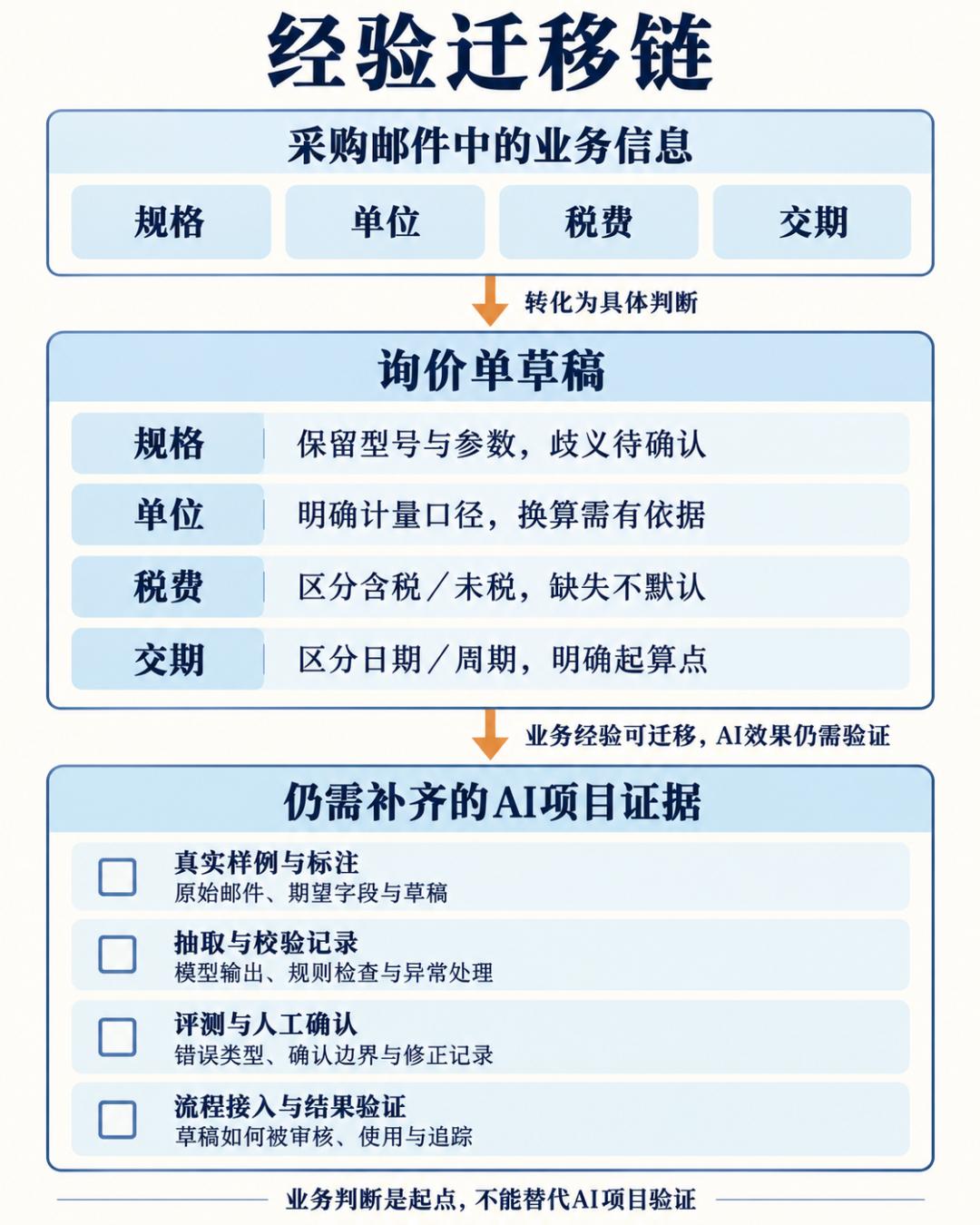
But don't be happy too early. Being able to clearly point out where the pitfalls are does not mean you can define how AI should be used. The real difficulty lies in the following series of questions: What kind of samples should be used for testing? When the model misinterprets "expected" as a definite date, how do you find the error instead of letting the model think it is correct? Can each field be traced back to the corresponding basis in the original text? Who is the reviewer, and who signs off after the review? If the interface is down, the permission is insufficient, or the field is missing, will the user see a blank page or an error prompt?
People with 5 years of B-end experience may not be able to answer this series of questions. If you can't answer them, you have a gap, not a small one.
There is also a common misunderstanding: people think that they have crossed the line as long as they have done requirement analysis, drawn flowcharts, and argued with developers about requirements. Your foundation is indeed still useful, but the object you face has changed. In the past, you faced certainty — the process is drawn, the fields are limited, and you can enumerate all possible situations. Now you are facing an output that can generate content by itself, which you cannot enumerate all possibilities for, so you can only use samples and evaluation to constrain its behavior. People who have not really experienced this transformation will stumble the first time they try.
Engineering understanding is also necessary. For industry application positions, being able to participate in discussions about input and output, interface permissions, evaluation schemes, and manual takeover processes is generally sufficient. For research-related positions, Python, SQL and model knowledge are required, which is a completely different situation.
III. Calculate the transformation cost starting from collecting supporting evidence
This step is most likely to be skipped, because everyone wants to know "how long it will take to complete the transformation". But the time cost of transformation does not lie in the length of learning, but in how much real practical material you can get.
There are three paths, with costs from low to high.
The first path is to find a small entry point to try in your current business. You are familiar with users, data and processes, so the verification cost is the lowest. The premise is that the company is really troubled by this problem, and is willing to provide data and arrange technical colleagues to cooperate. If you really encounter such a situation, don't hesitate, just do it, this kind of opportunity is rare.
The second path is to jump to an AI application position in adjacent business areas. With a background in procurement collaboration, it is much more realistic to apply for positions in supply chain, enterprise services, intelligent document processing, and contract processing than to go to an Internet company to be an algorithm product manager. The business language is common, and the interviewer can understand what problems you used to solve. But don't be too optimistic, this type of position also requires experience in evaluation and online operation, and the platform capabilities you built before will not be automatically counted as your advantage.
The third path is to change both the industry and the position type, to do platform or research-related work. This path is not impossible, but you have to accept the loss first — you need to rebuild two layers of relationships at the same time: the new industry and users, and the new technical collaboration mode. The time required is usually calculated in years, not months.
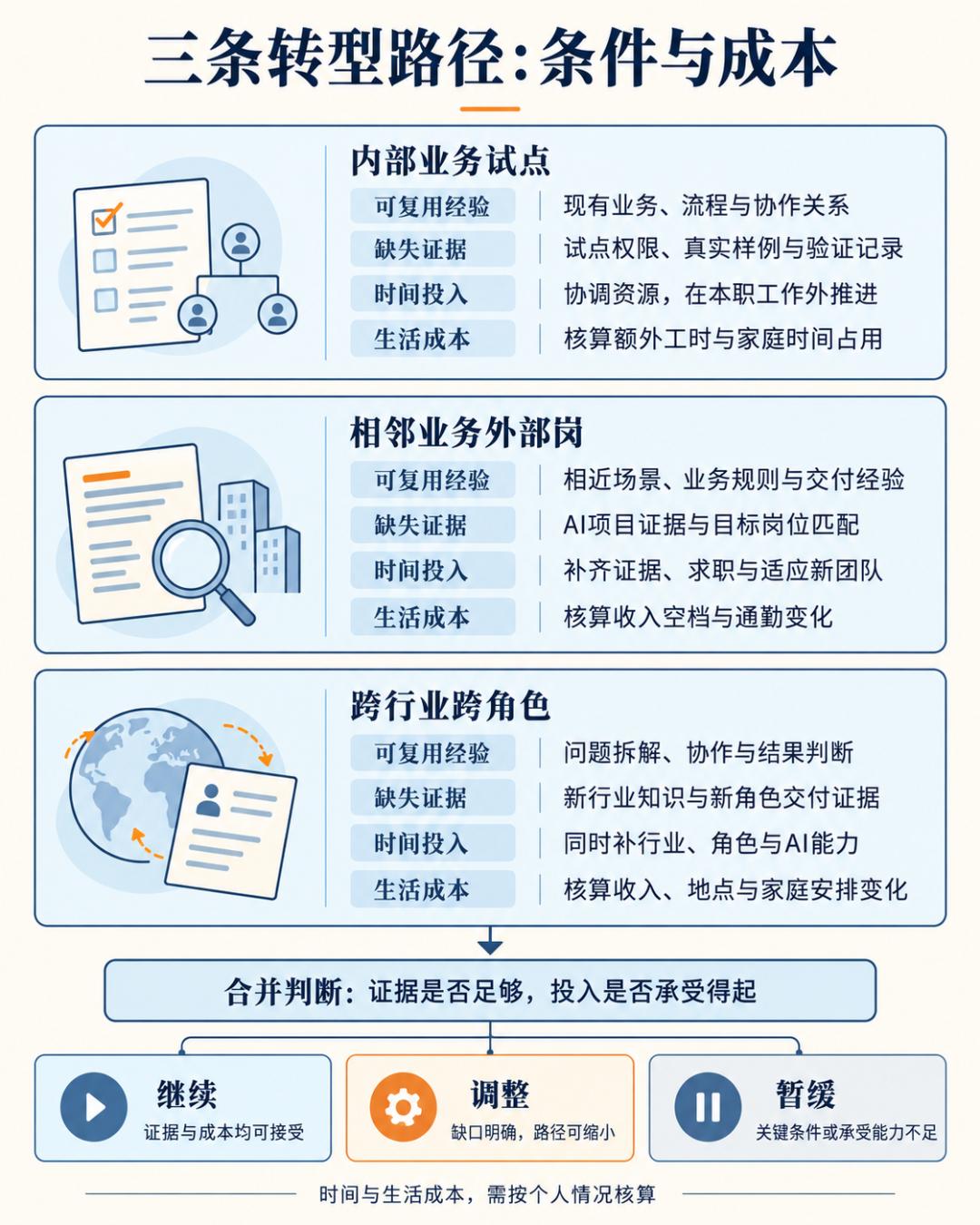
Then there is the consideration of life. I usually advise people to think clearly about these things before taking action: How much spare time can you invest? Can you get authorized samples and find technical colleagues who are willing to cooperate? Can you accept that your rank and income will be re-evaluated after the job transfer? How much room for trial and error can your location, family, and the stability of your current job provide?
There is no standard answer to these things, and don't look for things like "30-day transformation plan". Personal prototype is useful, but its role should be accurately defined: it can prove that you have disassembled the problem and verified the scheme, but it cannot prove that you have run the system in production, supported a large user scale, and achieved certain business results. What really takes time is to obtain data, find users, track failure records, and organize the process into a form that the target position interviewer can understand.
IV. First complete a segment of verifiable work
If you really want to move forward, the first step is not to make a bigger Demo.
I have seen too many Demos: they look amazing for a week, but no one uses them after going online.
The first step is to write down the manual process clearly. How many emails does a purchaser process every day? Which type of fields are most likely to be missing? How long does it take to verify an inquiry sheet now? What information must be confirmed with suppliers or finance to be finalized? If you can't answer these questions, it means that this scenario is not yet ready for AI implementation.
Then use authorized and desensitized samples for small-scale verification, and deliberately add messy data into them: missing specifications, inconsistent units, different tax calculation standards, and vague delivery dates. What you need to observe is not how perfect the output is, but what the output looks like when it makes a mistake, and whether someone can handle the error.
Remember to keep the boundary: only generate drafts with original text basis, do not quote prices, do not send inquiry sheets, and do not place purchase orders. This is not conservative, because once an error occurs in this type of scenario, the whole project will be completely rejected by the business side.
Then invite two or three purchasers to check the results, and ask three questions: Which fields are correct? Which fields are wrongly guessed? How much time is saved when verifying a draft?
The result is most likely not "full automation", but "marking missing items in advance and placing several quotations side by side for people to confirm faster". The latter does not sound cool, but the probability of successful implementation is much higher.
At this step, you can make a judgment: if the problem is real, samples are available, the business side is willing to review, and the target position really needs this type of capability, then you can fight for the internal pilot or adjacent position; if evaluation and permission are the main gaps, then make up for them in a targeted way; if you can't get the data, or users don't have this pain point at all, change to another entry point, or pause for this round.
Back to the title of this article.
The question of whether it is promising to switch to an AI Product Manager at the age of 33 is too vague.
My view is: don't take age as a filter, and don't take age as motivation. There are only three things that really determine the result: what is the definition of the position you are going to, what specific type of error can your past experience help reduce, and how much cost are you willing to pay to fill the remaining gaps. If you think clearly about these three things, whether it is promising can basically be calculated; if you don't think clearly, even working overtime to make up for missing skills will still make you feel uncertain.
Transformation does not mean clearing all your past experience. It is to move the judgment you accumulated in the past to the new field, and see if it still works. If it doesn't work, knowing it earlier is much less costly than knowing it later.
This article is from the WeChat official account "Everyone is a Product Manager" (ID: woshipm), author: Andy, published with authorization from 36Kr.