Ordered to suspend production, a 30-year-old veteran daily chemical enterprise has been publicly notified.
Up to now, nearly 200 cosmetics enterprises have been found with production defects.
The quality compliance issues of cosmetics manufacturers in Jiangsu Province have once again been brought to the public attention.
On October 7, the Jiangsu Medical Products Administration (hereinafter referred to as Jiangsu MPA) issued the "Notice on Cosmetics Supervision and Inspection (No. 12 of 2026)". The notice shows that Jiangsu MPA recently carried out on-site cause-based inspections on some cosmetics manufacturers in the province, and three in-production enterprises including Yangzhou Qili Cosmetics Co., Ltd. (hereinafter referred to as Yangzhou Qili), Yangzhou Leishidun Biotechnology Co., Ltd., and Suzhou Xianghai Cosmetics Co., Ltd. were found to have "serious defects in the production quality management system".
In response, Jiangsu MPA has taken risk control measures against the above-mentioned enterprises in accordance with the law, including ordering them to suspend production.
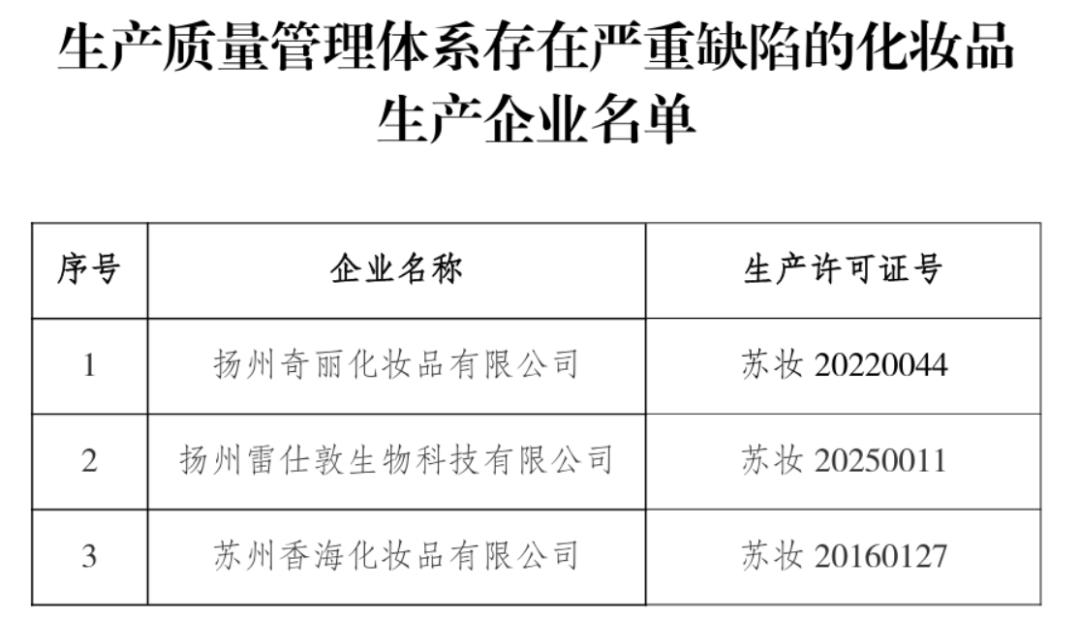
Image source: Jiangsu Medical Products Administration
It is worth noting that the so-called "cause-based inspection" refers to targeted verification carried out by regulatory authorities on enterprises based on risk clues, complaints and reports, or previous problems, which itself means that these enterprises have long been on the key supervision list.
Three enterprises "cross the red line", a 30-year-old established enterprise is on the list
Among the three enterprises notified this time, the problems of Yangzhou Qili are particularly prominent.
Public information shows that on March 31, 2026, Yangzhou Qili was given an administrative penalty by Jiangsu MPA, including confiscation of illegal gains of 425 yuan and a fine of 16,000 yuan, for "producing and operating cosmetics that do not meet technical specifications". Earlier in November 2022, the company was also punished for "marketing ordinary cosmetics that were not filed", with its illegal gains of 9,950 yuan confiscated.
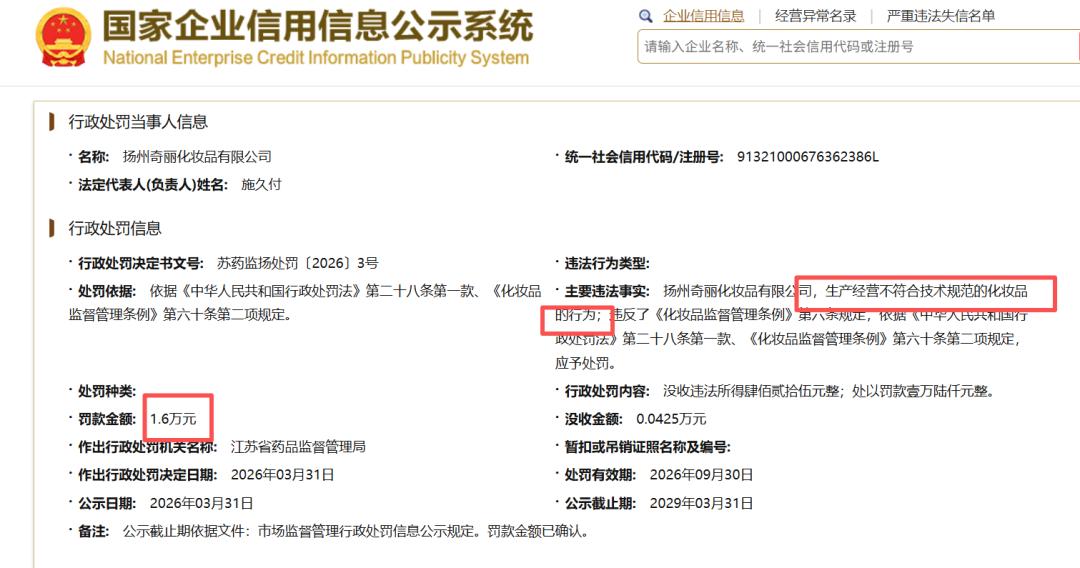
Image source: National Enterprise Credit Information Publicity System
This means that in less than five years, Yangzhou Qili has been punished twice for "unfiled sales" and "production not in line with technical specifications", and now it has been ordered to suspend production due to serious defects in its production quality management system. It is worth questioning that just after being punished in March 2026, serious defects were found again in October, with only half a year in between, which undoubtedly proves that there are loopholes in its management system.
Yangzhou Leishidun Biotechnology Co., Ltd. was established in November 2024 with a registered capital of 3 million yuan, and its business scope includes cosmetics manufacturing. This enterprise, which has been established for less than two years, was determined to have "serious defects in the production quality management system" in this unannounced inspection.
From the timeline, the enterprise has obtained the production license for more than one year, but obvious shortcomings have been exposed in the operation of its management system.

Image source: Qichacha
Another enterprise is more noteworthy. Suzhou Xianghai Cosmetics Co., Ltd. is a long-established daily chemical enterprise founded in 1997, whose main products include dishwashing detergent, shampoo, and daily cosmetics. This nearly 30-year-old established enterprise "hit the wall" in this round of supervision, and in its daily operation, the enterprise has been taken to court many times for housing lease disputes and trademark infringement cases, which shows that its awareness of compliance has hidden dangers as early as 2019.
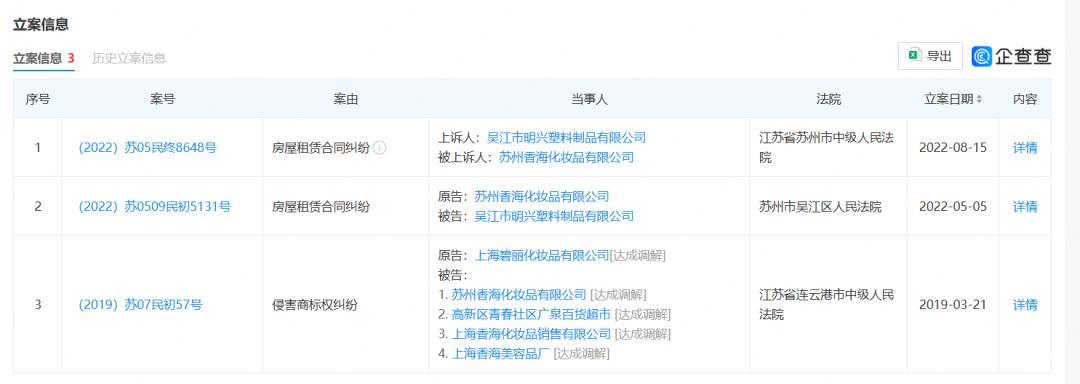
Image source: Qichacha
This notification is not the first action taken by the drug regulatory department of Jiangsu. In June 2026, Jiangsu MPA issued the No. 5 notice, carrying out cause-based inspections on 17 cosmetics manufacturers, and found that 10 enterprises had "serious defects in the production quality management system" during the production period, with the unqualified rate close to 60%. In less than four months, the bureau notified 3 more enterprises with serious defects, showing a clear upward trend in supervision density and inspection frequency.
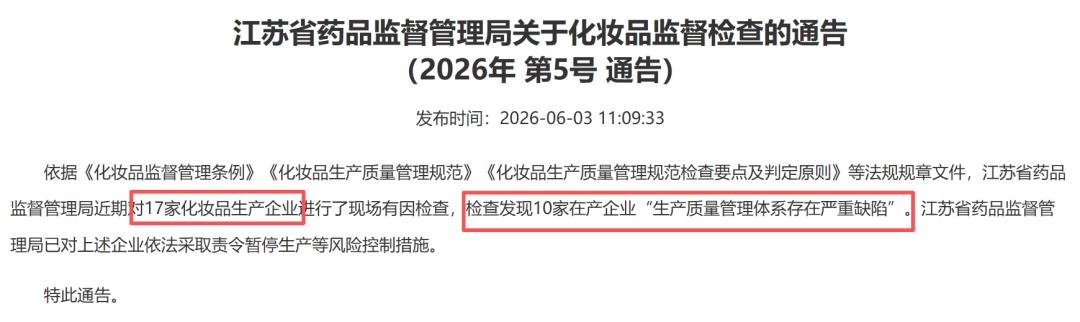
Image source: Jiangsu Medical Products Administration
175 enterprises have defects, Guangzhou is still the "worst-hit area"
Looking at the whole year of 2026, this notice from Jiangsu is just the tip of the iceberg.
According to Green Wing Compliance data, from January to June this year, the National Medical Products Administration and 31 provincial-level drug regulatory departments across the country have cumulatively released 16 issues of unannounced inspection notices for cosmetics, notifying 137 enterprises, with an overall defect detection rate of 76.3%. This figure is 23.5% higher than the same period in 2025, which reflects that the quality management system problems of enterprises are quite prominent.
In addition, according to incomplete statistics from Jumeili, 38 enterprises were inspected from July to October. As of the press date, the number of enterprises with production defects has reached 175.
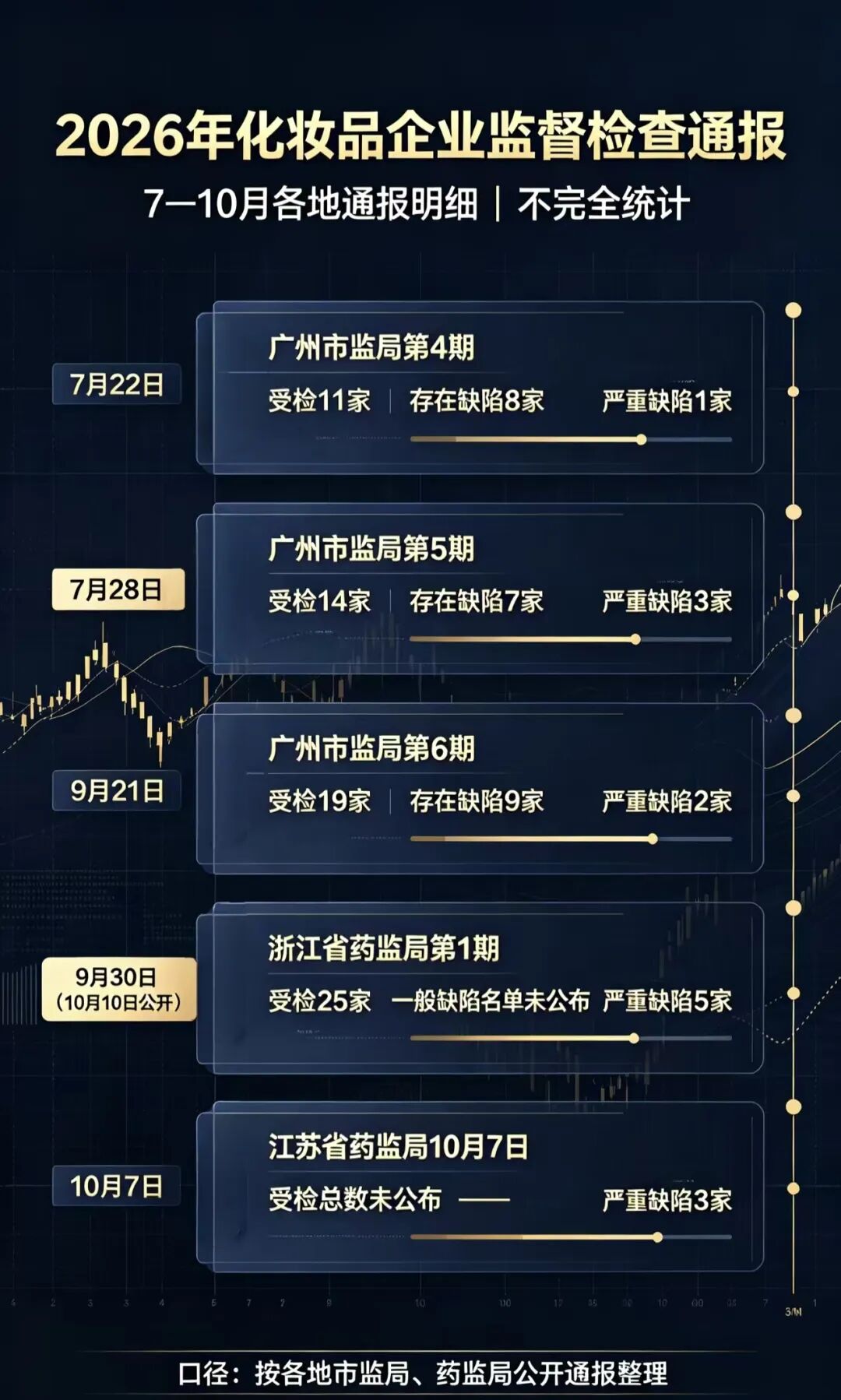
Chart by Jumeili, information source: market regulation bureaus and drug administration bureaus of various regions
From the perspective of regional distribution, Guangdong is still the "worst-hit area". As the largest province in cosmetics production, Guangdong has a huge number of enterprises and high industrial cluster density, and its system problems are the most concentrated. In some individual months, there was even a situation where all the inspected enterprises failed. Zhejiang, Guangdong, Jiangsu and other places have also notified multiple batches of enterprises with serious defects. For example, at the end of September, in the 2026 annual cosmetics supervision and inspection carried out by Zhejiang Medical Products Administration, 5 out of 25 sampled enterprises had serious defects, but all of them have completed rectification.
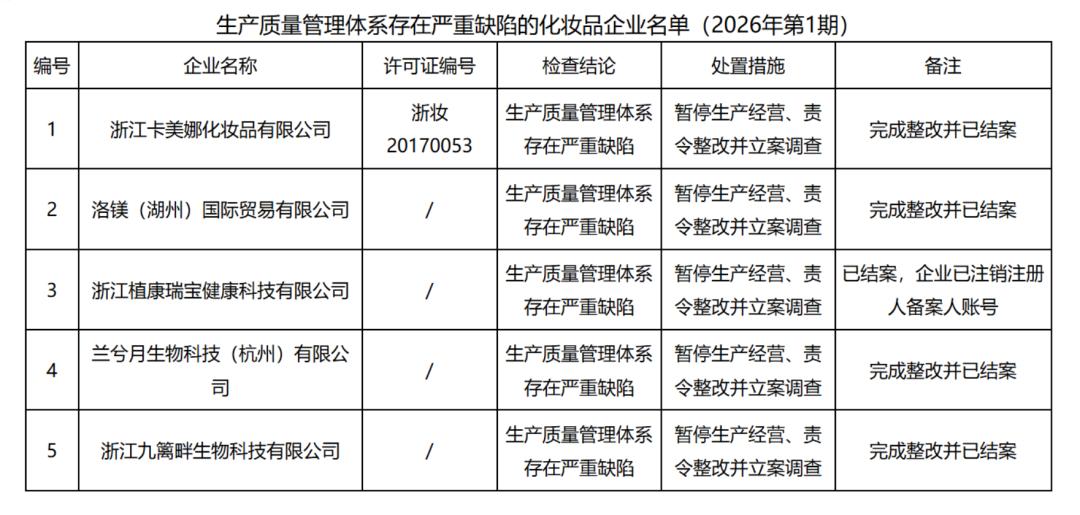
Image source: People's Government of Zhejiang Province
Some enterprises still "refuse to correct after repeated admonition" after being ordered to suspend production, and appear on the notification list again. Among them, Huzhou Kaisen was fined and confiscated more than 1.28 million yuan for several violations including "defects in the production quality management system", failure to implement the product sales record system, and untrue, incomplete and inaccurate label contents of cosmetics and industrial products, which reflects its weak awareness of compliance.
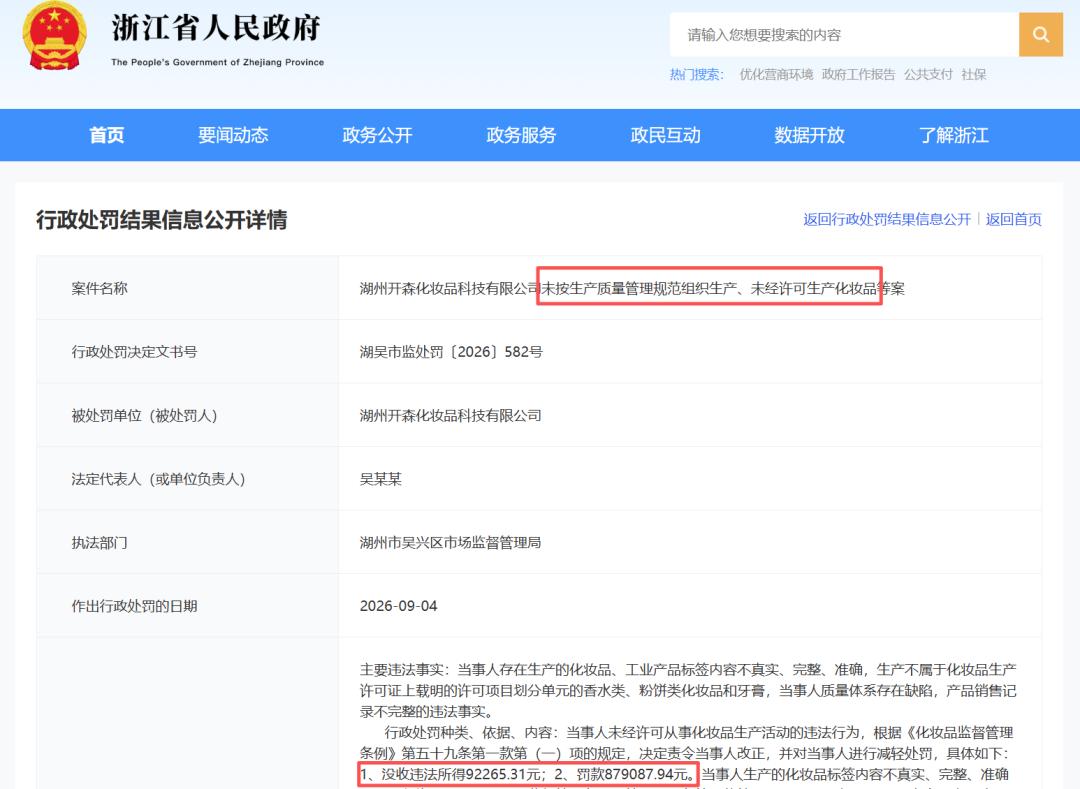
Image source: People's Government of Zhejiang Province
These problems seem to be scattered in different links such as raw materials, production and inspection, but their root cause often points to the same problem: their quality management system is virtually non-existent, with rules posted on the wall and implementation only staying on paper.
The notification in Jiangsu has not disclosed the specific defect details of the three enterprises, but referring to similar cases in the past, the most common prominent problems among the named enterprises include unclear responsibilities of institutions and personnel, non-compliant plant facilities, out-of-control material management, missing production records, and inadequate quality control.
In December 2025, the General Office of the National Medical Products Administration issued the "Three-Year Action Plan for the Improvement of Production Quality Management System of Cosmetics Enterprises (2026—2028)", which clearly requires provincial-level drug regulatory departments to formulate inspection plans scientifically, increase the supervision of the construction and operation of enterprise quality systems, require enterprises with defects to complete rectification within a time limit and implement review, and strictly implement the "penalty on individuals" for serious circumstances.
This actually means that the cosmetics industry has developed from barbaric growth to high-quality and fine management, and quality management capability has become the admission ticket for enterprises to stay in the market. For the 175 enterprises in the first three quarters, if they still regard the quality system as a "cost" rather than a "lifeline", there is not much time left for them.
This article is from the WeChat official account "Jumeili" (ID: jumeili-cn), author: Ru Zun, editor in charge: Gao Gao, published with authorization from 36Kr.