Exclusive Interview with Wang Wei of Hikvision Ruiying: The century-old X-ray technology is being redefined by AI
If we turn the clock back ten years, few people would have regarded industrial X-ray inspection (X-Ray) as a track with fierce competition and rapid technological development.
The discovery of X-ray dates back more than a century. In the industrial field, it has long been applied in scenarios such as foreign body detection in food, PCBA solder joint inspection and industrial flaw detection. As for the equipment, the core X-ray sources, detectors and mechanical structures have long had mature technical reserves, and leading overseas manufacturers have even been deeply engaged in this field for decades, making it a standard mature track.
However, Wang Wei, President of Hikvision Rayin, put forward another judgment: "Industrial X-Ray has just started, and the whole industry is still in the early stage. When you look back, you see a red ocean, but when you look forward, you see a blue ocean."
At this year's Industrial Expo, Hikvision Rayin officially released the high-precision 3D AXI inspection equipment for semiconductor packaging, further pushing the inspection capability to the sub-micron scale. On the premise of maintaining reliability and consistency, the equipment can realize sub-micron level measurement, 3D image reconstruction and defect analysis, thus entering higher-threshold markets such as advanced packaging and laboratory failure analysis.
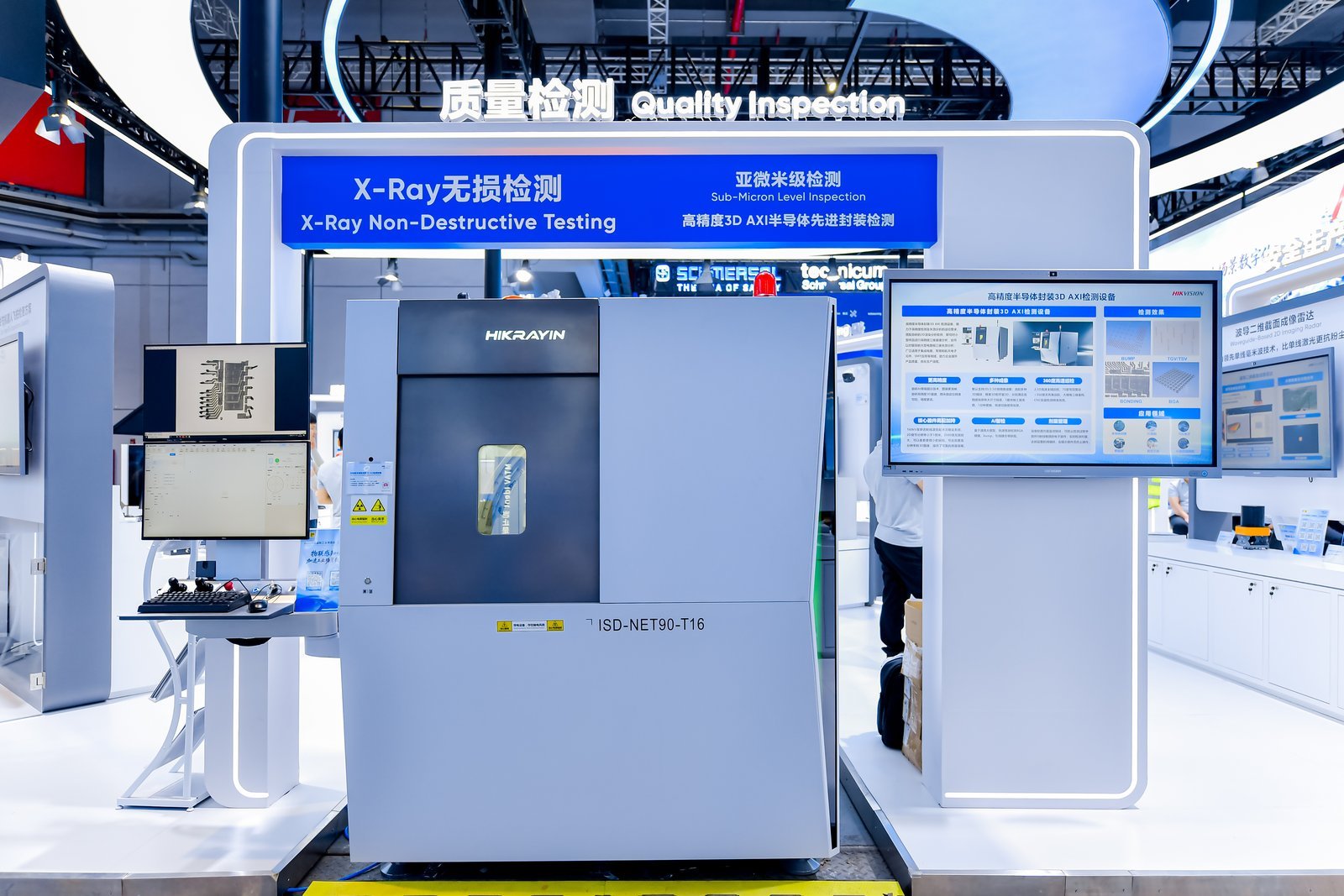
From millimeter-level security inspection equipment, to micron-level industrial inspection, and then to today's sub-micron level measurement, with higher precision, stronger penetration and higher defect detection capability, in just a few years, Hikvision Rayin has carved out its own place and gained a firm foothold in the X-ray inspection field with efficient R&D speed and continuous project implementation.
But what really caught people's attention is the new "variable" of the X-Ray track that Hikvision Rayin has fully bet on — AI.
For example, Apple's newly released foldable phone iPhone Duo once again brought the hinge technology of foldable screen phones to the spotlight. The internal hinge of a foldable screen phone may have hundreds of parts. In the past, workers could use a magnifying glass to check the surface, but it was difficult to stably judge whether there were defects or foreign matters inside, which directly affected the product yield.
Several years ago, Hikvision Rayin began to use X-Ray combined with AI technology for automatic hinge inspection. Wang Wei told 36Kr that at that time, hinge was a new process, facing the pain points of various defects such as foreign matters, cracks, voids and assembly missing flowing out. Through full X-ray AI inspection, the defect rate was reduced by an order of magnitude.
In addition, in meat processing, X-Ray was originally mainly responsible for detecting residual bones and foreign matters. After Hikvision Rayin added image AI algorithm and large model capability to the equipment, it further realized fat rate detection. In scenarios such as whole notebook computers, internal springs of eyebrow pencils, and auto parts, X-Ray, which rarely entered the production line in the past, has also gained new application opportunities due to the emergence of AI.
AI is becoming a brand new "decisive factor" in the industrial X-Ray track.
Hikvision Rayin was founded in 2020 and officially entered the industrial inspection field in 2021. Now, its industrial inspection business has covered many fields such as electronic manufacturing and food. Backed by Hikvision's strong technology R&D system, it has quickly become a first-tier player in the industrial X-ray field, ranking top 3 in China in multiple segmented tracks.
People's perception of Hikvision often stays at "the global leader in security", but the fact has long changed. Since 2016, Hikvision has quietly launched a ten-year strategic transformation. Over the past decade, Hikvision has continuously spilled over its capabilities of IoT perception, AI and other technologies to industrial fields such as semiconductors, automobiles and 3C. Its "Banyan Business Model" has built eight innovative business sectors including Hikvision Robot, Hikvision Microvision, and Hikvision Automotive Electronics, completing the strategic upgrade from a provider of security equipment and solutions to an AIoT technology company.
Hikvision Rayin is precisely one of the key business sectors of the "Banyan Model".
Wang Wei described the future X-Ray equipment as "intelligent equipment robots". In the future, equipment robots can automatically discover defects, understand defects, automatically adjust parameters, and further use inspection data to reversely affect the previous process.
"The future is definitely intelligent. The highest requirement today may be the lowest standard tomorrow." Wang Wei said.
From making machines "see and see clearly" to trying to make equipment understand, judge and even continuously evolve on its own, the route Hikvision Rayin has taken in X-Ray also provides us with a window to observe this emerging industrial leader Hikvision up close.
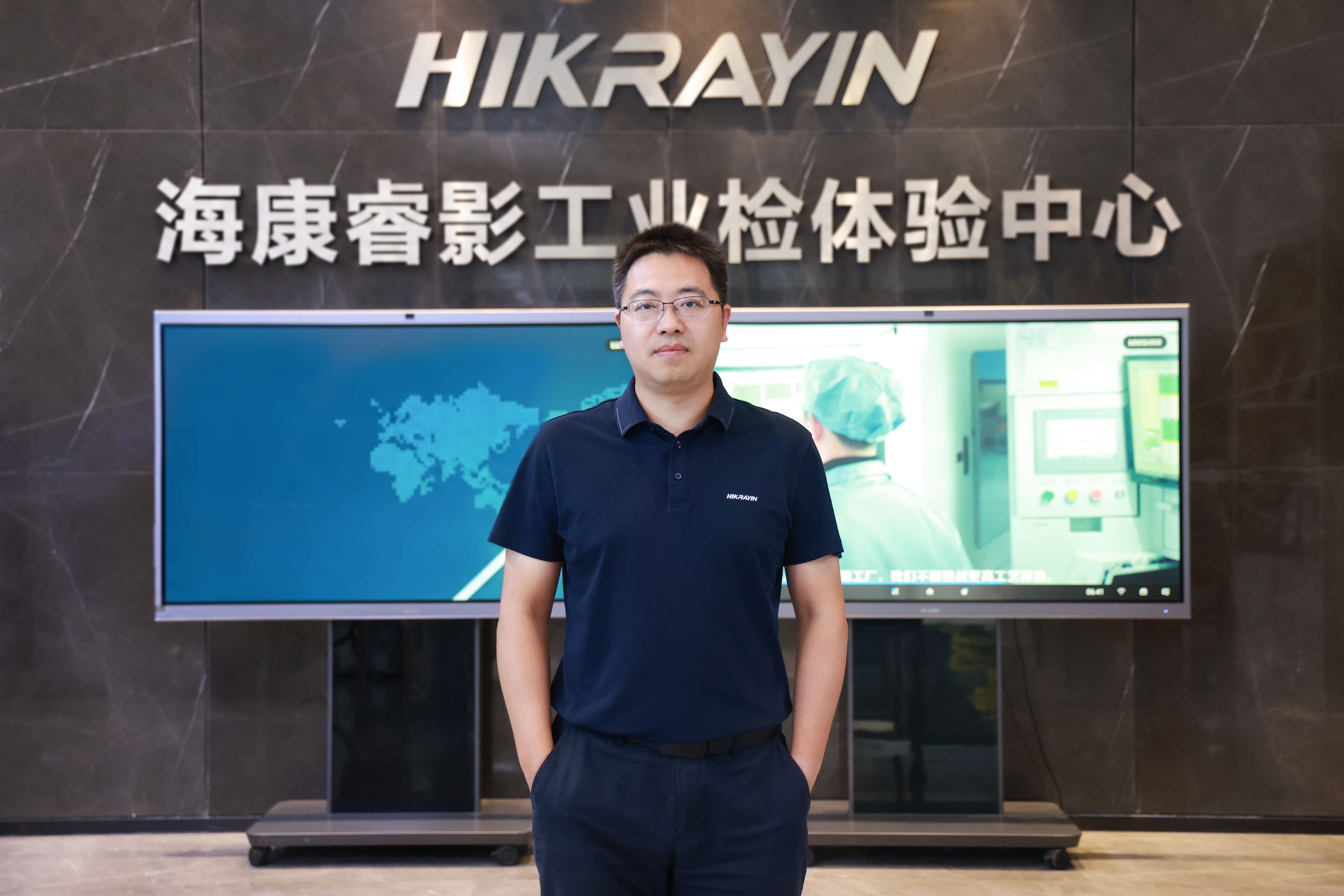
Wang Wei, President of Hikvision Rayin
The following is the QA record of 36Kr and Wang Wei, President of Hikvision Rayin.
I. "There are not many players in the world that can enter this field, and they can be counted on two hands"
36Kr: What is the core technological breakthrough of the sub-micron high-precision 3D AXI inspection equipment for semiconductor packaging released this time?
Wang Wei: We internally call this product 3D AXI. Its core is to realize sub-micron level X-Ray measurement under the condition of high reliability and high consistency. Sub-micron means less than one micron, which has entered the nanometer scale, and it also needs to complete 3D image reconstruction and defect analysis at the same time.
It has a relatively big difference from the equipment we made in the past. In the past, X-Ray was more of an inspection equipment in the manufacturing process, with the core goal of finding out defects. In addition to production inspection, this sub-micron product can also enter scientific research institutes and laboratories to become a measurement equipment. Inspection and measurement are not exactly the same. Production inspection is more about judging whether there are defects or not; in the laboratory, in addition to inspection, we also need to pay attention to the specific length, width and size of the structure, which will put forward higher requirements for precision, reliability and consistency.
36Kr: Which part of Hikvision Rayin's existing product matrix does this product complement?
Wang Wei: It mainly covers two directions: one is semiconductors, especially advanced packaging; the other is laboratory-level failure analysis and measurement. This means that our products, which used to focus more on production inspection, have started to extend to higher-precision measurement. There are not many players in the world that can enter this field, and they can be counted on two hands. Only a very small number of domestic manufacturers can move in this direction, and the whole industry is still in the relatively early stage.
36Kr: What level is this product at now compared with leading overseas manufacturers?
Wang Wei: Generally speaking, in the field of high-end X-Ray equipment, China used to mostly follow the overseas development path. But after this high-precision equipment is launched, its performance has basically reached the first echelon in the world. In some local scenarios, we can also take the lead. For example, for complex defect detection, we can carry stronger AI models; in some scenarios with poor signal-to-noise ratio, we can also enhance the image through image algorithms to present defects that were previously difficult to observe.
36Kr: From entering the industrial inspection field in 2021 to achieving sub-micron level today, what is the technical evolution route of Hikvision Rayin?
Wang Wei: At the very beginning, we made security inspection equipment, which was basically at the millimeter level; then we entered the industrial inspection field and reached the micron level; now with the launch of sub-micron products, we have taken a further step. The core lies in two things: one is physical perception capability, which pursues higher precision and stronger penetration; the other is inspection capability, which pursues higher detection rate and fewer false positives.
AI algorithms are also evolving at the same time. From the very beginning when we made inspection equipment, we rarely used traditional pattern recognition, and deep learning was already used in the first generation of products. In recent years, we have gradually moved from small models to large models. The general direction has not changed, but the specific pace will change according to user needs. We did not deliberately stipulate that we must enter a certain industry first and then another. It is more about the continuous collision of the real pain points of customers after the integration of X-Ray and AI. Where the value is greater and the pain points are more urgent, we will prioritize developing the corresponding scenario with users.
From the technical dimension, there is no end to the pursuit of higher precision and stronger penetration in physical capability. The same is true for AI. From pattern recognition, small models to large models, in the future it may further move towards autonomous evolution, making the equipment more and more easy to use with less human intervention. It is a bit like the world record in sports competitions. The record is there, but sooner or later someone will push it a little further. The same is true for us making equipment, we must constantly challenge this limit.
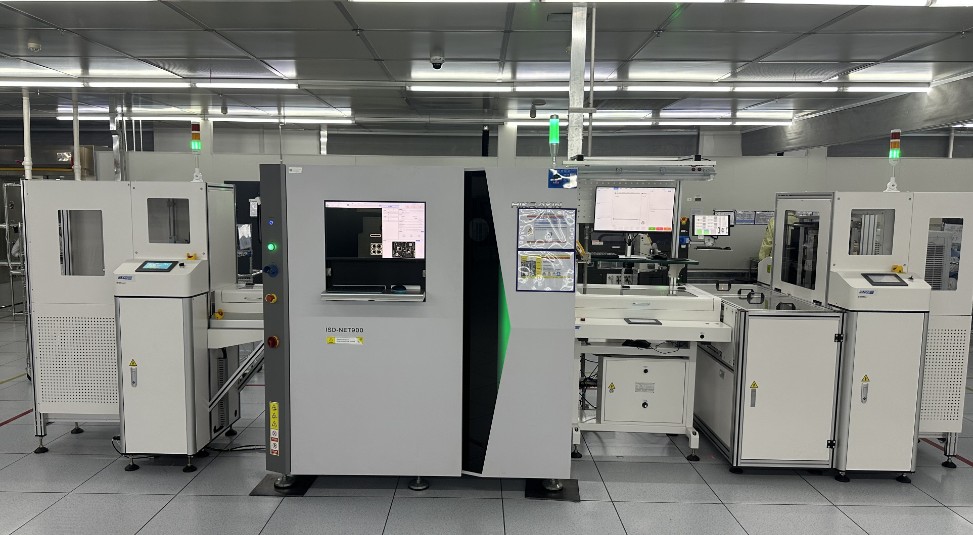
Hikvision Rayin 3D-AXI on automotive electronics production line
II. Game Changer: AI
36Kr: From the perspective of the integration of AI and X-Ray, what is the part where AI has truly changed X-Ray?
Wang Wei: Looking back, X-Ray is a very mature technology. There has been no particularly big breakthrough in core technology in the past ten years, only small iterations. So when you look back, you will feel that this is a traditional industrial equipment industry, many companies have been doing this for ten or twenty years, with deep material experience, mechanical experience and engineering accumulation. But if you look to the future, you will find that this industry is particularly immature, and the core reason is the integration of AI and X-Ray. In the past, X-Ray could take internal images, but many images could not be understood automatically after being taken, so it could only be used as laboratory equipment or sampling inspection equipment. Once AI can automatically understand these images, it will have the opportunity to change from "sampling inspection" to "full inspection".
The transformation from "sampling inspection" to "full inspection" directly determines whether this technology can achieve large-scale application. In the past, there were only a few X-Ray applications that formed a relatively large industry in the industry, such as food foreign body detection, PCBA solder joint void detection, and industrial flaw detection. Why can these scenarios achieve large-scale application? Because they realized automatic judgment at an early stage. Without automatic inspection, a factory may only need one or two sets of equipment in the laboratory for failure analysis and sampling inspection. But once full inspection can be realized, one production line may need one set of equipment, and the number of equipment will be completely different.
So I always think that X-Ray itself is a general-purpose capability. It can penetrate and form images. Theoretically, many products have the demand to check internal defects. The fact that many scenarios were not used in the past does not mean there is no demand, but more because the automatic inspection capability and input-output ratio have not crossed the threshold.
36Kr: Just like industrial cameras ten years ago?
Wang Wei: Yes. I often look back at the development of industrial cameras from 2015 to 2020. Before 2015, it was hard to imagine that industrial cameras would be used so much on production lines. But later, with the decline of cost and the improvement of AI and automatic inspection capabilities, industrial cameras became a ubiquitous perception capability on production lines. X-Ray may also go through a similar process. Industrial cameras mainly look at the surface, while X-Ray looks at the interior. Many products have internal defects, but in the past, the equipment was too expensive or automatic inspection could not be realized. Now the cost is decreasing and the capability is improving, these two bottlenecks are being broken at the same time.
36Kr: Are there any typical cases?
Wang Wei: The hinge of foldable screen phone is a very typical example. A hinge may have hundreds of parts inside. How was it inspected in the past? Most of the time, workers used magnifying glasses manually. But magnifying glasses can only see the surface, and for such complex devices, human beings will definitely have missed inspections after working for a long time.
We started to develop automatic X-Ray inspection for hinges several years ago. At that time, hinge was a new process, facing the pain points of various defects such as foreign matters, cracks, voids and assembly missing flowing out. Through full X-ray AI inspection, the defect rate was reduced by an order of magnitude. This is the result of X-Ray combined with AI, which turns the thing that was difficult to realize full inspection in the past into a "production process". There is also the whole notebook computer inspection, which is more complex than the hinge, but the essence is the same: whether there are missing screws, extra parts or foreign matters inside, these are all things that X-Ray is very suitable for doing.
36Kr: Is food inspection based on a similar logic?
Wang Wei: Yes, for example, there should be no residual bones in chicken breast and chicken drumsticks. After we entered this scenario several years ago, during the customer trial process, we were able to detect bones as thin as about 1mm. The customer was shocked at that time, because in the past, this field was basically dominated by foreign players. On this basis, we used the energy spectrum characteristics of X-Ray combined with AI to realize fat rate detection. For example, different proportions of fat and lean meat in pork will lead to different taste and price. In the past, only a few companies in the world could do this, and the equipment was very expensive. Now that we have developed this function, it will gradually become a more conventional capability.
I often say one sentence: When new technology collides with traditional technology, many sparks will be generated. What we need to do is to catch these sparks.
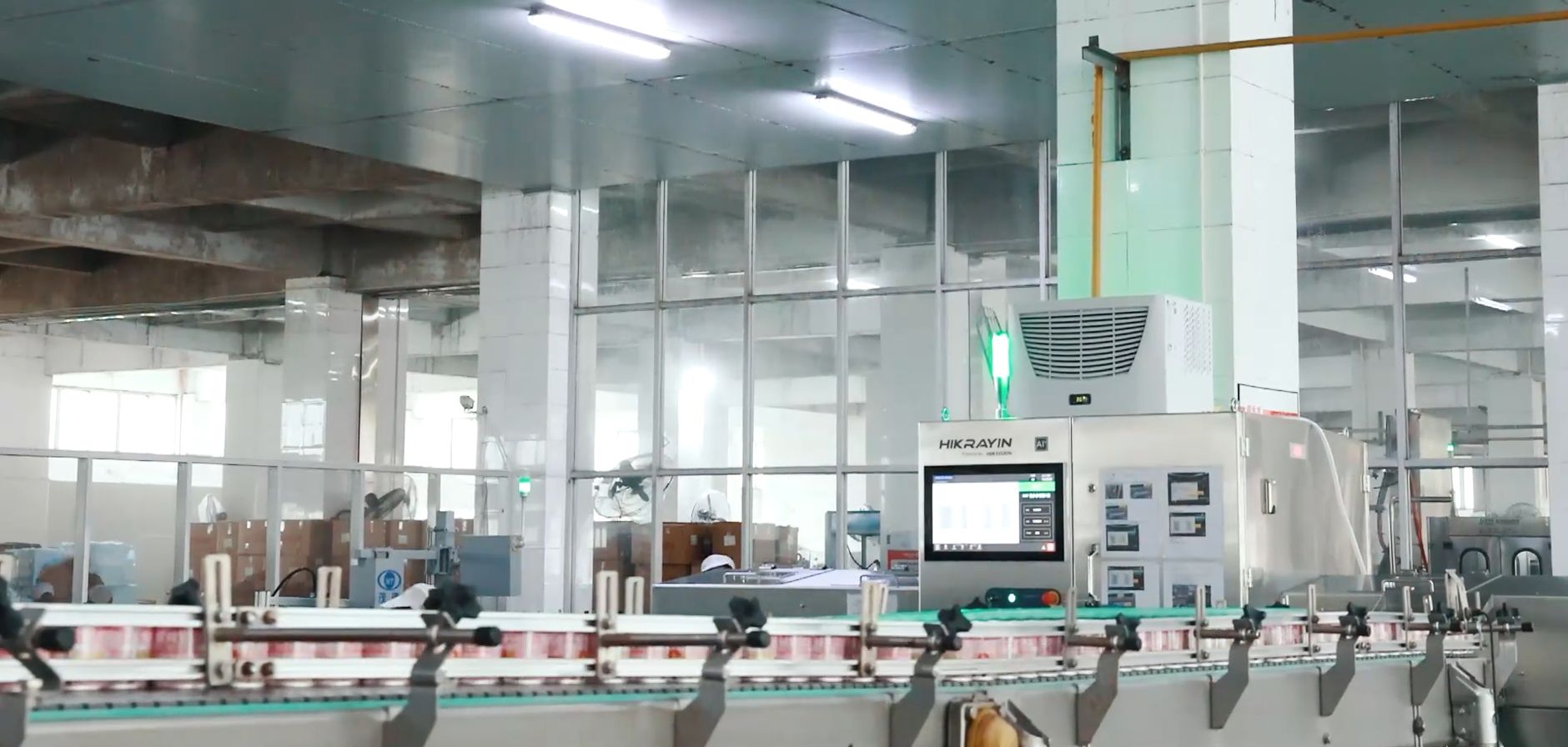
Hikvision Rayin industrial inspection products on food inspection production line
36Kr: Now everyone is talking about large models. What is the core value of large models when they are actually applied to industrial X-Ray?
Wang Wei: A very important point of industrial AI is practical effect. There are many open source models today, and at first glance, people will think that AI is already very mature. But when you actually go back to the industrial site, you will find that there are not many well-performing solutions. Why? Because many times, industrial scenarios do not give you enough time. From sample testing to mass production, a new product model may only take one or two months. Whether you can develop a brand new product category within this period and meet customer requirements has a very high threshold. If you give an enterprise one or two years, many companies may be able to do it. But industrial customers will not wait for you for a year.
36Kr: Is small sample learning very important here?
Wang Wei: Extremely important. In the traditional way, making a hinge inspection model may require thousands or even tens of thousands of images for labeling and training. Based on the base of Hikvision Guanlan Large Model, a brand new category can achieve good results with only one or two hundred or hundreds of images.