Churning out nearly 500 tokens per second, the Zhipu GLM-5.3 High-Speed Edition has made a quiet debut.
Crank up the speed of the coding process.
ZheDongXi reports on October 12. Recently, Zhipu has quietly launched the test of its high-speed flagship model GLM-5.3 HighSpeed in its AI programming tool ZCode.
Leo, an AI programming content creator on Platform X, broke the news that he has been granted grayscale access to this model, whose output speed can surprisingly exceed 490 tokens/s.
What does 490 tokens per second mean? According to the latest data from AI Ping, a large model API evaluation platform, the official API output speed of DeepSeek V4.1 Flash is 121.34 tokens/s, while the official GLM-5.3 API of Zhipu has a speed of 70.84 tokens/s. That means GLM-5.3 HighSpeed reaches several times the speed of current mainstream domestic models.
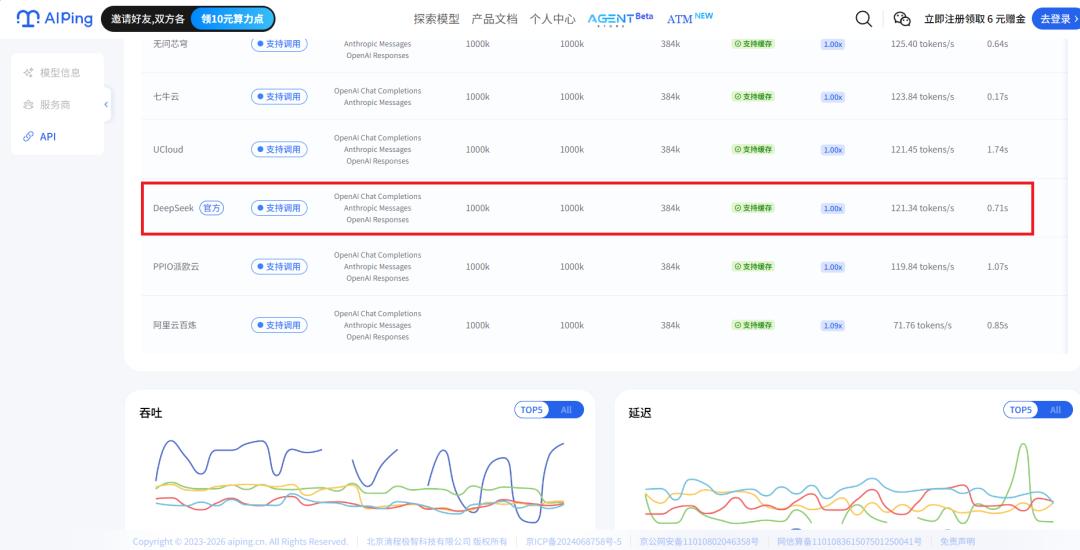
GLM-5.3 HighSpeed is currently only randomly open to ZCode subscription users, and there is no clear entry for internal test application. The extremely fast speed demonstrated during the internal test can only be used as a reference, and the final performance should be measured by its actual speed when it is officially launched and provides large-scale external services.
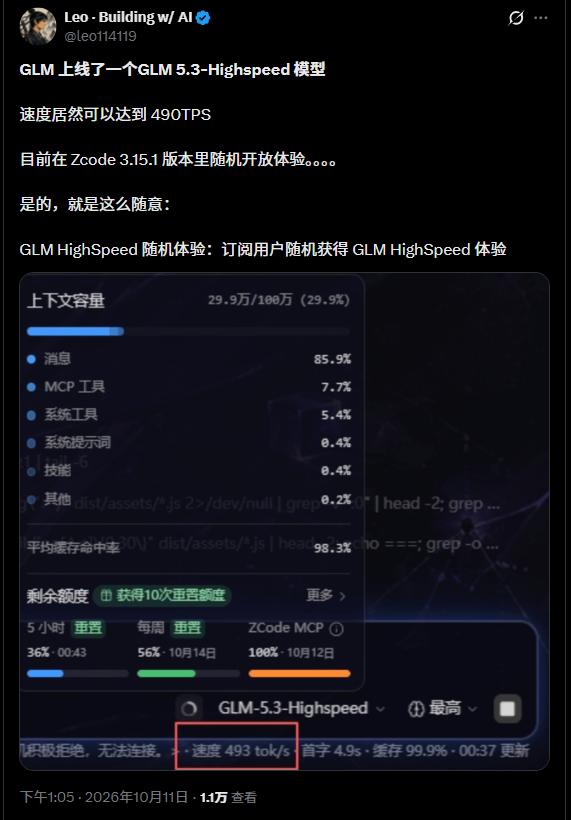
ZCode grayscale testing GLM-5.3 HighSpeed (Source: Platform X @leo114119)
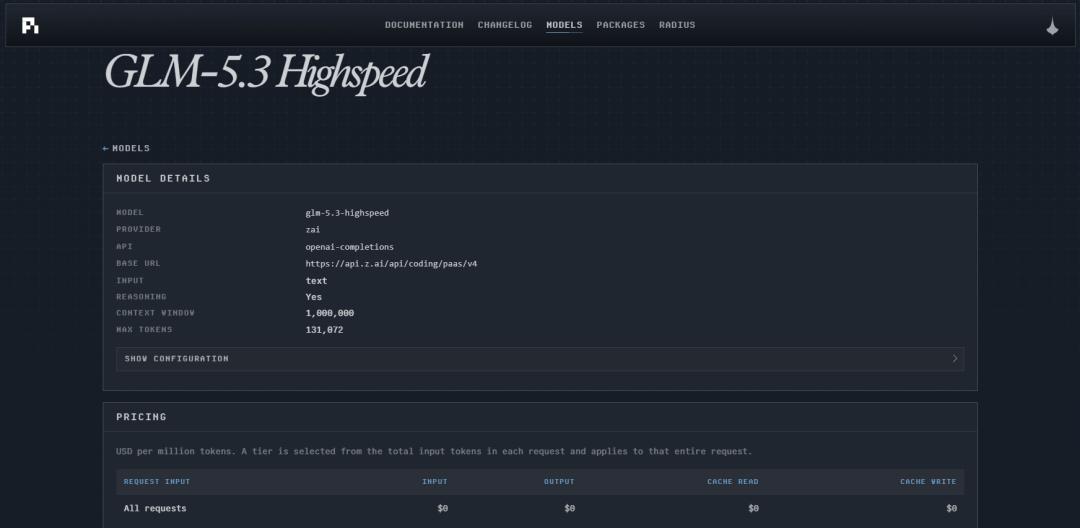
In fact, GLM-5.3 HighSpeed appeared on the official website of Pi harness, an open-source programming agent, a month ago, and the input and output pricing of this model has not been disclosed yet.
From the basic information of the model, GLM-5.3 HighSpeed has a context window of 1 million tokens, and can output up to 131072 tokens at a time, which is consistent with the specifications of GLM-5.3.
This is not the first time Zhipu has launched a high-speed flagship model. Back in May this year, a high-speed version API "GLM-5.1-highspeed" for partial enterprise users was launched for GLM-5.1, with a model output speed reaching 400 tokens/s.
At that time, Zhipu demonstrated the value of high-speed models in real production scenarios. A Coding Agent task often requires dozens of rounds of model calls. If a single round of response is even a few seconds slower, the total time consumption may be extended by more than ten minutes.
A faster model can "10x speed up" the coding process: the model can continuously generate code and modification plans while understanding the engineering context. Right after the user inputs the requirements, the corresponding functions, interfaces and call chains are generated synchronously, which significantly improves the iteration speed.
This level of output speed mainly comes from the optimization of software and hardware infrastructure. Previously, the GLM 5.1 Highspeed model API was jointly developed by Zhipu GLM Team and TileRT Team, which has carried out system-level optimization at three levels: inference engine, scheduling system and underlying infrastructure:
At the inference engine level, the research team rewrote the core inference path according to the architectural characteristics of GLM-5.1, effectively improving the single-card throughput capacity;
At the scheduling system level, they significantly reduce the tail latency under high concurrency scenarios through dynamic batching, request merging and KV cache scheduling optimization;
Finally, at the infrastructure layer, the team carried out collaborative optimization around inference cluster deployment, network links and load balancing, to ensure that the high-speed output becomes a stable and usable production-grade capability.
The core idea of TileRT is to abandon the dynamic operator scheduling of the traditional Runtime layer, and statically arrange the entire inference computation graph into a persistent Engine Kernel resident in the GPU during the compilation period, so as to minimize the overhead of scheduling, memory access and synchronization.
Nowadays, improving model inference speed has become the focus of many manufacturers. In addition to launching dedicated high-speed models, further raising the speed of flagship models by an order of magnitude is also becoming a new direction of competition.
This article is from the WeChat Official Account "ZheDongXi" (ID: zhidxc), written by CHEN Junda, edited by LI Shuiqing, and republished with authorization from 36Kr.