The total cumulative financing hits 4.3 billion yuan, giving birth to the largest domestic AI Infra financing deal, and MemryX has secured 2.3 billion yuan in its Series C round.
Zhidx learned on October 12 that Wuben Corefirm, a leading domestic AI-native infrastructure enterprise, has recently completed its Series C financing with a financing amount of 2.3 billion yuan, bringing its total accumulated financing to 4.3 billion yuan. Both the single-round and total accumulated financing amounts hit a new record high in China's AI Infra (Artificial Intelligence Infrastructure) industry.
It is understood that this round of financing has been fully closed, and the company is currently preparing for its IPO.
Since its establishment in 2023, this startup spun off from the Department of Electronic Engineering of Tsinghua University has stepped into the spotlight of the capital market. Behind its development are bets on the AI infrastructure track from state-owned institutional investors, industrial investors, and market-oriented financial investment institutions.
Looking overseas, the valuation of AI infrastructure companies is also rising rapidly. The latest valuation of Fireworks AI has reached 17.5 billion US dollars, Baseten 13 billion US dollars, and Together AI 8.3 billion US dollars. NVIDIA's investments in these three companies further highlight the importance that the computing power industry chain attaches to AI infrastructure.
At present, the competition in the global AI industry is extending from computing power and models to Token production efficiency and application productivity. How to convert diverse computing power into stable, efficient and low-cost Token services is becoming a critical business.
Behind the 2.3 billion yuan financing, what characteristics of the domestic Token factory have caught the attention of capital? Is the competitiveness of Wuben Corefirm a result of catching the market trend, or has it already built a sufficiently deep technical moat? Let's find out together.
01. Starting from the Department of Electronic Engineering of Tsinghua University, Conquering the Hard Nut of Heterogeneous Computing Power
As many people know, many enterprises in China's AI large model sector are spun off from Tsinghua University, leading enterprises including Zhipu AI, Moonshot AI, and Shengshu Technology are all representatives of this group.
The founding of Wuben Corefirm is also deeply rooted in the academic heritage of the Department of Electronic Engineering of Tsinghua University.
The company's initiator Wang Yu is a tenured professor in the Department of Electronic Engineering of Tsinghua University, former dean of the department, and IEEE Fellow. Co-founder and CEO Xia Lixue obtained both his bachelor's and doctorate degrees from the Department of Electronic Engineering of Tsinghua University, long engaged in research on design methodology of artificial intelligence systems, and once worked in Alibaba Cloud for the development and management of user growth products, with experience spanning underlying system research and industrial product practice.
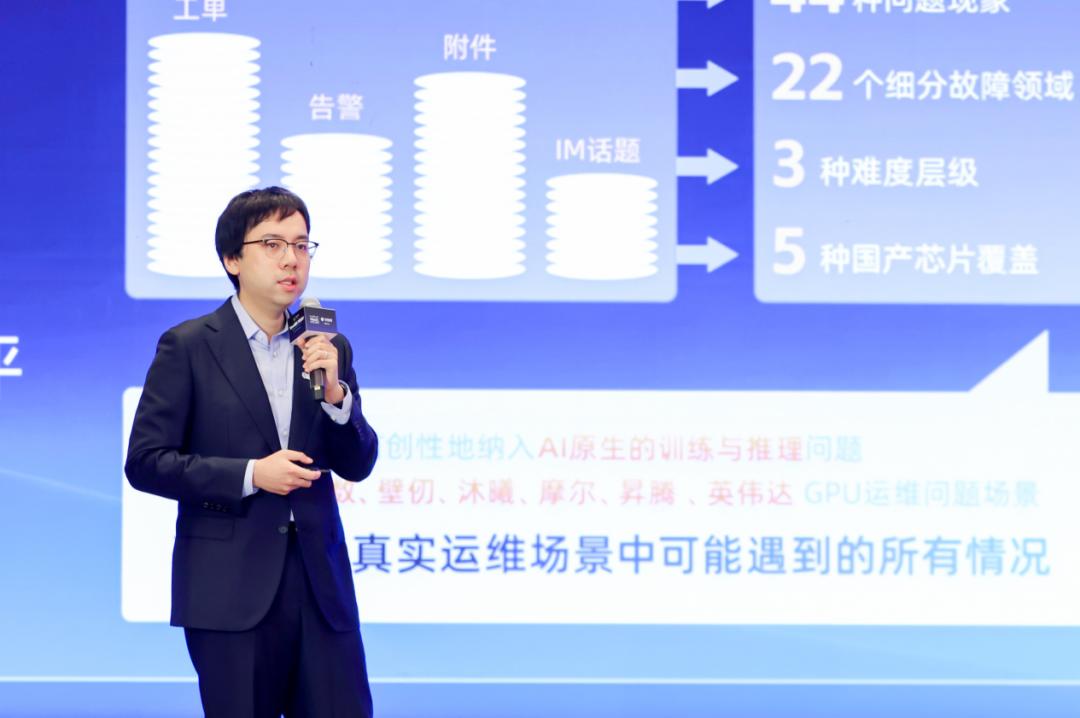
Xia Lixue, Co-founder and CEO of Wuben Corefirm
Another co-founder and chief scientist Dai Guohao also graduated from the Department of Electronic Engineering of Tsinghua University, currently is an associate professor at Shanghai Jiao Tong University, and has won many best paper awards at international academic conferences. CTO Li Boxun holds bachelor's and master's degrees from the Department of Electronic Engineering of Tsinghua University, former algorithm director of Megvii Technology, long deeply engaged in AI algorithm and software-hardware co-optimization.
The common accumulation of this team comes from the "Energy Efficient Computing Group of the Nano Integrated Circuits and Systems Laboratory (NICS-EFC)" led by Professor Wang Yu of Tsinghua University. Since 2008, the experimental group has been continuously rooted in the forefront of software-hardware co-design and AI computing power system research, and has accumulated more than ten years of technical experience in related fields. This long-term scientific research accumulation has also laid the foundation for the emergence of Wuben Corefirm.
At the early stage of the AI Infra industry, the development logic of the industry was very simple, which was to stack more computing power to support larger-scale models. With the continuous development of domestic chips, the supply of computing power has gradually shown diversification, and new problems have emerged: how do chips of different brands and different architectures work together? How to convert scattered computing power resources into stable, efficient and sustainable model training and inference capabilities?
This is exactly the direction that the Wuben Corefirm team has long been deeply engaged in. Public information shows that as early as 2024, Wuben Corefirm completed the world's first "4+2" type hybrid training of 70-billion-parameter large model on heterogeneous chips, using four domestic chips including Huawei Ascend, Iluvatar Corex, MetaX, Moore Threads, and two imported chips including AMD and NVIDIA, with a computing power utilization rate of 97.6%.
At present, it can complete the adaptation of new chips within 2 working days, reducing the adaptation cost of domestic chips by more than 70%; in the training of trillion-parameter-level MoE models, its throughput is 41% to 75% higher than that of mainstream open source frameworks, and it has even achieved a 10-fold reduction in inference cost within one year.
Behind these indicators is the technical accumulation of the team, from the laboratory to the front line of the industry, always deeply engaged in diversified heterogeneous computing and software-hardware collaborative innovation.
In the long run, the localization and diversification and fragmentation of computing power supply will make heterogeneous collaboration a continuous industrial demand. Wuben Corefirm has built a technical system around "M types of models × N types of chips" in advance, which exactly covers this long-term demand.
This first-mover advantage has allowed it to occupy a favorable position in the domestic heterogeneous layout.
02. "Front Shop, Back Factory, One Center" Strategy: No Involvement in Models or Chips, Neutral Platform Seizes the Outbreak of Token Demand
With the accelerated development of Agent applications, the tasks that AI infrastructure needs to handle are more complex. Wuben Corefirm officially proposed the strategic layout of "Front Shop, Back Factory, One Center" at the 2026 World Artificial Intelligence Conference, to deal with these challenges in three parts.
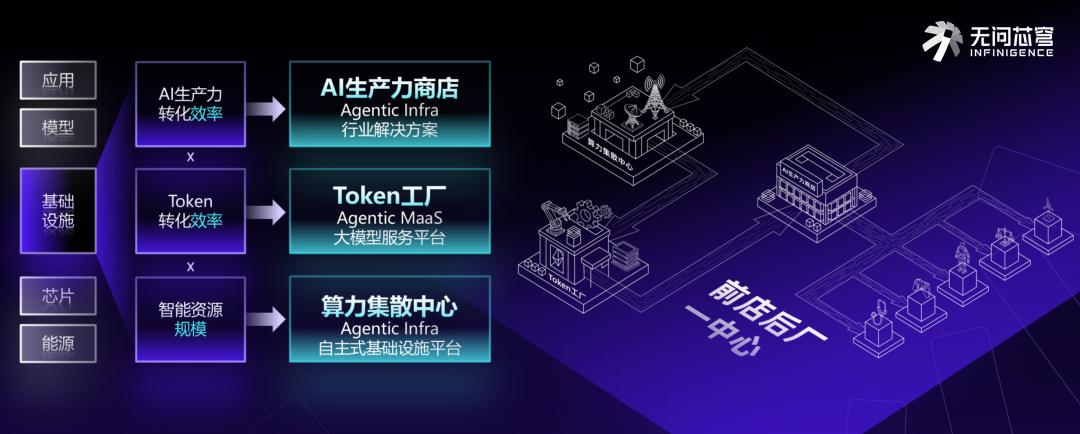
1. Computing Power Distribution Center: 37,000P Heterogeneous Computing Power, Realizing Production-level Hybrid Training
The "one center" refers to the Computing Power Distribution Center, corresponding to the Agentic Infra autonomous infrastructure platform, which is responsible for aggregating, managing and scheduling diverse heterogeneous computing power.
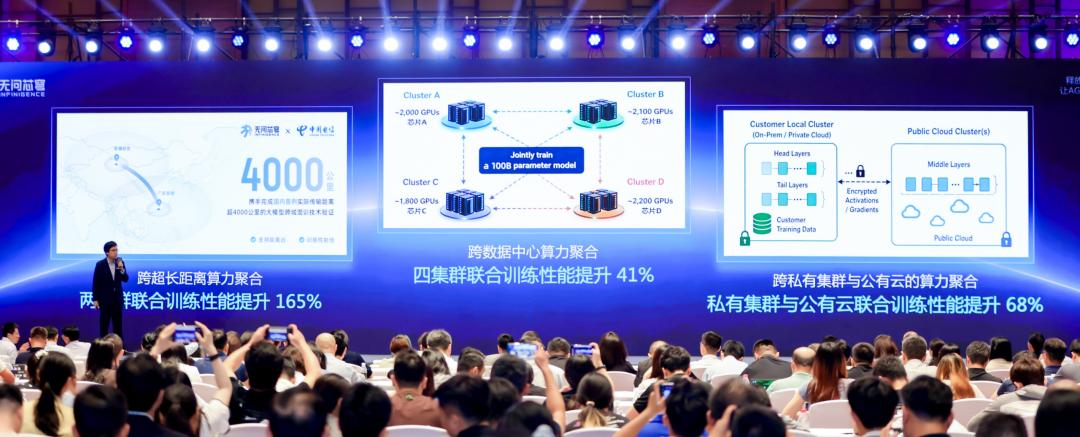
In response to the scattered and fragmented status of heterogeneous computing power, Wuben Corefirm has built a cross-domain training system for large models oriented to heterogeneous clusters. This system has withstood the production-level test of three types of cross-domain computing power aggregation training practices.
The first is ultra-long-distance aggregation. The company, in cooperation with China Telecom, completed the first domestic cross-domain hybrid training of large models over a distance of more than 4,000 kilometers, achieving a 165% improvement in joint training performance between clusters in Hami, Xinjiang and Shenzhen, Guangdong.
The second is multi-data center aggregation. It connects 4 GPU clusters of different generations and different models, jointly trains large models with nearly 10 billion parameters, and the collaborative performance of the four clusters is increased by 41%.
The third is hybrid cloud computing power aggregation. It realizes secure interconnection and hybrid training of local private clusters and public cloud computing power, with an overall performance improvement of 68%. At present, this cross-domain training system has been deployed across the country to cover more than 37,000P computing power, covering 16 mainstream chips.
2. Token Factory: 40-fold Growth in Daily Average Calls, 10-fold Reduction in Inference Cost
The "Token Factory" corresponds to the Agentic MaaS large model service platform, which is responsible for converting model capabilities into callable Token services.
In July 2026, Xia Lixue disclosed the optimization results of Wuben Corefirm's original new-generation inference system at WAIC, the cross-cluster heterogeneous PD separation architecture PDD. Based on the long-term large-scale practice accumulation of Agentic MaaS online business, this architecture reduces the first Token latency by 51.5% while reducing the cost per Token by 37.5%.
In the past year, Wuben Corefirm's Token factory has promoted a 10-fold reduction in inference cost through a series of original technological innovations. The company believes that with the large-scale implementation of the cross-cluster heterogeneous PD separation architecture, there is still a 10-fold room for reduction in inference cost.
The growth flywheel has also been fully operational. Official data shows that as of July this year, the daily Token call volume of this platform has achieved a 40-fold explosive growth compared with December last year.
3. AI Productivity Shop: From 3D Games to Law Firm Partners, Tokens Are Converted Into Real Economic Benefits Here
The "AI Productivity Shop" corresponds to the industry solutions of Agentic Infra. For the same scenario, different model scales and different hardware configurations may correspond to completely different Token costs. Wuben Corefirm takes the agent scenario adaptive technology as the core technical path to improve the conversion efficiency of AI productivity, outputs Agentic Infra solutions for the industry, and implements Tokens into deliverable industrial business results.
In the entertainment and game scenario, Wuben Corefirm cooperates with VAST's Tripo 3D large model to jointly create the AGENTIC 3D GAME GEN solution; in the legal terminal scenario, the company builds a law firm exclusive AI partner "Law Shield Core Man", and carries out cooperation with many law firms and ecological partners; in the energy and power scenario, the company is exploring an intelligent prediction and collaborative scheduling solution for computing center energy consumption based on agent technology with China Southern Power Grid Energy.
The three parts of "Front Shop, Back Factory, One Center" respectively cover underlying computing power, intermediate model services and upper-level industrial applications, forming a business chain from resource scheduling to Token production, and then to productivity conversion.
Another notable feature of Wuben Corefirm is that it adopts a light asset operation model. Wuben Corefirm does not own physical data centers, but reaches and manages computing power in third-party facilities distributed all over the country through technical services, and adapts to different AI chips such as Huawei Ascend and Moore Threads, using a lighter balance sheet to achieve faster expansion speed.
At the same time, the value of the independent third-party platform is emerging. Wuben Corefirm does not make models or chips, remains neutral, acts as an independent platform connecting models, chips and customer needs, organizes scattered model capabilities and heterogeneous computing power, and continuously optimizes the conversion efficiency from underlying resources to AI productivity.
Looking at the current industry pattern, the Infra of large manufacturers mainly serves internal business, the Infra of chip manufacturers is bound to the hardware ecosystem, and the self-built Infra of model companies is restricted by competitive relations. While independent cloud vendors that choose to stay neutral are growing into the core hub of the Token economy.
At present, Wuben Corefirm's customers and partners cover leading model enterprises, scientific research institutions and industrial customers. In terms of model services, the company cooperates with enterprises such as Kimi and Zhipu AI, and more than 100 large models have been launched on the Agentic MaaS platform to support customers to call on demand.
03. Double No.1 in Financing: All-star Investor Lineup, Valuation Still Has Room to Rise
The total accumulated financing of 4.3 billion yuan has refreshed the new high of China's AI Infra financing amount in one fell swoop, which is a concentrated vote of capital for Wuben Corefirm's development path.
Judging from the publicly disclosed investors, the company has formed a diversified shareholder lineup behind it. Since its establishment, its investor lineup is very luxurious, covering multiple categories such as state-owned institutional investors, industrial investors, and market-oriented financial investment institutions.
Among them, state-owned institutional investors include Hangzhou High-tech Investment, Social Fund Zhongguancun Fund (managed by Legend Capital), Zhuhai Science and Technology Industry Group, Xiamen Guoxing Investment, Xuhui Capital, Futeng Capital, China Insurance Investment, China Development Science and Technology Innovation, etc.; industrial investors include Dabanc Holding, Lenovo, JiuKun Investment, Tongge Investment, Tencent, Baidu, etc.; financial investment institutions include well-known institutions such as HSG, Hongtai Fund, Huiyuan Capital, Qiming Venture Partners, Dachen Caizhi, Shunwei Capital, and Lisi Capital.
Diversified investors have made it a recognized target in the industry. The national team values long-term compound interest, local state-owned assets value digital economy infrastructure, industrial capital values ecological collaboration, and leading VCs value the outbreak of the track. Funds of different attributes place bets at the same time, pointing to the same judgment: AI infrastructure is evolving from a technology project to an industrial base.
Compared with overseas markets, domestic AI Infra vendors still have obvious valuation space.
According to public information, Fireworks AI completed a 250 million US dollar Series C financing in October 2025 with a valuation of 4 billion US dollars; after completing a 1.505 billion US dollar Series D financing in July 2026, its valuation rose to 17.5 billion US dollars. Baseten has received two consecutive rounds of financing this year, and its valuation has also risen sharply to 13 billion US dollars in a short period of time. Together AI completed another 800 million US dollar financing in July 2026, with a valuation of 8.3 billion US dollars.
It is worth noting that NVIDIA has invested in all three of the above companies. For the chip industry chain, AI infrastructure can help more models run on a larger scale, and further release the application value of underlying hardware.
The similarity between Wuben Corefirm and them is that they all seize the inference market brought by the outbreak of agents in advance, and all serve model vendors and AI-native enterprises.
There are two differences: First, Fireworks, Baseten, and Together AI mainly run on the NVIDIA ecosystem, with relatively concentrated optimization objects; Wuben Corefirm faces the reality of the coexistence of multiple chips such as NVIDIA, AMD, Ascend, Biren, and Moore Threads, and must solve the heterogeneous collaboration problem from the bottom layer. This is a rigid demand in China, but not a core proposition overseas.
Second, overseas Neo Cloud generally builds or rents GPUs and expands through debt, and its profits depend on the spread of computing power leasing; Wuben Corefirm does not own data centers, takes the software orchestration layer as the core, earns profits from efficiency improvement, has lighter assets, faster expansion, and lower dependence on a single hardware system.
These