Why does our brain get foggier the more we use AI?
AI can help employees improve work efficiency, expand their thinking and drive innovation, but it may also cause cognitive overload, thus bringing negative impacts to both individuals and enterprises. Research shows that what matters most is not the extent to which individuals use AI, but how employees, teams, leaders and organizations shape the way AI is used.
On the first day of the 2026 New Year, programmer Steve Yegge launched the open-source platform Gas Town, which allows users to schedule a large number of Claude Code agents at the same time to assemble software at an astonishing speed. Its results are amazing, yet also dazzling. "There are far too many things happening on the platform beyond people's comprehension," wrote an early user. "When I watch it run, I clearly feel a sense of pressure. Gas Town is so fast that I can't keep up with it."
Gas Town reveals an increasingly prominent contradiction: AI is supposed to act as an "amplifier" that boosts efficiency and makes work easier, but employees find that AI tools not only fail to simplify their work, but make it even more onerous.
This situation is becoming increasingly common. Companies are encouraging employees to form and manage complex agent teams through various incentives. For example, they take token consumption as a performance measurement indicator, and conduct assessment and rewards based on it. Take Meta as an example, the company takes the number of lines of AI-generated code as one of the performance indicators for engineers. As more and more enterprises adopt multiagent systems, employees have to frequently switch between more tools. Dealing with multiple tasks at the same time and constantly switching between ongoing work is becoming a typical feature of employees' collaboration with AI.
Unsurprisingly, employees find that their cognitive capacity has reached the limit when working in this way. Many AI users posted on social media that their cognitive load has increased, their attention is almost saturated, and they feel mental fatigue. Francesco Bonacci, founder and engineer of Cua AI, published a widely noticed post on the X platform titled "Vibe Coding Paralysis: When Infinite Productivity Breaks Your Brain". He lamented in the article: "At the end of each working day, I am completely exhausted. What makes me tired is not the work itself, but the management of the work."
Our research team has been paying attention to the emerging workforce and AI trends, and these stress signals have caught our attention.
Existing studies present contradictory views on the relationship between AI and employee burnout. Occupational burnout is a long-term work stress state, manifested as physical and mental exhaustion, negative emotions towards work, and reduced work efficiency. Some studies show that replacing heavy tasks with AI can relieve fatigue; while other studies (sometimes targeting the same group) show that using AI will bring a sense of burnout. At the same time, high-intensity supervision of AI will trigger a drastic and overwhelming mental fatigue, which is different from occupational burnout, further complicating the problem.
To figure out the actual situation, we conducted a survey of 1,488 full-time employees of large U.S. enterprises (48% male, 51% female; 58% non-managerial employees, 41% managers), distributed across different industries, positions and job levels. We asked them about their AI usage patterns and frequency, work experience, as well as cognitive and emotional status.
We found that cognitive exhaustion caused by continuously supervising AI agents is not only real, but also has a significant impact. We call this phenomenon "AI brain fry", and define it as "mental fatigue generated by overusing or supervising AI tools beyond one's own cognitive capacity". This AI-related mental stress will bring significant costs, manifested as rising employee error rates, decision fatigue, and increased willingness to leave the job.
We also found that when AI is used to replace routine and repetitive tasks, the occupational burnout score will decrease, but the mental fatigue score will not decrease accordingly. This highlights a subtle but important difference: AI can relieve certain types of stress, but it may also exacerbate other types of stress.
Our research results are both a guide and a warning. If used prudently, these data can help enterprises design AI-driven workflows to reduce employee burnout. Even under the background that AI increases work intensity, enterprises can formulate specific measures for managers, teams and organizations to avoid mental fatigue.
Using AI Causes Mental Fatigue
Nowadays, there are huge differences in the ways employees use AI in many aspects: the number of tools used at the same time, the extent to which AI replaces work rather than assists work, the level of supervision required, and whether AI increases or reduces the overall workload. Employees may use search agents, research agents, data analysis tools, image generation or design tools, or programming agents. We combined these usage patterns with cognitive assessment indicators for analysis to understand the impact of AI usage on employees' mental state, and obtained some important findings.
First of all, in the process of using AI, the most mentally demanding link is "supervision", or the extent to which employees directly supervise AI tools. In our study, employees who said they needed high-intensity supervision of AI at work consumed 14% more mental energy than those who did not need high-intensity AI supervision. At the same time, high-intensity supervision of AI leads to a 12% increase in mental fatigue, and a 19% increase in information overload, that is, feeling overwhelmed by the large amount of information that needs to be processed at work.
Secondly, the extent to which employees feel that AI increases their workload is also an important predictor of cognitive load and mental fatigue. The two factors of "supervision of AI" and "increased workload" expand the scope of employees' responsibilities, requiring them to pay attention to more outputs from more tools in the same period of time.
As a result, the cognitive load increases, and mental exhaustion intensifies accordingly.
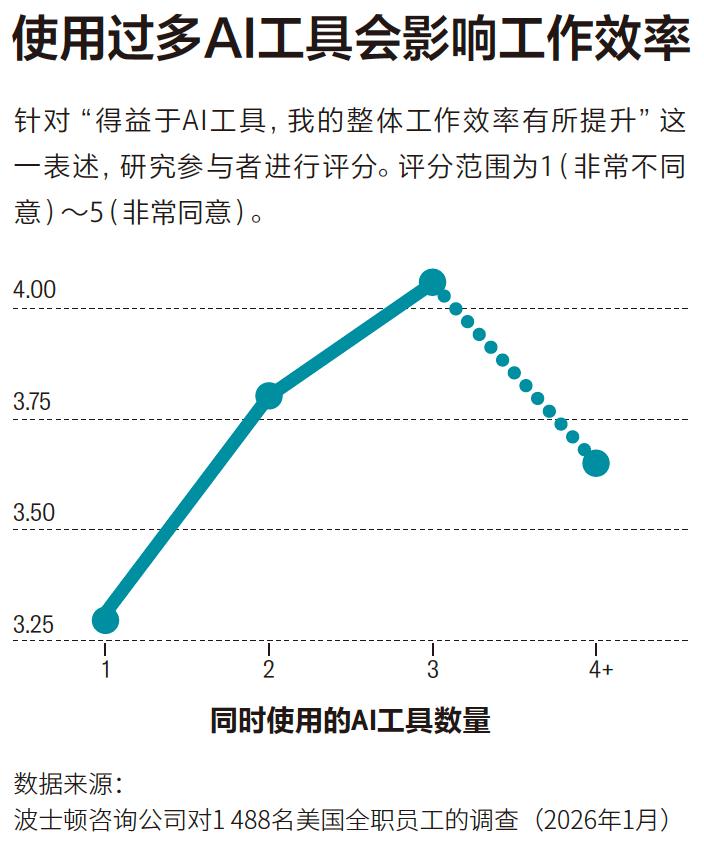
Thirdly, we found that there is a very interesting correlation between the number of AI tools used at the same time and the perceived efficiency improvement of employees. When employees switch from using only one AI tool to using two at the same time, their work efficiency is significantly improved (see the chart "Using Too Many AI Tools Will Affect Work Efficiency"). When they introduce the third tool, work efficiency continues to improve, but the growth rate slows down. After more than three tools, the efficiency score begins to decrease. It is well known that multitasking is often not efficient, yet people are repeatedly attracted to it.
Although using AI often causes mental fatigue, it does not seem to exacerbate occupational burnout. In fact, using AI to replace repetitive work can reduce burnout instead.
This may sound counterintuitive, but it has its own logic. In relevant literature, occupational burnout and acute mental fatigue are two different problems. Assessments of occupational burnout usually focus on physical and emotional distress (for example, asking "Does work make you feel exhausted"). In contrast, acute mental fatigue stems from individuals continuously mobilizing attention, working memory and executive control beyond their limited capabilities, which is exactly the requirement of high-intensity AI supervision work.
Manifestations of "AI Brain Fry"
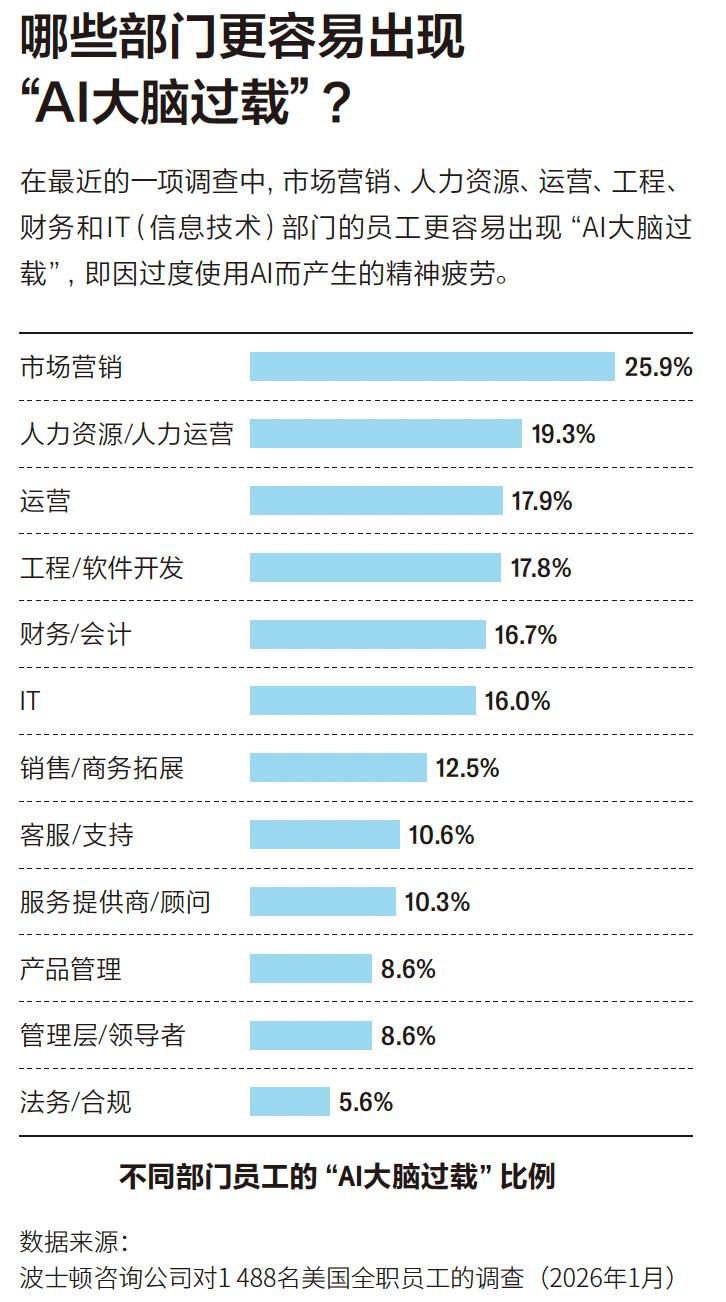
At the end of the study, we asked participants whether they had ever experienced "AI brain fry", that is, "feeling mentally fatigued due to overusing or supervising AI tools beyond their own cognitive capacity". In our study, 14% of the participants gave a positive answer, but there were great differences among employees in different functions (see the chart "Which Departments Are More Prone to 'AI Brain Fry'?").
So what is "AI brain fry"? Many participants described this state with "brain fog" or "buzzing in the head". They described that after high-intensity operation of AI tools, they could not maintain clear thinking, and their mental state was like a hangover, specifically manifested as difficulty in concentrating, slow decision-making and headache, and some people even had to leave the computer to "reset" their state.
For this feeling, a senior engineering manager described: "One AI tool helps me weigh technical decisions, and the other is responsible for generating drafts and summaries. I keep switching between the two and double-check every detail. This not only fails to make me act faster, but also makes my brain chaotic. It is not physical exhaustion, but a feeling that my brain is completely stuffed. It is like a dozen web pages are open in my mind at the same time, all competing for my attention. I find myself re-reading the same content repeatedly, more self-doubting than usual, and becoming extremely anxious. My thinking is not problematic, it is just flooded by noise, and my mind seems to be full of interfering signals. What finally woke me up was that I realized that managing these tools consumes more energy than actually solving the problem."
This description is very representative, consistent with the experience we heard from many participants. From a qualitative perspective, information overload and task switching are important factors causing "AI brain fry". From a quantitative perspective, we found that there is a significant correlation between "AI brain fry" and information overload, but the relationship with task switching is not so direct.
The Non-negligible Enterprise Cost
"AI brain fry" is far more than just uncomfortable. Our data shows that the cognitive pressure caused by high-intensity AI usage will bring many high costs to enterprises.
Decision Fatigue. Perhaps not surprisingly, when high-intensity AI usage causes cognitive load and depletes our mental energy, the psychological resources available for making high-quality decisions will decrease. In our study, employees who experienced "AI brain fry" had 33% higher decision fatigue than those who did not. A 2018 study estimated that for an enterprise with an annual revenue of 5 billion US dollars, the loss caused by poor decision-making can be as high as 150 million US dollars per year. If employees' decision fatigue increases by 33%, the annual cost of the enterprise may increase by millions of dollars.
Large and Small Mistakes at Work. We define "small mistakes" as "small errors that are easy to find or correct", such as code or format errors, and "big mistakes" as "errors with more serious consequences", such as errors that may affect safety, results or important decisions. Among the participants who used AI at work, those who had experienced "AI brain fry" reported significantly higher error rates. Compared with those who did not experience this situation, they were 11% more likely to make "small mistakes" and 39% more likely to make "big mistakes".
Turnover Risk. In many cases, employees who use AI intensively are exactly the star employees at present, the talents that the company must retain. However, there is a significant correlation between "AI brain fry" and employees' turnover intention. Among employees who have never experienced "AI brain fry", about 25% showed the intention to leave voluntarily; while among those who had experienced "AI brain fry", this proportion is close to 34%. We found that among heavy AI users, the intention to leave voluntarily increased by 39%.
Less Drudgery Leads to Less Burnout
However, not every use of AI will lead to "brain fry", and we also focus on how AI can relieve employee stress. The study found that when participants used AI to significantly reduce the time spent on routine or repetitive tasks, their occupational burnout scores were significantly lower, 15% lower than those of employees who did not use AI in this way.
The logic is intuitively understandable. Repetitive and tedious work, which our colleagues call "drudgery", is exactly the most suitable task for AI to complete. If we hand over this kind of unpleasant work to AI, we can free up more time to engage in more pleasant and more creative tasks. In our study, employees who used AI in this way reported higher scores for work engagement and motivation, more positive emotional experiences with AI, and fewer negative emotional experiences. They are more closely connected with colleagues, perhaps because they have more time to "step away from the keyboard".
These findings further highlight the difference between occupational burnout and "AI brain fry": the former is more derived from emotional exhaustion, while the latter is an acute cognitive stress. When we replace certain tasks with AI, we have time to participate in positive activities that help restore energy, which also helps relieve emotional exhaustion. On the contrary, our research shows that when high-intensity supervision is required in the process of using AI, AI tools may trigger mental exhaustion.
Practices of Managers, Teams and Organizations Are Crucial
Employees' experience of using AI is not only determined by personal choices. Our research found that practices at the manager, team and organizational levels have an important impact on employees' AI usage experience.
Manager Level. If managers are willing to take time to answer employees' questions about AI, the mental fatigue scores of these employees are 15% lower than those who do not receive any guidance. Conversely, if managers require employees to figure out how to use AI tools on their own, employees' mental fatigue scores will be 5% higher. The cost is small, but real.
Team Level. When employees feel pressured from the team to use AI, their mental fatigue level will rise accordingly; at the same time, when there is a large difference in the degree of AI usage within the team, employees' mental fatigue level is also higher.
Organizational Level. Formulating a clear AI strategy and providing relevant training will greatly benefit employees. In contrast, in enterprises that fail to clearly communicate the role of AI, employees have higher mental fatigue scores. Similarly, if employees believe that the organization expects them to use AI to complete more work, their mental fatigue scores are 12% higher.
In this context, it is even more necessary for enterprises to emphasize the efficiency improvement brought by AI while also paying attention to employees' mental health. In our study, if employees believe that the organization values work-life balance, their mental fatigue scores are 28% lower than those who do not think so. These signals are equally important and have a huge impact.
Implications for Leaders
AI can help employees improve work efficiency, expand their thinking and drive innovation, but it may also cause cognitive overload, thus bringing negative impacts to both individuals and enterprises. Our research finds that what matters most is not the extent to which individuals use AI, but how employees, teams, leaders and organizations shape the way AI is used. The following are several suggestions for leaders.
Redesign positions, work and tools from a holistic perspective to clearly distinguish the responsibility boundary between humans and AI. The supervision of AI cannot be simply superimposed on the supervision of employees, nor can the same employee be allowed to manage too many AI agents at the same time without restriction. Just as we have a set of management norms when managing employees, corresponding boundaries need to be set for human-machine interaction and the supervision of agents themselves. Our research shows that when more than 3 AI tools are used at the same time, work efficiency will decrease instead. In contrast, when the team deeply integrates AI into the workflow and regards this technology as a collective capability rather than a personal competitive advantage, the cognitive burden on employees will be reduced. In addition, AI tool developers should also fully consider neurobiological laws. Tools that place lower demands on attention or working memory while supporting divergent creative thinking, promoting social interaction or supporting skill development will not only continue to create greater commercial value, but also stimulate innovation, promote growth, and bring pleasant experiences to users.
Clearly set expectations for AI and workload. When enterprises only emphasize the efficiency improvement brought by AI without explaining how it will affect the workload, employees often interpret it as an increase in work intensity. That is to say, this ambiguity may increase employees' stress. Leaders can effectively alleviate this pressure by clearly defining the application goals of AI in the organization, explaining how it will change the scope of job responsibilities, formulating supervision and guidance plans, and clarifying how the workload will change. 70% of AI transformation work should focus on people and processes, and provide employees with correct and clear guidance so that they can give full play to their potential.
Assessment indicators should focus on actual results, not workload and intensity. If workload is only taken as the incentive standard, it will cause waste of resources, low work quality and unnecessary mental stress. Leaders should set clear and strategically meaningful "North Star Goals" and ensure that the goals point to measurable results. They should be prudent when promoting efficiency innovation. For example, if a creative employee reduces the corresponding workload through automation, managers should not rush to assign new tasks to him