Bring the legendary Claude on board, can Google stage a comeback through Agent?
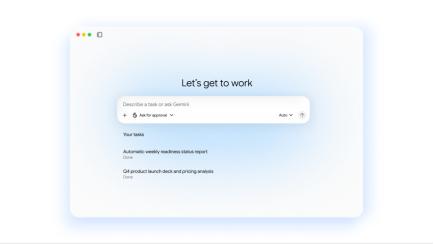
Google is now building its own agent too, and surprisingly, its confidence comes from Claude. The other day, Google Cloud launched the new Gemini Agent. It is named Gemini, but when facing challenging tasks, it can also call on Claude to complete the work.
In the agent ecosystem, Claude, the long-standing industry leader, has become a highly sought-after resource. Just the day before, Elon Musk announced that Grok Bot would select the most suitable model based on tasks in the future, and Claude was also on the candidate list.
Google especially needs some external support right now.
A week ago, Google just unveiled its new flagship model Gemini 4 Argon, which achieved impressive scores on various leaderboards, but the model is not open to the public yet. According to reports, its actual performance still falls short of the public's expectations for Google.
Google failed to stage an impressive comeback in the model track, but the agent sector has suddenly become bustling: Meta's Muse has just boosted the popularity of personal agents, opening a new overtaking lane right in front of Google.
Can Google achieve a curve overtaking with the help of agents? It is far from easy.
Nevertheless, trying to move forward is always better than standing still like Apple. At least this new track has not had the chance to launch a series of familiar consecutive blows to Google yet.
Google finally launched a decent agent
To be honest, Google is probably one of the most suitable companies in the world to build agents.
If you lay out all the components required for an agent, including models, tools, data, execution environment and user entry, Google has almost everything you need.
In particular, Google owns a full set of office products that have been operating for more than 20 years and have firmly occupied users' minds.
From Gmail, Calendar to Docs, Sheets, Drive, and then to Google Chat for teams, many people's work is already completed in Google's ecosystem; when office agents from other companies want to truly work for users, they often cannot bypass Google's system.
After many other agents have connected to Google's products one after another, Google has finally begun to make serious use of its existing advantages.
At the Gemini at Work conference on October 8 local time, Google Cloud CEO Thomas Kurian officially introduced the new Gemini Agent, trying to organize the originally scattered applications, data and workflows in Workspace into a unified working agent.
For example, you only need to tell it: "Help me schedule a meeting with several people in charge of the last event."
Gemini Agent can combine previous emails, group chat and calendar records, find relevant personnel within the authorized scope, check their available time, and then send emails to coordinate the meeting. Users do not need to re-tell it who each person is, nor do they need to open each application for operation one by one.
Relying on Google's powerful ecosystem, Gemini Agent can directly access the workflow of Google applications. In Gmail, if the boss sends an email requesting to organize the latest project progress into a PPT, Gemini can actively identify the task and provide a one-click entrustment entry. It can also modify documents in Docs, respond to tasks in Chat, and retain the same context, memory and skills when working across applications.
Of course, cross-application execution, long-term memory, and cloud operation are not new functions in the entire AI industry. Meta's Muse can help users shop, send emails and arrange trips through a dedicated cloud computer and browser; OpenAI's Dots also has an independent cloud computer, which can connect to applications authorized by users and continue to advance tasks after users leave.
Google's real advantage is that the capabilities of Gemini Agent can be directly combined with the ready-made enterprise collaboration system.
In addition to being a personal assistant, Gemini Agent can also become a long-term working team member. Google calls this form Coworker Agent. Users only need to describe what position they want it to take, and Gemini can create an AI colleague with fixed responsibilities and independent identity.
For example, the marketing team can create an agent responsible for event coordination. This agent will get its own Workspace account, including email, calendar and Drive storage space.
It can even appear in the company's address book. Colleagues can @ it in Google Chat to assign tasks just like contacting other employees, or ask it to modify files in the sub-comment area of Docs.
Coupled with data infrastructure such as Google Cloud and BigQuery, Gemini Agent can also connect to enterprise databases, call analysis tools, and even generate reports based on the company's existing business indicators and definitions.
Therefore, Google has the opportunity to extend the working scope of agents from the office software used daily by employees to the data and business systems in the enterprise background.
By the way, Microsoft also has a complete ecosystem like Microsoft 365 and Azure, and it even put Copilot into office software earlier. But after years of development, Microsoft has not been able to fully integrate the AI capabilities scattered in various products.
Admittedly, having abundant resources is one thing, but whether you can really make good use of these resources is another matter.
This time, Google has another very commendable point: it is more open-minded this time, realizing that its own Gemini may not be able to handle all tasks.
Therefore, it also invited the industry-leading Claude to work together.
Thomas Kurian clearly stated in the official introduction that Gemini itself is an agent, and the specific model behind it can be freely selected. It will choose a more appropriate model to complete the task according to the nature of the task.
At present, Gemini Agent can schedule between Google's own Gemini and Anthropic's Claude, and more models will be supported in the future.
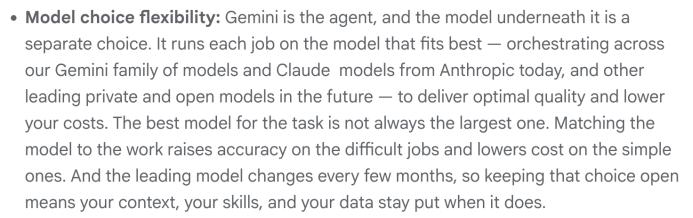
The official explanation sounds quite reasonable, saying that the top-performing model may change every few months, different tasks do not necessarily require the same model, and flexibly choosing suppliers can balance effect and cost.
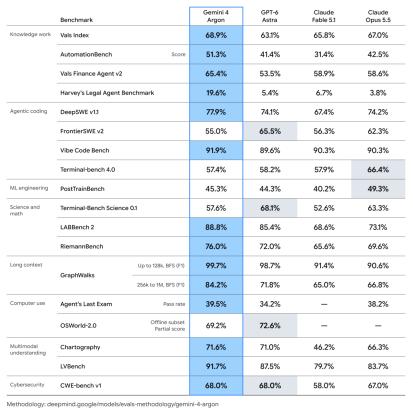
In fact, even in the beautifully polished evaluation list released by Google itself, Gemini 4 Argon only scored 57.4% on Terminal-Bench 4.0, while Claude Opus 5.5 scored 66.4%; on FrontierSWE v2, Argon also lags behind Claude's 62.3% with 55.0%. (The data from third-party independent evaluations is slightly different, but let's look at Google's own list first.)
At least in some complex programming and agent tasks, Google really cannot beat Claude.
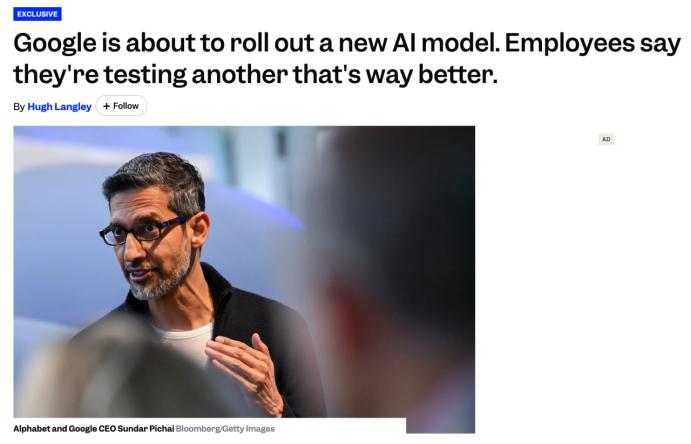
According to a report by Business Insider on October 9, a Google employee believes that the early tested Argon even lags behind the previous generation of Claude Opus 5 in some coding tasks.
Google has left itself a way out this time: when encountering hard tasks that its own model cannot handle, it can at least call for external help.
Google Cloud actually allowed enterprise developers to use Claude before, but this time, it further brings multi-model selection into the general-purpose working agent it provides.
At least on this enterprise product line, Google has begun to clearly prioritize the competitiveness of the agent itself over the exclusivity of its own model.
I think this step is worthy of recognition.
Why is Google always one step behind?
However, speaking of which, hasn't Google ever made agents before?
As early as December 2024, Google launched Google Agentspace, which integrated Gemini's reasoning capabilities, Google Search and enterprise data, allowing employees to search for information across systems, create and use agents.
In April 2025, Google launched Workspace Flows, allowing users to create automated workflows in natural language. For example, after receiving customer feedback, AI can automatically read the form, analyze the problem, find solutions, generate a reply, and then hand it over to customer service for review.
Last October, Google simply integrated Agentspace into the newly launched Gemini Enterprise, trying to build a unified enterprise AI work entry.
From enterprise search and cross-application automation to agent creation and scheduling, Google has long proved that it has the corresponding technology.
But the problem is that other players have already established distinct product awareness of agents with products such as Manus and Muse, while Google has never been able to launch a representative work that is equally popular.
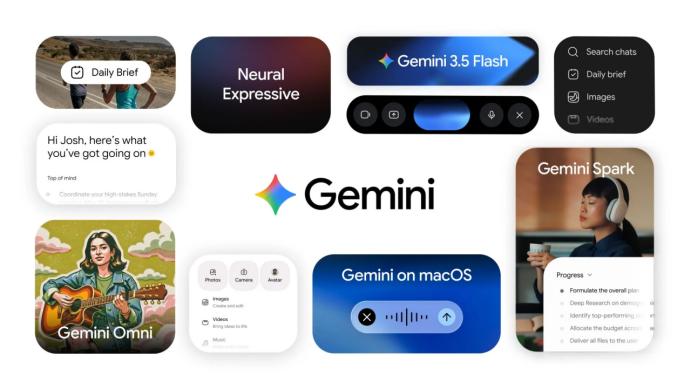
At the Google I/O conference in May this year, Google also launched the personal agent Gemini Spark, but this product hardly caused any splash after its release, which was almost like a dud.
Google has all the necessary resources, but it has not achieved remarkable results for a long time.
For readers who are familiar with Google, this plot is really not unfamiliar at all.
Looking back at the past few years, from general large models to chatbots, and now to agents, Google always seems to be unable to catch up with the latest market trend in time.
In 2017, Google researchers proposed the Transformer architecture, which laid an important foundation for the later large language models.
In terms of research, Google has a top team like DeepMind. In terms of computing power, it developed TPU by itself very early. Coupled with sufficient funds and a huge product ecosystem, it almost has no obvious shortcomings.
But in the era of general large models, OpenAI first made a name for itself with the GPT series.
As early as 2019 to 2020, Google engineers Daniel De Freitas and Noam Shazeer had already developed a conversational robot internally. The two saw the commercial potential of chatbots very early, and repeatedly promoted Google to open the product to external researchers, connect to Google Assistant, and even hold public demonstrations. But Google's management never gave the green light.
Interestingly, Shazeer later left his job and founded Character.AI, and was invited back to Google in 2024 through a $2.7 billion technology licensing transaction. he left Google again in June this year and joined OpenAI.
At the end of 2022, ChatGPT took the lead in detonating the consumer market and opened the era of chatbots.
Google then rushed to respond, even a little too hastily. In February 2023, Google's Bard had not been officially opened to the public, but it already made a joke because of a wrong answer in the promotional demonstration. Coupled with the underwhelming performance of the press conference that day, the stock price of Google's parent company Alphabet plummeted that day, with its market value evaporating by about 100 billion US dollars.
Of course, later Gemini did catch up in model capabilities — for a period of time — and Google's AI business is far from a failure.
But the interesting part is that Google always seems to get the ticket to the next generation of technology in advance, but it is difficult to become the first person to make new products popular.
It used to be models and chatbots, and now it is the turn of agents.
In terms of technology, resources and user base, Google is one of the most promising players every time. But when it comes to real market competition, it often becomes a follower, running behind others.
I think this may also be a common problem for established technology giants — they subjectively want to get things done, but they are too bloated to move fast, and easily dragged down by the organization.
Established companies do not lack talents, technology or determination. It can even be considered that it is precisely the success of the past few decades that has led them to build a huge, mature organizational system that is difficult to change easily.
But the problem is that what agents need to do is exactly breaking the boundaries between different products.
For startups, building an agent means designing a new product from scratch and connecting to other people's ecosystems; but for giants like Google, it means reorganizing the products and businesses they have accumulated over the past 20 years.
The more mature the business is, the more difficult the transformation will be. Whether a new function can be launched depends not only on whether it can be technically realized, but also on whether existing users will accept it, whether it will affect existing businesses, and who will be responsible if something goes wrong.
It is reasonable to have these concerns, but by the time large companies have considered all aspects clearly, the market may have already been preempted by others.
In addition to Google and Microsoft mentioned in the previous part, Amazon and Apple also have similar problems:
Amazon brought Alexa into millions of households as early as 2014, and behind it there is AWS, e-commerce and a huge smart home ecosystem. But in the era of large models, Alexa+ has experienced a long period of development and launch twists and turns, and has never set off a new product wave like ChatGPT.
Not to mention Apple, which holds billions of devices, a complete software and hardware ecosystem and the ready-made entry of Siri, but is powerless in the new round of AI competition. The originally promised personalized Siri has been delayed again and again, and the major upgrade was officially launched only this year, and it is still in the preview stage.
These giants clearly got the admission ticket early, but they often need to spend more time to really get on the train.
Of course, we can't attribute all problems to the organizational bloat of large companies. But at least from the past rounds of AI product competition, there has always been an awkward gap between Google's technical reserves and