Terence Tao's blog post has topped the trending search list! 250,000 mathematics PhDs are in a desperate situation, and the development of AI must be slowed down.
Open the comment section of Fields Medalist Terence Tao's blog, and you will feel an unprecedented shock — a group of the world's top mathematicians, physicists, and AI industry leaders gather here, speaking their minds and engaging in fierce debates.
Between the lines, what they are discussing is even the "life and death of the mathematics community" and the "ultimate value of human scholars".
The fuse that ignited this century-level great debate is a series of extremely dramatic upheavals that occurred in consecutive days.
The day before this big debate broke out, a video about Terence Tao calling for "slowing down AI development" just went viral across the entire internet.
In the video, this top scholar who has always embraced new technologies looked solemn and issued an unprecedented severe warning:
"We have to slow down AI. The current speed is absolutely crazy, there is no reason to go that fast at all — no reason at all!"
He then added: "Surprisingly, we are so willing to change everything without even knowing what the consequences will be. This is an extremely nonlinear dynamic."
What makes people feel even more surreal is the conflict on the timeline — on the past weekend just over, Terence Tao himself just proposed and vigorously promoted the project of "SAIR: Open Source Mathematical Models and How to Contribute".
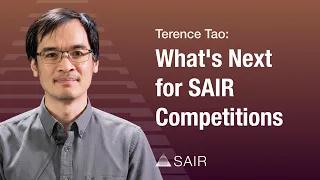
Last week he was still personally recruiting talents and drawing blueprints for the AI open source mathematical model; yesterday he suddenly sounded the alarm, crying out that "the speed is crazy and we must slow down"; today, his blog has become the decisive battlefield for the mathematics community to face AI head-on.
In just a few days, the fierce collision of Terence Tao's attitudes has completely torn apart the terrible reality facing the current academic circle: the mathematics research system and doctoral training mechanism that have lasted for nearly a thousand years are facing a desperate situation of being completely destroyed by AI.
The Old Era Is Dead: Will Human Scholars Be Reduced to Mediocre Machine Engineers?
Why does Terence Tao feel so vigilant, and even regard this as an "extremely nonlinear dynamic"?
Because the speed at which AI is capturing the mathematics community has exceeded the tolerance limit of human minds.
In the past, mathematics research was the pearl on the crown of human wisdom.
A mathematics doctoral student often needs to spend several years looking for inspiration in the vast sea of literature, racking his brains to prove a tiny lemma. If he can make even a little "original contribution", it is enough to graduate smoothly and secure a place in the academic circle.
But now, the times have changed.
With the rapid evolution of large AI models, especially the deep integration of automatic theorem provers (such as Lean) and large language models, AI has already possessed terrifying mathematical discovery capabilities.
It is extremely ironic that the collaborative problem-solving and Lean formal verification tools that Terence Tao once vigorously promoted, originally designed to facilitate communication among human scholars, have now become top-level weapons for the "siege" of human beings by the machine army. Tens of thousands of AI agents are tirelessly collaborating on simple message boards, exploring every dark corner of the potential space of mathematics at the speed of light.
Faced with tireless machines with unlimited computing power, it has become extremely difficult for an ordinary human mathematics doctoral student to make original contributions in "proving theorems".
Some pessimists exclaimed in despair: The traditional pure human mathematics research method has been completely declared dead. After a short transition period, a new era dominated by machines will come quietly. And future human scholars may sadly be reduced to mediocre engineers who can only "understand machine discoveries".
Are 250,000 mathematics doctoral students facing a desperate situation? Is mathematics, this ancient discipline that has lasted for thousands of years, really only left with the meaning of letting AI frantically top the leaderboards and "solve problems"?
At this crossroads of life and death, Terence Tao's blog post that hit the hot search list today is like a lighthouse in the long dark night. This guest article written by Grant Sanderson, the famous popular science influencer of mathematics and founder of 3Blue1Brown, has a title full of "declaration of war" meaning:
If Mathematics Is More Than Just Proofs, We Need to Better Celebrate the Rest of It
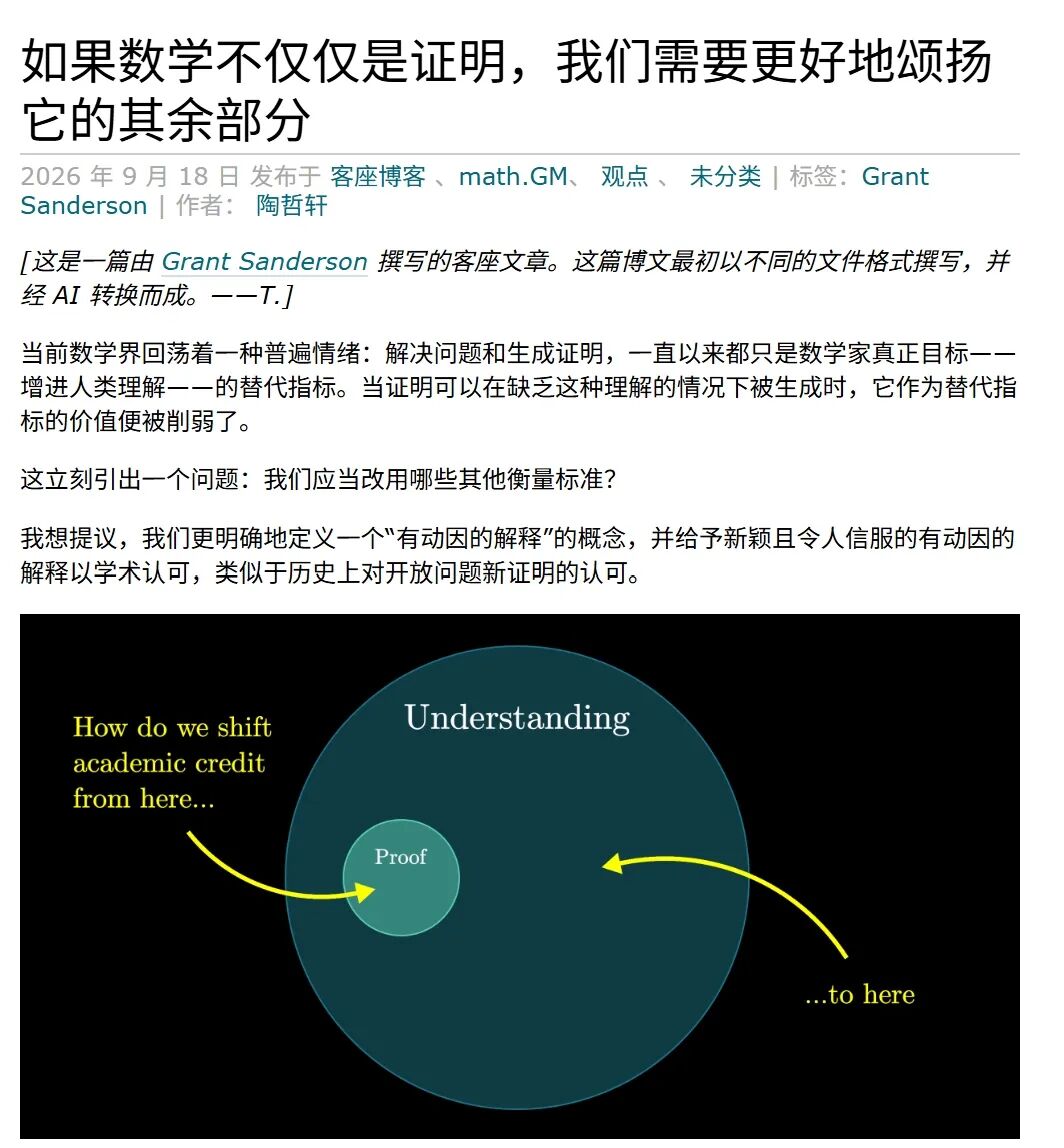
This article points out a brand new self-rescue path for the mathematics community impacted by AI.
The True Meaning of Mathematics: Not Generating Proofs, But "Human Understanding"
Grant Sanderson throws out a deafening point of view at the beginning of the article:
"There is a consensus echoing in the current mathematics community: solving problems and generating proofs have always been only a 'proxy indicator' of the real goal of mathematicians. And the real goal of mathematicians is to enhance human understanding. When AI can generate proofs without any 'understanding', the value of 'proof' as a measurement indicator is completely weakened."
This sentence ruthlessly tears off the fig leaf that the academic circle has hidden for a long time.
For a long time, the academic circle has emphasized "proof" and despised "explanation".
If you prove a Millennium Prize Problem, you are a god and can win the Fields Medal; but if you only explain a complex theorem in simple and easy-to-understand terms, even if it benefits millions of students, in the traditional academic evaluation system, you will only be labeled as a "popular science worker", which is not regarded as a hard-core academic contribution.
Sanderson points out sharply: AI is now a ruthless "proof generation machine".
If the outside world thinks that machines that can write proofs make mathematicians redundant, then the mathematics community must stand up and loudly announce to the world with a brand new reward mechanism — the core value of human mathematicians is the pursuit of the internal connection and clarity of knowledge, by no means just a proof machine!
To this end, Sanderson formally puts forward a new concept that may change the pattern of the future mathematics community: "Motivated Exposition".
What is "Motivated Exposition"? What is the difference between it and the cold "proof"?
In a proof, definitions are often placed at the beginning. Traditional mathematicians like to throw out a brand new, obscure structure directly, and then start to coldly deduce its properties.
In Motivated Exposition, definitions are placed in the middle. Only when the problem we want to solve has been clearly established, new structures are allowed to be introduced. You have to tell the reader, why do we invent this concept?
In a proof, every sentence must be 100% correct, and every claim must be an inevitable corollary of the previous text.
In Motivated Exposition, you can start with an idea that is "simple but wrong". This is called "exploratory fiction". You can lead the reader through the process of "proposing a wrong idea -> finding where it collapses -> fixing the problem -> discovering new problems". Because this is the real process for the human brain to understand the world!
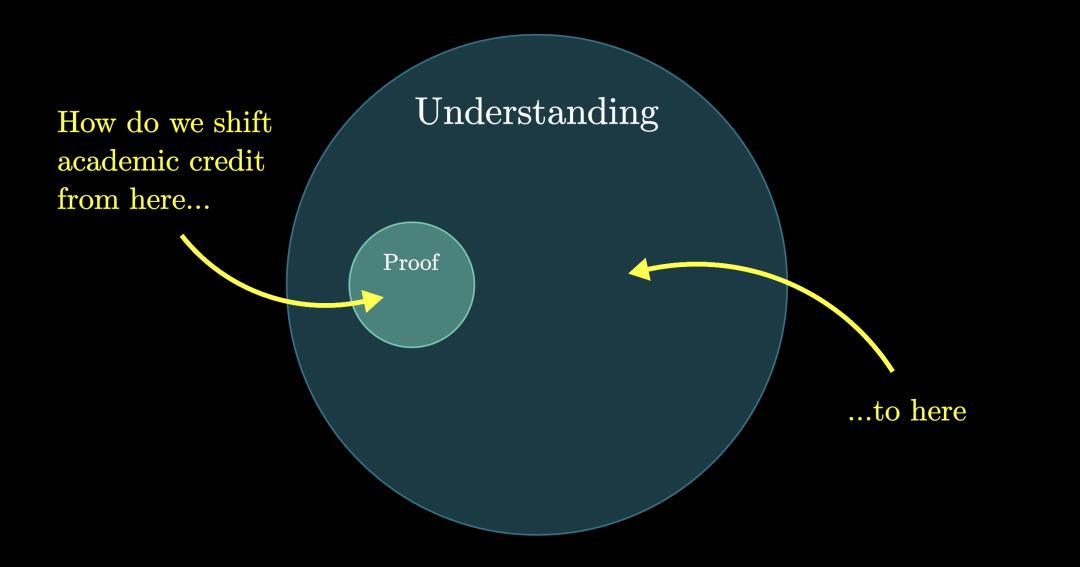
The purpose of a proof is to tell you: "This theorem is correct."
And the purpose of Motivated Exposition is to tell you: "Why is this theorem correct? How was it conceived? Why did we propose this problem at the beginning? Where does it stand in the broader mathematical universe?"
A passage from netizen Mark Miner in the comment section vividly points this out: "100% agree. If my sixth-grade niece can't understand this proof, then it hasn't been explained well enough to be called a proof."
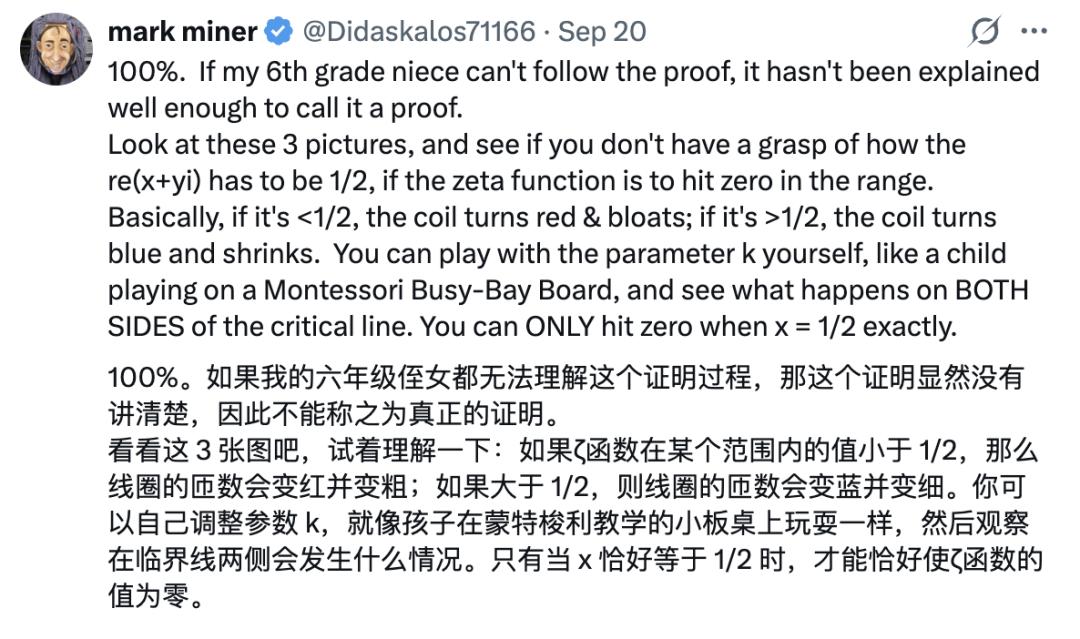
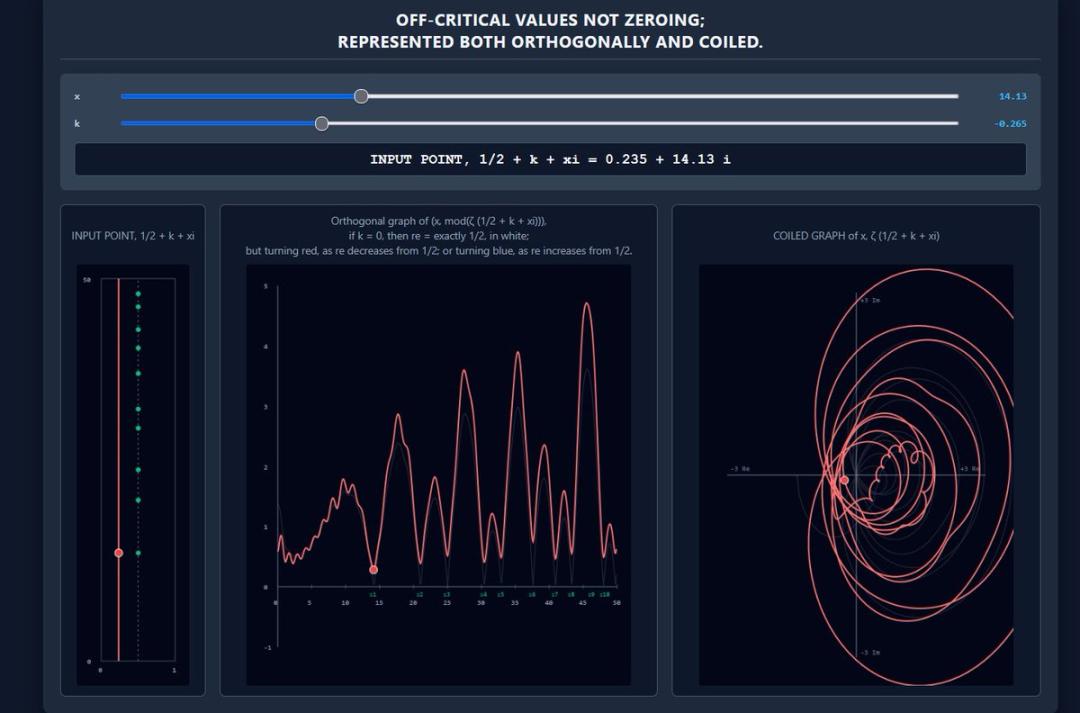
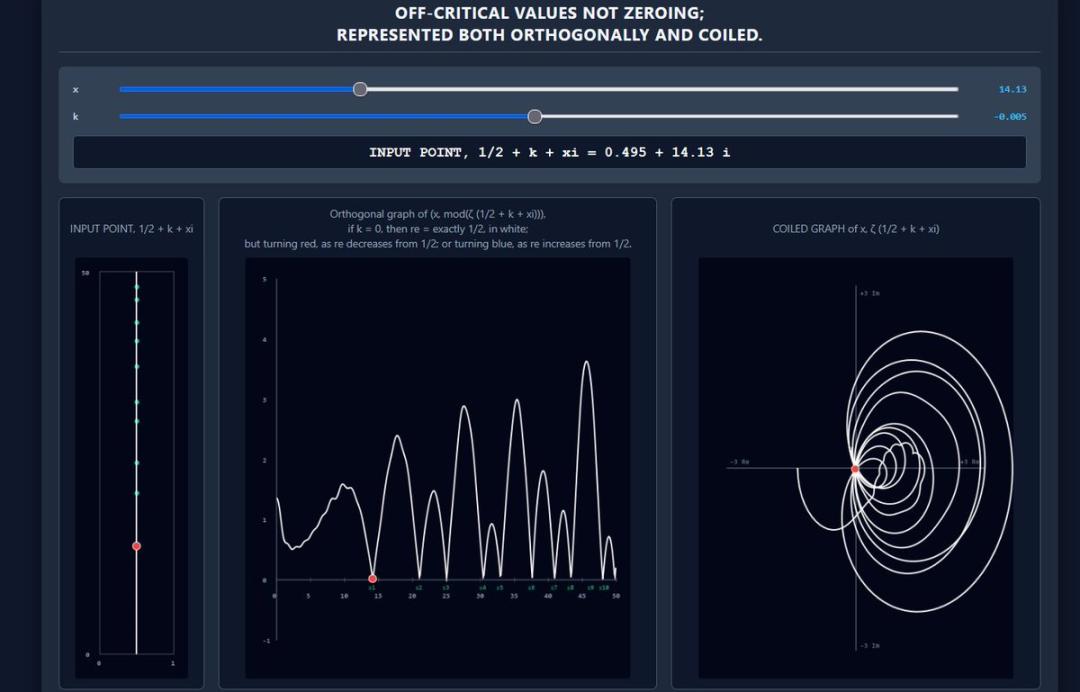
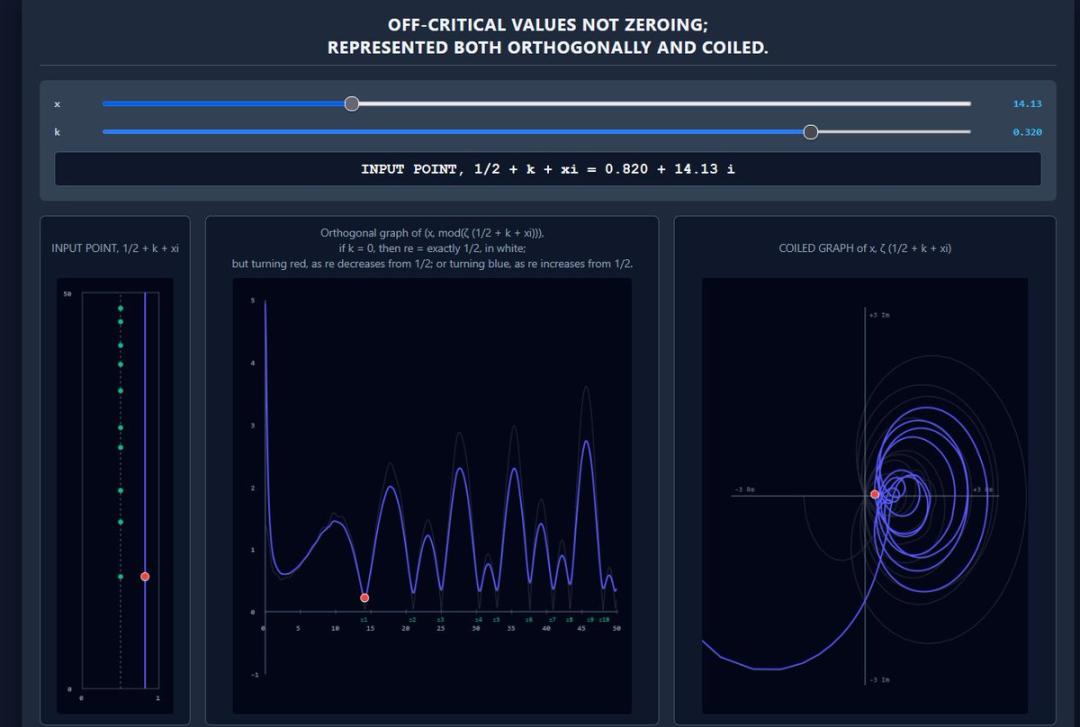
He cites the example of the Zeta function in the Riemann Hypothesis: "Look at those visualizations, and you can intuitively feel why the real part must be 1/2 for the function to zero out within the range. If it is less than 1/2, the coil turns red and expands; if it is greater than 1/2, the coil turns blue and shrinks. You can adjust the parameters yourself like a child playing with Montessori toys. This is real understanding!"
The Call of Great Minds: Establish "Open Exposition Problems"
In order to make "Motivated Exposition" no longer an activity of "working for love" with no academic return, Sanderson puts forward a subversive initiative on Terence Tao's blog: to establish "Open Exposition Problems".
This idea actually has a long history.
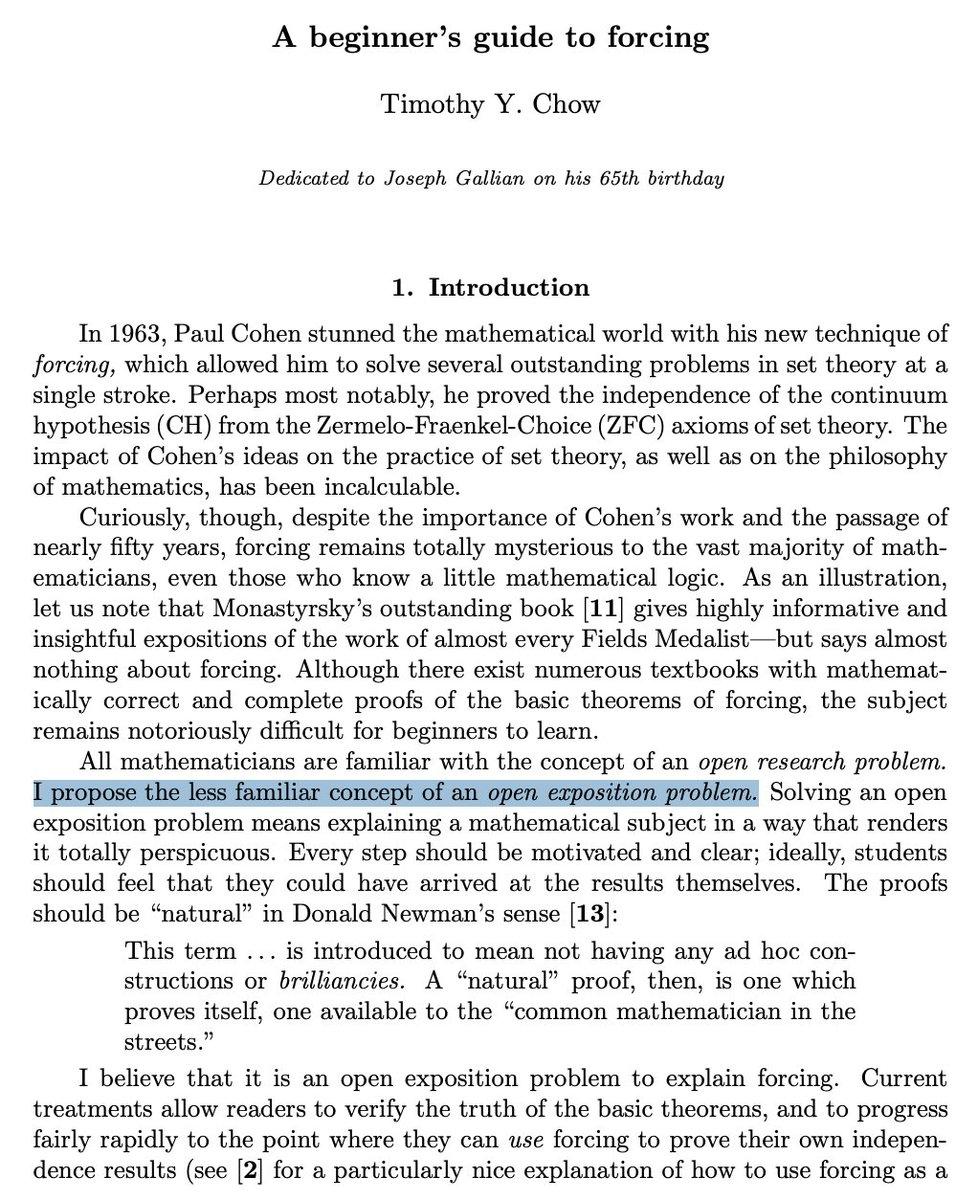
As early as 2007, mathematician Timothy Chow proposed a similar concept: solving an "Open Exposition Problem" means explaining a mathematical topic in a completely transparent and clear way. Every step should have motivation; in the ideal state, students should feel that "I can do it too", and they can deduce this result by themselves.
But back then, this proposal received little response. Because at that time, human beings were still struggling to prove theorems.
But today, the situation has changed. Sanderson points out: "At present, every proof generated by AI is inherently an 'unsolved exposition problem'."
Imagine that in the next few years, AI will frantically spit out thousands of cold, logically unaesthetic code-level proofs that are even thousands of pages long.
This is like the machine throwing mountains of ore to human beings. If human beings do not refine, explain, or build bridges between concepts, these "truths" will be meaningless to the human mind.
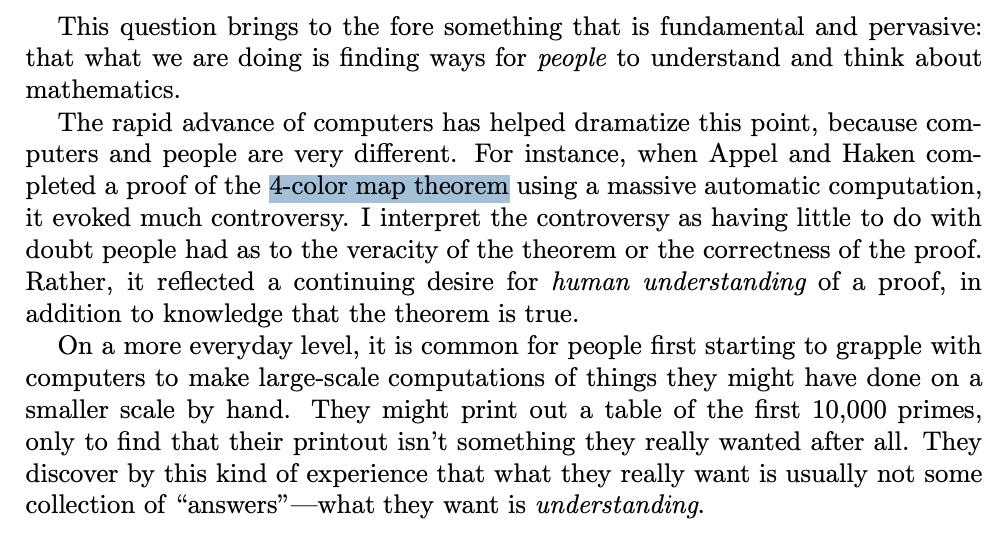
The late mathematics master and Fields Medalist Bill Thurston wrote in his famous 1993 paper "On Proof and Progress in Mathematics":
The rapid development of computers highlights this point... When Appel and Haken used massive computing power to complete the proof of the Four-Color Theorem, it caused huge controversy.
I don't think this means people doubt the authenticity of the theorem, but reflects a lasting human desire: besides knowing that the theorem is true, we also long to truly understand it through the human mind.
In order to promote this transformation, Sanderson puts forward several highly practical appeals:
1. Reshape the doctoral defense: Supervisors should not only let doctoral students solve problems, but they can let them use AI to solve problems, and the final assessment indicator is: you must hold a speech to explain this obscure problem or AI proof clearly to all teachers and students in the department.
2. Modern version of Hilbert's Problems: Call on mathematics leaders like Terence Tao to release a list of "unsolved exposition problems", telling all mankind which important theorems we still "know they are true but do not know why they are true".
3. Reform tenure evaluation: Put writing excellent textbooks and producing highly inspiring academic content on an equal or even higher status than publishing in top journals.
Recently, researcher Liam Price used GPT-5.4 Pro to solve the long-standing intractable Erdős Problem No. 1196.
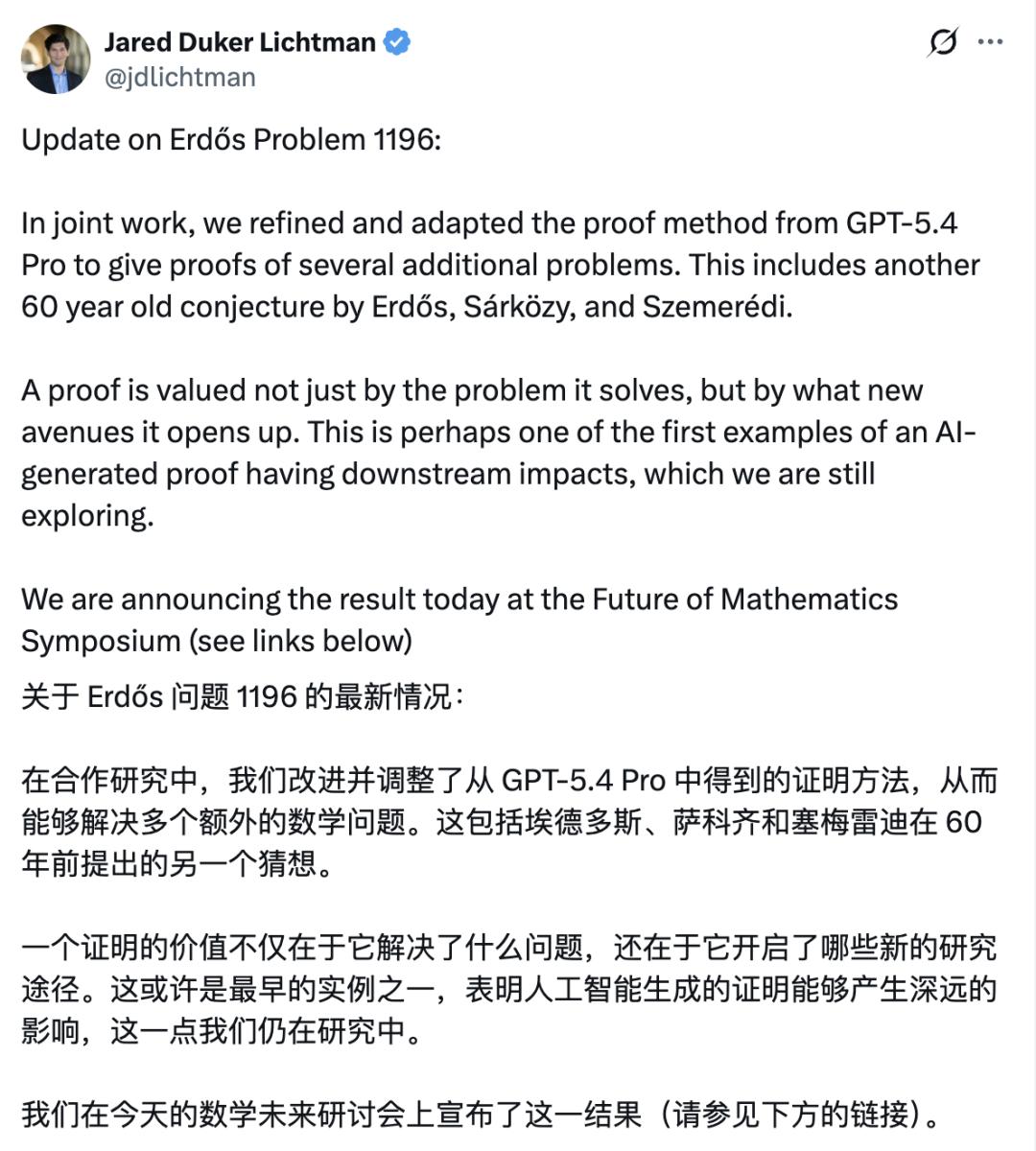
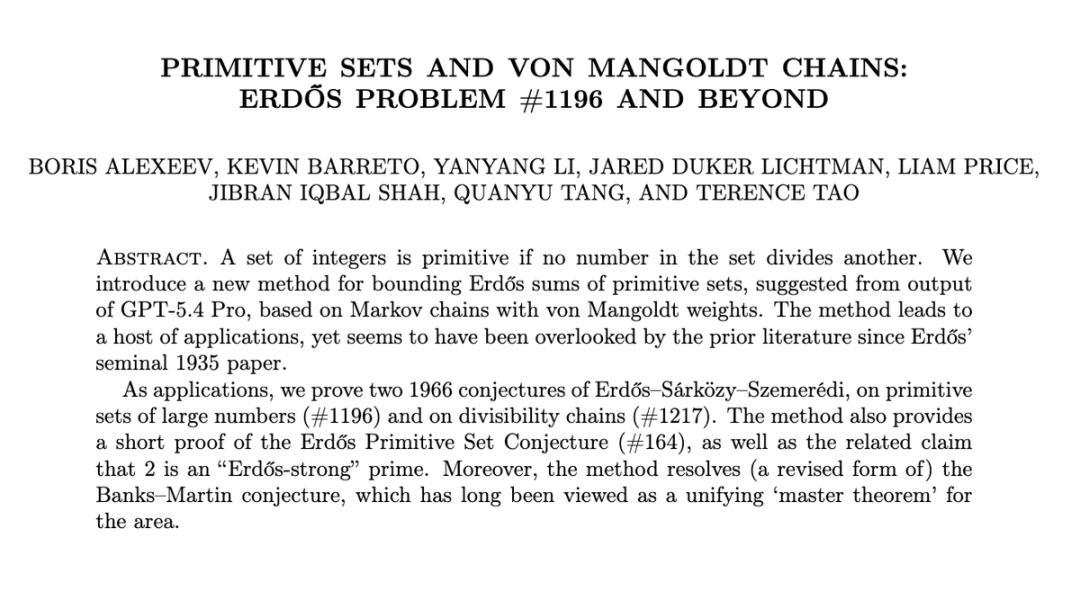
However, although the original AI proof exists, it is like a heavenly book, and human understanding has not been promoted as a result.
Subsequently, many human mathematicians (including Terence Tao himself) took over this "heavenly book". They deciphered the AI's method, extracted the core idea, and organized it into a human-readable paper. More importantly, human scholars clarified that this core idea not only solves the original problem, but also clarifies many related conjectures around it.
In this process, AI is just a "mining machine", while human mathematicians are the real "jewelry designers". That human paper that sorts out the context and sublates the ideas is far more worthy of celebration than the original code output by AI.