"Without Windows, NVIDIA would never have been born!" Jensen Huang declared, does the world's most valuable company owe its entire existence to Windows?
When the entire tech industry is shifting its focus to cloud-based large models, AI data centers and Agent portals, Jensen Huang, CEO of NVIDIA, brought the starting point of NVIDIA back to 1992 at a Microsoft event:
"NVIDIA was founded because of Windows... Without Windows, NVIDIA would never have existed in the first place."
Recently, at the joint event hosted by Microsoft and NVIDIA to unveil laptops equipped with the RTX Spark chip, Jensen Huang and Microsoft CEO Satya Nadella made a rare joint appearance, reviewing their decades-long partnership: from Windows, GeForce GPUs to CUDA, and further to providing computing power for OpenAI to train large models, the technical collaboration between the two tech giants has extended all the way to today's AI era.
However, this conversation did not only cover the past. As AI Agents begin to operate computers directly and call professional software, the two sides also shared their vision for the next-generation AI PC: to enable local computing power and cloud models to work in synergy, and solve the security and permission issues of Agents from the underlying operating system at the same time.
From jointly driving PC innovation to exploring personal computing in the AI era hand in hand, the two tech giants are trying to answer a new question: When AI is no longer just an application inside a PC, but an assistant that can use the computer on behalf of people, what will the PC evolve into?
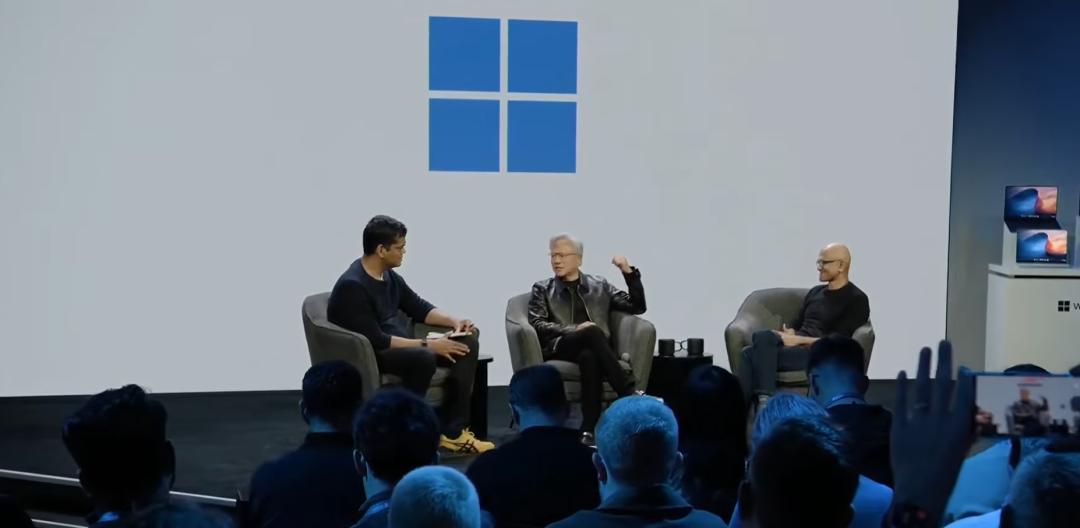
No Windows, No NVIDIA: The Partnership Between the Two Giants Dates Back to 1992
Sriram Krishnan: It's actually pretty rare to see both of you on the same stage together. Microsoft and NVIDIA share a deep partnership spanning decades, and you two have also worked together personally for decades. So Jensen, could you start by sharing with us, what is your most memorable or favorite memory from working with Microsoft and Satya?
Jensen Huang: NVIDIA was actually founded because of Windows. It was the end of 1992, when Windows 3.1 had just been released, and we started to vaguely foresee the possible future vision of PCs. To be honest, I had never even seen a PC before that, and I spent most of my time working on workstations, file servers, and supercomputers used for chip design.
At that time, my co-founder and I were discussing: what would the future look like if we added 3D graphics capabilities to PCs, so that they could not only play games, but also become workstations for engineering design? That's how we mapped out such a world, and it's fair to say that without Windows, NVIDIA would never have been born.
By 1995, Windows 95 truly redefined everything. Windows 95 made it possible to connect GPUs to PCs, and it was DirectX that completely revolutionized the GPU ecosystem. The Direct3D API allowed applications to call and unlock the full capabilities of GPUs. In the DirectX 8 era, we co-invented the world's first programmable GPU with Microsoft, which is the programmable shader. After several iterations and evolutions on this basis, CUDA, which is widely known by everyone today, was finally born.
Looking back at the entire development history of our company, Windows has always been at the core position:
No Windows would mean no GeForce → no GeForce would mean no CUDA → and no CUDA would mean researchers including Alex Krizhevsky, Ilya Sutskever, Yann LeCun and Andrew Ng could not find a single computer capable of running deep learning.
It is exactly this path that has brought us all the way to where we are today.
Satya Nadella: Haha, now Jensen is planning to transfer part of the market cap back to me.
Jensen Huang: I do that every single day!
Satya Nadella: The story Jensen just told is absolutely incredible, which in a sense is the entire history of computing technology development. What I admire most about Jensen is his unwavering, consistent adherence to the vision of "how far accelerated computing can go". Looking at the development trajectory of the entire industry, he is one of the very few people who have held on to this single core idea for decades, and this influence even surpasses any single PC form factor or chip architecture.
When I look back at the past, one of my earliest memories is that we were discussing how large cloud accelerated computing or high-performance computing (HPC) could scale. I remember the very first partnership we reached on Azure was figuring out how to make HPC even larger.
Jensen Huang: Satya was the first person to deploy InfiniBand inside cloud data centers, which directly led to the provision of supercomputers for OpenAI to train GPT models, and the rest is history as everyone knows.
Satya Nadella: Exactly. If we had not done those explorations for HPC back then, if we had not by chance built the InfiniBand-based supercomputer, and Sam Altman had not come over and asked "do you have any computing power", and we replied "maybe we do", none of the subsequent things would have happened.
Frankly speaking, what really makes Jensen stand out is his continuous vision for the future development of accelerated computing — not today, not tomorrow, but treating it as a long-term trend. It is exactly this far-sighted vision that has brought us to where we are now.
Jensen Huang: That also led to an in-depth discussion between us, which I remember very clearly. At that time, Satya and I were discussing: what does this mean for PCs? In the post-deep learning era, how should we build the ultimate PC?
In my mind, the PC is the ultimate core tool, and it is the same for a whole generation of people. When the Agent era arrives, when Agents run directly on your computer and act as personal assistants, they need to access all kinds of powerful tools inside the system. These tools are widely distributed across NVIDIA's ecosystem, covering gaming PCs and workstations running software from Dassault, Siemens, Autodesk, Adobe and other vendors. We hope to deploy the world's top tools including Blender, Unreal Engine, Omniverse and CATIA on the same PC alongside AI at the same time.
So how do we make that happen? This discussion that started four years ago took us a full four years to implement.
Agents Should Not Get the "Master Key" to the Entire PC, Implement Security Isolation Down to the Operating System Level
Sriram Krishnan: Satya, over the past few months, we have continuously seen all kinds of reports about Agents and security. Everyone is using all kinds of Agents in daily life, granting them full file system permissions and letting them act on behalf of users. The MXC (Microsoft Execution Containers) demonstrated by Microsoft today, in my opinion, is a brand new core primitive for Agents at the operating system level. Could you tell us why the operating system is the best place to host this mechanism, and what possibilities does this primitive bring?
Satya Nadella: First of all, remember that all of this started with code Agents that run directly on the desktop. If you look at which part has the most urgent demand for security isolation primitives, the answer is exactly the local host environment, that is, its permissions to access the file system and perform execution actions.
Therefore, when working with Jensen and his team, we were thinking: no matter in the cloud or in the local operating system, how can we implant this layer directly into the primitives at the underlying system? Since the code runs on the local desktop first, even if the model comes from the cloud, we must ensure that the desktop becomes the safest environment for Agents to perform tasks — that is where MXC comes from. It's amazing to see that OpenShell can integrate natively with MXC.
The control mechanism Pavan just mentioned shows that security protection must penetrate all layers, from microVMs, full virtual machines to the specific session layer. And what I am most looking forward to is the Windows session-level isolation mechanism.
Security isolation is the foundation, and end-to-end full-range observability is also required. To achieve observability, Agents must have independent identities, so that the system can track and observe all their behavior trajectories, and implement governance based on policies. This is the only way to make enterprise IT operations (ITOps), security operations (SecOps) and even financial operations (FinOps) feel at ease.
By the way, the ability to track Token consumption and where it occurs cannot be ignored either. This is not the credit of a single technology, but the result of tightly stitching the entire link together. The biggest obstacle that prevents widespread technology adoption is usually the lack of consideration for the completeness of the entire process. If you only do part of it and ignore the other part, you cannot build trust. I am glad that we have achieved integration between the cloud platform, clients, and ITOps, SecOps and FinOps. This is a heterogeneous integration, which is not limited to a single Microsoft technology, but fully supports all related technologies.
Jensen Huang: What Satya just said will become the cornerstone of the next-generation IT system. Just like Windows and DirectX completely reshaped the way applications are built, MXC will also completely reshape the way Agents are built and deployed. Without this layer of security infrastructure, large-scale adoption is completely out of the question.
Run Models Locally, Relay in the Cloud, "Hybrid Intelligence" Will Become the Norm for PCs
Sriram Krishnan: This is highly relevant to another core topic: Hybrid Intelligence. In the past few years, people have been accustomed to using large models in the cloud and getting results back. But the scenarios demonstrated today are completely different: you can choose different models, some run locally, some run in the cloud, and you can switch back and forth between the two.
A line from the speaker who introduced GitHub Copilot earlier left a deep impression on me: "These Tokens are completely free." Could you tell us what possibilities this brings? Because this is a brand new paradigm: part of the workload runs locally on your laptop, the other part runs in the cloud, and there is intelligent scheduling between the two, what will this bring?
Satya Nadella: This is a bit like a defining moment in the history of technology development. I remember when I was a grad student in the late 1980s, I used a VT100 terminal connected to a VAX mainframe at school, and I had a PC at home. The PC had a modem plugged in to dial up to connect to the terminal, running DOS and early Windows locally. But it was not until the emergence of Windows 95 and the Mosaic browser that the local side and the network were truly integrated into a seamless holistic experience. Users don't care whether the computing power comes from the local side or the cloud, they just want to call computing capabilities at any time in a seamless workflow.
What Daniel demonstrated today is amazing: he pulled the model in local ComfyUI, generated assets, imported them into Blender for enhancement, then moved to Photoshop to further enhance the effects with local models, went back to ComfyUI, and finally migrated the entire workflow to the cloud via Astra and Unreal Engine. He just used applications on the desktop, ran models locally, and ran models in the cloud, everything happened naturally.
This is exactly what I want to say: there are so many amazing devices and various technologies demonstrated today, but for me, the future development direction is very clear — from now on, we will no longer distinguish between "this runs locally, that runs in the cloud", and hybrid intelligence will become a ubiquitous, normal experience.
Jensen Huang: The workflow demonstrated just now includes accelerated Blender, accelerated ComfyUI, cloud-based Astra, and locally running Agents. The entire "effective interaction surface area" of computing is extremely large, it essentially mobilizes all the top-tier software engineering accumulated by the entire tech industry for decades to serve this single application scenario.
Satya Nadella: Exactly. Workflows that used to take several days to complete can now be finished in just a few hours. That represents a real acceleration of individual creativity and ambition, which I think is really cool.
Sriram Krishnan: These models are getting more and more powerful in terms of calling tools, but tools and core files are often stored on local devices. Here is a key point: for the requirements of data security, privacy and control, users usually want tool calls to happen as close to local data as possible.
Satya Nadella: Exactly. After the rise of code Agents, people are amazed by the power of the console terminal, and also re-realize the power of the file system as an abstraction. Agents will most likely become the largest users of the file system in the future. They need to process scattered data in heterogeneous environments, such as extracting information from downloads, cloud-synced files and emails, importing it into file system containers, and then driving models for in-depth processing. This is the brand new computing paradigm: I use the computer, my Agents also use the computer, and these Agents need all these basic capabilities too.
Think about OneDrive: when was the last time I treated OneDrive as a cloud service or a client tool? It has long been ubiquitous. So in the future, whether you are on the local PC or roaming on mobile, the system and Agents should always be with you.
Jensen Huang: What's even more amazing is that Agents will become better tool users than humans. Ordinary people usually only master 10% to 15% of the features of any professional software, but Agents know every single feature. When these powerful professional design tools run natively with deep acceleration on devices like the Surface Laptop Ultra, Agents can take full control of all these capabilities.
No one knows exactly what we can achieve in the future. Just look at what it has already done: the performance of calling Blender, Unreal Engine and ComfyUI at the same time is absolutely stunning.
Squeeze the 1 Petaflop DGX-1 Into a Laptop
Sriram Krishnan: Jensen, I'd like to ask you about your thoughts on hardware. We often see you talk about those huge architectures, such as Vera Rubin, Blackwell, and NVL72, these "smart Token factories" that power data centers. But today we want to talk about the RTX Spark that runs locally, supporting mobile and desktop workstations. Could you talk about your views on this development trend of generating Tokens right by your side instead of generating Tokens in the Vera Rubin system inside the data center?
Jensen Huang: The number of engineers involved in this project is staggering — more than 4000 engineering years. This is a grand project that truly redefines the PC. For the first time in our history, we have completely unified and encapsulated the top-tier computing power possessed by gaming PCs, laptops, workstations and cloud supercomputers into a single Superchip.
This chip is a real computing power monster: it fuses and encapsulates two giant chips together, delivering up to 1 Petaflop of computing power. To put this in perspective: the first generation of DGX-1 supercomputers that kicked off the modern AI revolution had a total computing power of 1 Petaflop, weighed 500 pounds and sold for $250,000; but today, the exact same amount of computing power is fully encapsulated in a thin and light laptop.
This is the only PC in the world that can natively run the full DirectX, Direct3D, all versions of OpenGL, and seamlessly run all CUDA applications and Unreal Engine. What Satya and I discussed four years ago was exactly that there will be a whole new generation of "AI software developers" in the future — they either develop AI applications, or write software with AI assistance. This requires the underlying computing platform to be fundamentally restructured to fully support CUDA natively.
This is a complete redesign. We know very well how important what we are doing is. At present, we have tested more than 1200 applications, including some of the most complex, most performance-demanding applications in the world. We have completed comprehensive functional testing, performance testing and compatibility testing, and optimized for these applications.
And our work will continue. The ecosystem support of this system, the software, middleware and algorithms that will be introduced, are all an ongoing process with no end point. This is a truly remarkable thing.
When you finally see this beautiful laptop, you will understand how much effort has gone into all of this. Not only engineers from our two companies are involved in this work, but also many enterprises from all over the world. All of this stems from a shared belief: the PC has always been the tool