Microsoft has publicly backed an article which states that AI can only drive a 1.5% growth in GDP over the next decade.
Microsoft, the biggest backer behind OpenAI and one of the biggest beneficiaries of this current AI narrative, published an article on its own publication that pours cold water on AI.
And the person who is pouring cold water on AI has an extremely impressive background. Daron Acemoglu, MIT economics professor, 2024 Nobel Prize in Economics laureate, ranks among the most cited living economists in the world today.
His core judgment can be roughly summed up in one sentence first:
Over the next decade, AI will likely only drive a 1.5% increase in GDP, and replace a maximum of 5% of jobs.
You may have no sense of these two figures, so let's take a reference object.
This very year, Google, Microsoft, Meta and Amazon plan to pour a total of about 725 billion US dollars into AI infrastructure. That's the amount for just one single year.
As for the 1.5% GDP increment, calculated based on the size of the US economy, spread over ten years, it is roughly 40 to 50 billion US dollars per year.
On one side is an annual investment of over 700 billion US dollars, on the other side is an expected return of tens of billions per year. Of course, this calculation is rather rough, and economics really cannot be calculated in such a simplistic way.
I. What Exactly Happened?
The incident itself is pretty straightforward.
Microsoft runs a publication called *The Humanist Review of AI*, which has a very old-school style. Its inaugural issue even used handwritten signatures for the authors, exuding the stubbornness of intellectuals.
Acemoglu's article is published on it, titled *Will AI Replace Workers? Not If We Build It Right.*
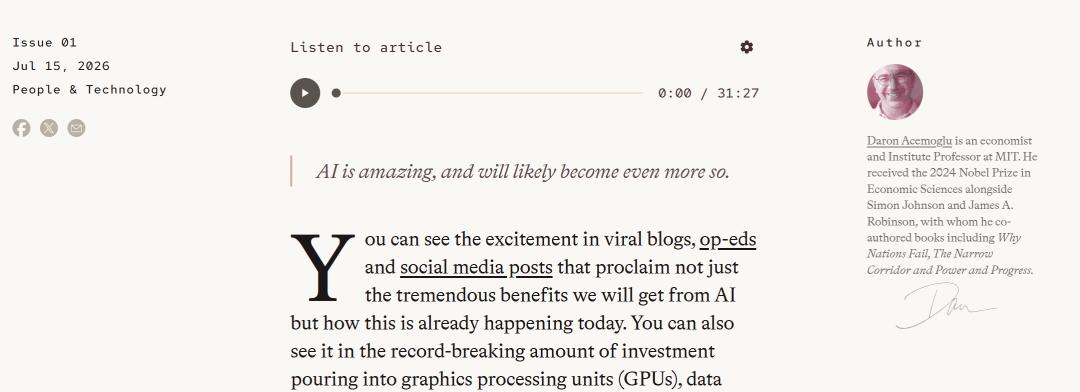
Visit: https://humanistreview.ai/issue-1/acemoglu-ai-replace-workers/
The article page is marked with a date of July 15, but it did not attract widespread attention until October 6, when media reported on it intensively. Mustafa Suleyman, CEO of Microsoft's AI division, even personally posted a long post to recommend it that night, and the views quickly exceeded 400,000.
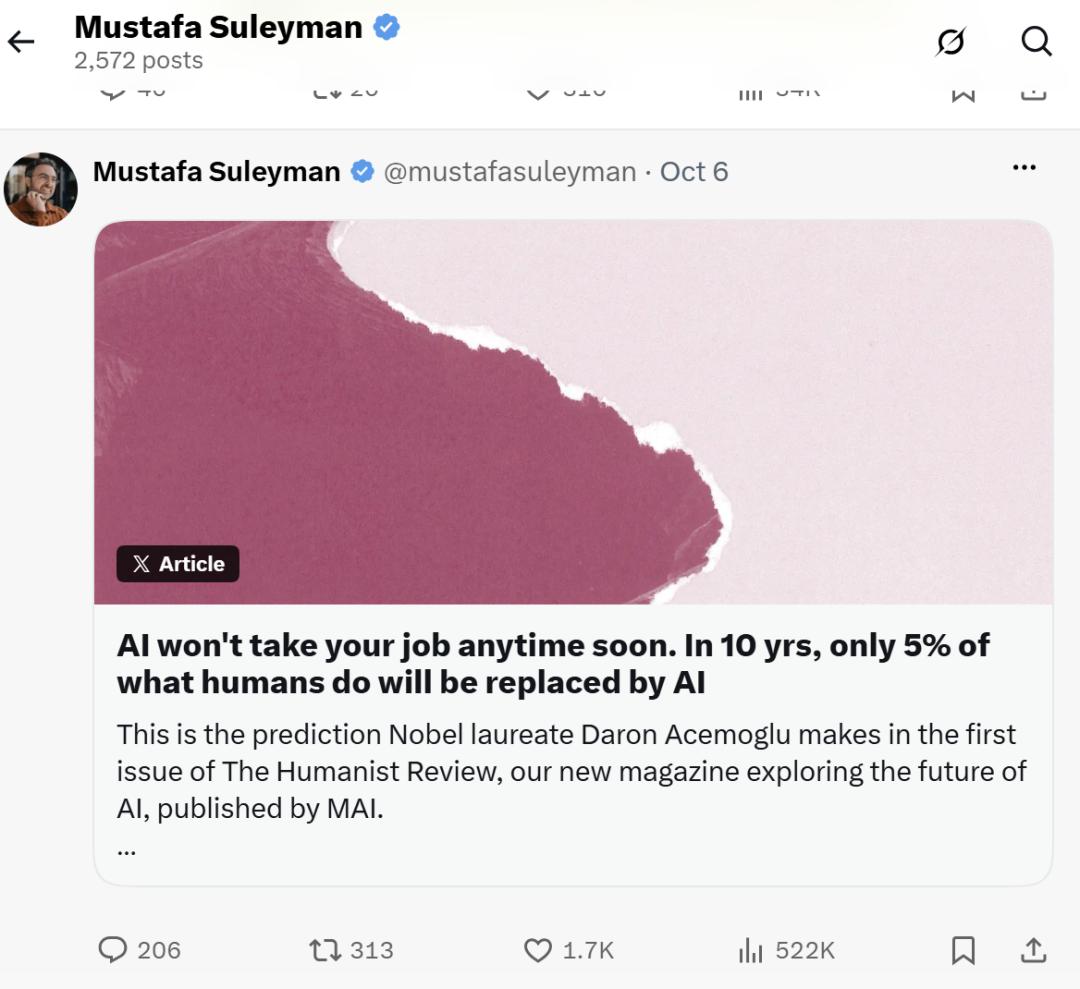
For a major backer to personally endorse an article that pours cold water on its own track, isn't that a very contradictory thing to do?
II. Let's Talk About This Contrarian First
You may not be familiar with the name Acemoglu, but you have most likely heard of his book *Why Nations Fail*, a blockbuster economics work that became popular far beyond the economics circle. He won the 2024 Nobel Prize in Economics together with two other scholars.
He has spent his entire life researching three core areas: technology, institutions and growth.
The key point is that he is far from being an AI doomsayer. He neither thinks AI is a bubble, nor believes AI will destroy humanity. What he is fed up with is something else: too many people are mindlessly shouting about AGI, while very few people are doing serious calculations.
And this is not a random whim of his. Back in 2024, he published a paper called *The Simple Macroeconomics of AI*, in which he estimated back then that AI would bring a GDP growth of roughly between 1.1% and 1.6% within ten years.
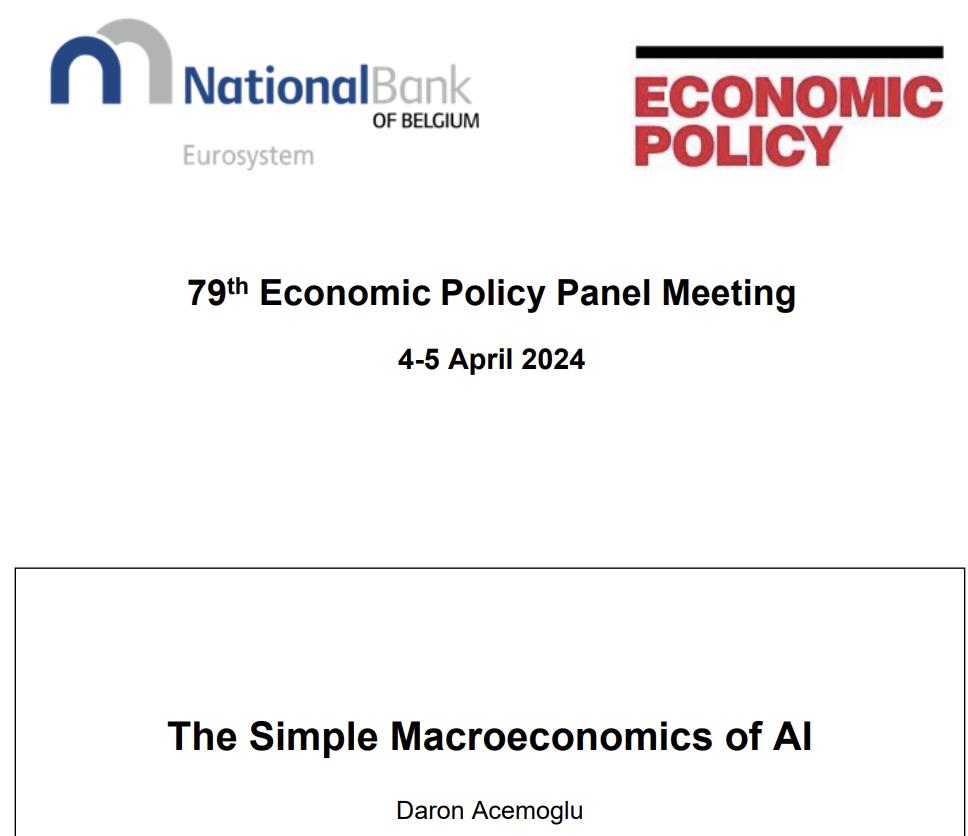
The 1.5% figure in this new article falls right in that interval.
In other words, for two full years, the models have undergone earth-shattering changes, evolving from GPT-4 all the way to GPT-6, the entire industry has been completely renewed, but this guy's prediction has barely changed.
Just this point alone is enough for us to seriously listen to how he came up with his calculation.
III. How Is the 5% Figure Calculated?
His calculation method has only two steps in total.
The first step is to estimate what AI is capable of doing. He judges that by the end of the 2020s, what AI can truly and reliably automate is mainly simple office cognitive tasks, which account for about 20% of all jobs in the US economy. As for complex positions that require judgment, multi-dimensional reasoning and social skills, it will take a very long time for AI to take over, and the society will probably not feel relieved to let AI manage air traffic control towers, provide psychotherapy or run companies. Jobs that interact with the physical world will have to wait even longer, as flexible robots are still nowhere to be seen.
The second step is to estimate the deployment speed. Referring to the diffusion pattern of earlier technologies such as electricity and computers, he judges that among all the automatable tasks, only about a quarter will be truly automated within ten years.
20% multiplied by a quarter equals 5%.
He even admitted himself that this is a guesstimate, which means an academic-level rough estimate.
But he gave two very solid reasons to explain why the deployment will most likely not be fast.
The first reason is the famous Solow Paradox. In 1987, economist Robert Solow put forward a famous quote: Computers are everywhere, except in the productivity statistics. Today's AI is in a similar situation. AI performs extremely well in laboratories when writing code or analyzing images, but when it is actually deployed in companies, engineers have to spend a lot of time fixing bugs in the code generated by AI. When radiologists use AI assistance, the actual effect is even compromised.
The second reason is the story of electricity. In 1881, central power stations already existed in New York and London. At that time, many people thought that the manufacturing industry would be completely overturned immediately. But what was the actual result? By the 1920s, nearly 40 years later, only about half of factories and households had access to electricity.
Even a technology as foundational as electricity took 40 years to popularize. AI has even more things to adjust: tasks need to be reallocated, employees need to be retrained, and management teams have to learn from scratch how to collaborate with AI. Organizational changes are often far slower than technological progress.
So people have been shouting that "radiologists will disappear soon" for almost a decade, but the reality is that hospitals are hiring more and more radiologists.
IV. A Past Story About Speech Recognition
The following part is my personal favorite section in the entire article, a story that has almost been forgotten by most people.
In the 1980s, a couple in the US, James and Janet Baker, founded a company called Dragon Systems, focusing all their efforts on speech recognition. Their idea was very rebellious at the time: ignore grammar and semantics completely, and directly use machine learning to map speech to the most matching text, purely based on prediction.
In 1997, they released Dragon NaturallySpeaking, the first software that could recognize continuous natural speech, with an accuracy rate close to 95%.
Why is Acemoglu so familiar with this part of history? Because he was one of the first users. In 1997, he suffered from arm strain and could not type at all, so he relied entirely on this software to get his work done. His exact words were that even though the processors at that time were extremely slow, using that software still felt like magic.
According to the normal script, the next step should be rapid technological development, with speech recognition taking over the whole world.
But in 2000, Dragon was acquired by a Belgian company called Lernout & Hauspie. A few months later, that company went bankrupt directly, and its co-founders were later convicted of corporate fraud. Then ScanSoft bought the company at a low price, renamed it Nuance, put its consumer-grade products on the back burner, and focused on medical and enterprise business. In 2022, Microsoft acquired Nuance and continued to follow the same path.
The final outcome is: today's speech recognition on PCs is only marginally better than it was in 2000.
The underlying technology has clearly advanced by leaps and bounds, but consumers have waited in vain for more than 20 years.
There are two hidden easter eggs in this story. First, breakthroughs in infrastructure must be matched with the right applications and proper distribution channels, which were not available back then. Second, when Dragon 16 was released, it claimed a 99% accuracy rate, but that was only under ideal conditions. The remaining 1% is enough to change the meaning of an entire sentence, forcing you to proofread every email from beginning to end to fix those deeply hidden typos caused by accents.
99% sounds like an impressively high figure. But once it is applied to the last mile in the real world, it is often still not enough.
This logic also applies to AI automation. Full automation means that AI has to take over every single task in a profession, including high-risk judgment and interpersonal communication. Today's AI is still far from reaching that state.
V. Between Humans and Machines, Who Should Imitate Whom?
After telling the story, Acemoglu put forward the most critical point of the entire article: the current industry route may be fundamentally wrong. Because we are doing one thing: forcing AI to imitate human intelligence.
The difference between these two types of intelligence is so huge that they are almost like two different species.
How do humans learn? We look at a few examples, form a hypothesis, simulate various possibilities in our minds, and then go to the real world to test and make corrections. Young children learn in basically this way. This kind of learning is inherently social: you will observe people you think are more experienced to see how they do things. Humans can even be said to think with their entire bodies: the brain, nerves, senses, and even the gut are all involved in reasoning.
The most interesting part is his re-evaluation of "hallucinations". In his view, human hallucinations are close to a kind of natural gift: we imagine a lot of non-existent worlds, then quickly filter out the unreliable ones, and keep the ones worth pursuing.
AI is almost the complete opposite. It learns from massive amounts of data, and is good at capturing patterns in huge corpora. Once it masters a certain reasoning method, it can apply it to both abstract and specific scenarios. But it lacks real-time social learning, and its hallucinations are basically a disaster, because it does not have the same filtering mechanism that humans have.
So his view is that when two things are so different, forcing one to imitate the other is mostly a stupid path.
He gave a very brilliant example: Steve Jobs and Steve Wozniak. If Jobs had spent all his time trying to replace Woz's engineering capabilities, and Woz had looked down on Jobs' talent for design and marketing, the Mac that we all know would probably never have existed. The success of these two people came from combining two completely different sets of capabilities. The relationship between humans and AI may also be like this.
In fact, this path was pointed out 65 years ago. In 1960, J.C.R. Licklider, known as the "Grandfather of the Internet", wrote a sentence: The human brain and computers will be tightly coupled together. This partnership will think in ways that the human brain has never done before, and process information in ways that today's machines have never achieved.
The roadmap was drawn long ago, but the industry took a big detour that lasted for 60 years.
Acemoglu gave a name to the direction he proposed: pro-worker AI. Instead of pursuing full automation, we should build tools that empower workers.
He gave an example from the education sector. Most current educational AI is focused on taking over the work of teachers. But full automatic teaching is nowhere in sight. Once we change the line of thinking, new possibilities open up immediately: AI can identify which knowledge points each student is stuck on, then suggest teachers to split the class into small groups, and provide targeted tutoring for the weaknesses of each group. Personalized education used to be extremely expensive and only affordable for a small number of families, but AI has the opportunity to make it very cheap and accessible to all.
He also revealed that his team has already built a prototype and is currently evaluating it. The technology they used is not mysterious at all: a medium-sized large language model, fed with course content and cases of excellent teachers handling various student problems. According to him, this is well within the capabilities of current existing technology.
VI. Then Why Is the Industry Still Obsessed With Pursuing Full Automation?
Since this pro-worker AI path is so promising, why are so few people taking it? He listed four driving forces, the first three are at the economic level, and the last one is ideological.
First, the business model. Big tech companies' revenue mainly comes from selling enterprise software and digital ads, and there are very few options for "empowering workers" in this set of business operations.
Second, market concentration. The seven tech giants, Alphabet, Amazon, Apple, Meta, Microsoft, Nvidia and Tesla, account for 60% of the Nasdaq market cap. Even if a startup stands out, its common final destination is to be acquired. So the ones that end up winning are almost always following the same old business model.
Third, he gave it a very vivid name: the nuts and bolts problem. A nut is useless without a bolt, and a bolt is useless without a nut. Enterprises assume that tech companies will only sell automation tools, so they make their plans based on automation. Tech companies assume that enterprises will only buy automation tools, so they only develop automation products. The two sides are locked in a mutual cycle, and neither side can easily make the first move to change.
Fourth, the AGI obsession. This industry has been influenced by the idea of "machines that act like humans" for more than 70 years, which can be traced all the way back to Turing's 1950 paper, which opens with the famous imitation game. With decades of influence from science fiction novels and movies, "reaching human-level performance" has almost become the minimum standard for all applications in Silicon Valley. Many tech leaders genuinely believe that human beings are error-prone and unreliable.
Based on this diagnosis, he proposed four solutions: symmetric taxation on labor and capital. Currently in the US, the marginal tax rate on labor income exceeds 25%, while the tax rate on capital income is close to zero, which in his view is equivalent to the government subsidizing enterprises to replace human workers with machines; the government funds demonstration projects for pro-worker AI to prove its feasibility to the public; antitrust laws should be updated and strictly enforced, and a digital ad tax can also be considered; finally, establish a data market, so that top experts can control, price and monetize their high-quality knowledge.
VII. Epilogue
Finally, let's talk about two small stories.
The first story happened back in 1987. When Solow said the famous