An open letter from NetEase Youdao has left itself with very few fallback options.

Recently, LobsterAI (Youdao Lobster), the desktop-side Agent under NetEase Youdao, released an "Open Letter to Users".
The letter is not long, but the wording is highly targeted. In addition to emphasizing long-term investment, dedicated product development and responsibility for users, LobsterAI also specifically wrote: "We will not develop products with the 'act first and think later' mentality, nor will we treat user experience and data as bargaining chips for internal horse racing."
At the end of the letter, NetEase Youdao extended an invitation to Tencent QClaw users: everyone is welcome to migrate to LobsterAI, a dedicated migration assistant is ready, and new users can also receive 1000 points.
Behind this statement is a product adjustment that Tencent has just completed.
On September 24, Tencent QClaw announced that it will officially cease operations on December 24. Valid subscriptions and points that have been purchased but not fully used can apply for refunds, and user data can be backed up or migrated to WorkBuddy, another office Agent under Tencent. On the day the shutdown announcement was released, LobsterAI launched the QClaw migration assistant.
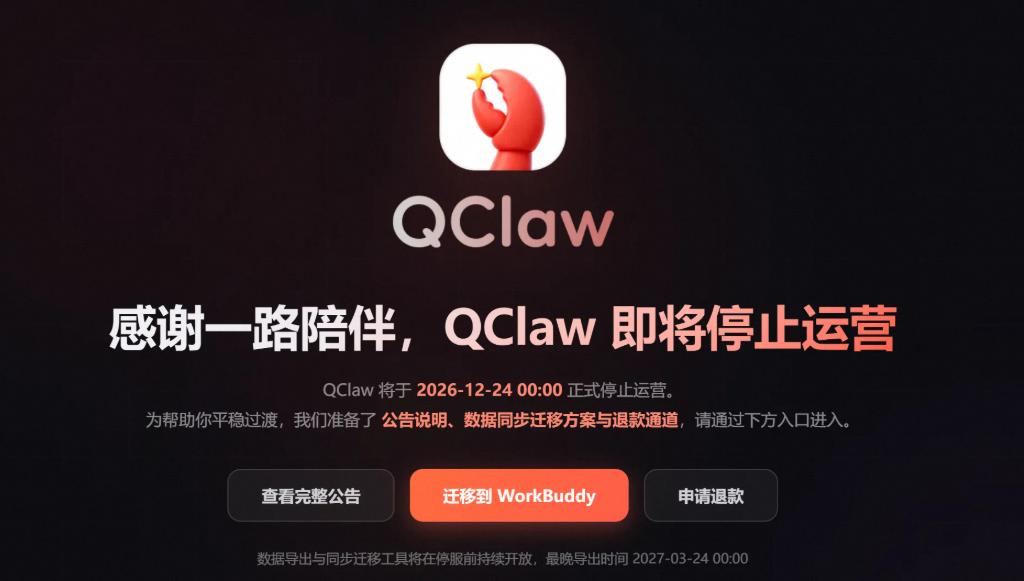
While one side is shrinking its product line and the other is actively accepting users, the actions of the two companies form a sharp contrast.
NetEase Youdao has obviously seized a good opportunity. Office Agents have begun to delve into personal files, browser operations and daily workflows. The troubles brought by product shutdowns are far more complex than replacing a chatbot. At this time, emphasizing long-term stability can easily gain user recognition.
However, when NetEase Youdao publicly stated that it would not treat users as bargaining chips for internal horse racing, it voluntarily raised the outside world's expectations for LobsterAI and put itself under greater pressure.
Chapter 1: Tencent shut down QClaw, NetEase Youdao takes on another round of competition
Although QClaw is about to exit the market, it is not a product that no one cares about.
According to data from QuestMobile, in July 2026, the monthly active users of Tencent WorkBuddy's PC client reached 6.582 million, and QClaw reached 2.259 million, ranking at the forefront of the office Agent market at that time.
Another report from Analysys shows that QClaw's monthly visits reached 3.54 million in June, while LobsterAI's was 1.15 million in the same period. According to this caliber, the visit scale of the former is about three times that of the latter.
These data are sufficient to explain why NetEase Youdao acted so quickly.
LobsterAI was launched in February this year, and the number of users has exceeded 1 million by the second quarter. For a new product, this result is not bad. However, compared with Tencent, which has a huge user base and office ecosystem, NetEase Youdao still has a gap in the accumulation of user reach and distribution channels.
The exit of QClaw provides LobsterAI with an opportunity to directly contact mature Agent users. These users have already accepted the product form of desktop automation and remote task execution, and have accumulated their own prompts, task configurations and usage habits, which can theoretically save a considerable part of the market education cost.
Interestingly, NetEase Youdao did not stop at verbal welcome.
The migration assistant launched on September 24 allows users to migrate their original Agent assets according to the guidelines; then it released an open letter to further emphasize the product's openness and long-term operation. This arrangement of providing tools first and then making statements is more practical than simply taking advantage of hot topics for promotion.
However, there is still a long distance between getting the migration entry and winning users.
Tencent has arranged an internal destination for QClaw users. Users can migrate to WorkBuddy and get a 1000-point subsidy. For people who are used to WeChat remote operations and have accessed Tencent-related services, staying in the Tencent ecosystem may mean lower reconfiguration costs.
NetEase Youdao provides another choice, but it requires users to actively change their original usage paths.
This also explains why Tencent's internal convergence and NetEase's external competition for users seem to happen in the same incident, but their business logics are different.
Since the beginning of this year, Alibaba has integrated multiple Agent products into Qianwen Office, ByteDance has further concentrated related products and teams to the Doubao Work system, and Tencent has gradually gathered office Agent resources to WorkBuddy. Large tech companies have begun to reduce redundant construction within the same group and invest resources in products with larger scale and collaborative advantages.
These adjustments will certainly affect user experience, but they also have rationality in product operation. Tencent's arrangement of announcing the shutdown of QClaw three months in advance and providing refund and migration plans is also part that needs to be viewed objectively.
NetEase Youdao is facing another kind of competition.
Tencent has WeChat and enterprise-level connection capabilities, Alibaba can rely on DingTalk to build organizational collaboration relationships, and ByteDance has Doubao and Feishu. Although LobsterAI can also access instant messaging tools such as Feishu and DingTalk, there is a big difference between being able to call these channels and mastering their organizational collaboration systems.
NetEase Youdao needs to build reasons for users to continuously open LobsterAI outside these platforms.
From the current product design perspective, it has chosen differentiated routes such as open source, local priority and cross-platform execution. These capabilities can attract users who value data autonomy and want to flexibly configure tools, and also leave certain space for independent office Agents. Unfortunately, as large tech companies gradually improve their own open capabilities, it will become more and more difficult to build long-term advantages solely by these features.
The shutdown of QClaw has brought potential users to NetEase Youdao, but it has not weakened the competitiveness of WorkBuddy. In the end, LobsterAI still has to rely on execution effect, usage cost and workflow experience to win users.
Chapter 2: After getting one million users, LobsterAI still needs to "open a new page"
For NetEase Youdao, long-term investment is not a slogan without business foundation.
In the second quarter of 2026, NetEase Youdao's net income was about 1.467 billion yuan, a year-on-year increase of 3.5%; operating profit was about 112 million yuan, nearly 3.9 times that of the same period last year, achieving operating profitability for eight consecutive quarters. In the same period, the company's R&D expenditure was about 142 million yuan, a year-on-year increase of 10.7%.
This means that NetEase Youdao's operating quality is also improving while promoting AI transformation. Compared with start-up teams that need to rely on continuous financing to maintain R&D, LobsterAI is at least backed by a listed company with sustainable operating capabilities.
Moreover, NetEase Youdao has verified the payment demand on some AI services. In the second quarter of this year, the sales of Youdao's AI subscription services reached about 100 million yuan, a year-on-year increase of more than 20%. Among them, the usage of AI functions in products such as Youdao Dictionary and translation has increased significantly, and the sales of AI oral product Hi Echo have also achieved rapid growth.
These businesses have accumulated experience in AI product pricing, user service and commercialization for NetEase Youdao, but the operation mode of LobsterAI is very different from the above products. Dictionary and translation services have a relatively mature user base, and users can directly perceive the value of a single translation, oral practice or simultaneous interpretation function. The tasks undertaken by desktop Agents are more complex, from data retrieval and document production to cross-software operation execution. The model resources consumed, running time and degree of manual intervention for each task may be different.
In its financial report, NetEase Youdao has not yet separately disclosed the paying users, revenue contribution and operating cost of LobsterAI. Among the currently disclosed AI subscription service sales of about 100 million yuan, LobsterAI only accounts for a part.
One million users prove LobsterAI's market attention, but it is not enough to prove that the product already has stable self-sustainability and has reached the stage where its achievements can be presented independently.
On September 16, LobsterAI released a 2.0 version. It is reported that in this update, NetEase Youdao added new capabilities such as Sites and Teams, supporting the generation of shareable web addresses from task outputs, and further exploring team collaboration. The charging model also began to emphasize pay-as-you-go, trying to lower the usage threshold brought by the traditional per-seat charging model of software.
Before that, LobsterAI was more focused on personal desktop tasks; after entering the team scenario, the paying targets that the product can attract began to expand from individuals to organizations.
Individual users may occasionally need the Agent to generate a PPT or sort out materials, but they may not be willing to purchase high-value subscriptions for a long time; if enterprise teams can hand over repetitive work to the Agent and form reusable task processes, their willingness to pay is usually more clear.
But team collaboration also means higher delivery requirements. When an individual uses an Agent, a failed task often only affects his own work efficiency; after an enterprise accesses the Agent to its business processes, permission allocation, data isolation, task audit, cost management and responsibility traceability will all become part of the procurement decision.
Sites supports sharing task outputs, which can improve delivery convenience, but it also means that the product needs to continuously improve its capabilities of sharing permission management, access control and data management. Pay-as-you-go is conducive to lowering the trial threshold, but it may make cost forecasting for complex tasks more difficult.
For NetEase Youdao, these are all costs that need to be borne when moving from consumer-grade tools to enterprise services.
There is another layer of competitive pressure from the company's original business structure. NetEase Youdao has long been deeply engaged in learning, translation and online marketing, and has accumulated product R&D and service experience, but the user relationships formed by these businesses cannot be fully reused with the organizational procurement, enterprise system integration and long-term delivery system required by office Agents.
Tencent, Alibaba and ByteDance already have enterprise collaboration products, customer channels or platform-level distribution capabilities. Even if NetEase Youdao can make a good Agent product, it needs to invest resources to build corresponding customer service and ecological cooperation networks.
When LobsterAI enters the team market, its revenue space expands, and the competition cost will also rise accordingly. It is worth noting that NetEase Youdao has achieved operating profitability for eight consecutive quarters, and the management has also clearly emphasized high-quality growth. At this stage of operation, it can not only provide a relatively stable investment foundation for AI products, but also means that new businesses need to gradually prove their operating value.
LobsterAI can continue to invest with the support of the group, but relying on low prices or even free to attract users for a long time will eventually require finding a reasonable balance between revenue and cost.
Chapter 3: Open source can reduce vendor lock-in, and long-term trust ultimately depends on delivery
The long-term trust emphasized by NetEase Youdao in the open letter is not completely unsupported at the product level.
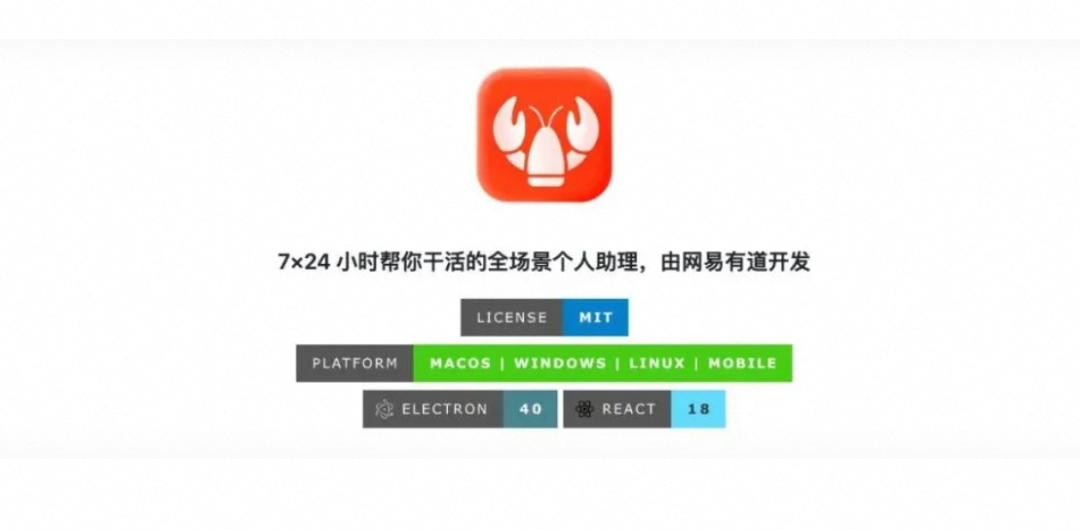
LobsterAI adopts the MIT license to open source its code, supports local data storage, and designs mechanisms such as sensitive operation permission confirmation. Its public technical documents show that part of the session information, configurations and workspace memories can be stored locally on the user's device.
These designs have practical value for office Agents. When the Agent starts to read files, operate browsers and call local programs, users will naturally pay more attention to the location of data storage and tool permissions. Open source allows developers to review and modify the code, and local data storage can also reduce dependence on a single cloud service to a certain extent.
In terms of product lifecycle, the MIT license also allows developers to continue to use, modify and distribute the existing code on the premise of complying with relevant terms. Even if the official no longer maintains it in the future, there is still the possibility of the community taking over subsequent development.
However, open source also has boundaries. The source code can be preserved, but commercial model interfaces, remote services, official point systems and continuous technical support may not be able to continue synchronously. Whether users can independently restore the original working environment also depends on the integrity of local data, the compatibility of third-party services and whether relevant dependencies can continue to be maintained.
Open source can reduce the risk of users being locked by a single vendor, but it cannot automatically eliminate the cost of service interruption.
This is also the part that the open letter deserves further review. NetEase Youdao mentioned that since its launch in February, LobsterAI has iterated 82 versions, established more than 100 user groups, and directly collected feedback through product managers.
For a product team that has not been established for a long time, these investments are worthy of recognition. Continuous updates and direct feedback at least show that NetEase Youdao is actively maintaining the product. But as Agents go deeper into real work, users' expectations for products will also change.
In the past, if an office software stopped updating, users might still be able to open existing documents; if the model, interface or service that the Agent relies on changes, some automated tasks may be immediately affected. The workflows, permission configurations and task records that the team has established are often more complex to migrate than exporting files.
Therefore, long-term trust needs to be implemented in more detailed product arrangements: whether users can fully export memories and task configurations, whether they can freely replace model services, whether third-party Skills and workflows are portable, and what level of migration support the official can provide when it stops maintenance.
Among these capabilities, LobsterAI has provided part of the foundation through open source and localized design. However, there is still not enough public information to fully evaluate the cross-product migration effect of complex workflows, as well as team-level data management and service termination arrangements.
The processing method of Tencent QClaw can provide a reference. Although the shutdown itself has caused controversy, Tencent has clearly announced the operation stop time, refund plan, data backup arrangement and the migration path to WorkBuddy, and retained a subsequent usage window for the backup function.
This shows that even if an enterprise finally decides to shut down a product, it can still reduce user losses through a clear exit mechanism.
In contrast, what NetEase Youdao is giving now is more of a future-oriented business attitude. Such a promise is of course welcome, but it also sets higher fulfillment requirements for the enterprise itself.
Long-term operation is a kind of ability, and decent exit is also a kind of ability. For office Agents, both should become part of the product credit.
Last Notes
NetEase Youdao chose to release the open letter after QClaw was shut down, and the timing is very clever.
Tencent's business adjustment has provided a rare customer acquisition opportunity for LobsterAI, and NetEase Youdao also took this opportunity to emphasize its product philosophy. Open source, local priority, rapid iteration and team collaboration exploration all show