x86, Arm and RISC-V meet head-on at the industrial edge.
Industrial automation is emerging as one of the fastest-growing vertical tracks for edge AI processors. According to research from the Yole Group, the rise of scenarios such as machine vision and predictive maintenance, coupled with the implementation exploration of on-site AI agents, requires edge chips to integrate the combined capabilities of real-time control, local large model inference, and multi-protocol access. Driven by this demand, the three architecture lines of x86, Arm, and RISC-V are converging head-on at the same intersection of the industrial edge.
Over the past decade, these three lines have each occupied their own territory: x86 dominated industrial PCs and high-end controllers, Arm ruled embedded systems and MCUs, and RISC-V mostly existed in niche markets and internal auxiliary cores. However, the outbreak of industrial AI has broken this fragmentation. The demand for edge computing power has become fragmented and complex, covering real-time control, AI inference, security isolation, and multi-protocol communication, No single chip can handle all scenarios, and no single architecture can monopolize all use cases. Multiple industry institutions estimate that the penetration rate of edge chips with AI acceleration functions in global industrial scenarios has approached 47%, and it is expected to exceed 55% within the year. The competition and cooperation between the three lines is exactly a sign that industrial edge computing is maturing.
x86: The ecosystem remains the same, but the narrative is taking a new turn
In the industrial edge scenario, x86 is somewhat like a long-established powerhouse. Its advantage does not lie in impressive technical parameters, but in the software ecosystem accumulated over decades, including Linux distributions, virtualization, middleware, and development tools, which cannot be replicated overnight. Industrial customers' biggest fear is that all their existing code becomes obsolete after switching chips, and the sense of security that x86 provides in this regard cannot yet be offered by Arm and RISC-V.
Intel's moves in the industrial edge space in 2026 are centered on the keyword "downstream penetration". At the Embedded World 2026 exhibition, Intel launched the 2nd generation Core processors with all performance cores, an industry-ready platform for mission-critical edge applications. By the end of May that year, more than 130 customers had developed edge AI and edge computing products based on Intel's Series 3 processor family. This figure is not small in the industrial edge market, indicating that x86 still has strong ecosystem stickiness.
But Intel's real advantage does not lie in hardware parameters, but in its software framework. The Open Edge Platform is positioned to enable unified programming and scheduling of different computing components with the same software framework. At the recent Connection Summit in Suzhou, the industrial agent solution jointly developed by Intel and its partner Qimur Intelligence demonstrated this idea: through the process world model and edge-side inference, robots are endowed with process self-adaptation and cross-work type collaboration capabilities. The medical terminal solution developed by CVTE based on the Core Ultra platform has been tested to show that business work efficiency is improved by about 20%, and terminal upgrade efficiency is improved by about 60%. This software base idea can also be migrated to industrial edge scenarios. These cases show that the value of x86 in the industrial edge is that it can provide an all-capable base that covers everything from real-time control to AI inference to the network protocol stack on a single platform.
AMD has taken a different path. In September, AMD published a technical article titled "Beyond TOPS", whose core judgment is: Traditional edge AI follows a linear pipeline: capture an image, run inference, trigger an action. But agent AI turns this line into a loop: intent, context, planning, tool usage, and service collaboration. A factory edge node may coordinate hundreds of lightweight agents bound to specific sensor streams, machines or policy domains. This means the CPU is no longer just the component that runs the operating system, it has to undertake a large number of orchestration, scheduling and exception handling tasks.
The Ryzen AI Embedded X100 series integrates x86 CPU cores, integrated graphics, NPU and unified memory, with a maximum system computing power of 80 TOPS. The flagship model X199 is equipped with 16 cores and 32 threads plus 40 computing units. The autonomous inspection robot launched by Weston Robot based on this series of processors has been deployed in industrial environments, and can ensure stable operation even when cloud network connectivity is limited. AMD's strategy is: not to simply compete with Arm on low power consumption indicators, nor to compete with RISC-V on instruction set customization capabilities, but to focus on industrial edge scenarios that are highly dependent on the x86 software ecosystem and have high computing power requirements.
But the cost of x86 is also obvious. An x86-based edge controller consumes 35W of power. After switching to the Arm Cortex-A53 quad-core, the whole machine power consumption drops to 8W, the cost is reduced by 40%, and the control cycle is stable at 500 microseconds with the Linux real-time patch enabled. Industrial customers are not unaware that x86 is easy to use, the problem is that power consumption and cost are indeed not cost-effective in many scenarios.
Arm: Energy efficiency ratio is the moat, heterogeneous architecture is the new growth driver
If x86 relies on its ecosystem for development, Arm relies on its energy efficiency ratio and flexibility. In markets such as small and medium-sized PLCs, HMIs and industrial gateways, Arm's basic market has hardly been shaken in the past ten years.
Rockchip's product matrix in 2026 is very illustrative. At the Embedded World exhibition in Germany, Rockchip demonstrated 4-channel concurrent video analysis with a solution based on the Qwen3-VL-2B model, with a fastest response time of 0.5 seconds. What is more noteworthy is the cost calculation: in the scenario of mobile phone display dead pixel detection, the previous mainstream solution used Nvidia Jetson Nano, with a core board priced at around 600 yuan. After switching to the RK3588 core board, the cost is reduced to just over 200 yuan, and the detection speed is increased from 2 pieces per second to 3 pieces per second. The same story is happening on fully domestic AI edge computing terminals, which adopts a full industrial-grade fanless passive cooling design, adapts to a wide temperature range from -40°C to 70°C, and the hardware cost is 40% lower than the previous generation solution.
The progress of the RK182X co-processor is worth mentioning separately. This chip was released in July 2025. By the first half of 2026, it has been introduced into dozens of industries and hundreds of customer projects for in-depth R&D, and the first batch of customers have achieved mass production in fields such as cleaning robots, companion robots, NAS, and smart home. In industrial and edge computing scenarios, ecological partners have developed a variety of solution products based on RK182X, such as AI Box, industrial personal computers, and robot controllers, to provide local computing power support for scenarios such as industrial vision, industrial quality inspection, energy storage power, and video analysis. RK182X is built with multi-core RISC-V CPU, multi-core NPU and 2.5GB/5GB DRAM, and can be interconnected with the main processor at high speed through PCIe and USB interfaces, so customers do not need to restructure the main control solution to add AI capabilities as needed. It only took about a year from release to deployment in hundreds of customer projects, a speed that is rare in the industrial chip field.
RK3572 represents another direction of Arm architecture in the industrial edge. With 8nm process, the CPU adopts a heterogeneous architecture of 2 A73 cores + 6 A53 cores + RISC-V, built-in NPU with 4 TOPS computing power, equipped with 2 Gigabit Ethernet ports, 4 CAN FD ports, 12 serial ports, 2 USB 3.0 ports, and 2 PCIe 2.1 ports. Compared with the previous generation mid-range platform, the performance is doubled, and the power consumption in typical scenarios is reduced by more than 50%. More importantly, RK3572 supports three operating system options: Linux-RT, RT-Thread and bare metal Baremetal, adapting to scenarios such as industrial PLCs, robot control, edge computing gateways, industrial and commercial energy storage EMS, and distribution network DTUs. Industrial scenarios are most afraid of products that run fast but lack sufficient real-time performance. Rockchip's polishing in this regard shows that it has a solid understanding of the needs of industrial customers. Chris Bergey, Executive Vice President of Arm, also clearly stated earlier that manufacturing and industrial applications are the directions with the clearest implementation paths at present.
But Arm also has its own anxieties: licensing fees and architectural restrictions are always swords hanging over its head. The RISC-V core in RK3572, to some extent, is also hedging against this risk. When a chip contains both Arm and RISC-V, customers have an extra layer of choice. This hybrid architecture is becoming the new normal in industrial edge chip design, where no architecture replaces the other, but each takes advantage of its own strengths.
RISC-V: Finally on the main stage, but the ecosystem barrier remains to be crossed
RISC-V's progress in 2026, in the words of academician Ni Guangnan, is rapidly moving from an alternative option to the mainstream. According to SHD Group's forecast, by 2031, the total shipment of RISC-V core devices will surge to 36 billion units, with a market size exceeding 3000 billion US dollars. The increase in RISC-V's penetration rate in the industrial field is one of the important driving forces for this growth.
The Xuan Tie C950 released by Alibaba Damo Academy in March is a landmark product this year. With 5nm process, 3.2GHz main frequency, 8-instruction decoding, 16-stage pipeline, and out-of-order window of over 1000 instructions, the SPECint2006 single-core score exceeds 70, and the overall performance is more than three times that of the previous generation C920. More importantly, Xuan Tie C950 can natively adapt to large models with hundreds of billions of parameters such as Qwen3-235B-A22B and DeepSeek V3-671B, realizing the local operation capability of RISC-V CPU for hundred-billion-parameter large models, which is a landmark breakthrough for high-performance CPUs of this architecture. The chief scientist of Damo Academy said: "Only by launching high-performance benchmark products can RISC-V truly seize the opportunities of the AI era and compete on the same stage with traditional architectures." The University of Edinburgh in the UK commented after the evaluation that this is the first RISC-V CPU that can be comparable to mainstream server-level products on the market.
RISC-V's real advantage in the industrial edge does not lie in single-core performance, but in modularity. The computing power requirements in industrial scenarios are extremely fragmented: some need to detect solder joints, some need to predict bearing life, and some need to optimize injection molding parameters. The scalable features of RISC-V enable chip manufacturers to carry out customized designs for different scenarios. The CCR7002 from NationalChip is a noteworthy case: it adopts multi-chip packaging technology, the SoC subsystem is equipped with a 64-bit high-performance quad-core RISC-V processor with a maximum frequency of 1.5GHz, and has completed the closed loop of "chip + algorithm + toolchain". NationalChip joined Damo Academy's "RISC-V Sword Alliance" in March 2026, and will carry out cooperation in fields such as SoC customized services, operating system ecosystem, and AI model and hardware integration.
The NA900 core from Nuclei System Technology is one of the world's first batches of RISC-V CPU IPs to pass the ISO26262 ASIL-D product certification. This certification means that RISC-V has begun to enter automotive and industrial safety-critical scenarios — scenarios that used to be almost dominated by Arm. The NB2 chip from Fudan Microelectronics adopts 12nm process, 4-core 64-bit RISC-V CPU, with a maximum AI computing power of 4 TOPS. It has been scaled for commercial use in the fields of smart energy and smart logistics, with a cumulative deployment of hundreds of thousands of units. The R500A core from Eswin is the world's first RISC-V core to pass the TÜV Rheinland ASIL-B functional safety certification, targeting high-security scenarios such as vehicle chassis and precision industrial control. As of March 2026, it has cumulatively owned more than 20 series of RISC-V cores, serving 220 customers worldwide. On October 9, Eswin Computing was officially listed on the Hong Kong Stock Exchange, becoming the first "RISC-V stock" on the Hong Kong stock market, marking that RISC-V has begun to enter the capital narrative stage.
But the implementation speed of RISC-V in the industrial edge is not as fast as expected. In the past two years, some chip companies have launched high-performance industrial MCUs based on RISC-V, whose hardware parameters are fully comparable to the Arm Cortex-M85. However, customer feedback is lukewarm. Industrial customers pay more attention to the reuse of existing code assets, whether mature IDE toolchains such as IAR and Keil provide native support, and whether RT-Thread and Zephyr can run stably. Arm's ecosystem has been developed for more than 30 years, with complete toolchains, IDEs, RTOS, and middleware. RISC-V's toolchains still have obvious gaps compared with Arm in compiler optimization and performance analysis. Industrial customers' code bases are often accumulated for ten to twenty years, from assembly to C to C++, with the bottom layer all optimized for the Arm architecture. Switching to RISC-V means recompiling, re-debugging, and re-verifying. This barrier cannot be crossed by relying solely on hardware parameters.
Meng Jianyi, Chief Scientist of Alibaba Damo Academy, said that RISC-V needs to meet two tough battles: general-purpose computing and AI computing. The industrial edge is exactly the intersection of these two tough battles. Industrial edge chips based on the RISC-V instruction set architecture are expected to usher in a commercial volume period between 2026 and 2030, and by 2030 their shipment share (in the industrial edge chip category) may jump from less than 7% in 2025 to more than 24%.
China International Industry Fair: The convergence point of the three architecture lines
From October 12 to 16, 2026, the 26th China International Industry Fair Integrated Circuit Exhibition will be held at the National Exhibition and Convention Center (Shanghai). This year's exhibition has upgraded the integrated circuit exhibition to a 30,000-square-meter independent full-hall National Chip Exhibition, covering the entire industrial chain of chip design, manufacturing, packaging and testing, equipment and materials, linked with ten themed exhibition areas. The newly added National Chip Exhibition has become the best window to observe the actual performance of the three architecture lines in industrial scenarios.
The Edge Computing and Storage Application Industry Forum, co-hosted by the China International Industry Fair and Semiconductor Industry Review during the exhibition, has set up three core highlights: "In the era of agent AI, how to build the x86 computing power base", "Can RISC-V crack the hard nut of the industrial edge", "How can a single edge SoC adapt to thousands of industries". From the setting of the topics, it can be seen that the focus of the industry is shifting, from the discussion of architectural performance to the practical topics of scenario adaptation and ecological tools. The forum will also release the "2026 Edge Computing and Storage Application Industry Research Report" on site, using data and benchmark cases to anchor the development trend of the track.
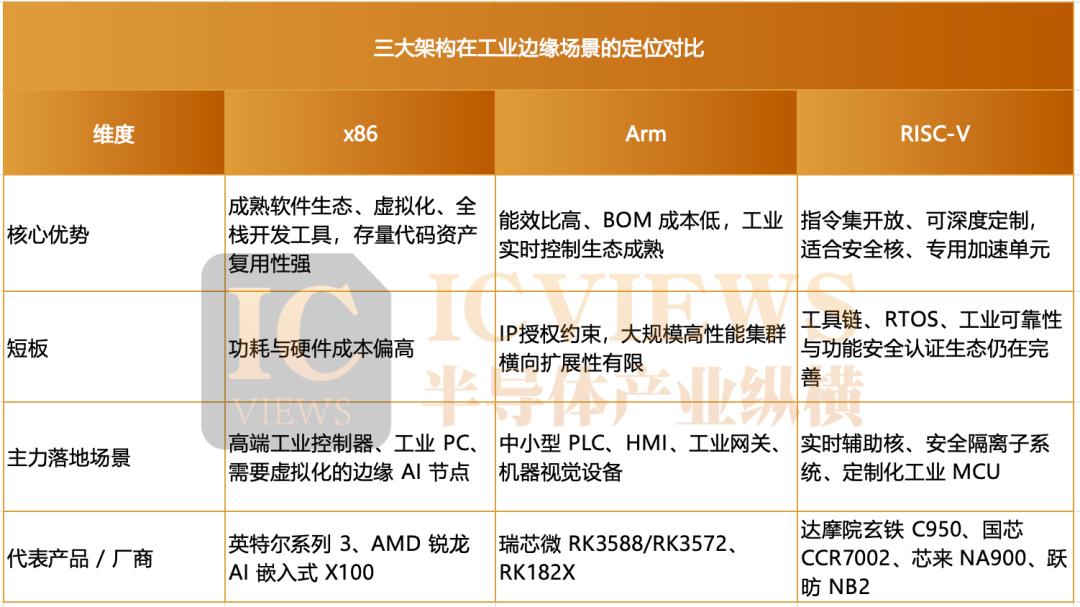
The positioning of the three architecture lines in the industrial edge is moving from ambiguity to clarity. x86's hidden card is its ecosystem, and both Intel and AMD are using software frameworks and open platforms to extend this moat. Arm's hidden card is its energy efficiency ratio and flexibility. Rockchip uses a heterogeneous architecture to put Arm and RISC-V in the same chip, which not only meets performance requirements but also hedges licensing risks. RISC-V's hidden card is openness and customizability. The Xuan Tie C950 and Nuclei NA900 prove that it already has the qualifications to compete in high-performance and safety-critical scenarios.
But the three lines are not ultimately competing on chip parameters, but on who can move faster in the soft infrastructure such as toolchains, RTOS, application frameworks and certification systems. The competition in the industrial edge will not be determined by a single parameter in the end. Whether the computing power can be applied on the production line, and whether improvements can be seen after application, these are the places that truly test the real strength of the technologies.