Its speed is 35 times that of GPT-6 Sol. Microsoft has launched a high-speed decision-making AI model that ranks first in accuracy across 36 tests.
Microsoft has launched a new generation of AI models built specifically for structured decision-making tasks, which far outperforms existing large language models in terms of speed and cost.
On Friday, Microsoft unveiled Microsoft-Decision-1, a new-generation fast decision-making AI model specifically designed for structured decision-making tasks.
According to Microsoft, the P50 version of Microsoft-Decision-1 has completed tests in multiple internal scenarios, covering areas such as incident response, quality control and scientific discovery. Its operating speed is 35 times that of OpenAI's GPT-6 Sol and 4.5 times that of Quyet-1.0-Large.
CEO Satya Nadella posted on X that the model "delivers exceptional performance on structured decision-making tasks, outperforming both large language models and other decision models in terms of latency and quality", and has been tested in Microsoft's internal scenarios including incident response, quality control and scientific research.
In terms of pricing, the model charges $0.042 per million tokens for input, and the output is free. This pricing structure is highly attractive for high-frequency, repetitive decision-making applications at the cost level.
01
Focus on Decision-Making, Filling the Capability Gap of Large Language Models
Different from traditional large language models that focus on text generation and complex reasoning, Microsoft-Decision-1 has a more focused design goal.
The Microsoft-Decision-1 model selects the optimal solution from preset options and assigns probability scores to each alternative answer, so as to help downstream applications determine whether to continue execution, retry, escalate processing, or submit for manual review.
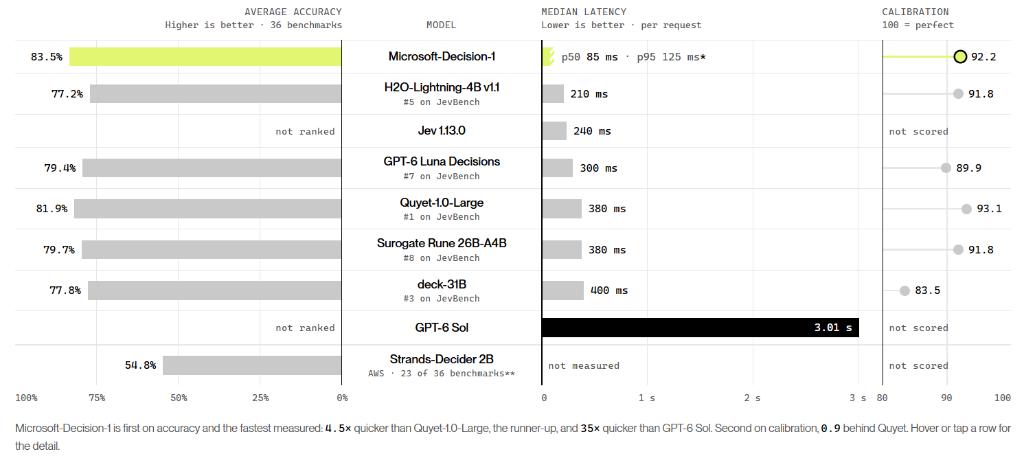
(Microsoft-Decision-1 ranks first in accuracy and is the fastest model measured in actual tests)
Microsoft states that the model ranks first in accuracy across 36 benchmark tests covering nearly 150,000 questions. Its functional positioning includes routing and distribution, content classification, task prioritization, result verification and workflow control, and can be seamlessly embedded into existing applications, AI agents and workflow systems.
However, the above performance data comes from Microsoft's own benchmark tests, and independent third-party verification has not yet been completed.
02
Internal Tests Show Significant Advantages in Speed and Cost
Microsoft emphasizes that each decision adds latency, especially when one step depends on another. For example, if 20 consecutive decisions are made and each decision adds 100 milliseconds, the entire workflow will add 2 seconds.
The latency of Microsoft-Decision-1 P50 is 35 times that of GPT-6 Sol.
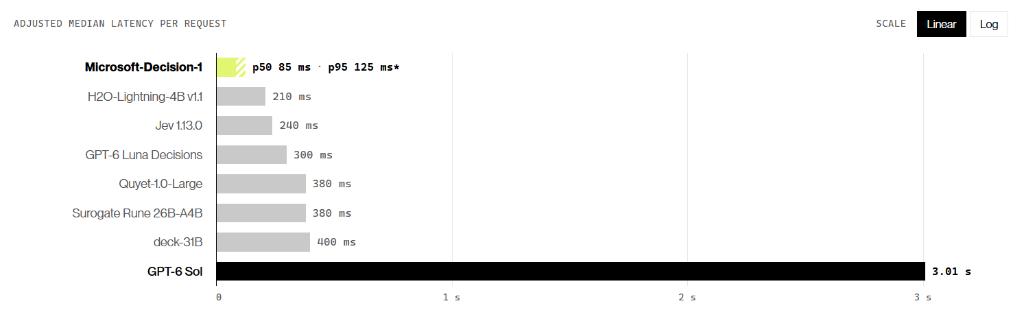
(Time to generate a decision in a single request, the lower the value the better, taking the median of the JevBench test set)
The Xbox Research team used it to classify more than 10,000 pieces of game feedback. The results show that its quality is comparable to GPT-6 Sol, but its speed is more than 14 times higher, and the cost is reduced by about 200 times. The Microsoft Copilot team also found that the model performs similarly to GPT-5.6 Luna in AI response evaluation tasks.
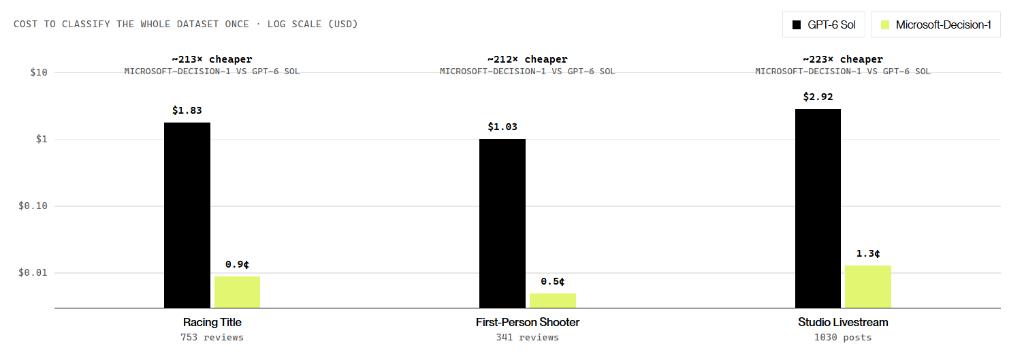
(When Microsoft-Decision-1 classifies the same text, the cost is only a few tenths of that of GPT-6 Sol)
In terms of technical architecture, Microsoft-Decision-1 is built on Qwen3.5-9B and has undergone special post-training centered on single decision score.
Microsoft also plans to migrate the model to other bases such as its MAI series models and OpenAI models in the future.
Microsoft emphasized in the announcement that the model is designed to "integrate decision intelligence into existing applications in a safe and trusted environment", and positions it as one of the basic components of AI agent workflow orchestration.
03
Robustness and Security Are Highlighted
Microsoft has focused on the stability of the model in its design.
Test data shows that after eight forms of perturbation processing on the same request, Microsoft-Decision-1 has an average of only 1.3% probability of decision flip, and the flip rate is zero in scenarios such as rewriting option descriptions or reversing the order of options.
In terms of security, Microsoft has tested the model with 11 benchmarks covering a total of 5250 requests, involving harmful content identification, jailbreak attacks and prompt injection. It claims that the model successfully rejects harmful requests while maintaining high utility for normal use.
At present, Microsoft-Decision-1 has been open to developers through Microsoft Foundry, Microsoft's AI development platform, and access support for OpenRouter is also in the plan.
This article is from the WeChat official account "Wall Street News Max", written by Bao Yilong, and authorized for release by 36Kr.