New competitor of Muse, launched for only six weeks, with a valuation of 2 billion.
Reported by Zhidx on October 9, according to tech media TechCrunch, on October 6, US personal AI assistant startup Tab officially exited stealth mode, with its valuation reaching 300 million US dollars (approximately 2 billion RMB).
Recently, the Personal Agent track has seen frequent moves. At the end of September, the newly established Instinct just completed a $1 billion Series C financing at a valuation of $10 billion; Meta launched Muse, OpenAI launched Dots, and Cognition acquired Poke.
From large-scale financing obtained by startups to tech giants accelerating product deployment, Personal Agent is becoming a new round of competition focus in the consumer AI sector.
The so-called Personal Agent refers to agents oriented to individual users. It will call browsers, calendars, phones and payment tools, and turn the demands in chats into actual operations such as booking tickets, placing orders, making appointments and making payments.
Among them, Tab is also very easy to use. Users can send instructions via iMessage or WhatsApp to ask it to order food, arrange schedules, buy gifts, make phone calls or pay bills. Tab has its own phone number, computer and wallet, and can directly perform tasks on behalf of users.
Tab's investors in this round include SV Angel, Valar Ventures and American Spirit. However, Tab has not disclosed the actual financing amount, nor has it announced the number of users, revenue and payment status.
The date of its first trademark application was August 24. It only took about six weeks from the time the product began to provide services under the name of "Tab" to the announcement of the $300 million valuation. So, what makes a newly unveiled AI startup get such a valuation?
01.
From AI Bible to Creation Tool
A Six-Year Team Behind Tab
The operating entity of Tab is Terrasoft, Inc. Terrasoft was founded about six years ago and belongs to the Y Combinator 2020 Winter Batch. Benlloyd Goldstein, co-founder of Terrasoft, served as CTO of the company from 2020 to 2025 and has now left the Tab team.
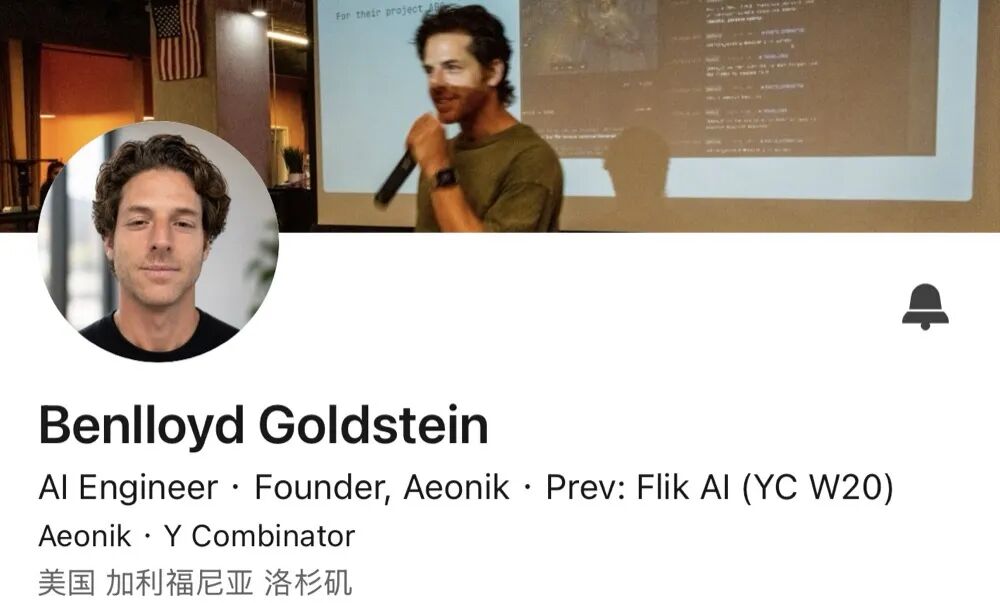
▲ Early co-founder Benlloyd Goldstein
This company has previously developed a number of consumer AI products, among which Faith and Flik are more closely related to Tab.
Faith is an AI Bible application. It uses AI to turn Bible stories into videos, and users can also ask about scriptures, pray and seek religious advice through text or voice.

Faith supports voice functions in 8 languages and text functions in more than 95 languages. It is free to download, and some functions are charged through in-app purchases. This application once ranked 12th in the Books & Reference category of the US App Store. The old version recorded by third-party application data has about 4700 ratings.
In 2026, Brennan Erbz and co-founder & COO Stafford Schlitt began to publicly promote generative AI tool Flik.

▲ Co-founder Brennan Erbz and co-founder & COO Stafford Schlitt
Flik can put video, image, sound and copywriting generation tools in the same workspace, and charge content creators. Adapt Ventures, a private investment institution for early-stage tech projects, once invested in Flik at the pre-seed stage.
This investment also brought out the third co-founder of Tab. Ammar Amdani was originally co-founder of Adapt Ventures. After Adapt Ventures included Flik in its investment portfolio, Amdani appeared in the Tab team as a co-founder.

▲ Co-founder Ammar Amdani
Now when you visit flik.ai, the page will directly jump to workspace.tab.bot. The original Flik product is still in existence, and is charged under the name of Tab creative workspace, with packages starting at $40 and $80 per month.
Therefore, to be more precise, Tab is the latest brand after Terrasoft pivots to Personal Agent.
02.
Give the AI a Computer and a Payment Card
It Starts to Perform Tasks on Behalf of Users
The difference between Tab and ordinary chatbots lies in task execution.
Users can send it text, images, screenshots, PDFs and videos. Tab then logs in to websites, fills out forms, makes phone calls, contacts merchants, and confirms with users before payment. It can also connect to accounts such as Gmail, Google Calendar, Slack, GitHub, Linear and Notion.
In early September, Tab successively launched functions including WhatsApp connection, group chat, browser operation, up to one-hour phone calls, regular check and bank card payment. The product is updated very quickly, but it is still in the internal test stage at present.
As an AI that can view emails, use accounts and spend money on behalf of users, the first problem to be solved is the permission issue. Tab's current approach is to store login credentials separately from the AI, and set the authorization scope for each task. The system will stop operating when encountering an uncertain transaction status.
The payment process uses one-time links. The link is bound to a specific merchant and amount, expires after ten minutes, and can only be submitted once. Bank card data is stored in an independent secure vault, and the password is encrypted using the commonly used symmetric encryption method AES-256-GCM.
The terms of service also clarify the responsibilities, and users need to handle purchases, returns and subscriptions by themselves. In case of disputes, the upper limit of Tab's liability is usually the higher of the fees paid by users in the past twelve months and 100 US dollars. If Tab places an order on behalf of the user, the transaction consequences are still mainly borne by the user.
03.
97 Messages Output a Score of 5.9
Payment Is an Obvious Short Board
Whether Tab can complete the task can be compared with similar products.
Assistant Benchmark is an independent personal AI assistant evaluation website, which uses the same 15 tasks to test different products. The top three on the list are exactly Muse, OpenAI Dots and Instinct mentioned at the beginning of the article, with scores of 9.3, 8.4 and 8.5 respectively.
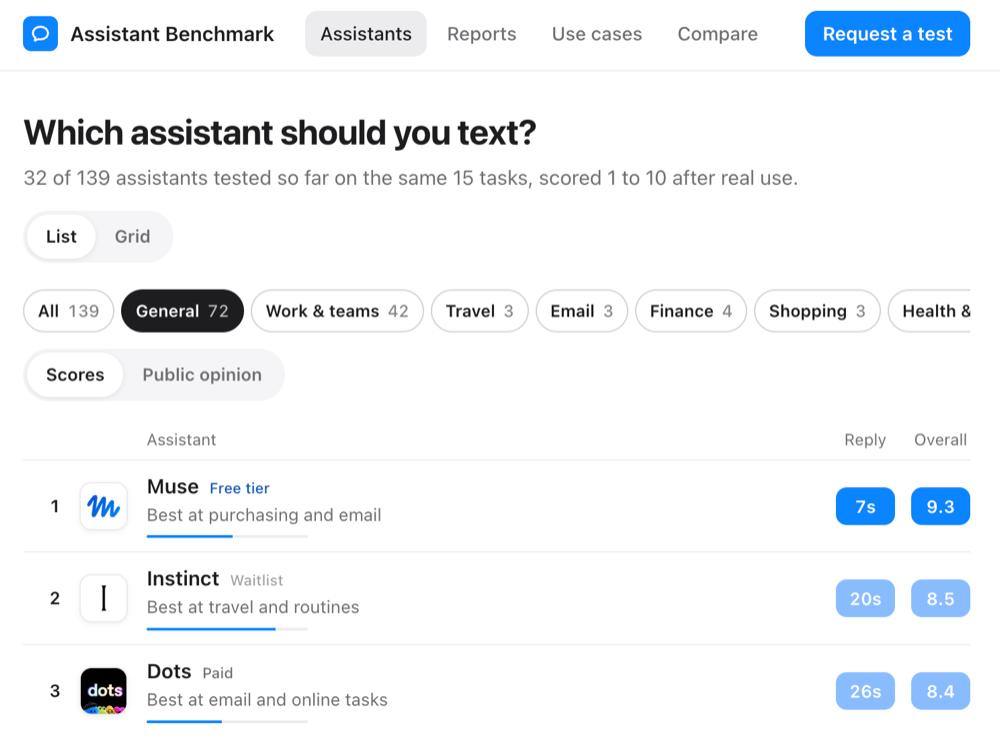
From October 7 to 8, the website tested Tab with the same set of standards. Within two days, the testers sent a total of 97 messages. The median response time of Tab was 12 seconds, no messages were missed, and no irrelevant messages were actively sent.
Phone call task: 10 points. The tester asked Tab to contact a restaurant, Tab made the call within 1 minute, and then quickly fed back that the restaurant used an automatic reservation system.
Permission and privacy item: 9 points. Tab receives bank card data through a link that it cannot read, checks the total amount before payment, and can terminate the task after the user requests to stop.
Reserve a restaurant through website and phone: 3 points. Tab failed to complete it for 3 consecutive times, and one of the reservations expired when filling out the form.
Travel task: 5 points. It gave 3 direct flight options in 10 minutes, then spent nearly 1 hour operating the airline's website, and finally stopped before payment.
Purchase task: 1 point. Tab has put the product on the order page, but encountered bank card payment failure for 3 consecutive times, and finally bought nothing.
The total score of the whole round of test is 5.9, ranking 21st.
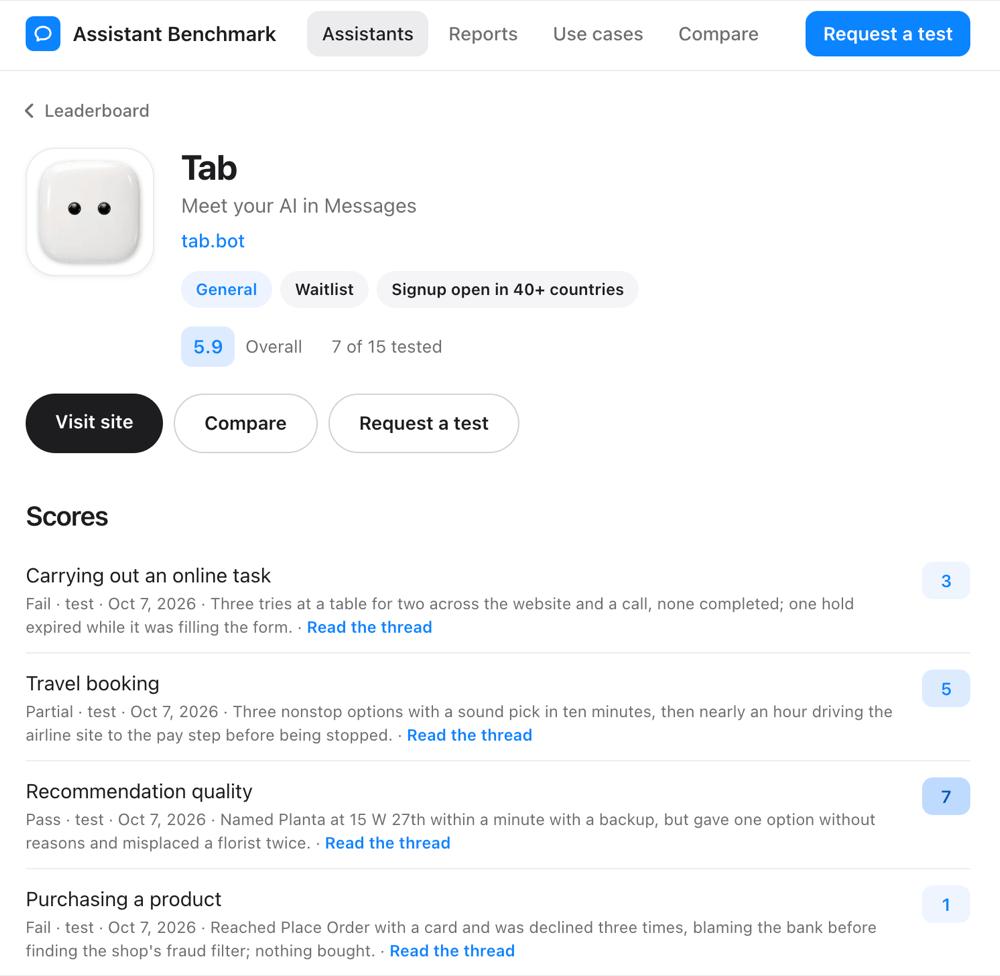
It can be seen that Tab exposes a major problem of execution-oriented AI. Being able to reply, recommend and make phone calls does not mean that the task has been completed. Any step error such as website restrictions, form timeout and payment risk control may lead to the failure of the task result.
04.
Conclusion: The Tide of Personal Agent Is Rising
Exchanging Permissions for Capabilities Also Amplifies Risks
Tab has also caught up with the stage of rapid rise in Personal Agent valuations.
It is not difficult to understand that the concept of Personal Agent continues to heat up. Chatbots can provide information, while Personal Agent can also call mailboxes, calendars, browsers, phones and payment tools to turn a user's sentence into a real operation.
Once this product is reliable enough, it may become the main entry for individuals to handle consumer and service affairs.
But real tasks often span multiple websites and services, and if any link fails, the entire task cannot be completed.
In order to operate on behalf of users, AI also needs to master account, communication and payment permissions. The stronger the capability, the higher the risks of security, privacy and responsibility. Tab performed well in the phone call task, but got stuck frequently in reservation, travel and shopping, which just illustrates the current situation of this category. Whether the task can be completed and whether user privacy is safe will determine how far Personal Agent can go.
This article is from WeChat Official Account "AI Application Trendsetter", written by Jiang Yu, edited by Mo Ying, and published with authorization from 36Kr.