OpenAI spearheads the acquisition spree: 195 AI mergers and acquisitions are included, with the largest single deal valued at 11 billion USD.
Zhidx October 9 news, according to the latest data from Crunchbase, the world's well-known venture capital database, as of September 29 this year, the number of acquisitions of AI startups by VC-backed AI companies has reached 195, 14% higher than the total number of acquisitions in 2025. Only 12 of the 195 transactions have disclosed their prices, making it difficult to measure the total expenditure of AI startups on acquisitions.
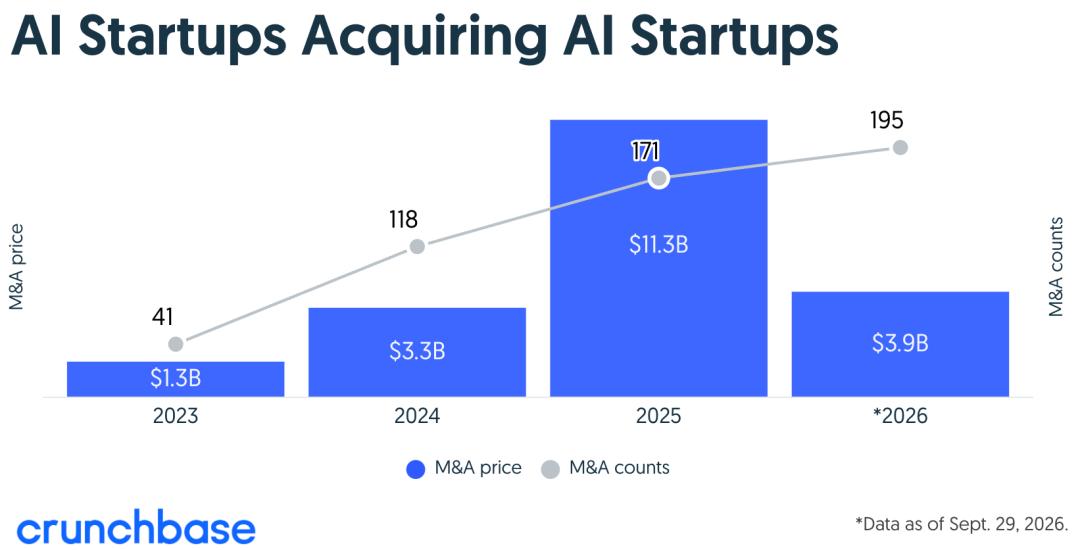
In terms of the number of M&A projects, OpenAI is the most active acquirer in the past three years, having completed 20 AI-related acquisitions in total, of which 10 took place this year. Other companies with frequent acquisitions include Anthropic, which has launched 5 acquisitions, as well as vertical sector enterprises such as legal AI startup Legora and AI programming company Cursor.
Compared with foreign markets, domestic Chinese AI startups have relatively few AI acquisition moves. According to public information, Zhipu acquired about 60% controlling stake in AI compilation team Zhongke Jiahe in late July, and the latter was fully integrated into Zhipu AI Infra department.
Back in June, Tencent was exposed to have joined a consortium including HSG to buy back the AI agent startup Manus from Meta for 2 billion US dollars. But Crunchbase's statistics this time do not include AI acquisitions initiated by large tech companies.
In the AI field, speed is of the essence. Acquiring teams or products is far faster than in-house development, which is expected to help AI startups attract more attention from investors.
OpenAI made 10 acquisitions in a year, legal AI startups completed 5 consecutive and 4 consecutive acquisitions respectively. What on earth are they scrambling for? Among the 195 transactions, which tracks have received the majority of the capital? This article attempts to break down the industrial logic behind this wave of AI M&A.
01. 195 AI M&A Deals: Transactions Up 14%, OpenAI Takes the Lead
Crunchbase analysis shows that the acquirers involved in the 195 transactions are mainly two types of AI companies: one is giant AI unicorns like OpenAI and Anthropic; the other is AI startups in vertical fields, which acquire companies in their respective sectors.
Its data shows that the number of AI startup M&A has increased by 14%, but the number of acquirers has only increased by 2%. That means the companies making acquisitions are still mostly the same ones, but they have become far more active in acquisition moves.
OpenAI is by far the most active acquirer; other companies with frequent acquisitions include Anthropic and legal AI startup Legora, both of which have announced 5 acquisitions.
Following closely is Harvey, a legal AI startup, which has completed 4 acquisitions. Sierra, a customer service AI provider, and AI programming company Cursor have both completed 3 acquisitions this year, while Cohere has announced 2 acquisitions.
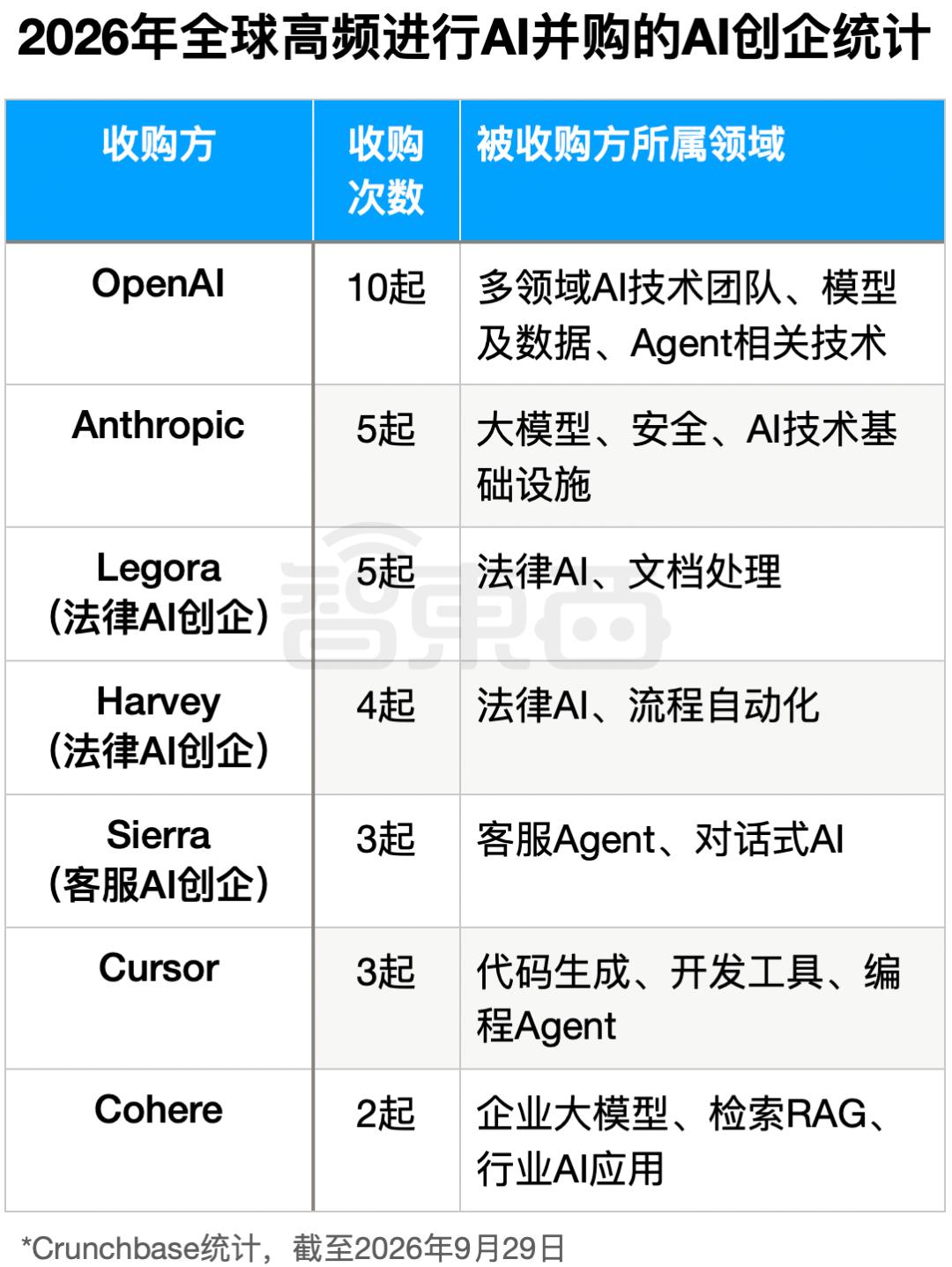
▲ 2026 Global Statistics of High-frequency VC-backed AI M&A (Chart by Zhidx)
02. Only 12 of 195 Deals Disclose Prices: Top 5 AI M&A Transactions, the Largest One Reaches 11 Billion
Overall, only 12 of the 195 transactions have disclosed their prices, making it difficult to measure the total expenditure of AI startups on acquisitions.
The top 5 largest transactions recorded in the dataset as of September 29 are as follows:
1. Nscale, a European AI infrastructure vendor, acquired Anyscale, an AI distributed computing vendor, for 1.65 billion US dollars (about 11.06 billion yuan), which is the largest deal with a publicly announced price.
2. Cyera, an Israeli AI security platform vendor, acquired identity security startup Oasis Security for 1 billion US dollars (about 6.7 billion yuan).
3. Anthropic acquired AI pharmaceutical vendor Coefficient Bio for 400 million US dollars (about 2.68 billion yuan). The latter builds an AI platform to automate drug R&D pipelines, target discovery and clinical regulatory planning.
4. OpenAI acquired US computational photography startup Glass Imaging for 300 million US dollars (about 2.01 billion yuan). The company applies AI to camera hardware using customized AI technology to improve imaging quality.
5. Sword Health, a digital healthcare company founded in Portugal and operating in the US, acquired Kaia Health, the leading German digital therapeutics startup, for 285 million US dollars (about 1.91 billion yuan). The latter provides digital treatment for chronic musculoskeletal diseases based on AI visual motion analysis.
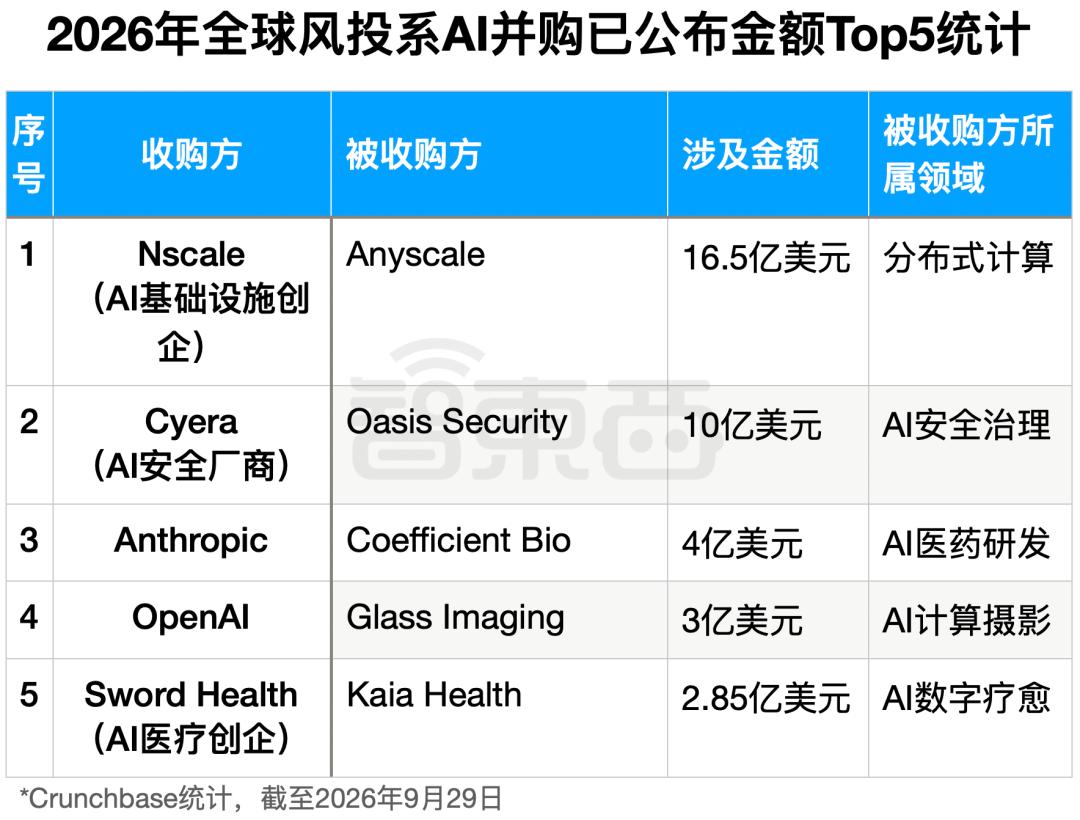
▲ 2026 Global Statistics of Top 5 VC-backed AI M&A Deals by Disclosed Amount (Chart by Zhidx)
03. OpenAI Keeps "Sweeping Up Acquisitions": From Medical Data to Developer Tools, All Included
Which companies are AI startups acquiring, and what do they want to obtain through acquisitions?
Take OpenAI, the most active acquirer, as an example. Its acquisition scope is very wide, covering multiple fields such as healthcare data, scientific writing software, developer infrastructure, security tools, front-end deployment, and professional talents.
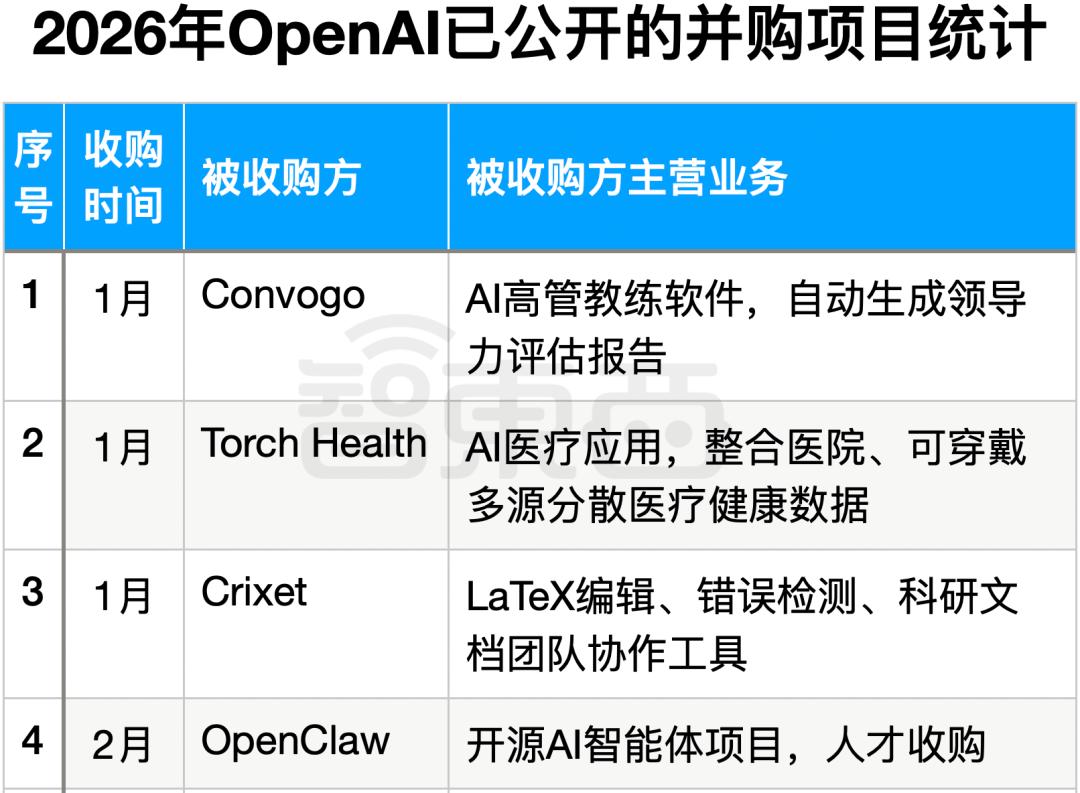
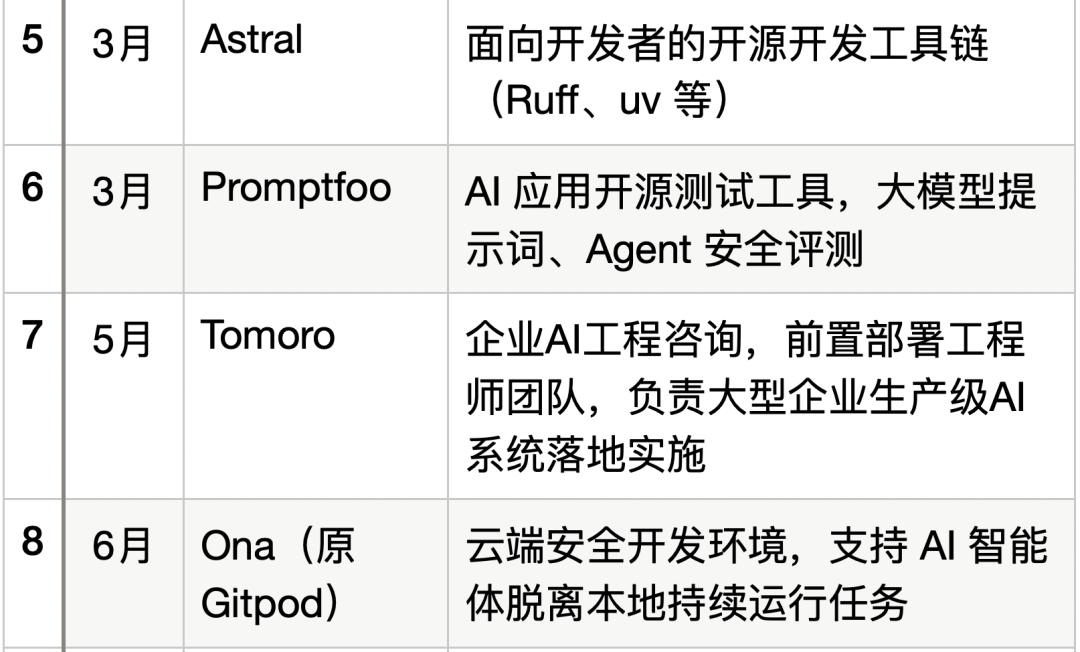
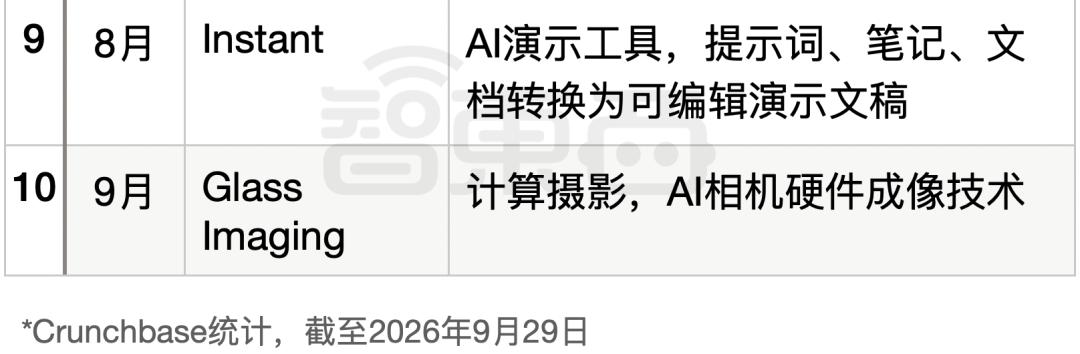
▲ 2026 Statistics of OpenAI's Publicly Announced M&A Projects (Chart by Zhidx)
Crunchbase data shows that the company announced three acquisitions in January alone, setting the tone for this year's frequent M&A activities:
Convogo develops AI software to help executive coaches automatically generate leadership assessment reports; Torch Health is an AI-powered health application designed to unify scattered medical records from hospitals, laboratories, wearable devices and consumers; Crixet provides LaTeX editing, error detection and team collaboration functions.
In February this year, OpenAI participated in an acquisition deal, acquiring the open-source AI agent OpenClaw (nickname: Lobster) and its founder Peter Steinberger.
Then in March, OpenAI announced plans to acquire Astral, a company that provides open-source tools for software developers. In addition, OpenAI also acquired Promptfoo, an open-source tool for testing AI applications.
In May this year, OpenAI acquired Tomoro, a British AI consulting and engineering service provider. Its core business is the FDE (Frontline Deployment Engineer) model, where engineers are stationed inside large enterprises to help customers implement large models into production-grade AI business systems, serving large enterprise customers such as Tesco, Virgin Atlantic and Supercell.
In June this year, OpenAI agreed to acquire Ona (formerly known as Gitpod), a company that provides a secure cloud environment where developers (and a growing number of AI agents) can continue to work even after users close their laptops.
In August, OpenAI acquired Instant, an AI presentation company that can convert prompts, notes and documents into editable presentations. In September, as mentioned earlier, OpenAI acquired Glass Imaging for 300 million US dollars.
04. Vertical AI is Also Booming: Legal Tech is the Most Aggressive, Harvey and Legora Keep Acquiring Small Companies
Analysis of Crunchbase data shows that well-funded vertical AI startups, especially those in the legal technology field, have also been actively acquiring smaller companies this year.
The acquisitions of US legal AI startup Harvey in the AI field are mainly focused on filling gaps in its core platform. Hexus develops tools for creating product demos, videos and guides, while Lume develops software to help enterprises connect customer data and applications with AI systems.
Benchmark, a New York-based company, has developed software to help asset management companies draw lessons from past investments and apply them to new transactions. This acquisition helped Harvey expand its business in the asset management field.
Harvey's fourth known acquisition this year is Guardrails AI. The company announced the acquisition of Guardrails AI on September 9. The latter develops open-source tools for testing, monitoring and managing AI agents.
Katie Burke, Chief Operating Officer of Harvey, told Crunchbase News that the company's M&A strategy is rooted in finding "technical talents with high autonomy and deep experience in legal technology or legal-related fields".
Legal AI startup Legora has further expanded its integration territory in the legal technology field. The five acquisitions announced this year by this Stockholm-based company include:
1. Walter AI is a Canadian startup with 9 employees, whose agent programs can run in Microsoft Word and Outlook.
2. Qura, a Stockholm-based company, is committed to developing AI-native legal research tools.
3. Graceview is an Australian regulatory intelligence platform that monitors changes in more than 100 legal fields.
4. Cadastral, whose AI agents analyze documents and data for commercial real estate companies.
5. London-based Wexler AI can help litigation teams extract facts from a large number of documents, identify inconsistencies and build case timelines.
The acquisition moves of Sierra, a customer service AI provider, reflect its efforts in geographic expansion and expanding the traditional customer service automation field. In March this year, the company acquired Opera Tech, an enterprise AI startup based in Tokyo, as part of its expansion plan in Japan.
After that, it acquired Fragment based in Paris, a company dedicated to helping enterprises use AI to automate operational work. In July, Sierra acquired TakeOff, a startup established only 14 months ago, which focuses on developing "long-term" intelligent agents.
05. Conclusion: AI M&A Volume Rises, OpenAI Takes the Lead in Replacing R&D with Acquisitions
From a global perspective, AI M&A has changed from sporadic supplementary moves to a normal strategy. Giants and vertical champions quickly make up for shortcomings in data, tools, talents and regions through acquisitions. Leading players are accelerating their "sweeping acquisitions" to replace R&D with purchases and seize the time window.
Well-funded startups expand their product lines and customer reach through M&A, while small companies accelerate their commercialization with the help of large platforms. At the same time, the low price disclosure rate and the remaining uncertainty about integration difficulty, as well as the challenge of digesting acquisitions and forming synergy, also bring challenges to the acquisition strategy.
Source: Crunchbase, Zhidx
This article is from WeChat official account "Zhidx", author: Li Shuiqing, published with authorization from 36Kr.