Opus 5.5 integrates everything, OpenAI is under siege by the entire Silicon Valley, and Google together with Elon Musk have collectively defected.
It's absolutely stunning. Gemini is calling Opus, and the era of super agents has truly arrived. From today onwards, Opus powers everything!
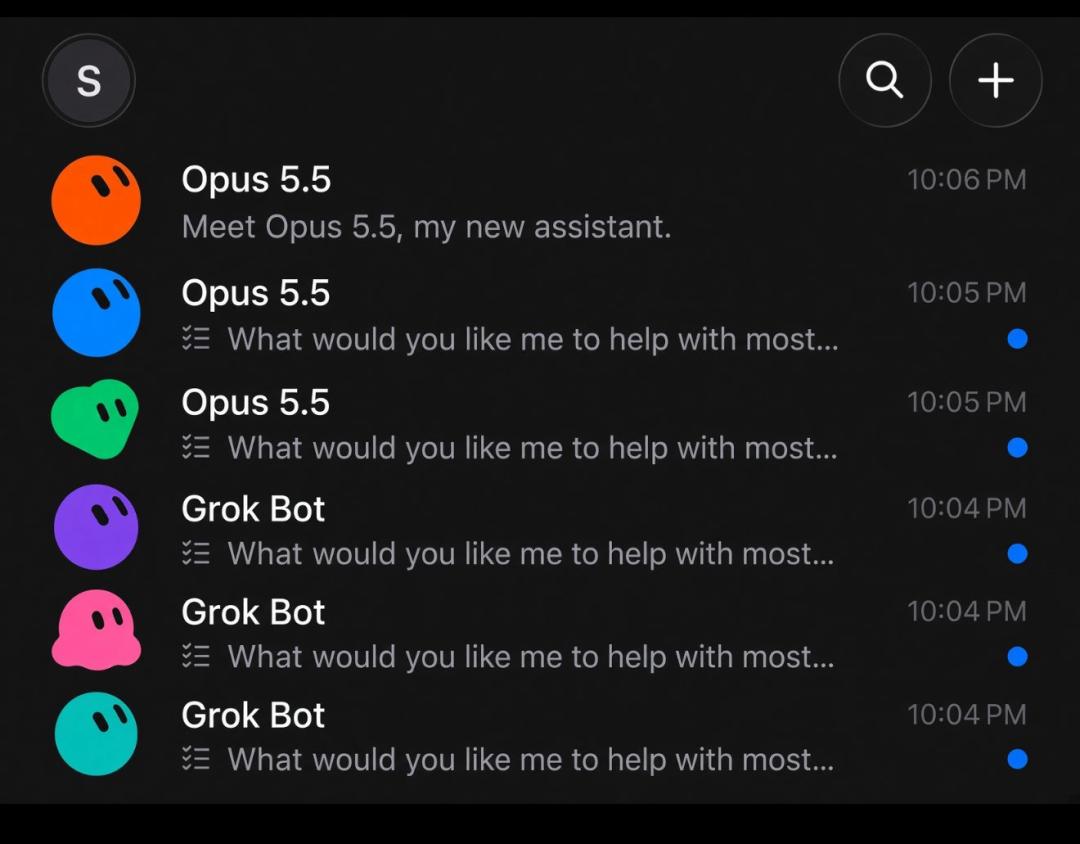
Yesterday, Elon Musk unexpectedly announced that Grok Bot will outsource its tasks to Opus 5.5.
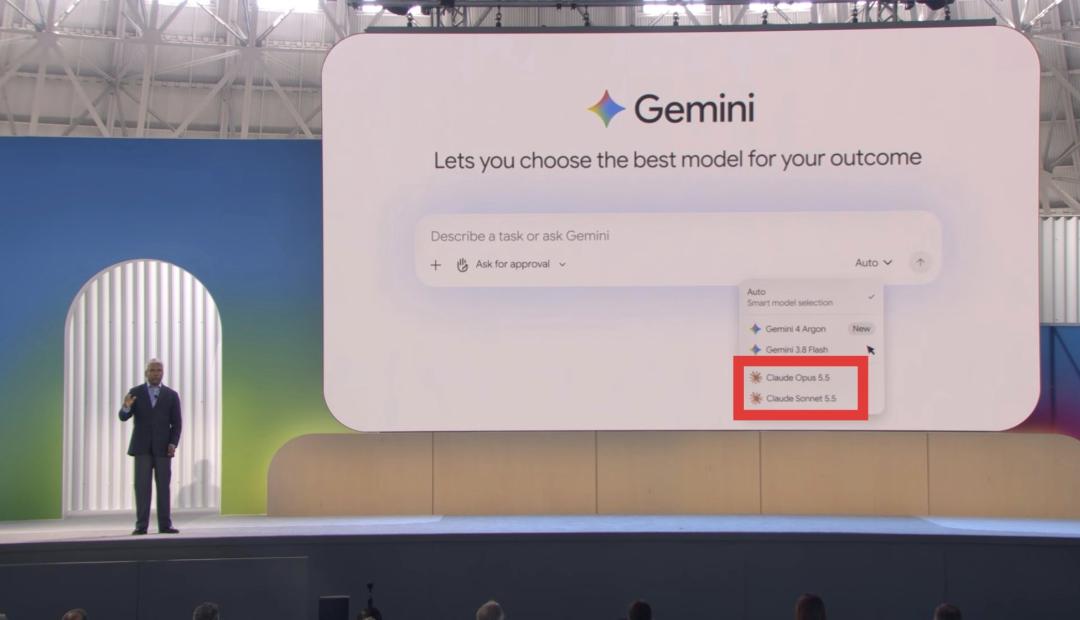
Just one day later, at the Google Cloud launch event, Google directly integrated Claude Opus 5 and Sonnet 5.5 into the Gemini Business enterprise agent!
Antigravity CLI has directly become Claude's agent framework, leaving Gemini as a supporting role.
The significance of this news may be even greater than the release of ten Gemini 4 models. Opus 5.5 has essentially become the configuration standard for super agent models.
From now on, we no longer need to look for any transit points, nor worry about account bans every day. As long as you connect to any mainstream super agent, you can directly access super intelligence!
This means that the previous generation of tech giants who competed fiercely on underlying large models have all turned into "super lobsters" now. Their outer shells look menacing, belonging to Google and Elon Musk, but once you peel off the shell, everything inside is Claude!
The next step is to see how domestic giants will follow up.
All future approaches are essentially building a fancy shell, then connecting to Opus 5.5. The so-called loud slogan of "All in ASI" is actually "All in Opus 5.5".
Next, we will see whose agent and whose workflow can get as close as possible to the full capacity of this strongest model and squeeze out all its potential!
The Cold War of large models has unexpectedly turned into a gateway blocking battle today.
Silicon Valley Brawl: A Joint Siege Against OpenAI?
No one expected that the real commercial war would be like this.
The integration of Opus 5 and Sonnet 5.5 into the Gemini Business enterprise agent also marks the first time in the history of Claude models that it appears alongside Google's own native model in the Gemini selector.
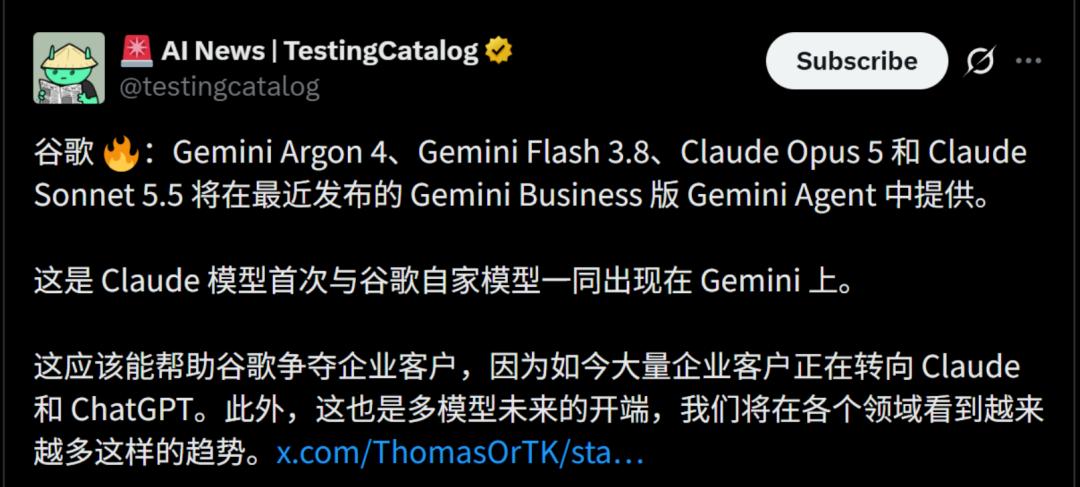
Elon Musk and Google, two giants in the large model track, unexpectedly took tacit actions within 48 hours: they do not recognize Musk's own underlying model, nor OpenAI's GPT, they only recognize Anthropic!
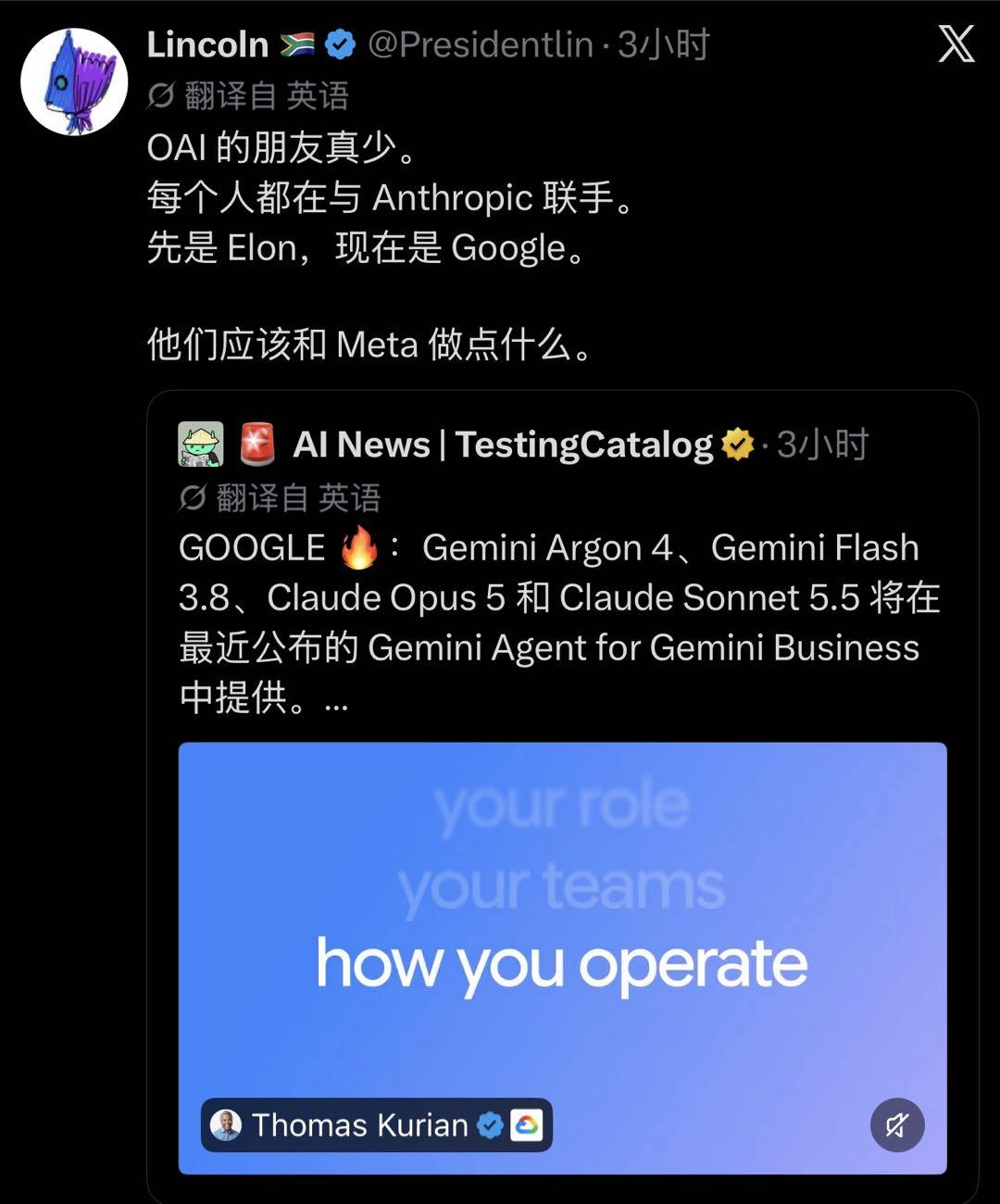
This has sparked frantic teasing from key opinion leaders: OpenAI really has too few friends, everyone is teaming up with Anthropic.
Why would they rather pay a high price to buy other companies' models and integrate them into their own high-end product lines?
The answer is simple: enterprise-level gateway hegemony has outweighed the victory or defeat of the model itself.
In this Game of Thrones, the underlying model can be outsourced, and you can use whichever is stronger. However, the core workflow gateway, user bills, and enterprise data permissions must be firmly controlled within your own system!
The giants have made very careful calculations: they would rather pay the inference fee to Anthropic than let customers flow to ChatGPT!
This is a joint siege against OpenAI.
Highlight of Google's Launch Event: The Strongest Gemini Turns Out to Be Claude 5.5?
Let's focus on the dramatic "Gemini at Work 2026" launch event.
Google grandly launched the Gemini agent. Its concept is very forward-looking: all work starts from the current prompt window. It is embedded in Workspace, moves freely in Gmail, Docs and code environments, and has all your business context.
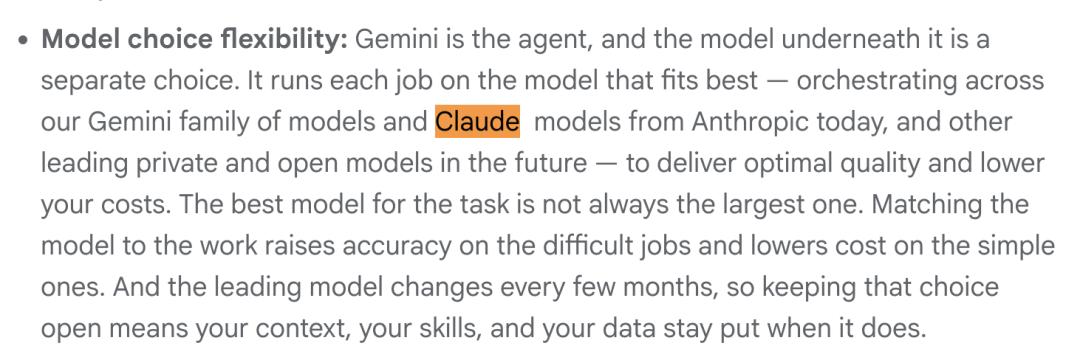
Google put forward six gorgeous core architecture principles: unified agent, full-end access, cloud memory, multi-agent orchestration, in-depth context, and — model selection flexibility.
It is this "model selection flexibility" that has become the biggest joke of the whole event.
In the drop-down menu of the enterprise version agent, the options are listed at the same time:
- Gemini 4 Argon
- Gemini 3.8 Flash
- Claude Opus 5
- Claude Sonnet 5.5
This is really eye-catching.
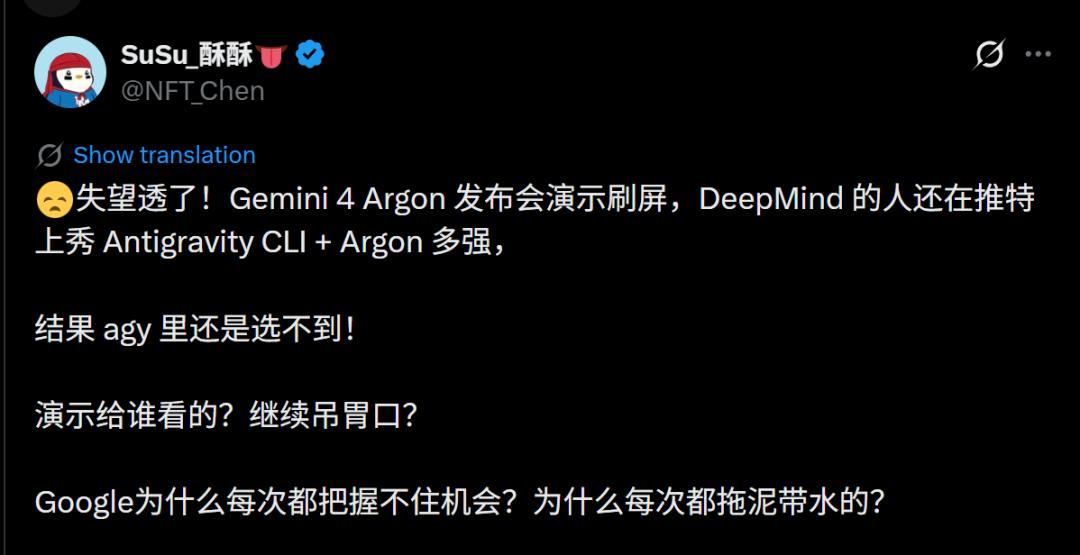
At the launch event, DeepMind executives frantically showed how powerful their new tool Antigravity CLI is when paired with Gemini 4 Argon. But when developers excitedly rushed into the system to check — sorry, Argon is marked "New", but you can't select it at all!
Sundar Pichai had already revealed the bottom line before: Argon will first be used by the Fairwind network defense side, and it will be released only after passing the security check.
Someone summed it up like this: Antigravity CLI has completely become Claude's proxy framework, and Sonnet 5.5 is equal to the strongest Gemini available at present!
Developers complained helplessly: I'm extremely disappointed.
Extremely disappointed! The demo is everywhere, but you can't select Argon in agy.
Who is the demo for? Keep tantalizing people? Why can't Google seize the opportunity every time? Why are they always dragging their feet?
In fact, this move by Google seems to lose face, but actually retains the core interests: everything is to retain customers.
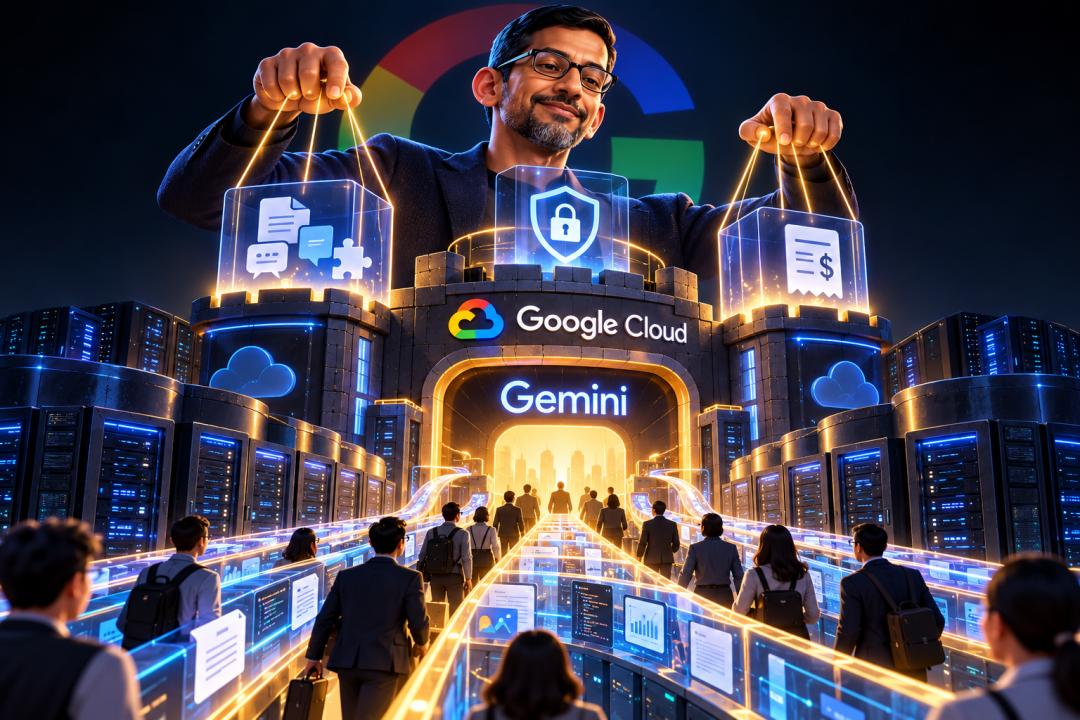
In the past year, nearly 500 Google Cloud customers have processed more than one trillion tokens, and 90% of the Fortune 100 companies are using Gemini Enterprise. If they don't provide them with the best models, they will buy OpenAI's enterprise version tomorrow.
It doesn't matter whose brain is used, the money and gateway must belong to me. After retaining customers, Gemini will naturally make huge profits easily, sitting and "collecting tickets".
Google said bluntly:
Gemini is an agent, and which specific model it uses at the underlying layer is another independent choice.
Behind Musk's "Bow": The $84.5 Billion Computing Power Plan
If Google's plan is the enterprise gateway, then Musk's "adoption of Claude" is a conspiracy of capital and computing power.
On October 7, Elon Musk announced that Grok Bot will be connected to Claude Opus 5.5, paired with multimodal Midjourney and Suno.
Many people mocked Musk that "Grok can't beat Claude after all, and huge investment ends up in vain", but the truth is chilling.
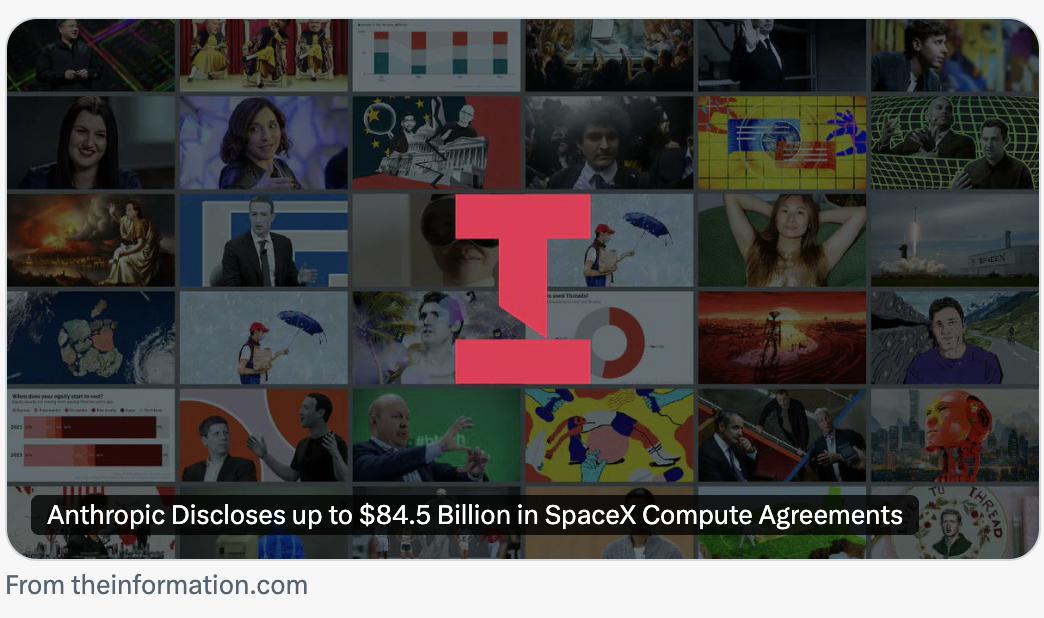
According to the recently disclosed SpaceX financing documents, Anthropic is negotiating with SpaceX and is expected to purchase up to about $845 billion worth of computing power resources.
The false reputation at the model level is not worth mentioning in front of real money business.
In front of the stage, Musk praised Anthropic's Claude to the fullest; behind the scenes, it is huge payment for the super computing power cluster.
At the same time, Grok users get the strongest reasoning ability on earth, which firmly locks the platform stickiness.
Whether it is Google or Elon Musk, they have seen through this underlying logic: large models are becoming infrastructure, and the intellectual leading period of a single model has been shortened to several months or even weeks.
It is not the optimal choice to sacrifice the ecological gateway and the commercialization of computing power in order to retain the false reputation of model ranking.
But in all this prosperity, there is no OpenAI at all.
The Silent Tacit Understanding of Giants: Why Do They Want to Sideline OpenAI?
When both Elon Musk and Google implant Claude in their respective agent hubs, who is the most uncomfortable?
There is no doubt that it is OpenAI.
The former "dragon slayer" has now not only become the public enemy of Silicon Valley, but also fallen into the dilemma of being isolated by all major giants.
Looking around this big game, OpenAI is tasting the bitter fruit it planted.
First of all, it is the distrust brought by "full-stack dictatorship".
From GPT-4 to GPT-4o, then to the o1 series and its own Operator agent attempts, Sam Altman's ambition has never been to be a "behind-the-scenes model supplier", but to uproot the entire consumer and enterprise ecosystem.
OpenAI not only wants to make underlying models, but also to make C-end super apps, enterprise agent operating systems, and even personally enter the hardware and search fields.
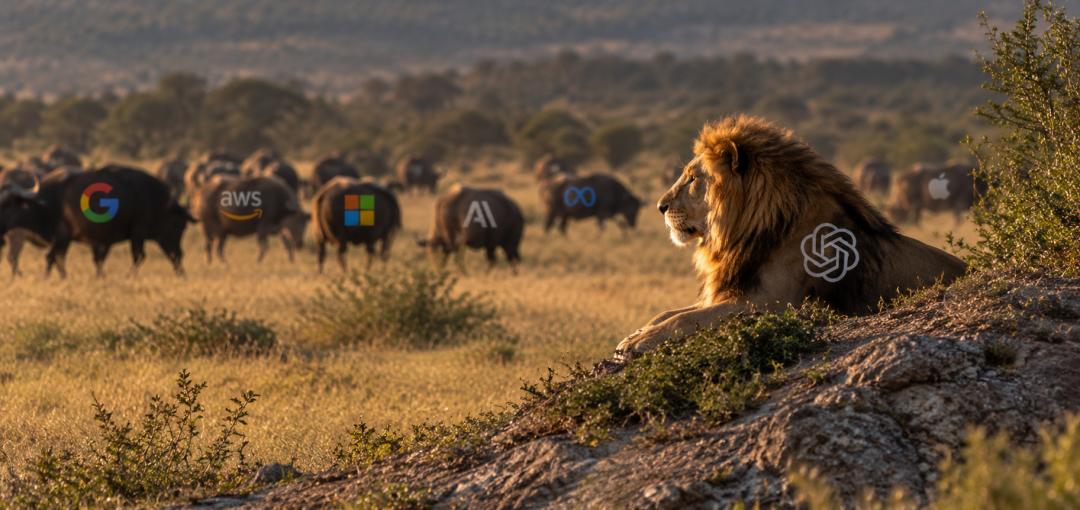
This attitude of regarding all ecological partners as "potential prey" eventually makes all giants have to take precautions.
In contrast, Anthropic gets along well with everyone, maintains a relatively restrained positioning, and is more like an "arms supplier", so it naturally becomes the preferred white glove for giants to check and balance OpenAI.
Secondly, there is the positional warfare crisis in the enterprise market.
In the enterprise-level market, customers do not need a "super tech empire" that is moody, frequently adjusts pricing, and always wants to take the core data of enterprises for themselves.
According to Reuters, Anthropic's prospectus states that its infrastructure commitments with six partners in the next ten years will be at least $518 billion, of which about 80% is non-cancellable or independent of usage: Google at least $111.1 billion, Amazon $110 billion, Microsoft $31.4 billion, Broadcom-related equipment leases of about $161.2 billion are largely non-cancellable, and AMD's expected computing power exceeds $20 billion.
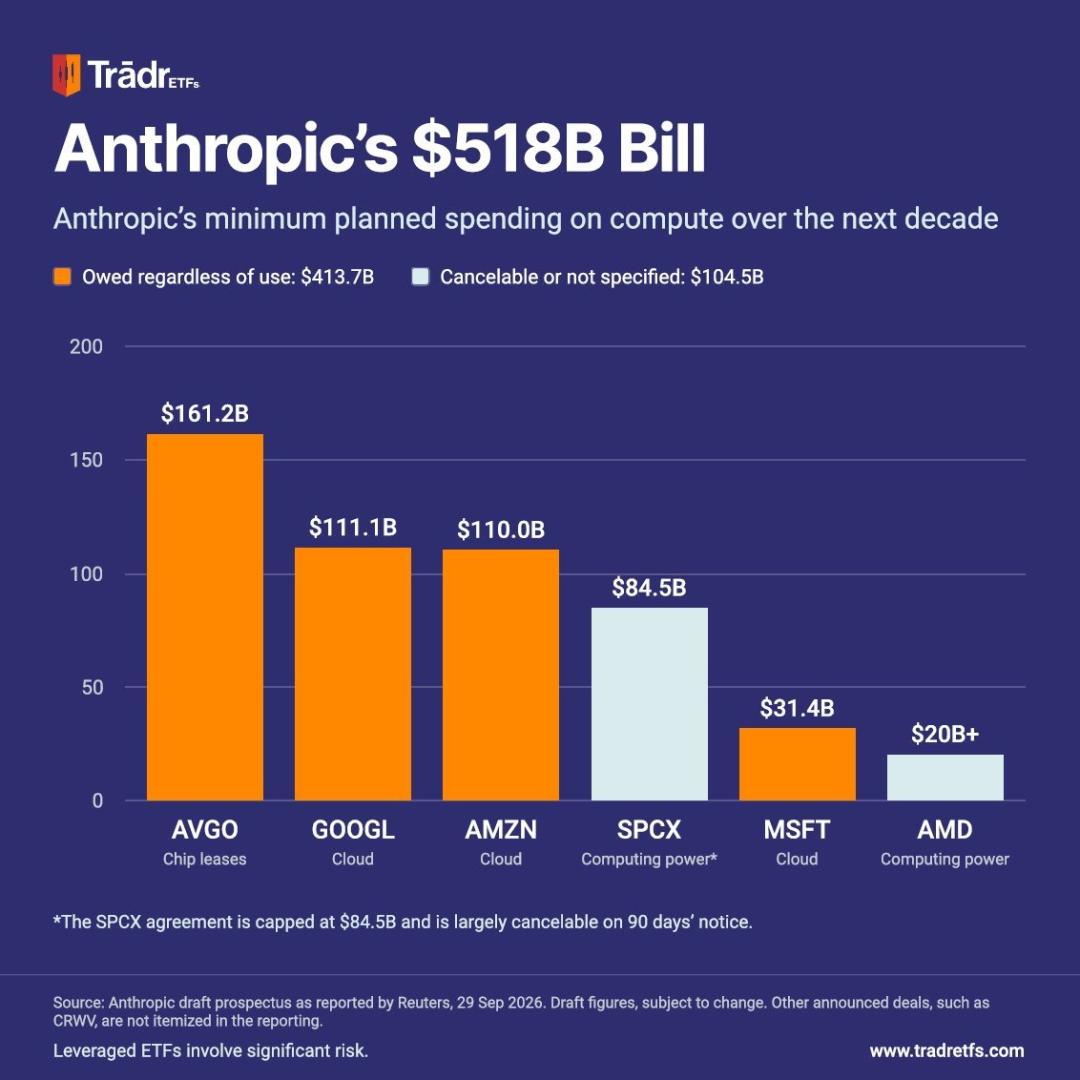
Anthropic's public image in AI safety, plus its compliance with cloud vendor gateways, makes it almost unimpeded in the B-end market.
Giants would rather work for their mortal enemies than hand knives to OpenAI.
A silent siege is pushing OpenAI to become a "lonely person".
What OpenAI is facing now is dimensionality reduction strike —
In terms of models, Opus 5.5 and Sonnet 5.5 can already match GPT-6. In terms of gateways, Google has Workspace, the world's largest office scenario, and Elon Musk has X, the world's largest real-time information flow.
As for OpenAI? It is stuck in the middle. Although its enterprise version is strong, it is still an "add-on" tool, lacking the natural workflow base like Google's full suite of products.
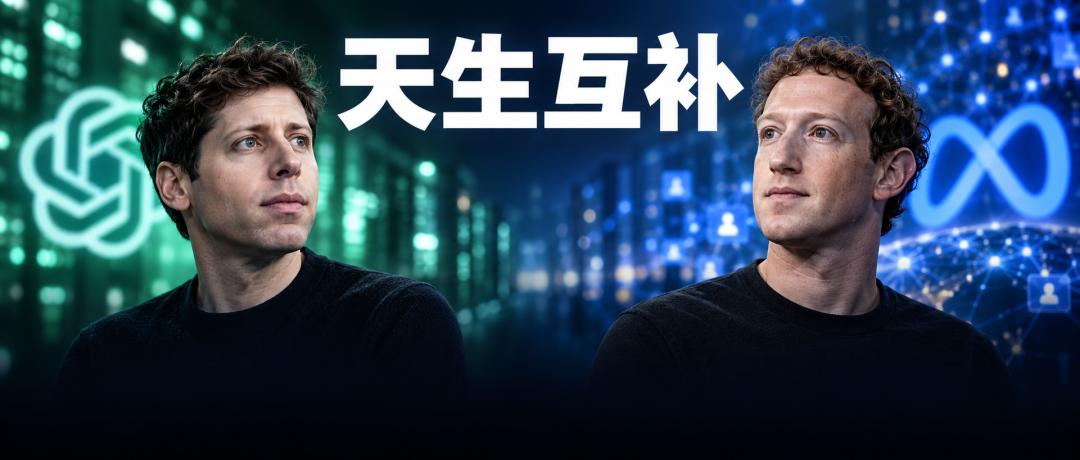
Overseas analyst Lincoln pointed out sharply: Now it is time for Sam Altman to call Mark Zuckerberg. The only hope for OpenAI to break the deadlock is to lower its stance and quickly join hands with Meta.
Meta has just launched its own enterprise platform and Business Agent, holding the huge traffic and enterprise merchants of WhatsApp, Instagram, and Facebook, and has not yet taken sides on top closed-source models.
If OpenAI cannot form an alliance with