Exclusive from 36Kr | An aerospace veteran has founded a startup focused on high-resolution remote sensing cameras, which has successively completed multiple rounds of financing totaling nearly 100 million yuan.
Author | Qiao Yujie
Editor | Yuan Silai
This article contains about 2300 words, and a 5-minute reading is recommended
36Kr Hard Krypton has learned that Beijing Zhongmou Technology Co., Ltd. (hereinafter referred to as "Zhongmou Technology") recently announced the completion of multiple rounds of financing totaling nearly 100 million yuan, co-invested by Minsilver International, Yizhuang Seed Fund and Far Wing Capital. The funds will be used for mass production of 0.5m resolution remote sensing cameras, construction of standardized production capacity, and R&D of remote sensing camera products with higher resolution.
Founded in 2024, Zhongmou Technology is the first high-tech enterprise in China's commercial aerospace field that specializes in optical remote sensing cameras with 0.5m resolution or better than 0.5m resolution. The company can provide a full range of solutions including integrated satellite-borne design, R&D and manufacturing of high-quality remote sensing cameras.
(Image source / The enterprise)
Ma Bo, founder of the company, once worked at Aerospace Dongfanghong and China Spacesat, and presided over a number of national key aerospace projects. All core members of the team are from the national "national team" of aerospace and leading commercial aerospace enterprises, with an average working experience of more than 15 years, and have full-process engineering experience in 0.5m and better than 0.5m resolution cameras from design, assembly and adjustment, testing to large-scale delivery.
At present, satellite remote sensing is gradually moving from traditional professional field applications to a broader commercial and mass market, and the global remote sensing industry has entered a stage of accelerated development. According to public industry statistics, as of April 2025, among the remote sensing constellations that have been publicly planned and constructed in China, there are 75 optical remote sensing constellations, involving more than 10,000 optical satellites. Under the wave of large-scale constellation networking, the market demand for high-quality 0.5m optical remote sensing payloads is rapidly released, but there is still a significant gap in the supply of commercial cameras that can balance high performance, engineering implementability and mass delivery capability.
Facing the long-term development demand for quantitative remote sensing applications, Zhongmou Technology is committed to providing high-resolution camera products and systematic solutions with better "cost-effectiveness ratio", so as to solve the problems of insufficient production capacity and high cost of optical remote sensing cameras.
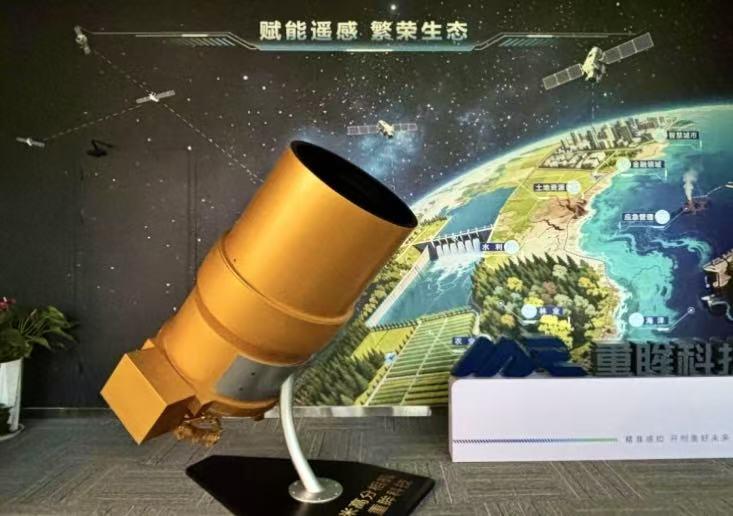
The development technology of remote sensing cameras with 0.5m resolution or better than 0.5m resolution has a high threshold, which is highly dependent on engineering development experience. The technical team of Zhongmou Technology covers the whole chain of high-resolution camera development, and has accumulated development experience of nearly 30 sets of 0.5m and better than 0.5m resolution cameras before.
(Image source / The enterprise)
The size of the optical system corresponding to the 0.5m resolution camera usually falls into the category of "large aperture", which puts extremely high requirements on the machining accuracy and structural stability of structural parts. Zhongmou Technology has now broken through the development technology of 1000mm aperture primary mirror, which can achieve surface accuracy better than 0.015 wavelengths, thus ensuring stable on-orbit imaging quality. At the same time, the company has established refined capabilities in the lightweight and thermal control design and stiffness coupling design of the optical system, so that the camera can maintain the stability of the optical axis even in the complex dynamic and temperature change environment during on-orbit operation.
Focusing on the above core technologies, Zhongmou Technology has now opened up a complete capability chain from design, device processing to complete machine assembly, adjustment and testing in multiple key engineering links, and mastered key technical know-how.
In terms of product strategy, Zhongmou Technology adopts the "1+X" mode, that is, the coordinated development of standardized spectrum products and customized products. At present, the company has planned a number of standardized products, including 5-spectrum and 9-spectrum models with 0.5m resolution and 12km swath width at 500km orbit, as well as 9-spectrum products with 150km swath width, and at the same time laid out products with resolution better than 0.5m for the future. These standardized models can realize rapid delivery, and carry out modular customization according to different application scenarios on this basis. The products are oriented to the general commercial satellite, industry constellation operators, vertical terminal application fields, covering quantitative remote sensing application scenarios such as ecological monitoring, agricultural yield estimation, disaster prevention and mitigation, and adapting to the large-scale networking demand of commercial constellations.
In terms of delivery progress, the company will complete the development of multiple cameras including 3m resolution, 0.5m resolution and situation awareness cameras this year, and plans to deliver them to customers successively in the fourth quarter.
(Image source / The enterprise)
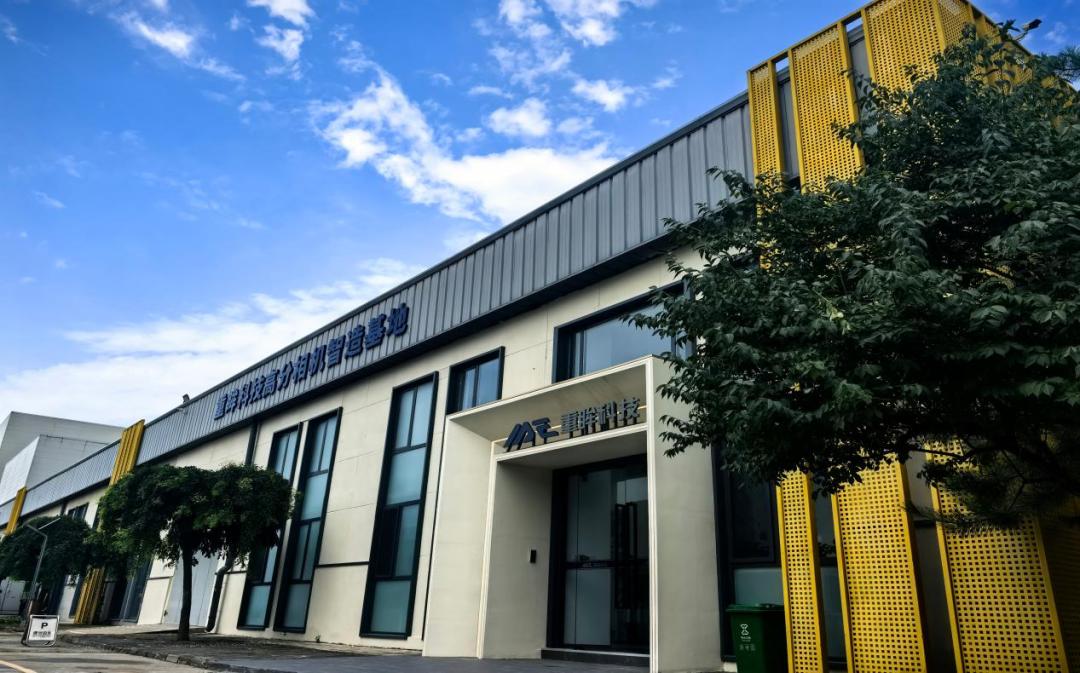
Earlier this year, Zhongmou Technology completed the production line construction in Yizhuang, which has now been officially put into operation and has mass production capacity. The first batch of products is being assembled and adjusted on the production line. It is understood that the annual production capacity of this production line can reach 10 to 15 sets of 0.5m level high-resolution cameras, and it is expected to realize large-scale delivery next year.
The following is an excerpt from the founder's communication (slightly edited):
Hard Krypton: How to understand the barrier or scarcity of systematic engineering experience in the field of high-resolution optical payload development?
Ma Bo: Optical payload is not a simple splicing of components, but a complex systematic engineering. A good design scheme on paper is only the first step. To turn the drawing into a product that can be used in space, it is necessary to connect design, processing, assembly and adjustment, testing, and also consider various on-orbit working conditions such as launch impact, space temperature change, and tremor. It is far from enough to have strong capabilities in a single link, and experience precipitation of the whole chain is required.
This kind of experience depends on the practical accumulation of a large number of projects, which is difficult to be completely covered by theory and simulation alone. Especially in the assembly and adjustment link, no matter how good the lens design is, it is equal to zero if it cannot be assembled. If assembly is the upper limit of physical work, then assembly and adjustment is the ceiling of craft work. Even if all individual parts are qualified, the tolerance will accumulate continuously, which will eventually affect the imaging quality of the whole machine. Assembly is to assemble the parts in place, while assembly and adjustment is to assemble, detect and correct at the same time, and offset various errors through centering, ring trimming and other means, so as to turn the paper design into a physical product with up-to-standard performance.
From prototype production to product capability that can be delivered in batches, the precipitation of full-chain engineering experience is required in the middle. Zhongmou Technology has accumulated engineering experience from drawing design, precision assembly and adjustment, complete machine testing to large-scale delivery. The designers in the team understand assembly and adjustment, and the assembly and adjustment technicians understand design, which can translate the actual application requirements of users into clear design indicators, and finally produce high-resolution intelligent cameras. This cross-link connected systematic engineering capability is exactly what is relatively scarce in the current commercial aerospace optical payload field.
Hard Krypton: What is the difference between "quantitative remote sensing" and "qualitative remote sensing", and why the demand for "quantitative remote sensing" will become a development opportunity for high-resolution commercial remote sensing payloads?
Ma Bo: In simple terms, traditional qualitative remote sensing is more about "seeing what it is", such as identifying the outline of ground objects and distinguishing the type of targets; while quantitative remote sensing is to "calculate how much it is", which can extract quantifiable data such as temperature, vegetation growth, and water body parameters from images.
It turns satellite images from a single "photo" into data sources that can be analyzed and calculated, and the value will be multiplied. No matter it is agricultural yield estimation, ecological environment assessment, disaster loss assessment, or fine management of natural resources, it is inseparable from the data support of quantitative remote sensing. With the acceleration of digital transformation in all walks of life, the market is no longer satisfied with "being able to see", but needs to "calculate accurately", which is exactly the huge development opportunity for high-resolution commercial remote sensing payloads.
Hard Krypton: What considerations are behind the strategy of coordinating standardized spectrum products and customized products?
Ma Bo: For commercial aerospace, standardization means lower cost and higher delivery efficiency. Through spectrum-based products, repeated R&D can be reduced, the reuse rate of the supply chain can be improved, and customer demands can be met faster. However, the demands of different industries and different application scenarios for remote sensing cameras are significantly different, such as orbit altitude, swath width, spectrum configuration, resolution, etc. Therefore, based on standardized products, we will make targeted configuration adjustment and modular customization combined with the specific demands of customers in vertical industries.