Over 3 billion US dollars are pouring in frantically, and Physics AI is breaking through the ceiling of the AI pharmaceutical industry.
Recently, the term "physics" has appeared more and more frequently in the narrative context of AI4S and the pharmaceutical industry.
Especially in the past six months, startups whose businesses cover the upstream, midstream and downstream of AI4S have scrambled to include the exploration of the physical world in their financing documents. In August 2026, Transfyr completed a $25 million seed round of financing immediately after its establishment, and the words "Physical AI Platform for Science" were written into the title of the financing news. In China, Shuye Technology completed its Pre-A round of financing in September, and also included "building a self-driving laboratory with Physical AI" in the title of its financing press release. While Jindushengke, which secured a nearly 100 million yuan Series A financing in June, also clearly proposed in its news title to reshape the paradigm of life science research with physical AI.
Although the industry has not yet reached a consensus on what physical AI in the pharmaceutical industry exactly is, it seems that as long as the word "physics" is grasped, the entrance to the real world is obtained.
01
The surging wave of physics emerges in the fast-growing AI4S track
Physical AI is originally a popular new term from the technology industry. In this latest artificial intelligence boom, physical AI often appears alongside embodied intelligence and world models. In the tech community, physical AI generally refers to AI integrated with the physical world, such as autonomous driving. At the Consumer Electronics Show (CES) earlier this year, Jensen Huang called physical AI the next wave of AI.
Compared with embodied intelligence and world models, physical AI offers a broader conceptual extension and more room for imagination, so it has quickly gained high recognition from the capital, academic and industrial circles. Today, the tide of physical AI has poured into the life science world and gained an even wider conceptual extension.
"In fact, the term physical AI is also a new concept for peers in the industry," Li Su, founder and CEO of Shuye Technology, told vcbeat. "Combined with our experience, physical AI refers to AI that can truly perceive the real environment and manipulate devices previously controlled by humans to perform tasks. In the laboratory scenario, it can be interpreted as allowing AI to participate in experiments through instruments or robots." Li Su pointed out that the key value of physical AI in life science laboratories is reflected in the links of environmental perception, decision-making and judgment. According to incomplete statistics from vcbeat, in the past year or more, life science enterprises labeled with physical AI have obtained intensive financing, including a large number of large-scale early-stage financings.
Two companies that have attracted much attention in this round are located in New York and Shenzhen respectively. At the end of 2025, Medra, a New York-based AI robotics startup, completed a $52 million Series A financing. Together with the previous $11 million seed round, the total financing reached $63 million. The founder of Medra is Michelle Lee, a Chinese female scientist who graduated from Stanford University and has engaged in research on robot foundation models at the Stanford AI Lab for many years. Before leaving to start her own business in 2022, Michelle Lee also interned at Elon Musk's SpaceX. Medra is committed to developing physical AI scientists for drug discovery, and Michelle Lee summarizes this work as the collaboration of two levels: scientific AI puts forward hypotheses, and physical AI operates instruments.
Six months later, Shenzhen-based Jindushengke completed a nearly 100 million yuan Series A financing led by Good Health Investment. Earlier, Jindushengke received several rounds of financing from HSG Seed Fund, Chuangdongfang Investment and Nanshan Strategic Emerging Industry Investment in 2025. Jindushengke is led by founder and CEO Jin Yongcheng, together with three other alumni from the University of Oxford. They have published more than 60 papers in top journals such as *Nature*. When announcing the Series A financing, Jindushengke clearly stated that the funds from this round will first be used to deepen the underlying architecture of physical AI.
In addition, a number of older companies have also regained favor from capital with the help of the physical AI trend. In May 2025, Suzhou Yulu Qianxing completed a tens of millions of yuan Series A financing led by Yuan Sheng Venture Capital. Its founder Zheng Zheng once said that the technical path of Yulu Qianxing is to deeply integrate AI and physical simulation, and use molecular dynamics to calculate the dynamic interaction between drug molecules and targets. In March 2026, Hangzhou Hetan Intelligence obtained a new round of 50 million yuan financing led by Yonghua Investment. It has been 3 and a half years since its last round of financing. Chen Zhigang, founder of Hetan Intelligence, served as the first chief digital officer of WuXi AppTec. He did not directly use the term physical AI, but emphasized that Hetan Intelligence aims to build a general-purpose, software-defined robotic scientist.
In August of the same year, Hangzhou Shuye Technology, founded in 2018, completed its Pre-A round of financing. Li Su, founder and CEO of Shuye Technology, holds a doctorate in engineering robotics from the Technical University of Munich, and the company's slogan is "Physical AI for Science". The next month, Nanjing UD Bio, founded in 2013, announced the closing of tens of millions of dollars in Series C1 financing. In the financing press release, UD Bio emphasized the dual-wheel drive of AI and physics to identify hidden allosteric sites that traditional force fields cannot capture.
It is worth noting that investment institutions have shown great enthusiasm for extremely early-stage physical AI life science projects. In April 2026, Transfyr closed its $25 million seed round, equivalent to about 168 million yuan. The company directly positions itself as a research-observable physical AI platform. In China, in August 2026, Deepcell completed a nearly 100 million yuan seed round of financing, proposing to use AI and physics to write molecular physical mechanisms into model constraints. The next month, Shanghai Phyraxis AI, which was just one month old, completed a multi-million yuan level of first strategic investment. Phyraxis AI named its brand Phyraxis AI, and its positioning is directly targeted at physical artificial intelligence for science. Wang Tong, founder of Phyraxis AI, mentioned embodied intelligence when discussing the company's business, pointing out that embodied intelligence in the field of life science cannot only stay at the level of robots demonstrating a single action.
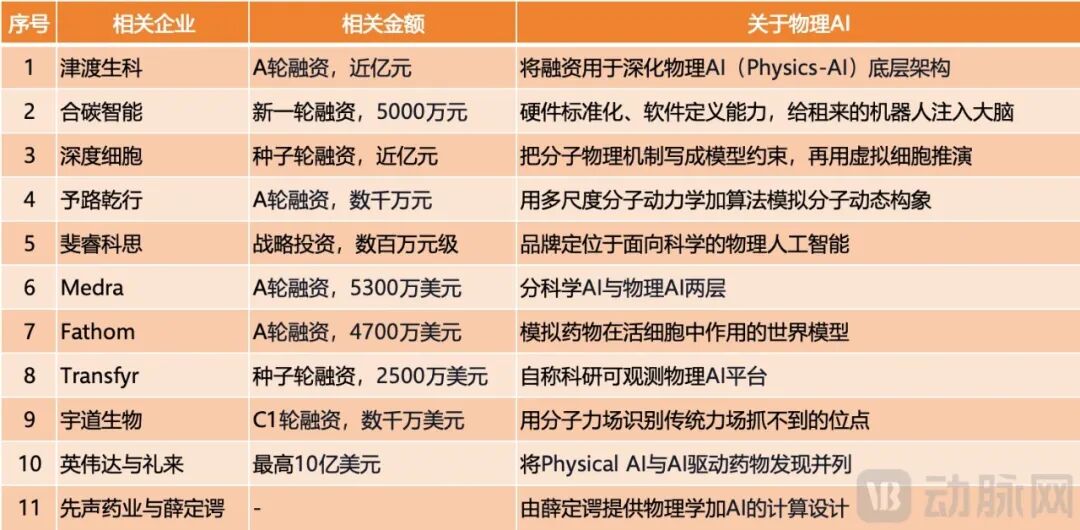
On the other hand, pharmaceutical giants have also shown unprecedented enthusiasm to actively embrace physical AI. In January 2026, NVIDIA and Eli Lilly announced a partnership to build a joint AI innovation lab in the San Francisco Bay Area, connecting the former's BioNeMo platform to Lilly's R&D process. It is expected that up to $1 billion will be invested within 5 years to cover the resulting talent, infrastructure and computing power expenses. In the title of the released press release, Physical AI and AI-driven drug discovery are placed in parallel, and a large number of pharmaceutical companies and automation companies such as Thermo Fisher Scientific, Amgen, Roche, and Multiply Labs appear in the ecosystem list. In addition, in August 2026, Simcere Pharmaceutical reached a global drug discovery and development cooperation with Schrödinger. The two sides made it clear that Simcere will lead the preclinical and clinical stages, while Schrödinger will provide computational design capabilities integrating physics and AI. Earlier, Anthropic, the large model giant, cooperated with HHMI Janelia to open-source a set of model hardware standards MHS, which aims to enable models to discover and call microscopes, liquid handlers and robotic arms in a unified way, greatly reducing the difficulty of AI entering laboratories.
So far, more than $30 billion has flowed directly or indirectly into this field, which fully demonstrates the popularity of physics in the AI4S industry.
02
What is Physical AI4S supposed to do?
In essence, the core of physical AI is to break away from computational models and integrate with the real world. The real world that Physical AI4S combines is the laboratory that has undergone tremendous changes under the AI wave.
With the continuous evolution of large biological models, the output of AI design has been sufficiently prosperous, while verification and data feedback are extremely scarce, which has stimulated huge demand for wet experiments. The design end produces molecules every day, and the verification end is the only exit. "This makes the data of real experiments, especially the data of failed experiments, extremely important," a practitioner told vcbeat. In general, the current Physical AI4S with different technical styles can be roughly divided into two categories: companies that take physics as a scenario, build robots, and sell experimental throughput and evidence chains, such as Medra and Jindushengke; and companies that take physics as knowledge, build models, and sell the service of pre-calculation before testing, such as Deepcell and Yulu Qianxing. Both types of Physical AI4S companies focus on experiments. The former improves experimental efficiency, while the latter reduces experimental demand.
Companies that take physics as a scenario mainly deal with the intelligentization of laboratories. This is somewhat similar to embodied intelligence in the life science field, so the concept of physical AI was introduced earlier. Although intelligent laboratories are not a new concept, most of the operations in current laboratories are still in the hands of humans. Except for the automation of some single links, the process from setting goals to outputting results still requires researchers to repeatedly try and make mistakes, which is cumbersome and not intelligent. "For Physical AI4S, the real bottleneck here lies in the loss of experimental experience," the aforementioned practitioner pointed out. "It is necessary to turn the intuition and tricks accumulated by senior researchers through years of practical experience into reproducible and traceable data." Therefore, many Physical AI4S companies have proposed the ultimate solution of creating AI physicists.
Specifically, the implementation mode of physical AI in laboratories can be divided into two types. The first type is self-built laboratories. For example, in April 2026, Medra inaugurated the so-called world's largest laboratory ML001 in San Francisco, covering an area of about 3,530 square meters, with hundreds of robots running around the clock. The other mode is lighter, which is to bring AI algorithms or robots into existing laboratories, and most Physical AI4S enterprises are rooted in this direction.
For example, Shuye Technology uses a vision-language-action model to build a "VLA Operon" physical multi-agent cluster, so that devices such as pipetting and purification are no longer isolated execution terminals, but agents with perception, decision-making and collaboration capabilities. At the same time, combined with modular workstations that can be combined in an intelligent Lego-style way, experiments are transformed from manual operations into self-driving processes. "After adding AI, we hope the system can not only analyze the results of this batch, but also help us decide which conditions to prioritize in the next batch, that is, help experimenters explore the preconditions," Li Su explained.
Another example is that Hetan Intelligence deployed robots in the laboratory of BeiGene Guangzhou Bio-Island Innovation Center to purify drug molecules. It is understood that after 50 days of trial operation, Hetan Intelligence's Talos ran 15 real drug molecules, each involving more than 200 consecutive operation steps, accumulating more than 3,000 physical operations, and successfully purified 14 of the drug molecules. Another example is that the four groups of wet experiments carried out by Yongsheng Intelligence and Shanghai AI Laboratory are more complete: all the bacteria cultured in 96-well plates grew, all 24 colony PCRs amplified the expected bands, two plasmids were produced by molecular cloning and 15 mutants were confirmed by sequencing, and 93 positive clones were obtained from 96 candidate clones by PCA assembly.
The models of Phyraxis AI and Jindushengke are even lighter. The former lists the execution evidence ledger as a platform module to record instructions, status, visual evidence, operation results and abnormal information, while the latter tracks the whole life cycle of experimental samples, with work orders accurate to liquid volume, temperature gradient and time window.
Companies that take physics as knowledge try to build a microscopic world model, integrating molecular force fields, conformational dynamics, quantum chemistry, etc. into the model, performing calculations first, and then handing the results to the laboratory for verification.
The idea of Deepcell is to convert molecular physical mechanisms into learnable and verifiable model constraints, rather than stacking several layers of physical rules outside the model. UD Bio has collected protein conformations for more than ten years to form a database, on the basis of which it trained a molecular force field for conformational changes to identify hidden allosteric sites that traditional force fields cannot capture, and its representative pipeline is the p53 Y220C reactivator. Fathom uses quantum chemistry plus AI to simulate protein motion at atomic resolution, building a world model that simulates the effect of drugs in living cells. Yulu Qianxing takes the path of multi-scale molecular dynamics, focusing on protein degraders, GPCRs and nucleic acid drugs.
The strategy of such companies to reduce experimental demand is to change the position of trial and error. When physical laws are integrated into the model, part of the trial and error can be completed in the computer first, that is, to reduce the experimental demand for falsification as much as possible. Aqemia, headquartered in France, even claims that it can generate synthetic data to replace experimental data without using experimental data, which means moving the entire trial-and-error process into the computer. Of course, most of these attempts are still in the early stage, far from being falsified or confirmed.
03
When AI drug development hits a real bottleneck
Among the rich application scenarios of AI4S, pharmaceutical R&D is the most mature and most potential one. Behind the boom of Physical AI4S, the current dilemma of AI drug development is undoubtedly a huge driving factor.
As AI drug development finally sends its in-development pipelines into Phase III clinical trials, the real value that AI brings to the ancient pharmaceutical industry is being increasingly questioned. Data from multiple sources show that although AI has improved the efficiency of new drug screening, the failure rate of these AI-selected molecules in subsequent clinical trials is even higher than that of molecules developed under the traditional process. In other words, the progress of AI drug development is concentrated in the calculable part, with accuracy and speed being refreshed every year, but it has not really changed the high-risk and long-cycle nature of new drug R&D. The ceiling of such AI drug development may not be very high. In the past few years, the pharmaceutical industry has continued to increase its investment in AI, and the number of molecules entering the pipeline has increased year by year, but very few of them have really reached the later stage.
The location of the bottleneck can be clearly explained by the model capability. The official evaluation of CASP16 shows that AlphaFold 3 achieves an average LDDT-PLI of 0.80 in protein-ligand conformation prediction, far exceeding all participating teams. However, the same evaluation concludes that the affinity prediction is completely unreliable, with the maximum Kendall τ with experimental data being only 0.42. The model can tell you how the molecule binds, but it cannot tell you how well it binds. That is to say, the key to breaking through the bottleneck of AI drug development is obviously no longer the large model. As Michelle Lee, founder of Medra, said, in the current AI plus drug R&D field, software is far ahead of hardware.
What the model learns is the statistical law of historical samples, but in the process of new drug development, the benefits brought by in-depth mining of statistical laws are very limited. "In life science laboratories, the most normal situation is that experiments do not always happen as expected," Li Su pointed out. "Therefore, we need to make the experimental system have the ability to independently perceive abnormal conditions." This is similar to the field of autonomous driving: there is a huge difference between performing cruise control on a specific road and realizing autonomous driving in any space.
Real data is exactly what AI pharmaceutical companies are most lacking. The closer drug R&D is to the clinical stage, the less data there is. A large amount of failed experimental data is deposited inside enterprises, and only successful cases can be seen externally, which easily leads to survivorship bias. This forms a structural mismatch: the batch of data that the model needs most is exactly the batch that is least likely to flow out. For pharmaceutical companies, the capabilities of external AI tools can be purchased, but data will not be provided externally. However, an available training set must include both successful and failed experimental data to form a closed loop, and then give reliable judgments on unknown R&D problems, which forms a paradox.
Under the dilemma of AI drug development, the demand for experiments has risen sharply. The limit of AI drug development is no longer the boundary of algorithms and computing power, but the boundary of the physical world.
Admittedly, the current popularity of the term physical AI does have elements of being a trend. But the direction of effort is correct. After all, the foothold of the Physical AI4S boom is no longer making models smarter, but starting to touch the experimental bench and data. If AI-based attempts make experiments reproducible, recordable, and able to feed back the next round of production capacity, then Physical AI4S capabilities will become the core competitive factor in AI drug development.