What does Meta Muse mean for GPUs and CPUs?
Unlike chatbots with high idle rates, the "always-on" feature of agents such as Meta Muse leads to an order-of-magnitude increase in their computing power consumption. Citi estimates that this trend will shift the CPU-GPU ratio from 1:8 during the training phase to 1:1, driving the global CPU market to reach $300 billion by 2030. Meanwhile, 100 million daily active users of Muse alone could generate up to $19 billion in GPU revenue for NVIDIA.
With the launch of personal AI agents such as Meta Muse, AI is evolving from passively responsive chatbots to agents that operate autonomously around the clock, which is likely to drive up consumption of CPUs, GPUs, memory and network infrastructure.
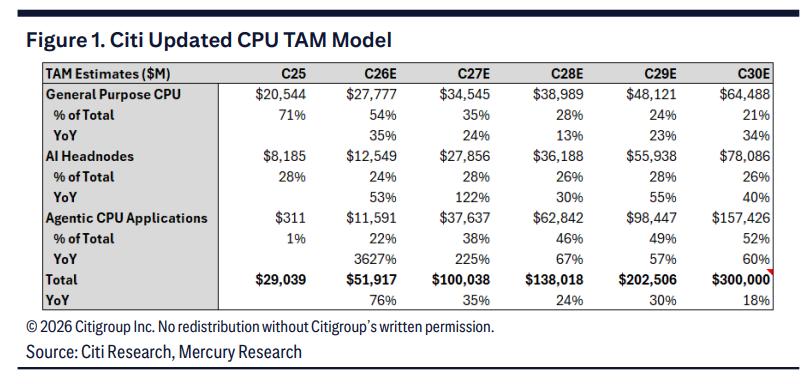
According to the latest research report released by Citi on October 6, agent applications represented by Meta Muse are pushing the market expectations for computing hardware to new heights. The bank estimates, by 2030, the total potential addressable market (TAM) of global CPUs will expand from $29 billion in 2025 to $300 billion, with a compound annual growth rate as high as 60%.
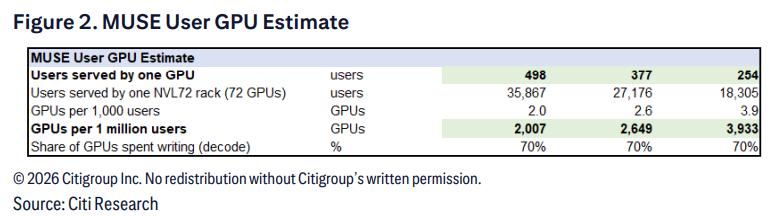
On the GPU side, agents are also bringing structural incremental demand. The bank calculates that if Meta Muse reaches 100 million daily active users, it will require approximately 200,000 to 390,000 Blackwell-class GPUs, which could bring NVIDIA one-time revenue of $7 billion to $19 billion.
This trend directly benefits core computing power suppliers. The bank pointed out that as Meta is one of AMD's largest customers in the server business, AMD will become a major beneficiary of the CPU renaissance, with its target price raised to $800; at the same time, NVIDIA will continue to benefit from the surge in GPU demand.
01
The Rise of Agents: CPU Becomes the New Bottleneck
Before the explosion of agent AI, CPUs were mainly limited to traditional workloads and served as the head node for AI applications. In the head node, the CPU is only responsible for "management", sending user requests to the GPU and returning results, while the heavy matrix multiplication and inference work is undertaken by the GPU.
However, agents have changed this division of labor. Citi noted in the report : "Compared with traditional chatbots, we believe that agent AI is a driver of potential order-of-magnitude growth in computing demand." Agents need to handle orchestration, inference loops, data processing and security components, which makes the CPU a new bottleneck.
As AI shifts from model training to inference, and then to autonomous agent workflows, the ratio of CPUs to GPUs is undergoing significant changes. At the model training stage, this ratio is 1:8; at the inference stage, it is 1:4; and in agent AI, this ratio is evolving towards 1:1 or even higher levels. The bank estimates that by 2030, CPUs dedicated to agents will grow at a compound annual growth rate of 247%, accounting for 52% of the entire CPU market.
02
GPU Computing Power Ledger of Meta Muse
Meta Muse is the first consumer AI agent launched on a real social network scale, and its computing footprint is one of the most important variables in current AI infrastructure. Unlike standard chatbots, Muse runs continuously as an autonomous agent, and its underlying logic determines that its GPU consumption is much larger.
Citi has built a bottom-up GPU demand model. Under the baseline scenario, it is assumed that a typical user makes 4 simple requests and 12 agent tasks (such as finding a restaurant, checking the calendar and drafting an invitation) every day, and each agent task contains about 8 model calls. Since the model has no memory between calls, it must re-read the growing dialogue context every time.
Based on this, the bank estimates that each Muse user needs approximately 0.0020 GB200-class GPUs. In short, one GPU can only serve about 500 users. The bank emphasized: "Agents are structurally more heavy inference workloads than chatbots." Under the same framework, the GPU capacity required by chat-style users is only 12.5% to 25% of that required by agent users.
03
Chain Reaction of Memory and Network
Agent workflows not only put higher requirements on logic chips, but their chain reaction also spreads to the memory and network fields. In terms of memory, CPUs have a high attachment rate to LP, DDR and SSD. Micron recently pointed out that agent workflows represented by Meta Muse are enabling consumers to obtain more value, and CPUs are imposing more constraints on DRAM.
On the network side, agent AI substantially increases network traffic. NVIDIA's management stated in communication with Citi: "Agents can run continuously for hours or non-stop... thus driving far more Token generation in consumer and enterprise workloads."
This continuous operation means that more and more agents rather than humans are accessing the infrastructure. This drives the growth of "north-south" traffic within the data center (such as services for storage access, security, configuration, etc.), thus creating new acceleration opportunities for the use of DPUs (such as BlueField 4) and Spectrum-X Ethernet.
This article is from the WeChat Official Account "Hard AI", Author: LONG Yue, Editor: Hard AI Editorial Department, Published with authorization from 36Kr.