Hard Krypton Exclusive First Report | AI glasses enterprise raises hundreds of millions of yuan in angel round financing, and has partnered with hundreds of offline stores to achieve monthly sales of thousands of units
Hard Krypton learned that Bitmojo, the company behind smart glasses brand NIMO, has recently completed an angel round of financing worth hundreds of millions of RMB, with the latest valuation reaching 1.5 billion RMB. Investors in this round include Bora Capital, Gobi Partners, Yuanhe Puhua, Shanshi Capital and other relevant investment institutions. The raised funds will be mainly used for product R&D, channel expansion and overseas market layout.
Bitmojo was founded in July 2025. In April 2026, NIMO launched its first product to the market. At present, NIMO's monthly sales volume has reached thousands of units. It is continuously promoting the deployment of products in LOHO offline stores, and has reached in-depth cooperation with Asia Optical (01120.HK), a Hong Kong listed international eyewear manufacturer with more than 50 years of industry accumulation.
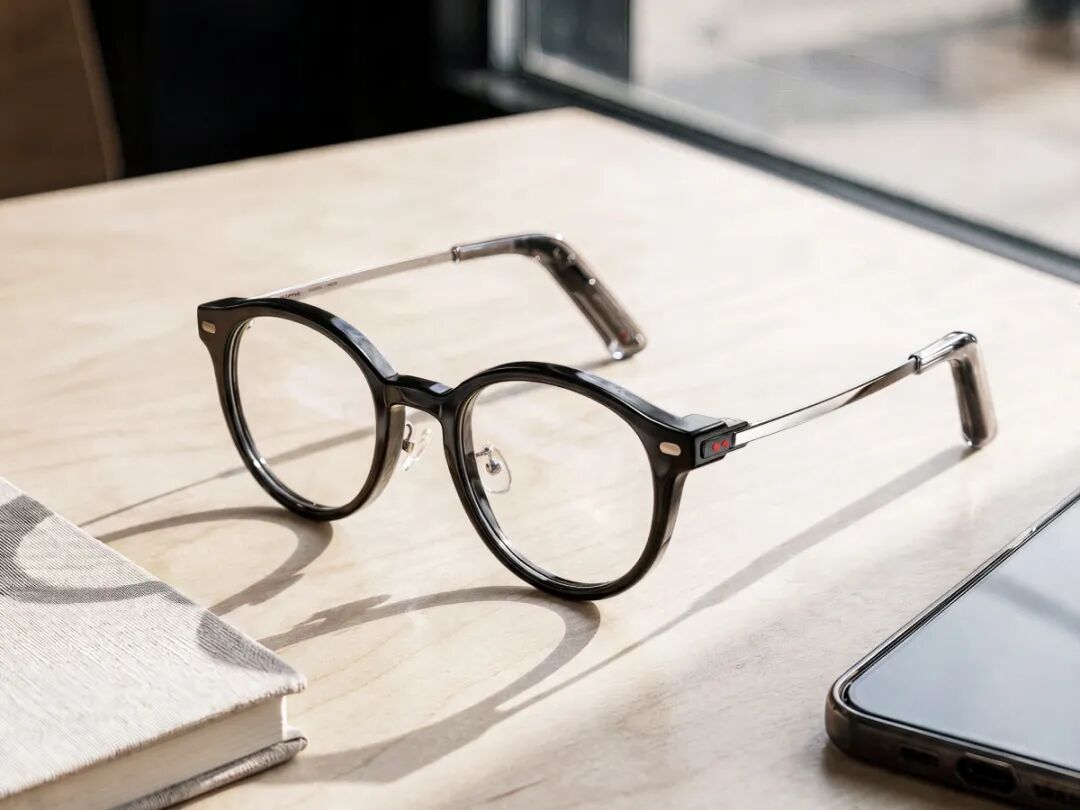
NIMO's first product
If we regard the development of smart glasses in the past few years as a function competition, NIMO is trying to take a different path: first re-make smart glasses into a pair of glasses that users are "willing to wear". This comes from the observation of the founding team: while capital continues to pay attention to smart glasses, in real life, it is still rare for ordinary people to see people around them wearing smart glasses frequently.
He Dilong, co-founder of NIMO, judged that the real threshold for this category to cross is not only the capabilities of display, AI or chips, but whether intelligent functions can be naturally integrated into the original form, wearing and consumption logic of glasses.
Based on this concept, NIMO is positioned as a fashion tech eyewear brand. The premise set by the team for the product is not "how many intelligent functions to add to the glasses", but to first make it a pair of glasses with daily wearing attributes - the shape, proportion, material, touch and wearing comfort all need to return to the evaluation system of traditional glasses.
This judgment also directly affects NIMO's trade-offs on product functions. Instead of stuffing as many capabilities as possible such as cameras, audio and more main control chips into the frame, NIMO actively cut off some functions in its first product, and reserved the limited weight and space for display, structure and wearing experience.
He Dilong mentioned that after investigating a large number of user demands, NIMO found that wearing comfort is the first demand for users to choose to buy smart glasses. Cameras and speakers greatly increase the product volume, causing wearing discomfort to users. The pursuit of extreme weight finally led NIMO to make function trade-offs. "At the same time, we are also customizing new camera and speaker solutions to provide users with more scenario choices in the future."
This product definition of "making a good pair of glasses first" is finally implemented in a series of technical choices such as optics, structure and materials.
The starting point of the display system is a MicroLED micro-display chip with a size of only 0.06 inches. It is understood that this chip is the smallest mass-produced silicon-based micro-display product in the world, with 70% lower power consumption than similar chips. The miniaturized display core releases more space for the design of the optical engine and the whole device; the lower display energy consumption supports the product to achieve longer battery life while remaining lightweight.
Around this micro-display chip, NIMO compressed the volume of its self-developed ultra-miniature optical engine to 0.03cc, that is, 30 cubic millimeters, and integrated the optical core for projecting images into the hinge area at the front of the temple, so that the complex display capability is hidden into the original outline of the glasses.
Matched with it is a 0.6mm thick volume holographic waveguide lens. Through the almost invisible grating design and precise light leakage control, the lens presents information while maintaining a transparent and natural appearance, and reduces the green light leaking out during display.
Lightweight is another technical path that runs through the product design. The current weight of NIMO's product is about 29 grams. He Dilong said that this is the first time in the industry that display-based AI glasses have been made under 30 grams. The frame is made of polymer composite carbon fiber material, and β titanium alloy hinge is used in the structure. The weight balance is realized through the layout of the front optical engine, the battery at the end of the temple and the components on both sides.
For smart glasses, weight itself is only a result. What is more critical is where the weight falls, whether the temple causes oppression, and the actual feeling after long-term wearing. Therefore, NIMO does not take "29 grams" as a separate selling point of the product, but considers materials, structures, hinges and front-rear weight distribution in the same system. The team also mentioned in the interview that traditional eyewear manufacturing processes, such as post-processes like polishing and electroplating, are also included in product development. The logic behind this is to make smart glasses meet the requirements of traditional glasses for touch, surface and structural details in addition to being an electronic product.
In terms of supply chain, NIMO does not simply purchase standard parts, but tries to bring the upstream supply chain into joint R&D. He Dilong said that some key components do not have ready-made mature solutions. Instead, NIMO puts forward product requirements and technical solutions, and then completes the development together with suppliers. For example, the 0.03cc miniature optical engine is the result of redefinition around the temple space.
In terms of commercialization, NIMO has also chosen a path closer to the traditional eyewear industry. Talking about offline cooperation, He Dilong told Hard Krypton that for NIMO, offline stores are not just an additional sales entry, because smart glasses still need to face the problems of optometry, fitting, lens replacement, after-sales service and user education in the traditional eyewear industry - if the first attribute of the product is still "glasses", then it needs to enter the scenarios where users originally buy glasses.
In the longer term, NIMO hopes that intelligence will gradually become a natural capability of glasses, so that users can still choose glasses based on aesthetics, wearing needs and lifestyle, while obtaining display and intelligent functions. "Eventually, what we hope NIMO does is not just a single smart glasses product, but to combine the glasses itself, intelligent capabilities and the future application ecosystem, so that smart glasses can truly become a product that users are willing to wear for a long time."

NIMO's first product
The following is an excerpt of the interview between Hard Krypton and He Dilong, co-founder of NIMO:
Hard Krypton: Why does NIMO develop smart glasses starting from "glasses" itself? What is your core judgment on the product?
He Dilong: I think smart glasses are first and foremost a pair of glasses. It can't just pile a lot of functions on the glasses, but first solve the problems of the glasses itself, including whether it looks good, whether it is comfortable to wear, and whether it is suitable for the face shape of Asians.
So from the very beginning, we have been emphasizing the "glasses sense", hoping that users will first feel that it is a normal and good-looking pair of glasses after wearing it, rather than an electronic device. On this basis, we then integrate the intelligent capabilities into it.
We will also actively cut off some functions that we think are unnecessary, because if all functions are added, it may eventually become a product with many functions that users are not willing to wear for a long time. For us, the premise for the real popularization of smart glasses is that users are willing to wear it every day.
Hard Krypton: In terms of product design, how does NIMO specifically solve the contradiction between "intelligence" and "glasses"?
He Dilong: We actually spent a lot of energy on weight, materials, structure and wearing experience.
For example, the temples are made of β titanium material, the nose pads are designed to adapt to the face shape of Asians, and materials such as carbon fiber are used to achieve lightweight. The product itself weighs about 29 grams. If you add custom lenses, the final weight may reach about 34 to 36 grams depending on the diopter and refractive index.
We also retained many traditional eyewear manufacturing processes. For example, the polishing of the temples itself takes several days, and the polishing of wood grain particles even takes two days and two nights continuously. We hope that after removing the electronic attributes, it is still a pair of glasses with complete workmanship.
The battery is also a big challenge. We use a steel-case battery. No obvious heating problem has been observed in actual use at present, and it can be charged to about 80% in 15 minutes. The display part is made as invisible as possible, with a light transmittance of 98%, so that users will not obviously feel that it is a display device in normal state.
Hard Krypton: How will users actually use NIMO at present? Why didn't you make the functions particularly complex?
He Dilong: At present, we are actually focusing on some functions directly related to users' daily life, such as stock quotes, news, messages, maps, teleprompters, translation, and automatic brightness adjustment.
We hope these functions can be naturally integrated into the wearing scenarios, rather than added just to demonstrate technology. For example, functions such as teleprompter and translation essentially make information appear directly in front of users, reducing the action of users frequently taking out their mobile phones.
In the future, we will also consider opening SDK and developer ecosystem. We believe that smart glasses do not necessarily have to define all application scenarios by ourselves in the end. Developers can develop more content based on the capabilities of the glasses itself. Now we hope to make the hardware, display and basic capabilities well first, and then gradually open up the ecosystem.
Hard Krypton: From the market feedback, how far are smart glasses from truly entering the mass market? How is NIMO promoting this matter at present?
He Dilong: We started official shipment in April this year. There were about 1000 units of reservations at the beginning, and then the monthly volume reached thousands of units. Now our channels mainly include Douyin, JD.com and offline stores, with about 150 stores at present. We attach great importance to offline channels, because smart glasses are different from ordinary consumer electronics. Users often need to actually wear and experience them to understand what value they have.
However, offline channels will also encounter some problems. For example, employees in different stores have different levels of understanding of the products, and consumers' awareness of smart glasses itself is still being established. Therefore, we will carry out offline training, hoping that the staff can fully demonstrate the main functions of the product in a relatively short time, so that users can understand it quickly.
From this perspective, we believe that the popularization of smart glasses is not only a hardware problem, but also requires the simultaneous maturity of user education and channels.