He created an AI e-ink screen to help you rebuild the main thread of your life, and both HSG and Linear have invested in it.
It does not grab your attention, but only helps you sort out your main priorities, which may well be the starting point of a Personal Agent.
GeekPark recently noticed that discussions about an AI card have been circulating and gaining momentum in the AI industry and among investor communities.
This card is Moonphase Flip, the debut product launched by NOOKLAB, an extremely "quiet" portable AI display. The product points to a key question: in an era where information is exploding and attention is being pulled in countless directions, what form should AI take to serve ordinary people well?
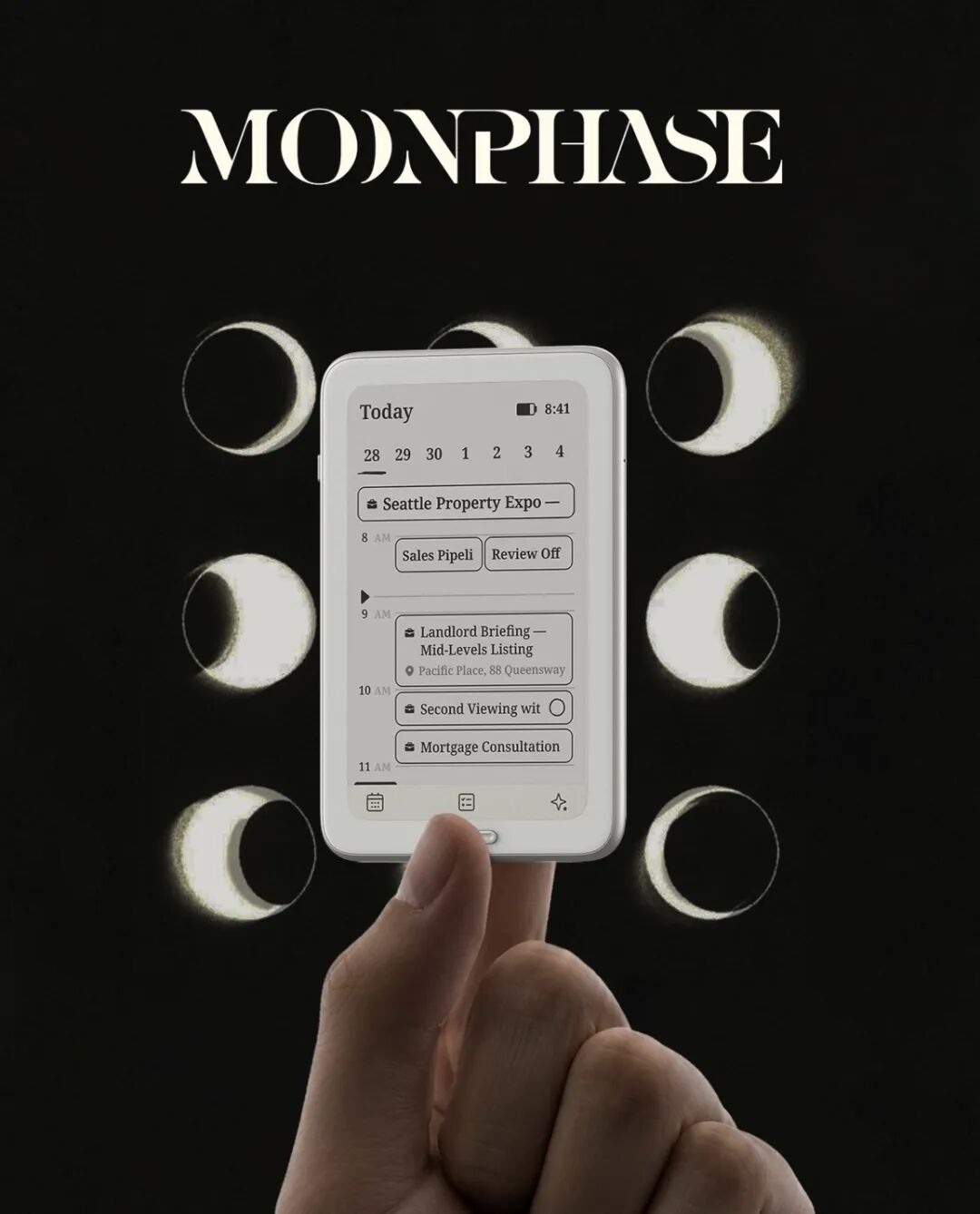
The low-distraction AI display that will soon be available and can be magnetically attached to the back of a smartphone | Image source: Moonphase Flip
The answer from Moonphase Flip is: it supports all-day non-intrusive recording, real-time transcription, and AI automatically extracts to-do items and schedules, then pushes them to a screen with only three tabs: Schedule, Task, and AI Interaction.
It focuses all its efforts on a seemingly very traditional small thing: todo and schedule management.
Even to avoid distracting users, it has no push notifications or reminders, and has removed all popular features such as e-book reading and full AI conversations. Its battery life lasts two to three days.
GeekPark learned that even at the idea stage, NOOKLAB quickly secured investments from top-tier institutions including Linear Capital and HSG.
Raymond, founder of NOOKLAB, has a resume spanning OnePlus, OPPO, Anker and ByteDance. In his early years, he worked on bar smartphones and the first smartwatch at OnePlus, defined the industry's first small foldable phone with a large secondary display at OPPO, led the magnetic wireless charger product line at Anker Innovations, and finally oversaw the design of the second-generation AI glasses at ByteDance.
In October last year, he left to start his own business. His first decision was to rule out the AI glasses direction.
"Looking at the end state, glasses may be the most perfect form. But if you start a business in this field today, 80% to 90% of your energy will be spent on issues that have nothing to do with AI and user experience, such as wearing comfort, fitting services, and gross margins of offline channels. The timing is not right, and this direction is more suitable for large manufacturers to invest in," Raymond told GeekPark.
Finally, after in-depth user interviews and prototype testing, they narrowed their focus to the "portable AI display".
Raymond judges that when "non-intrusive recording" evolves from a selling point to a standard industry feature, the next experience bottleneck of AI will lie in display and interaction. After comparing products such as glasses and watches, he believes that the portable card-shaped display is the carrier with the lowest friction and highest potential.
While everyone is in a hurry to use AI to "add extra information" to people, they try to use a minimalist "AI display" to help users completely reduce information overload and find their main priorities in a chaotic and noisy world.
The official website of Moonphase Flip went online not long ago. GeekPark talked with Raymond about their product philosophy and the thinking behind their bet on the direction of AI products.
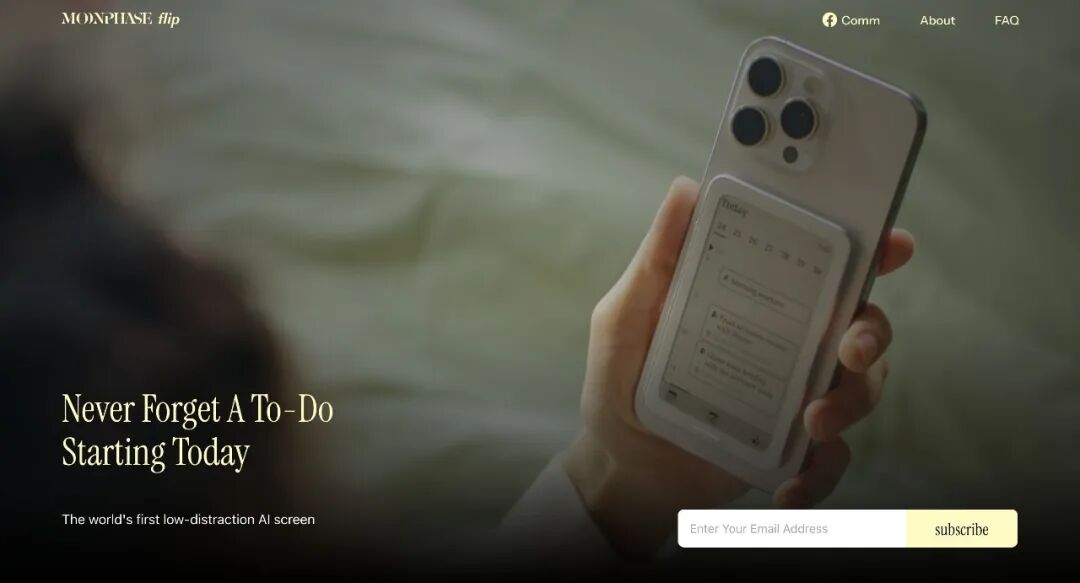
The homepage of Moonphase Flip's official product website | Image source: Moonphase Flip
Calmness and Rebuilding the Main Thread of Life,
Become a Rigid Demand in the AI Era
At Raymond's home, there has always been a huge whiteboard.
It is a habit he developed during his work at Anker Innovations. When he was overwhelmed by work and life pressure, facing the massive amount of information and choices coming at him, he bought a whiteboard and wrote down a three-layer structure on it: life principles, top priorities, and progress tracking.
This whiteboard accompanied him through the confused period all the way to the start of his business. "The whiteboard is like an e-ink screen. If you don't wipe it, it stays there. It doesn't speak, but every morning when you see it, it keeps reminding you what your main priorities are," Raymond said.
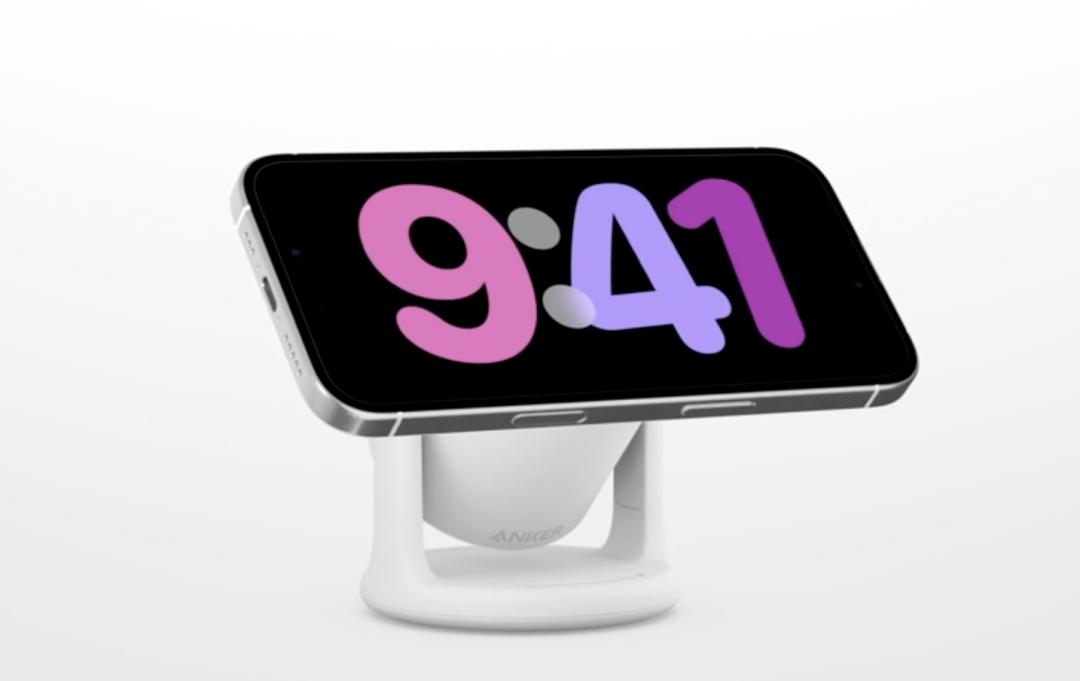
Anker MagGo, the magnetic wireless charger product led by Raymond during his time at Anker Innovations, which supports rotational angle adjustment | Image source: Apple official website
In addition to the whiteboard, Raymond's iPhone now has been kept in "Grayscale Mode" for a long time. Without the highly saturated, eye-catching icon colors, the phone becomes uninteresting. "Without color stimulation, you will think 'what am I going to do' before picking up the phone, instead of being pulled along by social media and news. It's like cutting oil and salt from your diet."
In Raymond's view, most of today's internet products are creating "instant gratification" — using strong stimulation to split users' attention into 30-second or even 5-second fragments. But what brings people long-term stability and satisfaction is the power of calmness.
He made an analogy: The development of information is undergoing a process highly similar to the evolution of human dietary structure: from the early "not enough to eat" (information shortage), to the "over-nutrition" (information overload) in the mobile internet era, and eventually it will inevitably move towards "eating clean" (minimalism, high quality, and finding back your main priorities).
"People need to engage in the real world and participate in the changes and productivity improvement of the world. But the way to engage is to find your main priorities and work efficiently — efficiency does not mean working 20 hours a day, but spending 8 to 10 hours a day truly doing things that matter to you."
The screen of Moonphase Flip adopts an e-ink display, which follows the same logic.
Raymond believes that large-size OLED screens will be expected to function as smartphones, and users' expectation for smartphones is to run apps, reply to WeChat messages, and watch short videos. If they want to provide a quieter, higher-value experience, e-ink screens have better power consumption performance and are more suitable for AI: it requires longer time to collect sufficient context, and value delivery is progressive, rather than the fast stimulation of short videos.
But low-distraction does not mean AI is not proactive.
Raymond believes that the core is not proactivity, but whether strong value is generated. Content quality comes before proactivity. There are two factors affecting quality: the intelligence level of the model and whether the context is complete. They help users collect context at the lowest cost, so that a sufficiently good model can generate value.
"Today, people do not lack push notifications, what they lack is high-quality content," he said, "Your phone will pop up a lot of push notifications if you leave it unused for 20 minutes, and all apps are fighting for your attention."
"Software provides functions, but hardware can change behaviors. We need to create an independent space where important things will not be disturbed." Therefore, an e-ink screen independent of the smartphone becomes necessary.
Focus on the Underrated Todo
From the outside perspective, todo may be a too thin and too small function. In the internet industry, todo is almost regarded as a fully developed, extremely marginal function.
Raymond does not think so. He believes that behind todo lies extremely profound personal life management philosophy and huge unmet demand.
"GTD (Getting Things Done) has a very complete set of theories, but the reason why traditional GTD fails is that it goes against human nature," Raymond explained. "It requires you to jot down ideas immediately when they come up, manually organize priorities, categorize items, and tick off completed tasks at fixed time. Everyone understands the principle, but almost no one can stick to it for a long time."
However, organizing, classifying, and summarizing context are exactly the things that AI is best at.
"Human brain power and energy should be used to do things, gain experiences, and create, not to act as operators of a management system."
In the setting of Moonphase Flip, the portable AI display will automatically complete information screening and refinement through continuous context awareness. The real difficulty lies here: to judge what information is valuable to the user.
Raymond introduced that first of all, through semantic recognition, Moonphase Flip can accurately extract hard commitments with "specific people, deliverables, and time nodes" from a whole paragraph of aimless casual chat or meetings.
For example, for lawyers, the progress nodes of cases and the names of clients are lifelines, and one memory error may bring months of remedial costs; for founders or salespeople, the advancement of key interpersonal relationships is the core. Moonphase Flip will provide industry templates, and AI will structure and visualize the scattered information that flows through according to the preferences of different professions.
More importantly, every view, confirmation, swipe and delete operation of the user on the portable display implicitly trains the model. If you only keep 2 of the 5 to-do items extracted in the first week, AI will remember this screening weight, and the summaries given in the next week will be more in line with your personal preferences.
In order to maintain focus and achieve the ultimate experience, they removed the e-book reading function, and also removed the open dialog box that allows users to ask AI questions freely.
"Actual user experience = actual perceived experience - expectation - cost paid. If we open the entrance of free conversation, users will have more expectations."
He explained, "During the test, some people asked AI how to build a company with revenue exceeding 10 billion yuan, or asked for navigation, which are very scattered demands. AI may give feedback, but when it cannot deliver a good or even beyond-expectation experience, the experience will collapse. We would rather lock three tabs, making it the absolute anchor point for you to find the main thread of your life."
Therefore, the app has Q&A capabilities, but it does not provide full AI Q&A, only for specific questions, such as key memories about a certain person or thing in the past month.
The judgment standard for trade-offs in Moonphase Flip's functional design is: your life focus and main priorities, as well as structuring and visualizing the people and things you have experienced. No other extra functions are added. Raymond said that reading is a stable demand that has been well solved, not a longer-term demand, and it is fine to leave it to existing products and teams in the industry to solve.
Minimalist Philosophy and the Critical Line
The product design of Moonphase Flip is extremely concise. The device weighs only 54 grams — Raymond, who was in charge of the magnetic wireless charger product line at Anker, especially emphasized the impact of weight on the experience when introducing the product to GeekPark:
"60 grams is the critical line for both physical and psychological perception. It will not work if the weight exceeds 60 grams."
After testing, they found that for products that are carried around every day, especially those attached to smartphones, if the weight exceeds 60 grams, there will be a threshold and interruption point every time you pick it up. Over time, users will leave it at home.
"It's just like users' perception of high frame rate, you can't describe it clearly but you can't go back once you use it," Raymond said. "Human beings are very sophisticated perception systems, and you will feel uncomfortable after getting used to a good experience and then switching back. The difference between 60Hz and 90Hz frame rate can't be described, but you can feel the frame drop."
In terms of functions, the device has only two buttons.
Press the side button to turn on the always-on audio recording, which saves power through VAD detection, and the microphone is fully turned on only when someone is speaking. When actively recording, if you think of something, just say to it directly: "I need to check the latest packaging plan tomorrow evening", it will record this sentence and turn it into a to-do item.
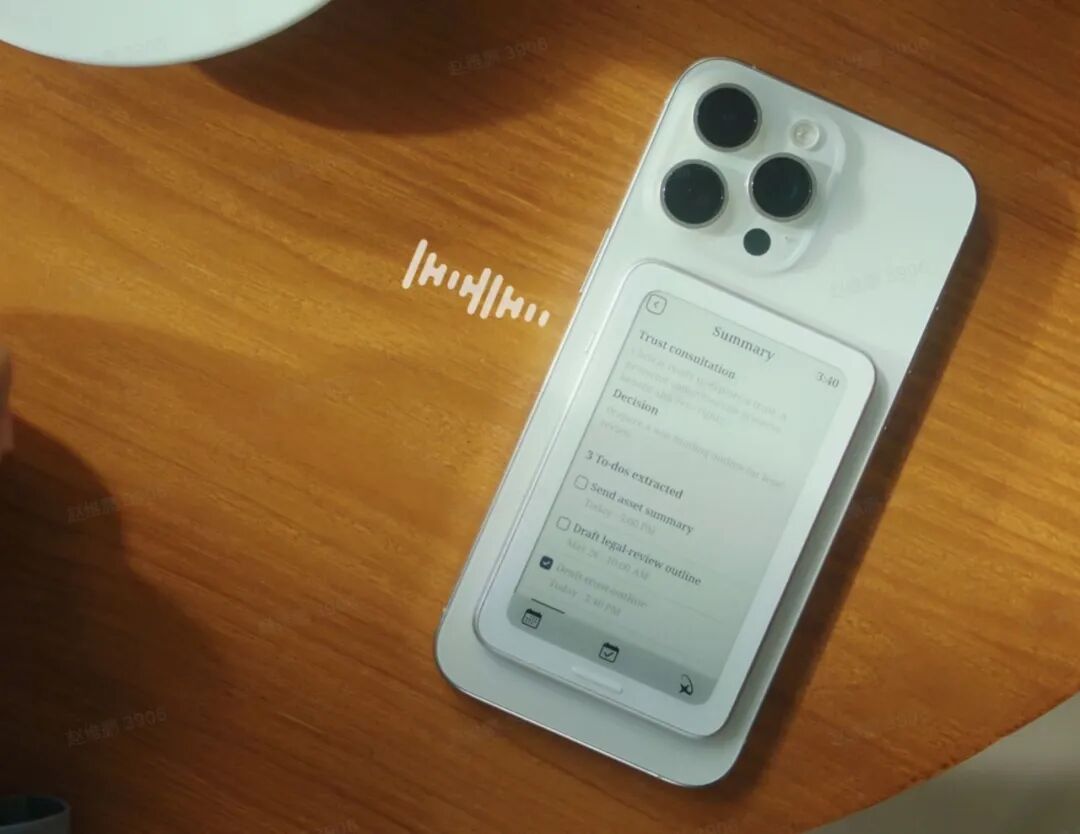
Help users turn the collected information into practical results | Image source: Moonphase Flip
There are only three tabs on the screen, corresponding to 3 core functions: Schedule, Todo, and AI interaction area.
The first tab is the schedule. It can import Google Calendar, Outlook, and system calendars for two-way synchronization. You can directly check who you will meet next and what the brief is. The summary after the conversation can also be viewed.
The second is the to-do items.
The third is the place to interact with AI. It needs to be used with the middle button. Press it to speak directly to take notes, and you can record any to-dos and ideas you think of. At the same time, if you want to retrieve the conversation at a certain day or a certain moment, you can also speak to it.
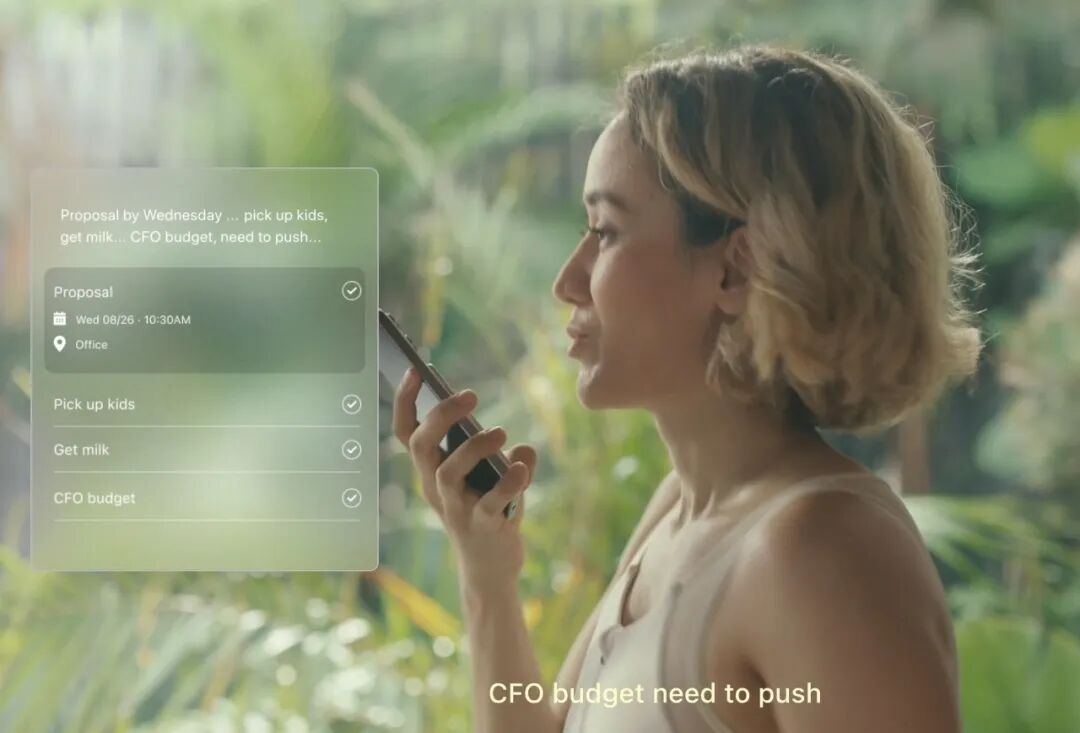
Press and hold the middle button, and you can record and set new to-do items via voice input | Image source: X
Raymond told GeekPark that in the future, it will also support connecting to Codex or Claude Code to perform tasks. You can directly speak to the card to command them to work.
There are two places to view records. You can view conclusions, commitments, and to-dos on the card, without checking the verbatim transcript. It also supports the web version of the app, where the verbatim transcript is stored. The web version has interactive analysis, such as people you have communicated with recently, analysis of each person, AI suggestions on who you should prioritize to build relationships with this week, etc., to structure and visualize all the collected information.
AI Recording Will Become a Basic Capability,
The Next Battle for Entrance Will Take Place on the Back of Smartphones
At Apple's press conference in early September this year, with Apple Watch silently launching functions such as double-tap to save audio and Siri Recap for non-intrusive recording and summarization, the entire industry has been pushed to a new inflection point.
A practitioner sighed: "In the past, Apple was extremely cautious about privacy. Today, the shift of large manufacturers marks that the door has been opened." Next, the smartphones and watches of large manufacturers may gradually support system-level all-weather recording.
When "non-intrusive recording" gradually evolves from a gimmick to infrastructure and a standard feature, the real test for AI hardware entrepreneurs has just begun.
Raymond does not believe that recording itself is the end state.
On the contrary, he regards the industry shift as a signal: Recording is becoming a basic capability, just like cameras, Bluetooth, and GPS, and sooner or later it will become a standard feature of a large number of AI hardware devices. If startups only make "recording bracelets, watches, and necklaces", they