Just now, GPT-6 has been fully opened to the public, and free users are also able to use it now.
Tibo's promised "28 consecutive days of release or reset" has reached its third day, and today's benefit is a banked reset for paid users.
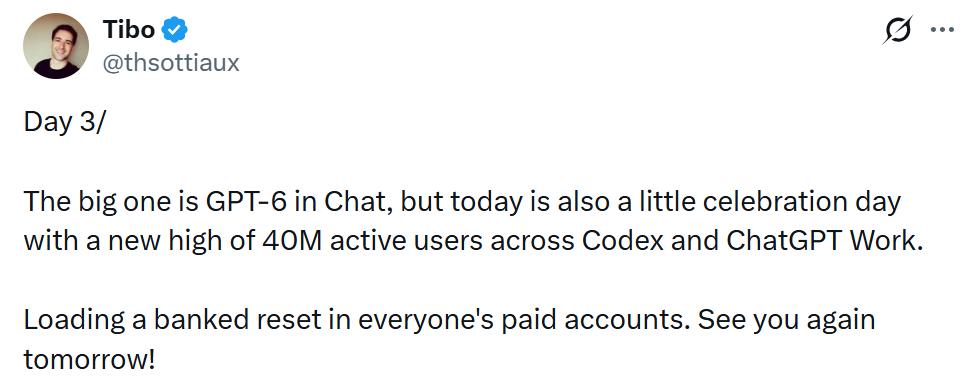
The real highlight is GPT-6.
Last month, OpenAI rolled out the first batch of GPT-6 models for paid users, and now the coverage has been further expanded.
Just now, OpenAI announced the launch of GPT-6 for all ChatGPT users worldwide, including free and paid users.
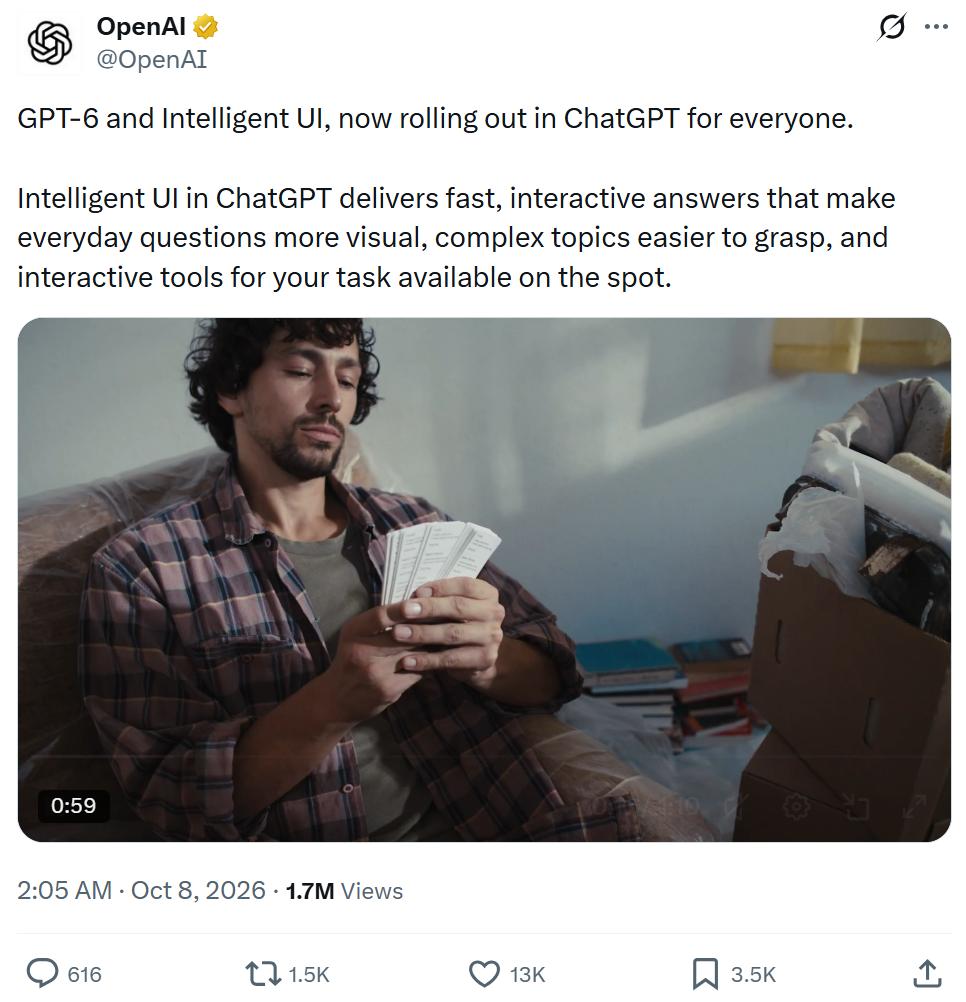
These models will replace GPT-5.6 Sol and GPT-5.6 Luna in ChatGPT.
Users accessing GPT-6 Sol and GPT-6 Luna via Codex and ChatGPT Work will still use the previously released versions.
In this upgrade, the most notable new capability is Intelligent UI.
It can quickly generate interactive responses, making the presentation of daily questions more intuitive, thus helping users understand complex topics more easily, and instantly creating directly usable interactive tools for the current task.
Just a few hours before the release of GPT-6, Sam Altman posted a meaningful sentence: When I look up at the stars tonight, there is an extra deep sense of awe in my heart. Your sea is so vast, and my ship is so tiny.

At the node of the full rollout of GPT-6, this sentence echoes to some extent: as model capabilities become stronger and AI can do more and more things, humans are still just at the starting point when facing greater unknowns.
Intelligent UI
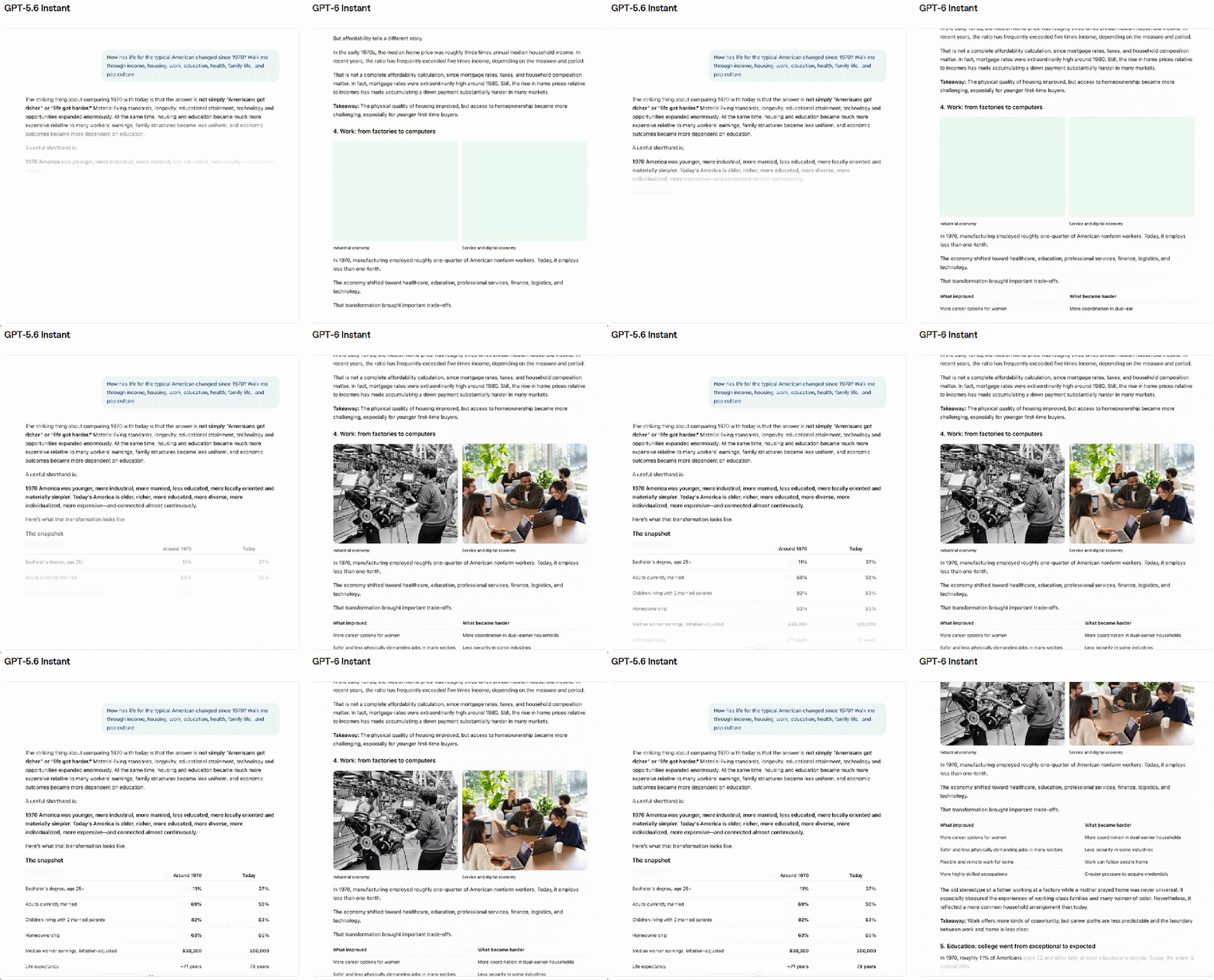
Different from the past where responses mainly relied on text, GPT-6 can now independently decide how to combine elements such as text, images, charts, buttons, and forms according to user questions, and directly generate an interactive response interface.
The specific presentation will vary with tasks. For example, when comparing products or solutions, ChatGPT can adopt a side-by-side display; when explaining complex concepts, it can generate interactive diagrams; if simple text is sufficient, it will continue to use the traditional text format.
OpenAI hopes to make daily Q&A more intuitive through this. For example, when making a plan for a Sunday roast, the recipe and schedule can be displayed at the same time; when planning a self-driving route, the stops along the way can be directly presented on the map, marking which locations are worth a detour.
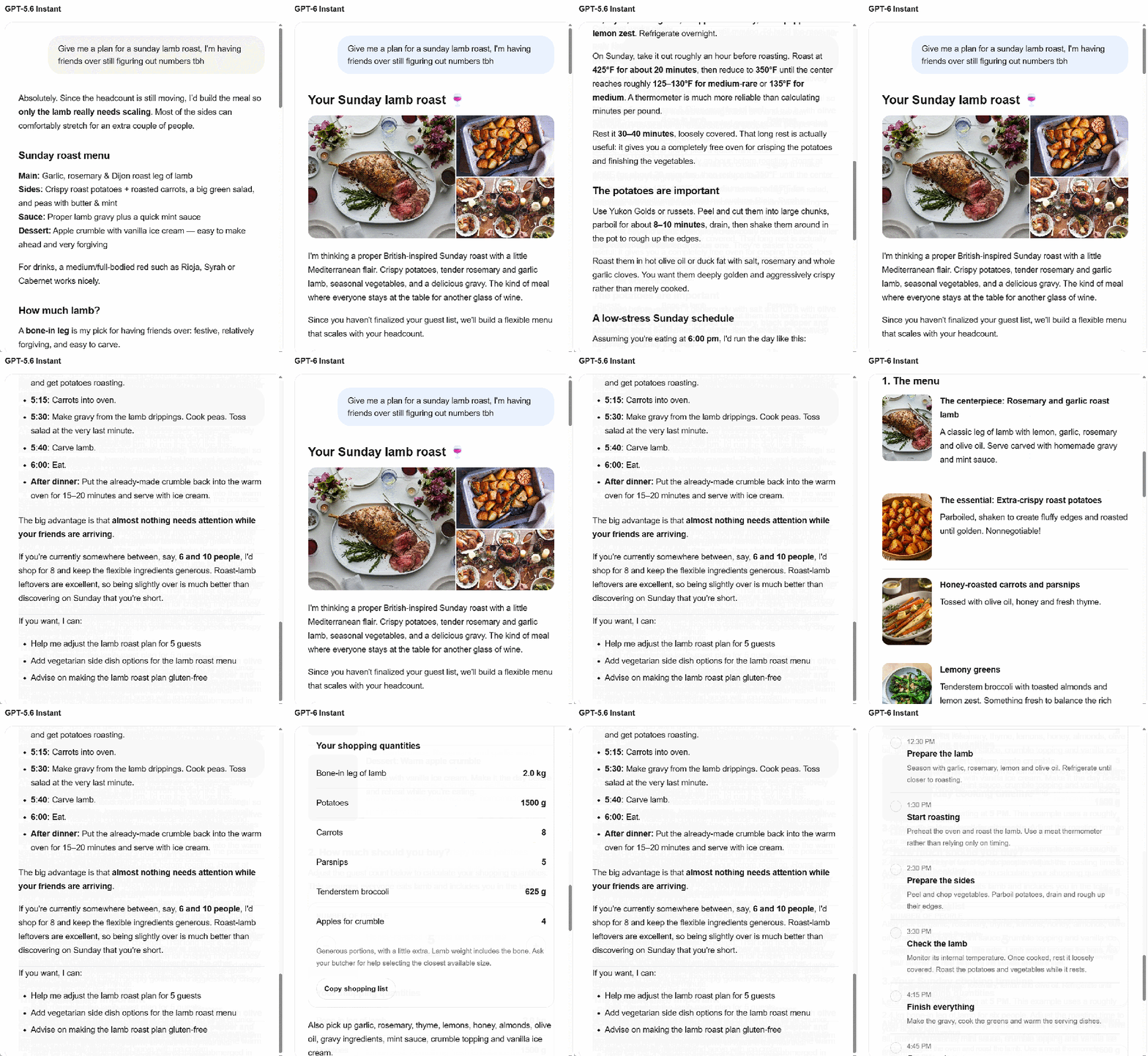
Understand complex issues more easily. With the help of visualization and interactive explanations, users can more intuitively explore the working principles of things, adjust inputs and see how the results change, and also complete problems step by step.
Users can also directly ask ChatGPT to create a tool for the current task. For example, it can generate a calculator to view how savings grow, a bill splitting tool for dining with friends, and even generate a playable mini-game directly in the conversation.
How Intelligent UI Works
From the perspective of technical implementation, the core of Intelligent UI is to enable GPT-6 to independently select the most appropriate interface form for different questions, while maintaining a consistent experience on the web and mobile terminals.
To this end, OpenAI has built a set of native component libraries that support streaming generation, and has also developed an interface compiler. When generating responses, the model can call these components and decide for itself how to combine elements such as text, charts, buttons, and forms; the compiler will render the interface step by step while receiving the output of the model, so users do not need to wait for the entire response to be generated, and the interactive interface can appear one after another.
In order to give GPT-6 better design judgment, OpenAI has also expanded its training methods to help the model better judge content, layout, visual presentation and interaction methods. During the training process, OpenAI will evaluate the interface generated by the model from the aspects of clarity, practicality and completeness.
Through these trainings, GPT-6 has learned how to use the component library and make more reasonable design decisions, including how to organize information clearly, when to add interaction, and when a simple text response is sufficient.
Of course, there is still room for improvement in the model's design judgment and the scope of content that can be generated. However, Intelligent UI already marks an important change in the way humans interact with ChatGPT.
In the past, different questions were often put into the same dialogue framework; now, ChatGPT can combine interfaces, data and operations to create a brand new way for users to explore, understand and interact with information.
With the help of GPT-6, ChatGPT can now start generating responses while continuing to think.
With the emergence of reasoning models, users can ask the model to handle more difficult problems, but they often need to wait for the model to finish thinking before seeing the answers.
Now, ChatGPT can interleave thinking and responding. OpenAI has specially trained GPT-6 to enable it to consider users' waiting time, and gradually organize and output answers based on the knowledge and phased conclusions it has mastered at the moment.
GPT-6 has also learned to continuously supplement effective information through multiple phased responses, avoid meaningless filler content as much as possible, while keeping the final answer overall coherent, and its factuality is close to that of a complete response written at one time.
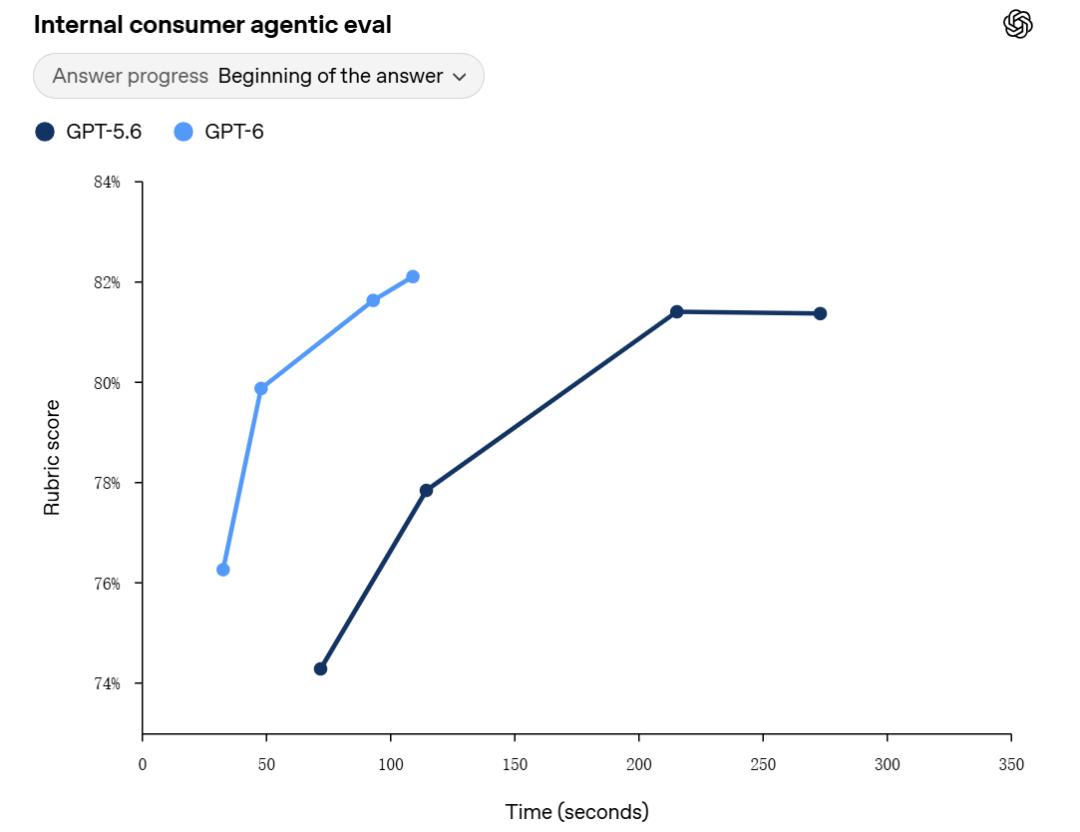
In an internal evaluation for high-value, daily Agent tasks, GPT-6 Extra High can start responding in as little time as GPT-5.6 Medium, but its overall score is higher than GPT-5.6 Extra High.
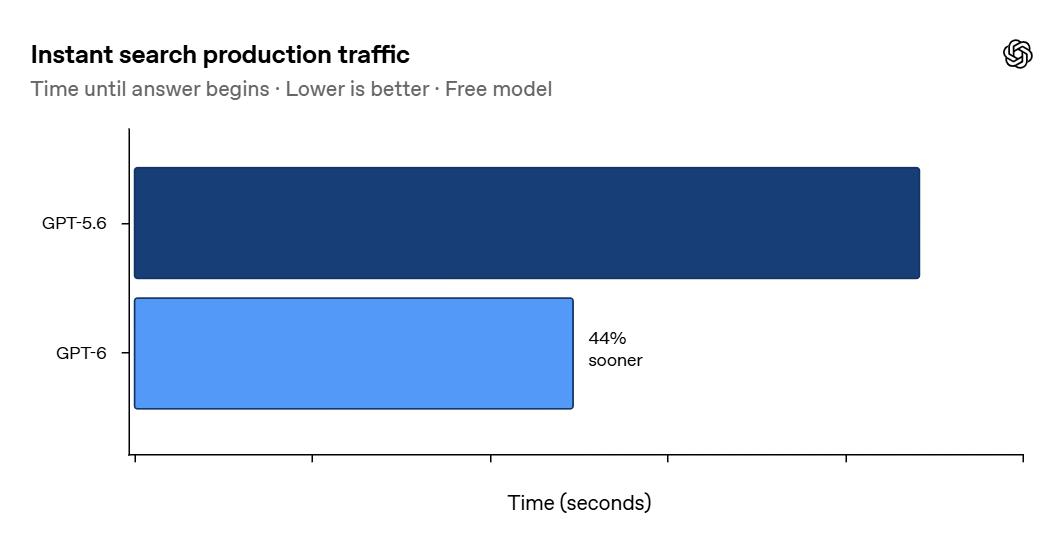
For questions that require web search, the average time GPT-6 Instant takes to start responding is 44% earlier than GPT-5.6 Instant.
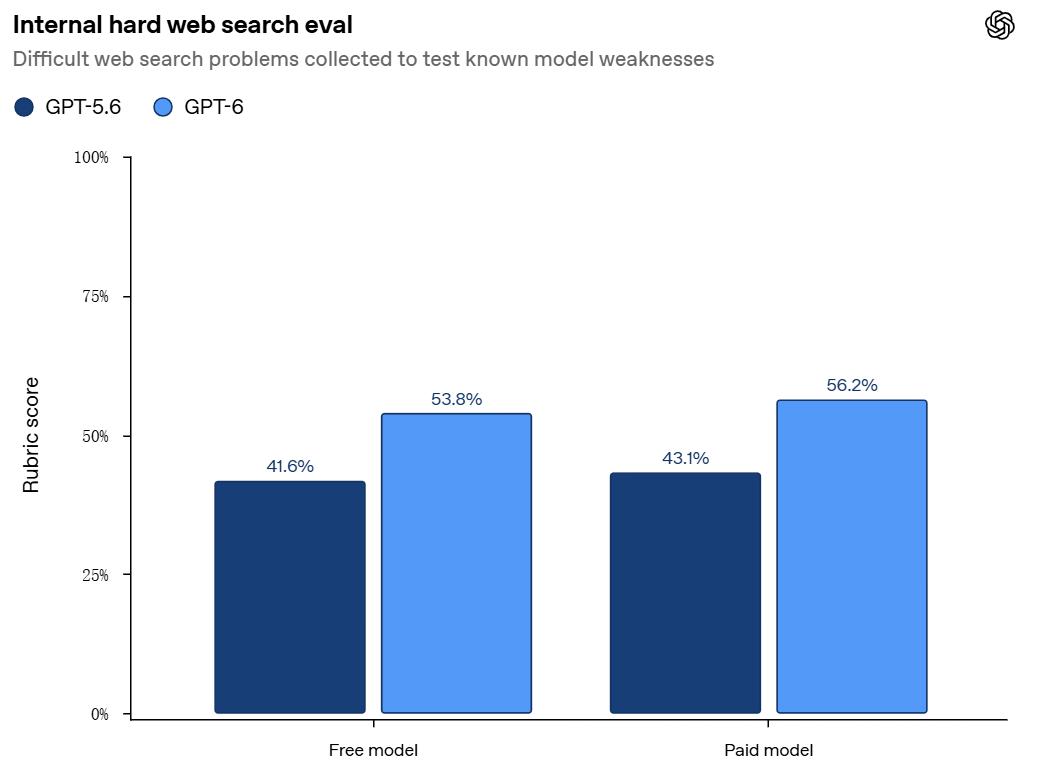
GPT-6 also improves the quality of responses when web search is required. It can more accurately judge when to look up external information, and more reliably find relevant content that can support the answer.
In an internal evaluation for highly difficult questions, GPT-6 more frequently and accurately grasps and responds to the key points in user questions than GPT-5.6.
Availability
GPT-6 with Intelligent UI will be gradually rolled out to global Plus, Pro, Business and Enterprise users via the Chat page of ChatGPT starting today.
Starting from tomorrow, the coverage will be further expanded to Free and Go users. Whether Enterprise users can use it depends on the relevant settings of the administrator of their organization.
In ChatGPT:
Plus, Pro, Business and Enterprise users are mainly supported by GPT-6 Sol;
Free and Go users are mainly supported by GPT-6 Luna.
Both models have been specially optimized for daily dialogue scenarios.
This update only applies to the Chat experience of ChatGPT. The models currently used by ChatGPT Work and Codex will not change with this release.
What Happens Next
OpenAI says its mission is to safely bring the benefits of artificial general intelligence to all humanity. GPT-6 brings the latest generation of intelligent capabilities to more than 1.2 billion users who use ChatGPT every week.
Intelligent UI is seen as an important step towards the next stage of ChatGPT: in the future, ChatGPT can dynamically shape a matching interface according to the task the user is completing.
In the long run, OpenAI hopes that ChatGPT can instantly create the interface users need for more daily tasks. Users only need to describe what they want to accomplish, and they can complete the task directly in the interactive experience generated around this goal.
Over the past few decades, people have always needed to learn how to use software and find functions in fixed interfaces pre-designed for specific tasks.
OpenAI believes that the future direction will be different: people no longer need to constantly adapt to software, and software will begin to actively adapt to people.
Reference links:
https://openai.com/index/gpt-6-for-everyone/
This article is from the WeChat official account "Machine Heart", and is republished with authorization from 36Kr.