Utopai Studios, the "Pixar Ambition" of the world's largest AI film and television company
AI-generated videos can already produce shots that look cinematic enough, but genuine AI-made feature films remain extremely rare. Once full-length production is underway, issues with character consistency, shot continuity, performance control and team collaboration will all emerge at the same time.
The more common UGC and ProC routes in China concentrate screenwriting, directing, storyboarding, editing and even production work on a single creator. AI boosts this individual's efficiency, but it does not organize a group of professionals into a streamlined production line. The upper limit of ProC is often the upper limit of the model; the upper limit of a film and television company, by contrast, can represent the upper limit of human creativity.
With this question in mind, looking at the latest audio-enabled text-to-video ranking released by Artificial Analysis, Utopai X, which ranks second globally with an Elo score of 1150, is a somewhat unusual name: it comes from Utopai Studios, which was called "the world's largest independent AI-native film and television company" by Variety.
We found that Utopai integrates the model into its PAI production system, which keeps scripts, characters, scenes, shots and revision records continuously associated, leaving the final decisions to the director, screenwriter, production and post-production teams.
The model is responsible for generating film materials, and PAI is responsible for organizing these materials into a professional production line. This, seemingly, offers a new path from "being able to generate shots" to "being able to participate in full film production".
1
To make films, you first need cinema-grade models
Model capability still dominates the final generation results, and Utopai Studios has proven the post-training path for professional teams based on open-source models.
On September 29, 2026, in the audio-enabled text-to-video ranking released by Artificial Analysis, Utopai X scored 1150 Elo, ranking after Wan 3.0 and before Dreamina Seedance 2.5. The evaluation adopts a blind test mechanism: two videos are generated from the same prompt, viewers do not know which model each video comes from, they only need to select the one they prefer, and the Elo score is calculated based on pairwise preference votes.
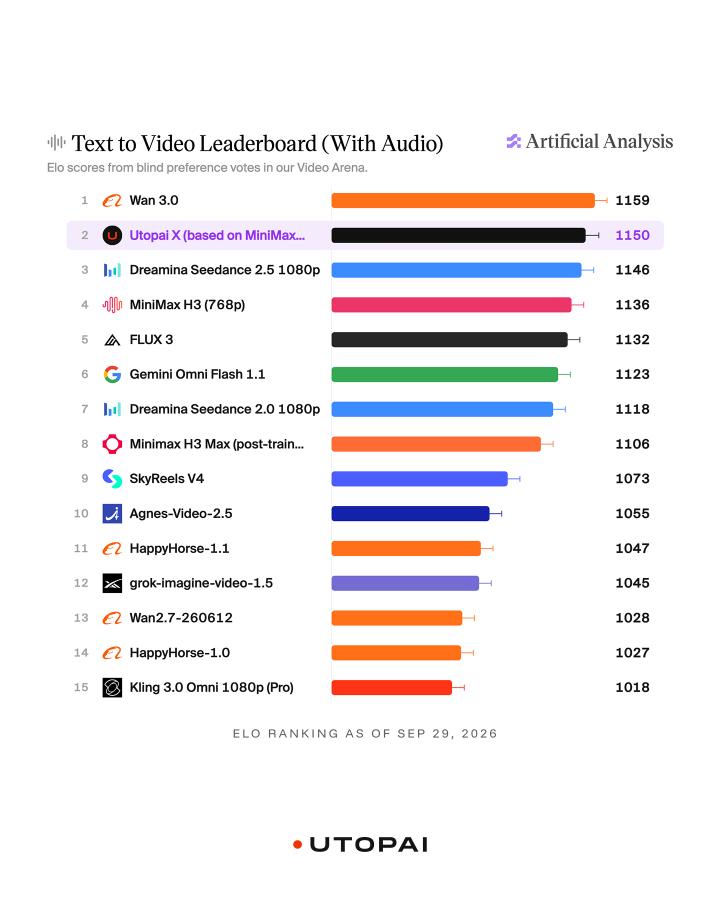
Image source: Artificial Analysis, Utopai Studios
"Second in the world" measures the performance of text-to-video models that generate both visuals and audio at the same time; whether a model can independently complete a full-length feature film still requires separate verification. Within this limited scope, the generated clips of Utopai X have already entered the world's top tier.
Utopai X is a post-training customized model oriented for film and television production. Its training targets focus on shot stability and usability, while spectacle generation is relegated to a secondary position. The capability of Utopai X is not only reflected in the beauty of generated visuals: objects that fall into water must show proper weight, shadows and reflections must change accordingly after the light source shifts, and the sound generated by mechanical movements must perfectly match the corresponding actions. The technical materials released by Utopai list spatial consistency, physical realism, audio-visual synchronization and shot controllability as core priorities. To put it plainly: characters, objects, light, sound and the camera cannot act independently, they must make the audience believe that all elements exist in the same shared space.
But a film is not just a collection of beautiful shots. A single satisfying shot can be generated by random chance, while full-length production requires characters and scenes to maintain consistency across different shots, edited segments can still connect to preceding and following sequences after modification, and the whole team can track the origin of every decision. The ranking only verifies the generation capability of Utopai X, and it is PAI that actually connects the model to real film production workflows.
PAI starts from a complete script. The system splits the script into separate lists of characters, scenes, locations, props and shots, and imports all this information into a unified visual workspace. The director and art team can build characters and the fictional world based on the story, while the cinematography and editing teams can continue to work on shots, versions and timelines. It is more like a production operating system built around specific film projects, rather than another generation window that only requires users to input prompts and wait for outputs.
The core problem it solves is project memory. Scripts, character settings, visual styles, approved shots and past revisions are all stored in the project context; once a character or scene asset is confirmed, it can be carried over to subsequent shots without requiring re-description every time. Teams can also compare different versions side by side, leave comments and approvals, import selected materials to the timeline, and export files to Premiere Pro or DaVinci Resolve to complete post-production.
Utopai X is one of the generation engines in PAI. It reads not only the current prompt, but also the script, character and scene assets, shot plans and team feedback, so the generation results belong to a specific project, scene and shot from the very beginning. The value of the model has also shifted: how stunning a single generation is matters, but it is far more important that the model can still retain the consistency of characters, space and creative intent after multiple rounds of revisions.
This system is also iteratively trained by real completed projects. Every film will generate scripts, character and scene designs, shot plans and multiple rounds of generation results; the director, cinematography and art team will then judge which shots are usable, which need to be re-generated, and the reasons behind the decisions. For film and television companies, the total number of generated outputs has limited value, while the reasons why the director keeps one shot and discards another are far more valuable. These professional choices are continuously input as signals for PAI and model training and evaluation.
Zijian He, Chief Science Officer in charge of technology, previously led the media generation foundation model team at Meta's Super Intelligence Lab, and participated in projects including Movie Gen and Llama Image Generation. At Utopai, his team no longer only focuses on producing videos faster, but makes the model understand all the decisions that have been made for a film, and continuously execute these requirements in subsequent production stages.
This is exactly the position of PAI in Utopai's technical system: Utopai X is responsible for producing individual shots, and PAI is responsible for ensuring all these shots belong to the same film. When scripts, assets, models, revision records and professional teams are integrated into the same system, AI begins to evolve from a generation tool to the infrastructure of film production.
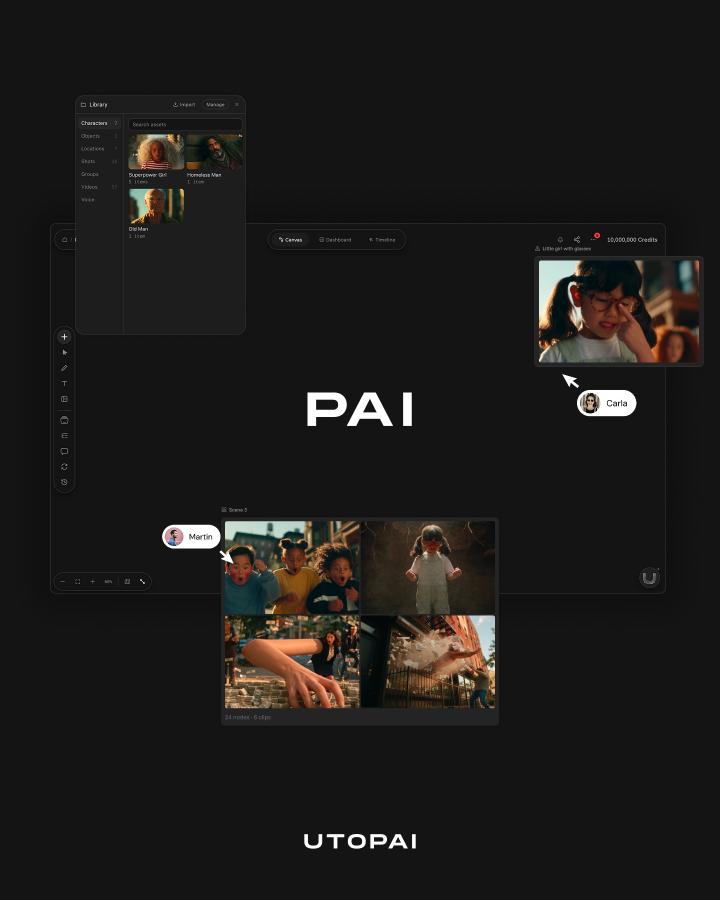
PAI organizes scripts, character and scene assets, shots and revision records in the same production workspace. Image source: Utopai Studios
2
Commercialization starts from theatrical film slates
Technology is only the entry threshold. For a film and television company, commercial value cannot be realized the moment the generate button is pressed.
ToC and ProC tools can be charged via subscription, point system or generation count, but the value of a film and television company can only be realized after the project completes development, production, distribution and finally reaches the audience. Utopai chooses to do two things at the same time: export PAI as production infrastructure to external partners, and take full risks for the commercial viability of its own works and IPs.
For a film and television company, the slate of films is far more direct proof of value than subscription data. According to Utopai's current plan, three feature films *Cortés*, *Half Moon* and *The Most Serious Fart* will all be released in theaters in 2027. All three works are being advanced as formal full-scale projects, which need to go through financing, production, international sales and theatrical distribution, and their scope of application goes far beyond simple model effect demonstration.
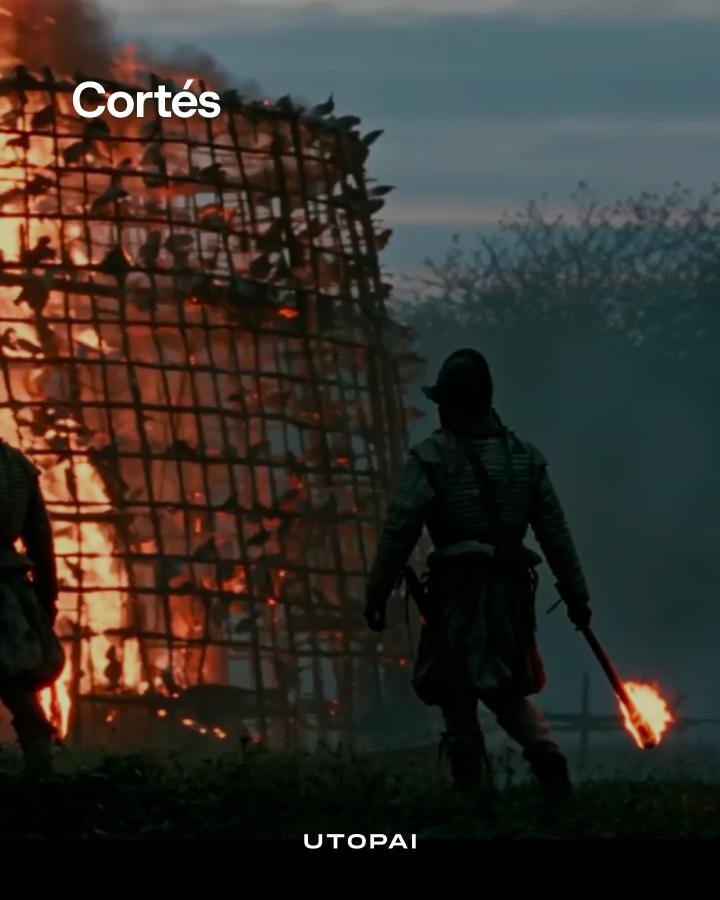
Among them, *Cortés* is a historical epic set against the background of the Spanish conquest of the Aztec Empire in 1519, written by Oscar-nominated screenwriter Nicholas Kazan and directed by Paul Mignot. It was not easy for this project to reach the theatrical release schedule in 2027. Kazan has been looking for a chance to bring this story to the big screen for more than 30 years. The huge scale and high cost brought by war, city and era scenes kept the project stuck at the script stage for a long time. Now, the project is planned to be shot in Spain, AI is used to break through the previously unaffordable production constraints, while the screenwriter and director still retain full creative control.
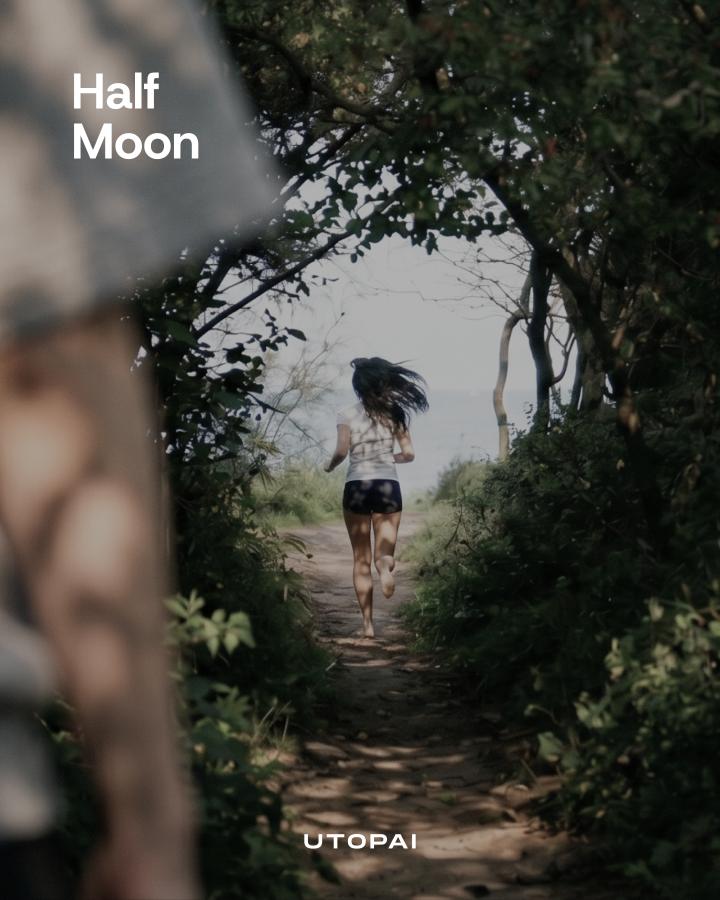
*Half Moon* takes a completely different path. It is a live-action coming-of-age film written and directed by Korean director Hyo-joo Yang, co-produced by Utopai, Germany-based In Good Company and South Korea's Paper Barn Studios. PAI is only used to support part of the visual elements, while performance, narrative and cinematography are still completed by traditional film crews.
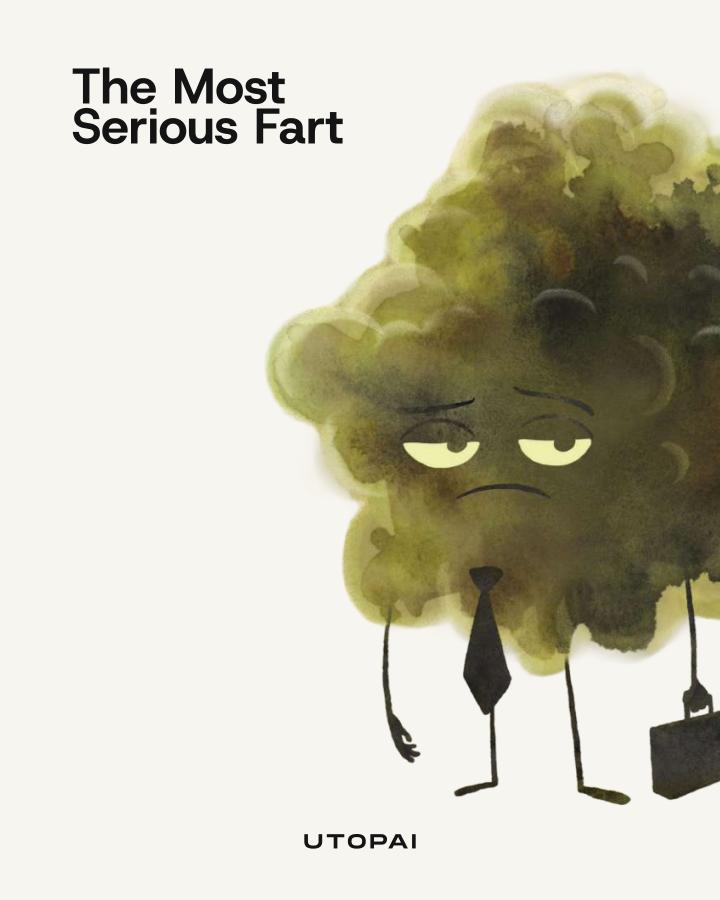
*The Most Serious Fart* is a theatrical animated family comedy, written and directed by original author, *Not Another Teen Movie* screenwriter Mike Bender, with Scott Muller, casting director of *The Simpsons*, participating in voice actor recruitment. In this project, AI is still positioned as a "production assistant", with directors, actors and screenwriters continuing to dominate the creative process.
These three films do not apply the same AI solution. The historical epic uses AI to break through budget and scene restrictions, the live-action film only uses AI in specific visual links, and the animated film embeds AI into the production pipeline dominated by professional teams. Taken together, what Utopai provides externally is more of a project-level capability: deploying technology, talent, capital and distribution resources according to different production needs.
In addition to its own film slate, PAI has also begun to enter the production workflows of external companies. In September 2026, Utopai and the Entertainment Development Division of Japanese company DeNA announced a partnership, planning to introduce PAI into experimental animation production for visual development, character and background design, scene planning and multiple rounds of revisions. Utopai's AI production staff will collaborate with DeNA's creative and production teams, while the final decision-making power over the story, style, performance and overall tone of the work remains in the hands of the creators.
Utopai and DeNA will experiment with introducing PAI into the animation production workflow in Japan.
DeNA is only one of the external clients served by PAI. According to information disclosed by Utopai, PAI has been used in US film and television projects and international co-productions across Europe, North America and Asia, and has also entered the production workflow of Chinese full-length content.
Sports content provides Utopai with another type of IP entry point. Utopai previously collaborated with James Harden to complete an animated short film inspired by his iconic beard; later, Naismith Memorial Basketball Hall of Fame member Carmelo Anthony became a strategic partner through his Creative 7 Productions, and the two sides will use PAI to develop original sports and entertainment IP covering film, television, streaming media and digital content. The first batch of plans includes developing anime-style entertainment projects based on Anthony's professional career and basketball culture.
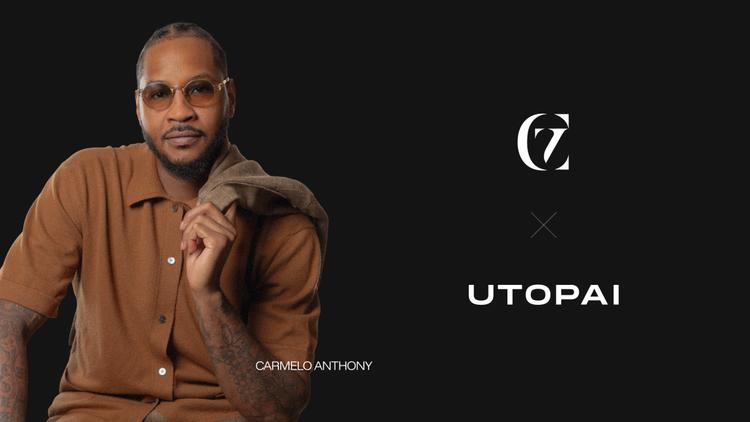
Carmelo Anthony partners with Utopai on sports entertainment IP development through Creative 7 Productions.
Athletes bring real stories, public influence and natural audiences, which form the starting point of sports IP. What Utopai needs to do is to organize these materials into projects that can be continuously developed. From theatrical films, to B-end production partnerships like DeNA, to original content driven by sports figures, Utopai is forming three mutually reinforcing commercial paths: works validate the technology, the technology enters more production workflows, and new partners bring new stories and distribution opportunities.
"Pixar for the AI era" obviously requires far more than a more powerful model. What is truly irreplicable about Pixar is its ability to turn technology into stable production capacity, and then continuously incubate, expand and operate IP around its works.
Judging from Utopai Studios' current layout, this complete puzzle has begun to take shape: Utopai X is responsible for generating film materials, PAI supports professional production, and the three theatrical projects, external clients and sports content respectively verify the company's capabilities in work development, external service delivery and IP expansion.
It still has a certain distance to reach the level of "Pixar", but several core capabilities that an AI-native film and television company needs to possess: technology, production, IP and distribution, have all been integrated into the same positive commercial cycle.
This article is from WeChat official account "Siliconist Pro", author: Yoky, published with authorization from 36Kr.