The hottest post-2000s rising star of this year has been born.
Founded just one year ago with only 14 employees, the company's valuation has surged to 10 billion US dollars.
Instinct rose to fame overnight. Surprisingly, the person at the helm is a post-2000s generation — Noah Shinn, who just turned 23 this year. He dropped out of Northeastern University in the United States three years ago and led his team to develop the personal Agent product Instinct, which currently has an annual transaction flow of over 1 billion US dollars.
A sensational development came recently when Shinn announced the completion of a new round of 1 billion US dollars financing, jointly led by Sequoia Capital (HSG), Benchmark Capital and Coatue, with a post-money valuation reaching 10 billion US dollars (about 67 billion RMB).
Imagine you are going on a business trip to Shanghai: you only need to send a voice message, and the AI assistant will automatically identify your location, book flights and hotels, and sync the arrangements to your calendar. "This will lead to a market worth trillions of dollars," Shinn makes no secret of his excitement about the prospects of personal Agent.
One cannot help but marvel that the AI era is spawning unexpected entrepreneurial legends.
The most popular post-2000s entrepreneur
23 years old, 67 billion valuation
The story begins with a post-2000s dropout.
Founder Noah Shinn, 23 years old, dropped out of Northeastern University in 2023, majoring in Chemistry and Computer Science, and participated in machine learning and large model technology research. He once joined AI unicorn Sierra as a core early employee, accumulating experience in AI R&D and implementation.

Noah Shinn
Sierra's AI products are mainly designed to handle customer service processes for enterprises. During his time there, he gradually realized that while Agents are already working in the corporate sector, there is still a blank space in the daily lives of ordinary people. So in 2025, he left his job to found Spear Street Technology and created the AI personal assistant Instinct.
"When we first experienced ChatGPT in 2023, we already had a clear vision of the ideal way AI should act." Shinn believes that this Agent should be able to help in all aspects of daily life and manage all kinds of trivial personal affairs.
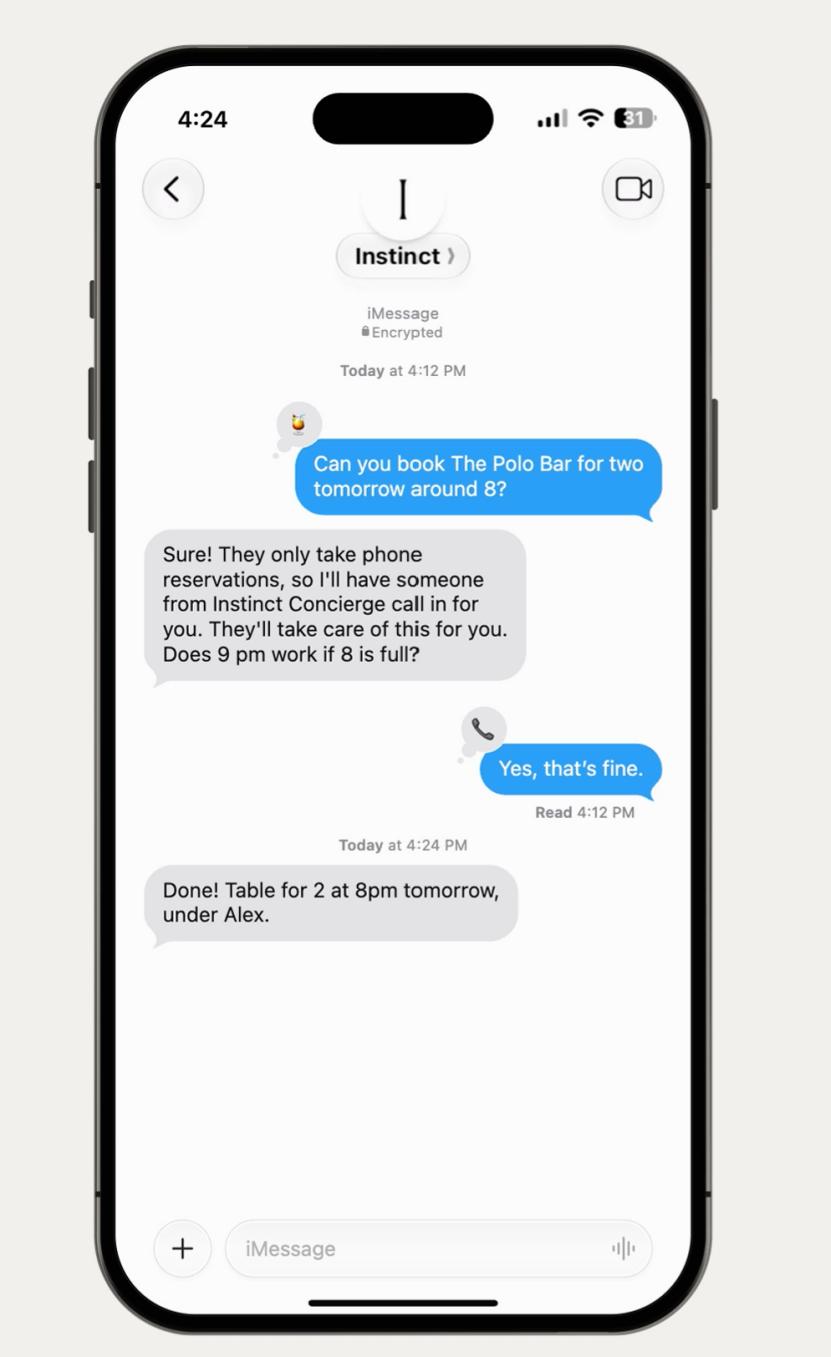
Instinct has a particularly unique design: it has no standalone APP, and users interact with it via SMS, phone calls, and emails, to automatically complete shopping, reservations, travel arrangements, and email processing. If there is an urgent schedule to handle, it will even take the initiative to make a call to remind the user.
For example, if a user just sends a voice message saying "I need to get to Beijing tonight", Instinct will automatically identify the user's current location, complete the flight booking according to their preferred airline, seat type and other information, then arrange hotel and airport transfer reservations, and sync all to the calendar in one go.
Instinct has designed a "Trusted Network", where colleagues only get access to the work calendar and specific inbox content, while family members can share more information. Different Instinct instances can collaborate to handle related affairs, supporting the sharing of PDFs, images, tables and other files.
At first, the team distributed the product to about 200 relatives and friends around them, each user had 5 invitation codes, and then the product began to grow at a daily sequential growth rate of about 10%. Some people even put the invitation codes up for sale on eBay, and the price once reached 300 US dollars.
Shinn hopes that Instinct will adopt a profit model similar to Apple Pay — users can use it for free, and merchants pay a service fee for each transaction. In this way, the Agent will not recommend unnecessary products to users for the benefit of advertisers.
Although it is still under an invitation-only system, the commercial scale of the product is already quite considerable. Noah Shinn revealed in an interview that the current user base is still very small, "the annual transaction flow of the product has approached and exceeded 1 billion US dollars".
14 employees
Ushering in the personal Agent era
Instinct rose to prominence almost overnight.
Earlier this year, the company completed its seed round of financing, led by Conviction with participation from Greenoaks, at a valuation of 50 million US dollars.
In August, Instinct first raised 75 million US dollars in its Series A round at a valuation of 500 million US dollars, and then raised another 250 million US dollars at a valuation of 2.5 billion US dollars at the end of the same month, with Index Ventures and Benchmark as the lead investors.
Until the latest completion of Series C financing, amounting to 1 billion US dollars, the valuation reached 10 billion US dollars. The valuation has skyrocketed in just a few months, while the team only has 14 people at this point.
"This is probably the most exciting software competition in history, and the end result will be a market worth trillions of dollars," Shinn said confidently in an interview. More than just Instinct, Silicon Valley has long been betting on personal Agents.
A landmark event was the launch of Muse, an AI intelligent assistant under Meta, which quickly topped the Apple App Store rankings. Similar to Instinct, users can use Muse to read emails, calendars and files, make one-click purchases of goods, book trips, or continuously process tasks in the background.
How popular is Muse? Just 5 days after its launch, the number of downloads exceeded 730,000, and its daily active user data far surpassed that of ChatGPT in its early days. Meta, which was rarely at the center of AI topics in the past, saw its stock price rise by more than 20% at one point, and its market value increased by 200 billion US dollars.
"In the past, most AI agents were targeted at developers and technology enthusiasts, and ordinary users had almost no practical usage scenarios. The emergence of Muse truly makes it possible for AI agents to gain popular adoption," an overseas analyst commented.
Not long ago, OpenAI launched the all-day personal agent Dots at its developer conference, which has an independent cloud computer, browser, and code writing and testing capabilities; SpaceX under Musk launched Grok Bot in August, whose global download count has quietly climbed to 2.2 million; Alphabet has just restarted and upgraded its experimental AI agent CC; Doubao is also advancing relevant product planning in the direction of personal assistants.
If the main interaction form of traditional large models is "question and answer", then intelligent assistants mean direct participation in execution. Imagine that AI takes full charge of booking flights and hotels, buying goods, and reserving restaurants. Having the authority of a butler is equivalent to grasping the throat of consumer-level business.
Of course, controversies are also surging. If users want to entrust their entire real life to an Agent with extremely high permissions, they must deeply disclose absolutely private data such as emails, calendars, personal accounts and even location, and the risks are self-evident.
"All of this is so new that no product has yet fully won people's trust," investors admitted. But the industrial wave has already arrived.
The AI era
Post-2000s generations are flooding the billionaire rankings
Looking around, post-2000s figures stand out particularly prominently in the AI era.
Not long ago, AI voice company Fish Audio announced the completion of a 52 million US dollar seed round of financing, jointly led by Capital Today founded by Xu Xin and Coreline Ventures. The founder behind the company is a post-2000s entrepreneur who started his AI voice project in his bedroom.
A little earlier, SpaceX bought Anysphere, the parent company of Cursor, for 60 billion US dollars, making the early founding team financially free overnight. Behind Anysphere are four post-2000s students from the Massachusetts Institute of Technology, and its product Cursor has quickly become the most popular AI programming tool in the world.
Looking back at China, the presence of post-2000s entrepreneurs is equally prominent — Chen Tianrun, a post-2000s graduate of Zhejiang University, founded 4D world model company MoCore Technology, which is about to complete a new round of financing with its valuation jumping to nearly 10 billion RMB; led by Liu Songming, a post-2000s PhD candidate at Tsinghua University, world model company LiberAI has completed a new round of hundreds of millions of RMB Pre-A++ financing... The list goes on and on.
After sorting out, the profiles of these young people are almost the same: they have educational backgrounds from top universities such as Tsinghua University, Stanford University, and Yale University, and started working on projects while still in school, accumulating resources and technical insights. They are concentrated in hard-core fields such as AI, robotics, and world models, and rapid trial and error as well as iterative entrepreneurship have become the mainstream.
Even their entrepreneurial ideas are almost identical — based on their own observations and experience, they start from a small entry point to solve pain points in daily life, and amplify the leverage of AI in a short period of time. It is not so much the traditional use of resources, but more about flexibly defining problems, leveraging tools, and integrating results.
If they had not founded their companies, they might have just graduated from university. In the previously released Forbes "2026 World's Youngest Billionaires" list, the three co-founders of AI recruitment startup Mercor are only 22 years old and have a net worth of 2.2 billion US dollars, which is equivalent to owning 100 million US dollars of wealth for every year of their lives.
"The AI era belongs to the post-2000s generation", such a conclusion is often heard in the venture capital circle. Growing up in the era of large model explosion and mature open source ecosystem, they have no path dependence on the mobile Internet, are not constrained by fixed business logic, and have an innate intuition for cutting-edge directions that the older generation cannot replicate.
Therefore, under the rapidly changing technological logic, they skipped the long period of industry accumulation and reached the top of the capital pyramid in one leap. According to the public data released by Forbes in March this year, the number of young people with a net worth of one billion US dollars before the age of 30 has reached a record high of 35.
Recalling the launch of ChatGPT and DeepSeek back then, the value of technical leverage has been re-evaluated. Instead of entering the public view after years of accumulation, young entrepreneurs are eager to try, and wealth is rapidly generated along the wave of the intelligent revolution.
One generation will eventually reach the shore, but there are always people who choose to set sail.
This article is from the WeChat Official Account "Investment China" (ID: pedaily2012), written by Yu Mengying, authorized for release by 36Kr.