After heavily investing in 14 companies over three years, is NVIDIA about to usher in a star-studded group of AI pharmaceutical IPOs?
AI-driven pharmaceutical R&D has been gradually stepping into the secondary market. Recently, Iambic Therapeutics, a leading star AI pharmaceutical enterprise, submitted its S-1 document to the U.S. SEC, sprinting for a Nasdaq IPO. Back in February 2026, Generate Biomedicines had already landed on Nasdaq.
Behind both of the two companies lies a common investor: NVIDIA.
From making intensive investments in the AI pharmaceutical sector since 2023 to entering the IPO harvest period in 2026, NVIDIA has invested in at least 14 companies in the AI pharmaceutical field, and has gone beyond the early stage of simply placing bets on technologies.
It is not rare for large tech firms to invest in the "AI+" track, yet NVIDIA's investment network in the AI pharmaceutical space is exceptionally large. What is the underlying investment logic? For AI pharmaceutical development that is held high hopes by capital, when can it truly complete the full path from algorithm to approved drugs even with the support of the secondary market?
01
14 AI Pharmaceutical Companies Invested in Within 3 Years
In the past three years, NVIDIA has made intensive investments in the AI pharmaceutical field. According to incomplete statistics, it has invested in at least 14 companies so far.
In 2023, NVIDIA and its subsidiary NVentures successively invested in companies including Generate Biomedicines, Genesis Therapeutics, Iambic Therapeutics, Inceptive, Terray Therapeutics and Evozyne, and at the same time made a $50 million PIPE investment in the listed Recursion (which was divested at the end of 2025). NVIDIA's investment targets cover from generative protein design and small molecule discovery all the way to RNA drugs and automated experiments.
After 2024, this investment network kept expanding. Companies such as Relation Therapeutics, Vilya Therapeutics, Superluminal Medicines and EvolutionaryScale came into view one after another; by 2026, Basecamp Research and Proxima became new investment targets.
More crucially, NVIDIA does not stop at one-off investments. Companies including Genesis, CHARM, Terray, Relation, Superluminal and Basecamp have all received two or more rounds of additional investment from NVIDIA, demonstrating NVIDIA's attitude of continuously supporting the development of AI pharmaceutical enterprises.
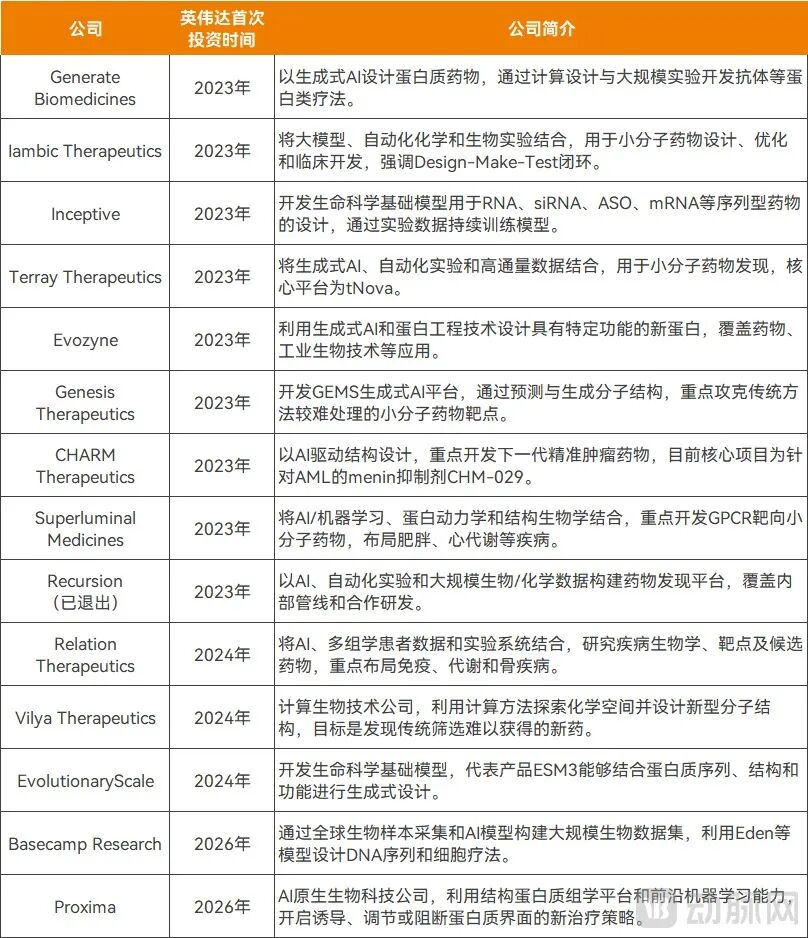
Partially counted AI pharmaceutical companies invested by NVIDIA, Source: Public corporate information
Based on the investment in several star enterprises, NVIDIA has been continuously expanding its portfolio for different technical routes and different R&D stages, and the types of its investment targets are increasingly diversified.
Early companies such as Generate, Genesis, Iambic and Terray mainly focus on solving such a problem: whether AI can help researchers find molecules with drug development potential faster.
After that, NVIDIA began to enter the more upstream biological models and data platforms. For example, ESM3 developed by EvolutionaryScale is a generative model that can understand the sequence, structure and function of proteins at the same time.
Basecamp and Proxima invested in 2026 represent NVIDIA's continuous expansion to new biological data, models and drug design routes.
It is worth noting that the AI pharmaceutical companies invested by NVIDIA have successively reached the key node of IPO since 2026.
In February 2026, Generate Biomedicines listed on Nasdaq, when the company's core asset GB-0895 had already entered Phase III clinical trials. In September, Iambic Therapeutics further submitted its IPO application, and the company's core candidate drug IAM1363 is in Phase I/Phase Ib, with a plan to push IAM1363 into registrational trials as early as 2027.
For AI pharmaceutical development, when an enterprise reaches the IPO stage, it means that its technology, pipelines and business cooperation will all accept long-term tests from the public market. Enterprises need to prove to more investors that their technology platforms can continuously produce candidate drugs, and confirm the actual value of these drugs through clinical development.
For NVIDIA, the large-scale investments it started in 2023 have seen phased results by 2026, and the invested enterprises are moving from early-stage technology R&D to the harvest stage in the capital market.
02
Full-chain Opportunities Behind Wide-ranging Investments
NVIDIA has invested in 14 enterprises, covering multiple links of AI-empowered drug R&D, showing obvious full-chain characteristics.
A survey of the businesses of these companies shows that NVIDIA does not necessarily simply want to bet on one or a batch of "AI pharmaceutical champions", but to lay out the new technology chain of AI implementation in life sciences: the bottom layer relies on computing power infrastructure, the middle layer is equipped with new models, datasets and software tools, and the upper layer puts the output results of AI back into real experiments and drug R&D scenarios for verification.
First of all, the deeper AI penetrates into the drug R&D process, the greater the demand for computing power, which is NVIDIA's most direct industrial opportunity.
Computing tasks in traditional drug R&D are relatively scattered, and AI is converting more and more R&D links into computing problems. Protein structure prediction, molecule generation, virtual screening, protein design as well as large model training and reasoning all require a large amount of computing resources.
As the parameter scale of life science models continues to expand, computing demand has gradually extended from a single task to the coordination of model training, reasoning and complex R&D tasks.
Take ESM3 of EvolutionaryScale as an example, it can process the sequence, structure and function of proteins at the same time, and design new proteins through generative models. Its training scale reaches 98 billion parameters, and it uses large-scale GPU computing resources. This type of model is significantly different from traditional single drug discovery software. It needs to continuously expand training data, model parameters and computing scale, thus forming continuous demand for AI infrastructure.
When NVIDIA invested in EvolutionaryScale, it valued not only the growth space of a protein AI company, but also the computing demand generated after the continuous expansion of basic life science models.
For NVIDIA, this is the most direct investment logic. The more widely AI is applied in drug R&D, the more complex the models are, and the more data that needs to be processed, the higher the importance of the underlying computing infrastructure will be. Investing in such companies can help NVIDIA access new life science computing scenarios earlier and understand the sources of new computing power demand.
Secondly, NVIDIA also intends to enter the model, data and software ecosystem, extending its computing power advantages to the R&D tool chain of AI pharmaceutical development.
As AI covers the complete R&D process, the problems that enterprises need to solve also include how to train models, how to use data, how different models cooperate, and how researchers apply these capabilities to drug R&D. If NVIDIA providing GPUs is building the most underlying infrastructure, then laying out development platforms, models and tools based on GPUs is equally important.
BioNeMo is an important carrier for NVIDIA to extend in the above direction. In recent years, NVIDIA has continuously expanded the capabilities of BioNeMo in life science model development, training, deployment and Agent workflow, and has cooperated with many AI pharmaceutical companies, including some of NVIDIA's invested enterprises.
For example, Proxima focuses on AI pharmaceutical R&D related to proximity therapeutics, positioning itself at the technology and data layer. Proxima has cooperated with NVIDIA to use BioNeMo and BioNeMo Agent to accelerate the progress of all stages of drug discovery, and NVIDIA's role has further extended from simply providing computing resources to R&D tools and model ecosystem.
Basecamp Research reflects another combination mode. The company uses large-scale biological data and AI models to carry out drug design, and cooperates with NVIDIA to develop relevant models and tools. In January 2026, the two sides further promoted the development of AI models based on BioNeMo; in September, Basecamp completed a $140 million Series C financing, which will promote AI-designed therapeutics into clinical development, and NVIDIA participated in this round of investment.
It can be seen that NVIDIA hopes to build an ecosystem centered on life science AI models and development tools. The more companies there are, the richer the models are, and the more complex the R&D tasks are, the more usage scenarios BioNeMo will have.
At the same time, NVIDIA cooperates with large pharmaceutical companies to verify the large-scale application value of various AI pharmaceutical technologies.
Whether AI pharmaceutical development can finally form a sufficiently large industrial market depends crucially on whether large pharmaceutical enterprises will turn AI from an experimental tool into R&D infrastructure. Pharmaceutical enterprises have rich R&D pipelines, experimental systems and real-world data, which are also the scenarios where AI models ultimately need to be verified.
In 2026, NVIDIA and Eli Lilly announced the joint construction of an AI innovation lab, with a plan to invest up to $1 billion in total in the next five years for the construction of talents, infrastructure and computing resources. The two sides will combine AI capabilities such as BioNeMo with Eli Lilly's drug R&D system.
NVIDIA is also promoting the "lab-in-loop" life science AI workflow, allowing models to put forward hypotheses, experimental systems to carry out experiments, and then feeding experimental data back to the models for the next round of optimization. Once large pharmaceutical enterprises further embed AI into the R&D process, it will generate continuous demand for model training, reasoning, experimental data processing and automated experiments, thus expanding the market space.
In recent years, it is not surprising that large tech companies invest and lay out in the AI pharmaceutical field. Google's core advantages come from its basic AI models and the DeepMind system, and it directly enters the AI drug discovery sector through companies such as Isomorphic Labs; Tencent relies more on cloud computing, AI capabilities and industrial investment to enter the life science field.

Differences in AI pharmaceutical investments between NVIDIA and some other tech companies, Source: Public corporate information
On the whole, compared with other large tech companies, NVIDIA has taken a composite path: holding the GPU computing power base, self-developing AI platforms such as BioNeMo, widely investing in startups externally, and at the same time carrying out in-depth industrial cooperation with multinational pharmaceutical enterprises. As AI continues to penetrate all links of drug R&D, the demand for computing and software tools will also grow simultaneously. What NVIDIA invests in is the infrastructure market opportunities released in the life science field.
03
The Big Test Has Only Just Begun
The increase in investment quantity and successive IPOs do not mean that NVIDIA's AI pharmaceutical investment has ushered in the harvest period. Judging from the technology or pipeline progress of these companies, the real harvest period is yet to come.
The pipeline progress of the entire portfolio covers different links from basic models, biological data, molecule and protein design to candidate drugs and human clinics. For example, Generate's GB-0895 has entered Phase III, Iambic's IAM1363 is in Phase I, CHARM and Superluminal have also entered the clinical stage; companies such as Proxima and Basecamp are still in the pre-clinical stage.
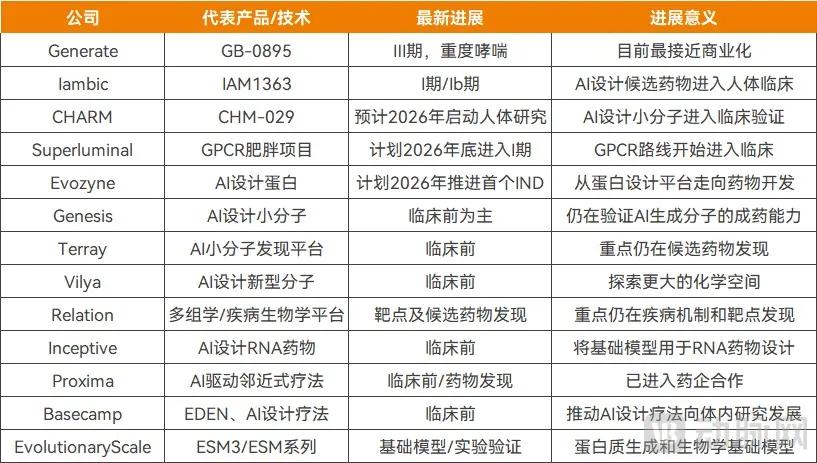
Pipeline or technical progress of AI pharmaceutical companies invested by NVIDIA, Source: Public corporate information
Generate's successful IPO and Iambic's sprint for IPO mean that more AI pharmaceutical companies are moving from the private equity market to the public market and beginning to accept public market pricing; the cooperation between companies such as Inceptive, Relation and Iambic and large pharmaceutical enterprises indicates that AI-driven R&D capabilities have begun to enter the stage of industrial cooperation. Therefore, NVIDIA's invested companies are seeing "harvests" at different levels.
However, major progress in the capital market and industrial cooperation does not mean that the harvest period of drug R&D itself has arrived. Next, AI pharmaceutical development still needs to face the test of many difficult problems.
For example, clinical verification is still the ultimate exam. Whether AI can improve the efficiency of target discovery, molecule design and candidate drug screening ultimately needs to be verified through human trials. In the past, the industry competed on whether models could find molecules, but now it begins to compete on whether these molecules can show sufficient safety and effectiveness in the human body.
It still takes time to verify when the drugs developed by these companies will be approved. At present, the most advanced Generate has entered Phase III, but none of NVIDIA's invested enterprises has obtained marketing approval for original drugs discovered driven by AI. In this process, the theoretical judgment that AI can shorten the R&D cycle also needs more products to complete the clinical and regulatory processes before it can be verified.
Whether AI can truly improve the input-output ratio of drug R&D is also a necessary question to answer in the commercialization process of AI pharmaceutical development. Even if drugs are approved later, the value of AI pharmaceutical development still needs to be evaluated from a more comprehensive and direct dimension, that is, whether AI reduces the cost of drug R&D, including not only time cost, but also the cost of capital and other R&D resources.
Only when efficiency improvement evolves into higher R&D success rates and lower cost for each successful drug, can the technical advantages brought by AI be truly reflected as industrial value. Compared with front-end indicators such as model scale and molecule generation speed, this may become the standard for the long-term value of AI pharmaceutical development.
All in all, even if only a few AI pharmaceutical enterprises succeed in commercialization in the future, NVIDIA can still obtain part of the industry dividends by relying on infrastructure such as GPUs and BioNeMo. If AI can deeply restructure the drug R&D process, industrial changes will take place from basic models and automated experiments to biological data processing and actual pharmaceutical R&D. NVIDIA's long-term goal lies precisely in this large-scale industrial transformation.
This article is from the WeChat official account "vcbeat" (ID: vcbeat), author: ZHANG Xiaoxu, published with authorization from 36Kr.