Just now, the Nobel Prize in Physics was awarded in the field of neutrino astronomy, and Francis Halzen, the father of IceCube, is the sole laureate.
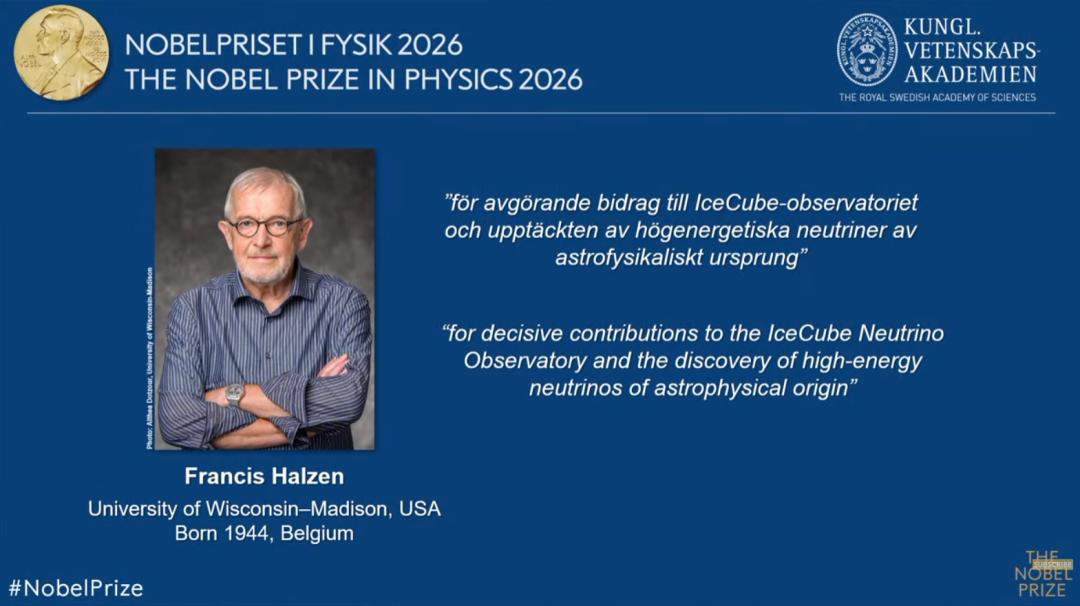
The Royal Swedish Academy of Sciences stated that this award is torecognize Francis Halzen's decisive contributions to the IceCube Neutrino Observatory and his discovery of high-energy neutrinos originating from astrophysical processes.
He is the only winner of this year's Nobel Prize in Physics.
Francis Halzen laid the foundation for a brand new astronomical observation method. His idea was,to use the glacial ice in Antarctica to capture an extremely difficult-to-detect particle:neutrino.
This idea eventually gave birth to the IceCube Neutrino Observatory. With the help of this facility, scientists can track neutrinos from the distant universe, thus observing the universe in a completely new way.
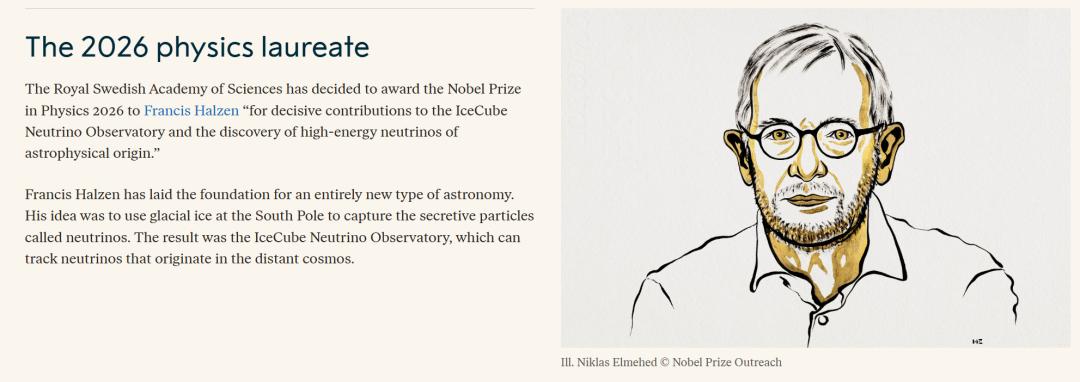
Francis Halzen was born in Belgium, obtained his master's and doctoral degrees at KU Leuven, and has taught at the University of Wisconsin-Madison since 1972. He is a theoretical physicist, and his particle physics textbook*Quarks and Leptons*is still widely used in universities today. According to his own account, he never originally planned to do this kind of experiment, and his involvement in it was somewhat accidental.
In the mid-1980s, he and postdoctoral researcher Enrique Zas began to study the possibility of building a neutrino telescope, and his key insight was:the Antarctic ice itself can be used to track neutrinos.
"Ghost Particle"
The most abundant and most elusive matter particle in the universe
The story of neutrinos began with an "unbalanced account". In the 1920s, physicists studying the beta decay of atomic nuclei found that the energy of the electrons emitted during decay was not fixed, and part of the energy always "disappeared" out of thin air, putting the law of conservation of energy in jeopardy.
In 1930, Pauli proposed a bold remedy:an uncharged particle with extremely small mass is also emitted during the decay, which quietly carries away this part of the energy.
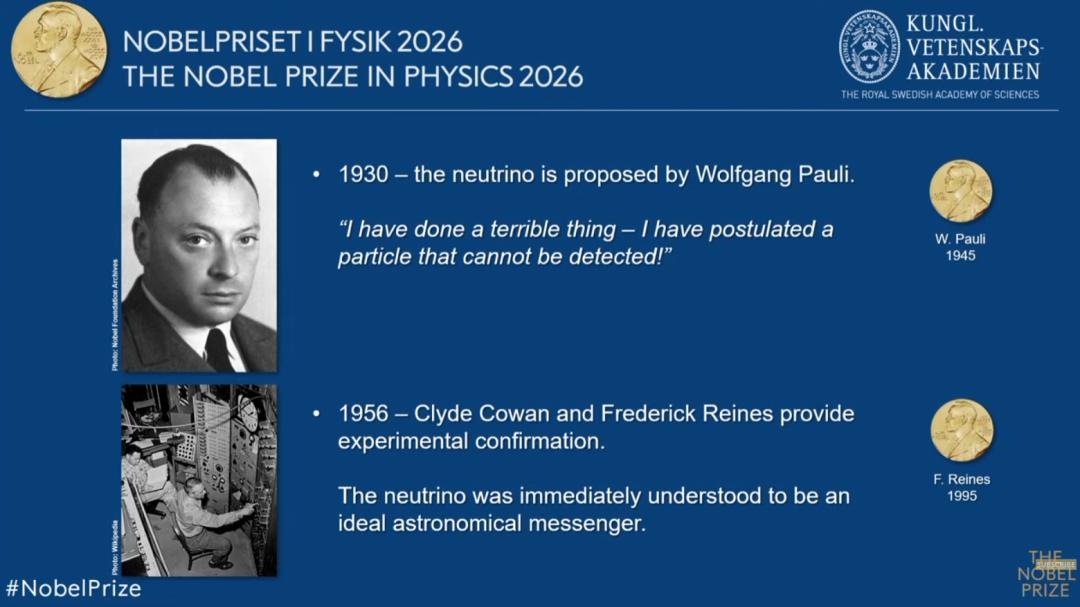
A few years later, Fermi established the beta decay theoryon this basis, and named the particle "neutrino", which means "little neutral one" in Italian.
This prediction waited for more than 20 years to be confirmed. In 1956, near the Savannah River Nuclear Reactor in the United States, Clyde Cowan and Frederick Reines, using the antineutrinos continuously generated by the reactor,directly detected neutrinos for the first time, and Reines later shared the 1995 Nobel Prize in Physics for this achievement.
Later, people gradually realized that neutrinos haveelectron neutrino,muon neutrinoand tau neutrinothree types, and they will transform into each other during flight, which is called "neutrino oscillation". The existence of oscillation means that neutrinos have a tiny but non-zero mass, and Takaaki Kajita and Arthur McDonald won the 2015 Nobel Prize in Physics for this discovery.
Neutrinos are the most abundant matter particles in the universe. For the neutrinos generated by solar nuclear fusion, more than 60 billion of them pass through every square centimeter of the Earth's surface every second. At this very moment, trillions of neutrinos are passing through your body without you noticing. The reason is that neutrinos are uncharged, do not participate in electromagnetic interaction and strong interaction, and almost only interact with other matter through weak interaction. For low-energy neutrinos such as solar neutrinos, it takes an average of about one light-year thick of lead to be blocked once.
"Ghost Particle" gets its nickname from this.
Why observe the universe with neutrinos
It is this characteristic of hardly interacting with anything that makes neutrinos the long-awaited messengers for astronomers.
The traditional method for humans to observe the universe is light, which has expanded from visible light to radio, X-ray and gamma ray. But light has its limitations. It will be blocked by interstellar dust and the dense matter of celestial bodies themselves, so we can often only see the "surface" of celestial bodies, but cannot see the most violent core area inside. The higher the energy of gamma rays, the more likely they are to collide with photons in the cosmic background radiation and annihilate during long-distance travel, so the highest-energy processes in the distant universe are difficult to observe clearly with light.
Another type of high-energy messenger is cosmic ray, which refers to high-energy protons and atomic nuclei flying from space. They were discovered more than a century ago