Senior female schoolmate from Jiao Tong University, with a valuation of 70 billion
Another AI myth has been born.
It is reported that TypeSafe AI is in talks for at least USD 1 billion in new financing, with some investors offering a valuation of over USD 10 billion. Just ten days before the news broke, the company had just emerged from stealth mode.
It is the suddenly viral new model Jev that underpins this optimistic expectation. From developer communities to investor group chats, this name is almost ubiquitous, with amazement and debates pouring in one after another. Amid the hype, the familiar fear of missing out (FOMO) has resurfaced.
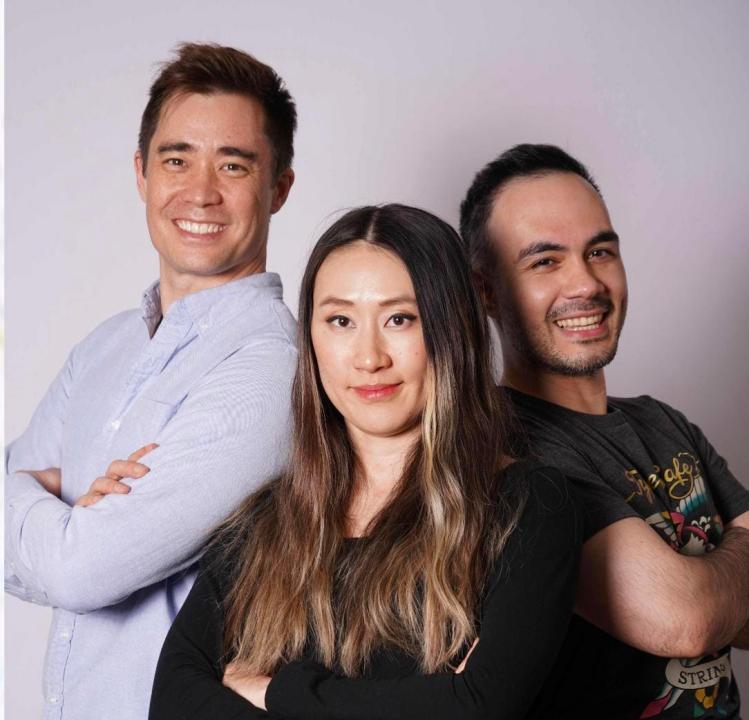
What draws more attention is that among the three founders of TypeSafe AI is a Shanghai-based female entrepreneur Sasha Sheng — she was admitted to Shanghai Jiao Tong University through the national college entrance examination, later joined Yahoo and Facebook, and grew her career from mobile product development and machine learning to AI entrepreneurship.
That is probably the charm of the AI era: the landscape seems to have settled, yet new players keep breaking in.
Three founders, USD 100 billion valuation
50-fold surge in 10 days
The story of Jev starts with several young talents.
Founder Diogo Almeida, a post-90s generation talent, graduated from Rensselaer Polytechnic Institute with a bachelor's degree and later obtained a master's degree from Georgia Tech. He used to work at companies including Google and OpenAI, participating in R&D related to ChatGPT, and claimed to be one of the few people inside who openly "criticized" ChatGPT.
In 2024, when ChatGPT was at the peak of its popularity, Diogo chose to leave. He gradually realized that large language models good at conversation are still not stable enough to truly take over high-frequency tasks in software. With this question in mind, he hit it off immediately with Sasha Sheng and Erik Gafni, and thus TypeSafe AI was founded.
Little known to the public, Sasha Sheng is a Shanghai native who labels herself first as a "dancer" on social platforms, before introducing herself as the co-founder of TypeSafe AI.
When she was little, Sasha did dream of becoming a dancer, but her family hoped she would focus on academic studies. Later, she was admitted to Shanghai Jiao Tong University through the national college entrance exam, becoming the first college student in her family, and earned a bachelor's degree in mechanical engineering from Shanghai Jiao Tong University and a master's degree in computer science from the University of Michigan.
Beyond coding, she has always been focused on people, products and expression. In 2014, Sasha joined the iOS team of Yahoo Mail, soon became the technical lead, and grew into an expert in the iOS field.
After that, she joined Facebook and stayed there for seven years. Sasha was initially in charge of mobile products for the feed stream, then voluntarily switched to back-end machine learning. She once led the development of a training data labeling system. To balance speed and quality, she leveraged her front-end development experience to build tools and align different teams, which was later adopted by multiple internal research teams. That was the first time Sasha experienced a feeling close to entrepreneurship: building a product, then finding that other people are willing to use it on their own initiative.
The turning point came after Meta's layoffs. Her career at the tech giant came to an end. After returning the company-issued laptop, her strongest feeling was relief. She did not rush to join another large company, but dived into AI hackathons. In less than a year, she participated in around 15 competitions and won 7 of them. When Diogo told her about the vision of TypeSafe AI, Sasha was very delighted, saying that moment felt like "taking a big breath of fresh air".
The other co-founder, Erik Gafni, has more frontline industry experience. He was an early employee of genetic testing companies Invitae and Freenome, and later founded Ravel, a multimodal AI company.
On September 15, TypeSafe AI officially came out of stealth, and announced the completion of approximately USD 40 million in seed financing led by DCVC, at a valuation of about USD 200 million.
About 10 days later, according to *The Information*, TypeSafe AI is in talks for at least USD 1 billion in new financing, with some investors offering a valuation quote of over USD 10 billion. If the deal is finally closed, it means the company's valuation has jumped by about 50 times.
It is the newly launched model Jev that attracts swarms of investors.
Jev goes viral overnight
The "mute model" unexpectedly gains explosive popularity
Jev is everywhere across the internet.
When it was first launched, the promotional video of Jev gained nearly 40 million views on social platforms. Just 24 hours after it was integrated into AI Gateway under the cloud development platform Vercel, the number of paid teams that adopted it broke the platform record, reaching more than twice that of any previous new model.
The hype soon spread to developer communities and social platforms.
Some developers use it to play Mario games, some use it to filter spam information and assist trading, while others connect it to Claude Code to specifically clean up useless context. More developers started to try to use Jev as the "referee" for Agents, to judge whether a task is completed and what tool to call next.
A comparison video went viral widely: when processing the same data classification task, Jev finished labeling 428 pieces of data within 28 seconds, while another model only processed the 6th piece of data.
Voices of doubt soon emerged. Some people hailed it as a real Agent revolution, while others bluntly said it was nothing more than a well-packaged JSON classifier. Praise and debates came at the same time, which pushed Jev to gain even wider public attention.
What exactly is Jev?
Its name comes from the Jevons Paradox in economics: when the cost of using a technology falls, its demand tends to rise. TypeSafe AI believes that the same rule will apply to the AI industry.
Different from common large language models before, Jev does not have a chat box, nor does it support long-form reasoning, and is jokingly called a "mute model". When users input specific content, set questions and candidate results, it will directly output structured judgments with corresponding probability.
For example, when given a set of customer data, Jev will not analyze in detail why a customer is likely to churn, but directly return the result: 82% probability of churn. When facing multiple candidate actions of an Agent, it will also directly select the next step.
TypeSafe AI refers to this type of model as System One Model. The name comes from "System 1" proposed by Daniel Kahneman in his book *Thinking, Fast and Slow*, which corresponds to the fast, intuitive judgment mechanism.
In the past few years, large language models have been pursuing more complex reasoning capabilities. The models think longer, output longer responses, and the invocation cost rises accordingly. The uniqueness of Jev is that it does not pursue expressive capability, but focuses on judgment.
Low cost is another reason for Jev's popularity.
The officially announced price is USD 0.042 per million input tokens, that is, USD 42 per billion tokens, with output tokens completely free. Compared with the prices of mainstream large language models listed by the company, Jev's input cost is as low as 1/238 of its competitors.
The cost advantage is not obvious when it comes to a single invocation. But once it is integrated into the Agent system, the significance is completely different. One single task may trigger dozens or even hundreds of model invocations, so the speed and cost advantages will be multiplied. For developers who call models at high frequency, this price is attractive enough.
According to the disclosure of DCVC's partner leading the investment, thanks to the low computing cost, TypeSafe AI has already achieved profitability, though the company has not released specific financial data.
But disputes came just as quickly.
Shortly after, OpenAI released the Decisions API for instant decision-making scenarios, which is almost regarded by the outside world as a direct response to Jev. A post with a straightforward title quickly spread on social platforms: "Jev Is Dead". In the comment section, the doubts are more direct: Jev has never had a real competitive moat.
After going viral, Jev soon faces more realistic tests: when tech giants enter the track, how long can its first-mover advantage last?
The next hit product, the next round of reshuffling
This scene feels familiar.
On September 28, Manus 2.0 was officially released, with the independent app Cue launched at the same time. The app allows each Agent to have its own email, phone number, wallet and computer, and Agents can even be added to the same group chat to work collaboratively like a small team. After the product was released, invitation codes quickly circulated across social platforms.
Back in March 2025, Manus made a splash with its "one-sentence execution of complex tasks" feature. Its demo video went viral across the internet, and the invitation code was once extremely hard to get. Afterwards, its valuation kept rising, making it one of the most notable AI startups in China.
A few weeks ago, the spotlight was on Muse under Meta. This personal Agent can send emails, book restaurants, and even handle second-hand transactions on behalf of users. After launch, Muse quickly gained millions of downloads, Meta's stock price once rose by more than 3%, with its market value increasing by approximately USD 56 billion. Later, Mark Zuckerberg integrated Muse into an AI hardware the size of a keychain.
Further back, OpenClaw sparked a "raise lobster" craze. Within weeks of its launch, it swept across GitHub and became the fastest-growing open source project in history. Mac mini was also unexpectedly driven to be popular, with stores in many regions once out of stock.
Installation tutorials soon covered all social platforms, and even the door-to-door installation service became a profitable business. Being able to "raise lobsters" seemed to become a sign of keeping up with the AI wave, and the "lobster anxiety" emerged as a result.
Soon, this "lobster" had a large number of Chinese counterparts. ByteDance launched ArkClaw, Tencent launched WorkBuddy, and Alibaba launched CoPaw. MoonShot AI, MiniMax and Zhipu AI successively released KimiClaw, MaxClaw and AutoClaw. The "Hundred Claws War" broke out.
The competition for Agents is ultimately pointing to the next generation of entry points.
In the mobile internet era, the entry points belonged to search engines, app stores and super apps. In the AI era, whoever becomes the host platform for Agents will have the opportunity to keep models, tools, services and payments within their own ecosystem, and seize a position for sustainable monetization in the future.
The hype pushes up valuations, and also amplifies the FOMO sentiment across the entire industry.
AI iterates so fast that waiting itself seems to be a kind of risk. Entrepreneurs are worried about betting on the wrong direction, tech giants fear losing the entry point, and investors are more afraid of missing the next platform-level company. Many products are still in the verification phase, while capital has already started looking for the next project.
People may not always remember a certain name among Manus, Muse or OpenClaw, but no one wants to miss the next DeepSeek moment.
This is probably the most thought-provoking part of this round of Agent boom: when individuals gradually gain capabilities that used to be accessible only to large teams, the entrepreneurial threshold and industrial division of labor may all change accordingly.
Anxiety may be inevitable. But more importantly, when changes happen, you need to first see clearly the direction of the wave.
This article is from the WeChat official account "PE Daily" (ID: pedaily2012), written by Wang Lu, authorized to be released by 36Kr.