Tell the doctor that people no longer roll their eyes at Doubao.
At the end of 2025, I went to the hospital to seek treatment for a cold, and the doctor diagnosed it as wind-cold type cold.
I said to him, "Doubao told me it's a heat-type cold, what do you think..."
Before I could finish my sentence, the doctor interrupted me. The final diagnosis was still wind-cold type cold, and I almost took the wrong medicine that time.
This year when I went to the hospital again, I slipped my tongue: "Doubao helped me check my average blood pressure over the past week and suggested that I come for a check-up..."
This time the doctor was very nice to me and even asked me to sit down and speak slowly.
AI has become a disruptive catfish in the online healthcare market
In early 2025, DeepSeek-R1 led a concentrated boom of large AI models. Data from QuestMobile shows that by March of that year, the monthly active users of AI-native apps in China reached 270 million, including 194 million for DeepSeek and 116 million for Doubao. Users did not just download the apps for a trial: the average monthly usage duration per user increased by 32.7% year-on-year, and the number of usages increased by 53.1%. By March 2026, the overall monthly active users of AI-native apps further reached 446 million, of which Doubao reached 345 million.
When hundreds of millions of people have been accustomed to asking about work, searching for information and writing content in the same window, questions about physical health are naturally raised to AI continuously. When OpenAI released ChatGPT Health in January 2026, it disclosed that more than 230 million people around the world had used ChatGPT to ask about health and wellness issues every week; by July, this figure exceeded 300 million. A similar trend is happening among Chinese users using AI, and it is developing very rapidly.
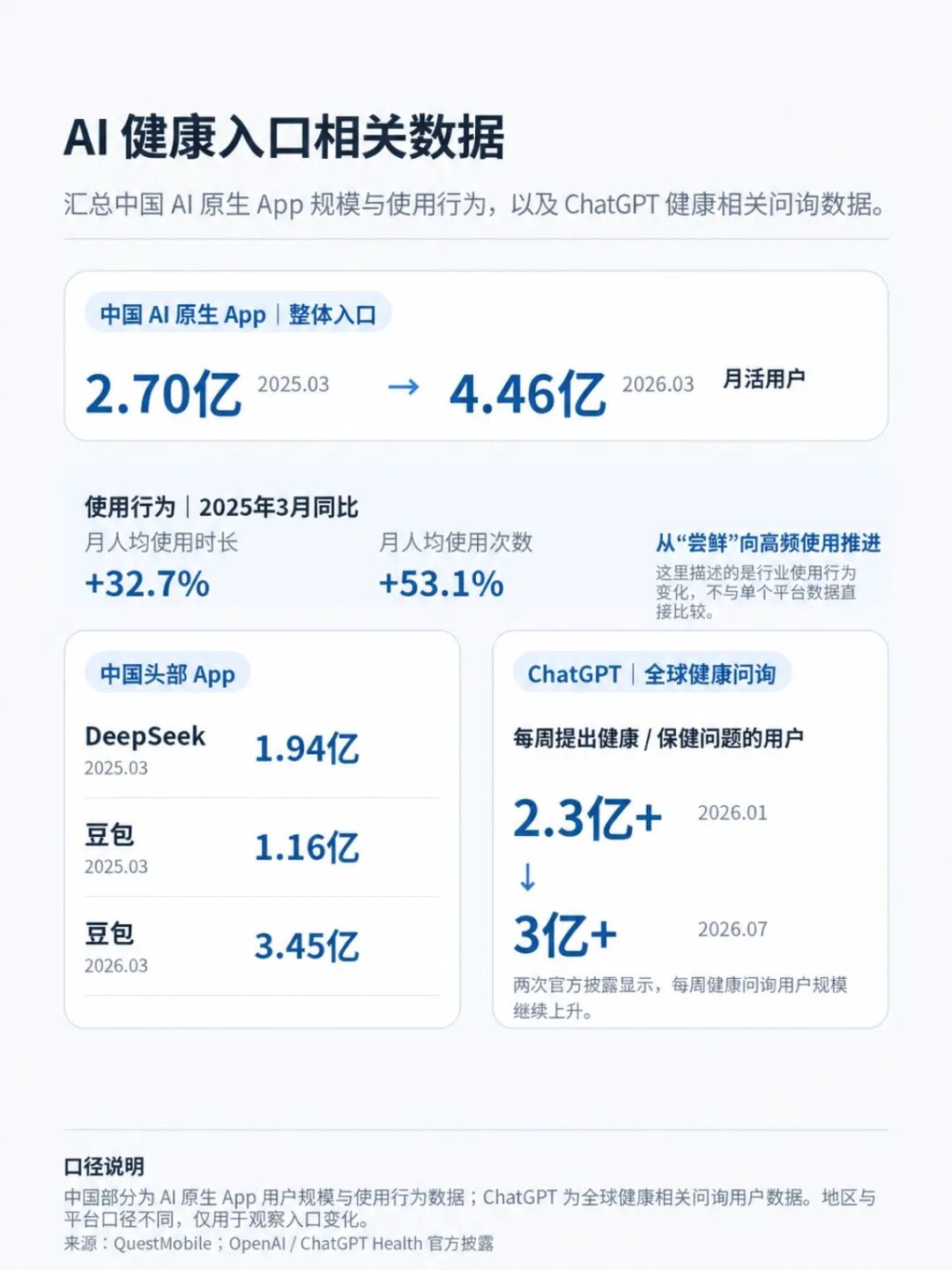
Data related to AI health entry (data source is shown in the figure)
Online healthcare in China has been developing for more than a decade, and there is still considerable room for development in terms of revenue. From 2022 to 2025, the revenue of JD Health increased from 46.736 billion yuan to 73.441 billion yuan, the annual active users increased from 154.3 million to 217.7 million, and the average daily online consultations increased from more than 300,000 to more than 500,000.
Ping An Health took another path: it experienced revenue contraction and losses in 2022 and 2023, turned profitable in 2024, and resumed growth in 2025. Alibaba Health turned from loss in FY2022 to profit in FY2023, and by FY2026, its revenue reached 34.255 billion yuan with a profit of 1.936 billion yuan.
This does not mean that "when AI rises, traditional online healthcare will decline". What has changed is mainly the entry point for users to deal with health problems, and we can observe what else is happening in the same period of time.
In 2025, Ant Group completed the acquisition of Haodf. Haodf has been engaged in internet medical services since 2006. By 2025, it had accumulated 95.2 million patients with internet medical service records, and the total number of doctor-patient interactions reached 1.16 billion. When the acquisition was completed, it had 280,000 real-name registered doctors. On the other hand, Alipay Medical has connected more than 3,600 hospitals, covering services such as medical insurance, registration, and medicine purchase.
In June 2025, Ant Group launched the independent AI health application AQ.
The first thing users face is no longer a list of doctors or hospital departments, but AI. Health science popularization, consultation for medical treatment, report interpretation, and health records are all developed around this entry point; it is connected to more than 5,000 hospitals and nearly one million doctors at the same time.
If you only look at the front end, AQ is very much like a typical AI native product. Many actions that originally required searching, finding departments, and looking up materials to complete are now compressed into a single dialogue window.
But it has the hospital, medical insurance, registration and medicine purchase capabilities laid out by Alipay in advance, and is also connected to the doctors, patients and doctor-patient relationships accumulated by Haodf over nearly two decades.
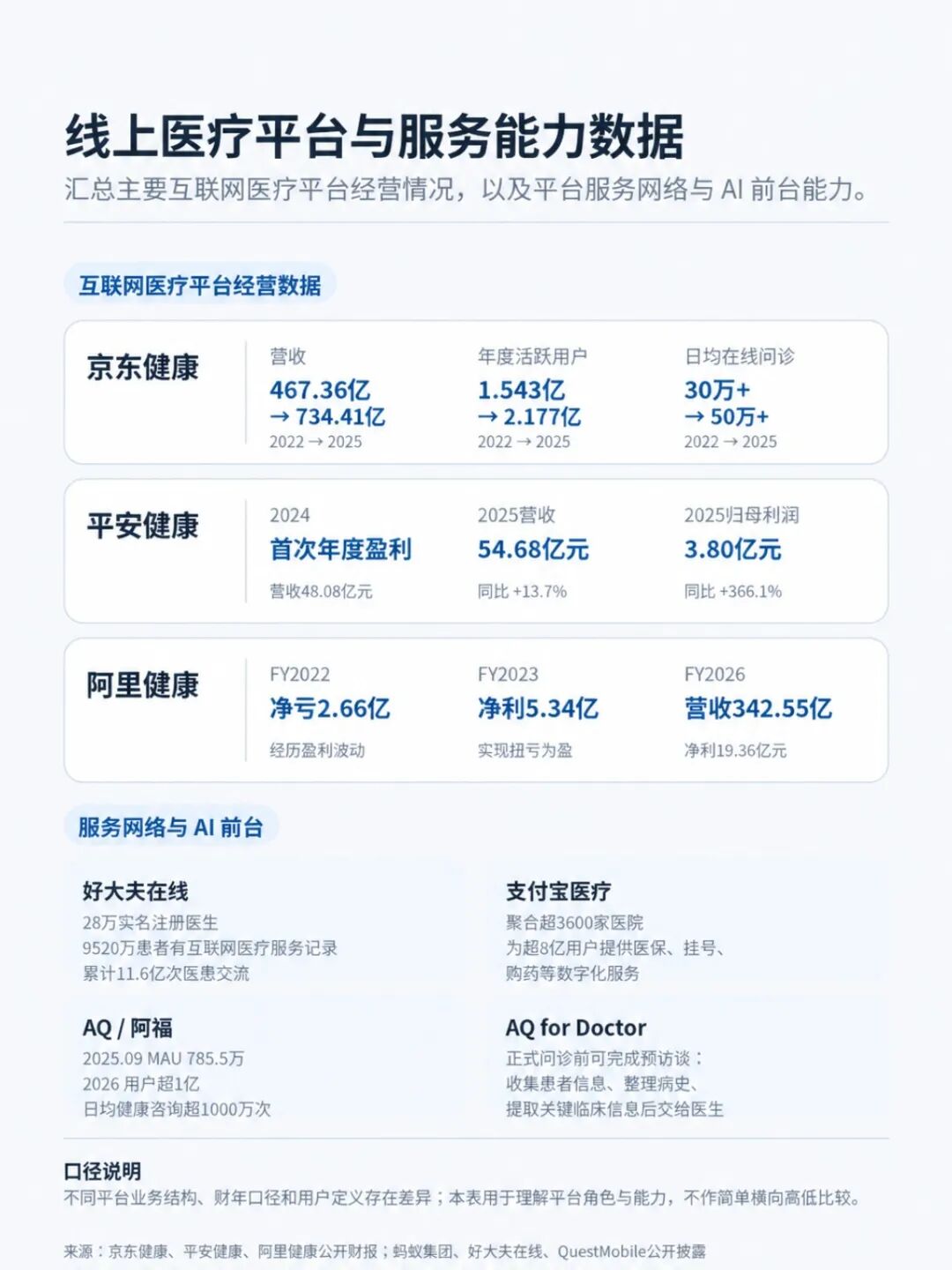
Data of online medical platforms and service capabilities (caliber of different platforms is shown in the figure)
In September 2025, the monthly active users of AQ reached 7.855 million. By 2026, Ant Group disclosed that the total number of users of AQ/Afu had exceeded 100 million, handling more than 10 million health-related consultations every day.
In August 2026, the Haodf Doctor app was upgraded to AQ for Doctor, and connected to the consumer end. The AI agent for doctors can follow up with patients to collect information and sort out medical history before the official consultation, and then hand over the key information to the real doctor.
The front end can be quickly replaced by AI, but many users still need to go deep into medical services, because what is connected behind is real doctors, hospitals and medical services that solve health problems.
You have talked a lot with AI before going to the hospital
The change in user behavior is more reflected in the transfer of the consultation entry before medical treatment, and "asking AI" and "looking for a doctor" are not contradictory.
Rock Health surveyed 8,000 American adults in 2025, and the proportion of using AI chatbots to obtain health information rose from 16% in 2024 to 32% in 2025.
42% of the respondents will continue to search for other materials after asking AI, 40% of the respondents will continue to consult doctors or medical professionals, and 81% of the respondents have taken at least one follow-up action.
In the 2026 KFF survey, 65% of users use AI mainly to get information faster, 41% of users use it to understand the situation before deciding whether to see a doctor; others use it to interpret test results, understand treatment plans, or help judge the next step. Among people who use AI to deal with health problems, 41% have uploaded personal medical information such as test results and doctor's records.
Things that used to be scattered in search, consultation, personal organization and needed to be done before waiting to see a doctor can now be completed in the same AI window.
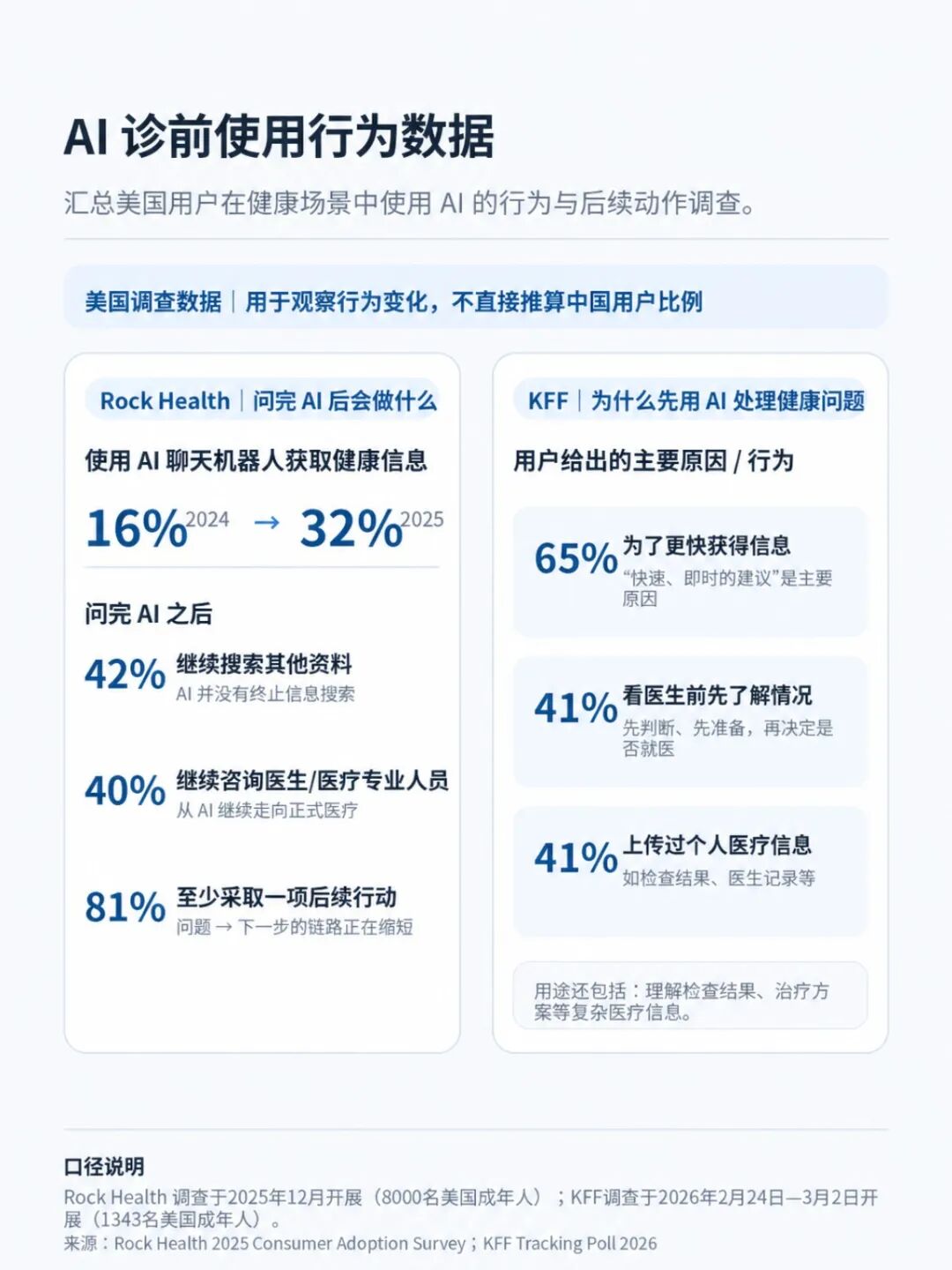
Data of AI pre-consultation usage behavior (survey data of US users)
If people can't understand a lab test report, they can take a photo and ask AI: "Is this value too high?"
If you can't remember the name of the medicine, just take a photo of the medicine box. If there is a change on your skin and you don't know how to describe it, just send a photo first. You don't even have a complete question, you just start with "I feel a little unwell recently" and add details while chatting.
There is a saying that a long-term patient becomes a doctor. When you go to see a doctor, if you want to avoid unnecessary trips and recover as soon as possible, you need to learn a lot of knowledge, look up a lot of materials, and be able to understand which indicator in the report is abnormal and what the name of the medicine is.
Multi-modality and real-time speech reduce the understanding cost of this part. Users can directly submit more original materials to AI, and users who have tried it will quickly develop usage habits.
With the development of AI, it has stronger memory and longer context processing capabilities. Many users find in communication that AI can remember a lot of their own conditions. Many data and test results that they may need to check the lab report to find can now be known by asking the commonly used AI.
ChatGPT Health already allows users to actively connect medical records and data such as Apple Health, compare old and new tests, and view changes in sleep, activity and exercise over a period of time. This also provides a data basis for comprehensive comparison and judgment of physical status.
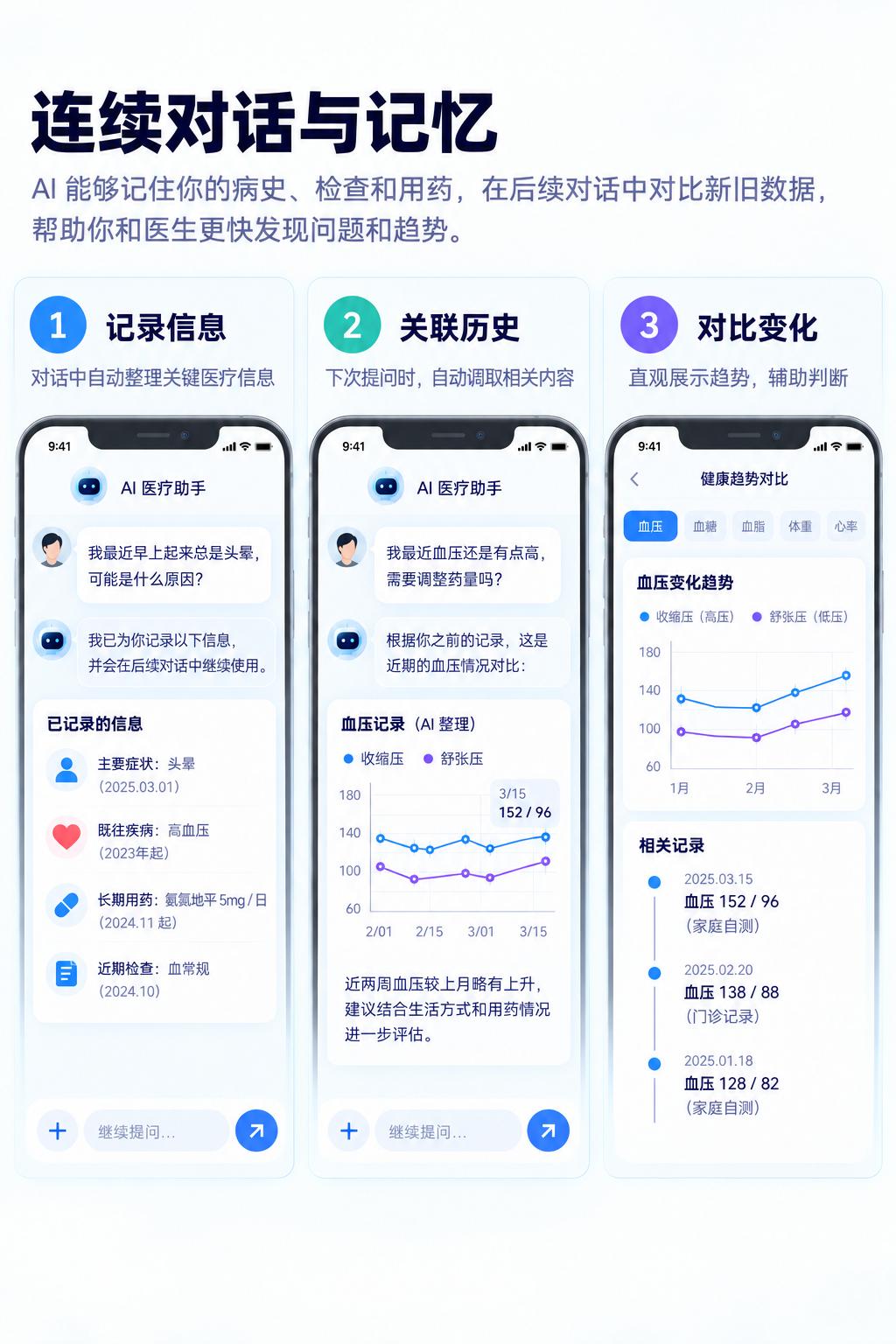
Schematic diagram of continuous dialogue and memory: let the information of the previous round enter the next communication
When you go to see a doctor, these capabilities of AI can also provide a practical help: organize pre-consultation information.
Ant Group's Afu can read physical examination reports for consecutive years together, compare changes in key indicators, and store the materials in personal health records. The patient profile of Tencent Health can use AI to sort out the timeline of the illness, past medical history, test reports and indicator trends; the intelligent pre-consultation forms a pre-diagnosis report through multiple rounds of follow-up questions. Since 2024, JD Health has used AI to assist in collecting patients' illness conditions. Patients first submit a simple chief complaint, and AI then asks about the time, location and accompanying symptoms of the symptoms, sorts them into an overview of the illness and submits it to the doctor.
There is a very important limitation here: JD clearly states that AI is responsible for follow-up questions and organization, and the diagnosis and treatment opinions are still given by doctors. OpenAI's positioning of ChatGPT Health also follows this rule — it supports medical care, but does not replace medical diagnosis and treatment.
I encountered the other side in my own cold experience: if the judgment given by AI is wrong, and people directly take the answer as a diagnosis, they may take the wrong medicine that does not suit their symptoms, causing more trouble.
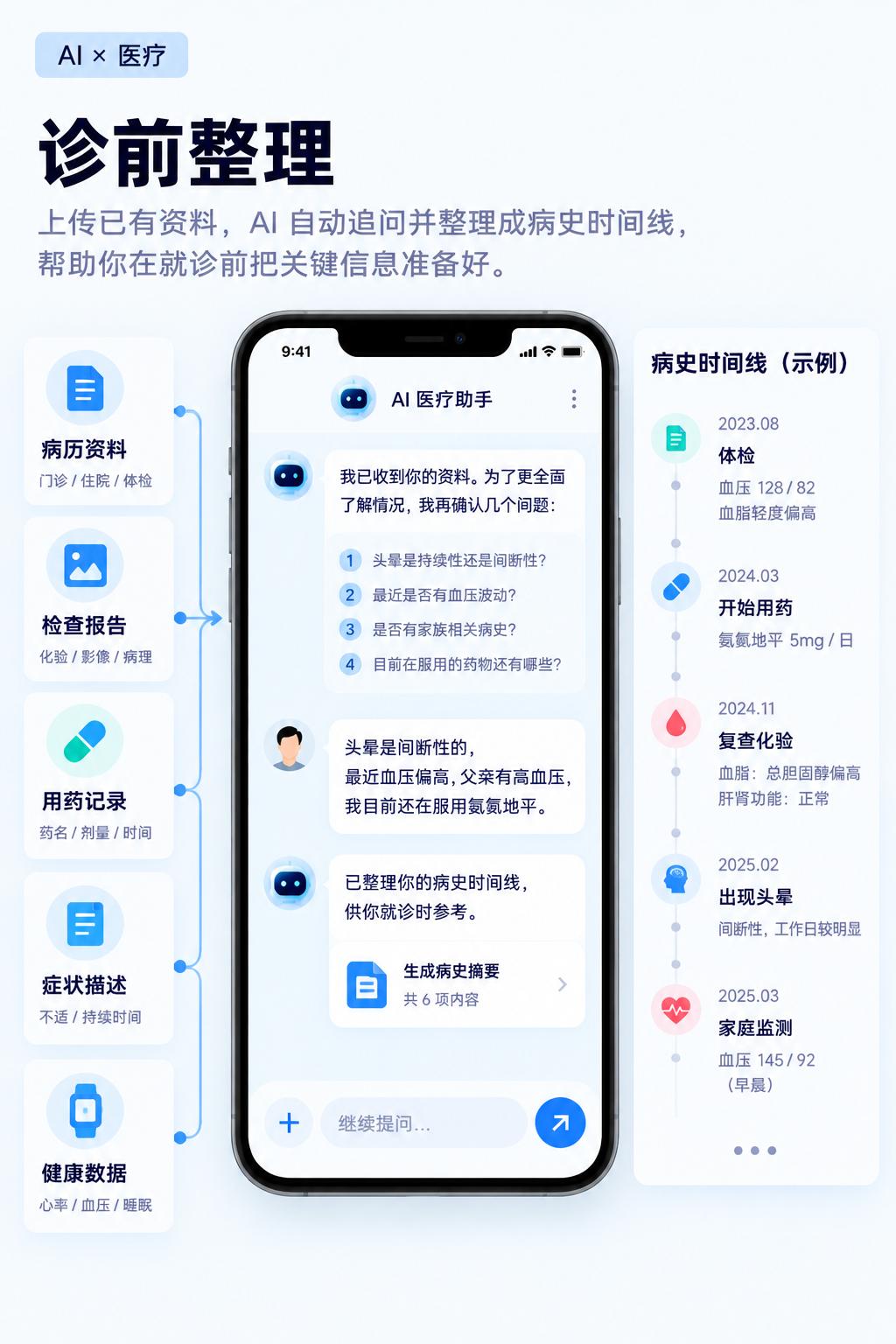
Schematic diagram of pre-consultation organization: AI is responsible for reading, asking follow-up questions and organizing, and the diagnosis and treatment opinions are still given by doctors
The two times I mentioned Doubao to the doctor were almost a year apart. The installed capacity of AI rose rapidly, and its capabilities were also improving rapidly. Doctors themselves are users of certain AIs, which may be one of the reasons why their attitude towards me changed.
AI is no longer just answering questions
In the past, most health information came from a physical examination, a consultation, or an active record after the body had obvious discomfort. Now, smart watches can collect data such as heart rate, blood oxygen, HRV, and sleep for a long time. For example, Huawei has been continuously strengthening PPG, multi-optical path sensing and long-term health monitoring, which essentially makes the physical state gradually change from isolated time points to data that can be observed continuously.
When these long-term data are imported into AI, the context will really start to be valuable.
A single high heart rate reading has limited meaning, and only by putting together several months of data can we see the trend of change; a single physical examination report can only describe the state at that time, and only by putting together the test results of several years can we form a trend. What AI is best at processing is exactly a large amount of information that is difficult for people to sort out by themselves for a long time.
On the one hand, the understanding ability, memory, multi-modality and context of large models are continuously improving; on the other hand, devices such as smart watches continue to generate health data; on the other hand, more and more users have been accustomed to asking AI first before deciding what to do next.
As a result, the entry point of medical care is moving from hospitals, registration platforms and dedicated medical apps to AI and devices that users use every day.
When the entry point changes, the resources behind it will also be recombined accordingly.
Doctors can get more complete medical history and trends in advance, reducing the time of repeatedly confirming basic information during the consultation; hospitals can extend part of consultation, follow-up visits and health management outside the hospital; users may avoid one unnecessary trip to the hospital, skip one repeated test, and find the services they really need faster.
For companies such as JD Health, Ping An Health, Alibaba Health and Ant Group, this also means new development space.
In the past, internet medical services first solved specific links such as registration, consultation and medicine purchase. After AI pushes the entry point further forward, health management, consultation, medicine, insurance, chronic disease management and follow-up services all have the opportunity to be carried out continuously around the same user. The doctor, hospital, medicine and insurance resources they have accumulated for many years also have the opportunity to give full play to greater value under the new entry point.
Therefore, the greater change brought by AI medical care may be: AI, wearable devices, doctors, hospitals, medicines, insurance and internet medical services are being reconnected around a person's long-term health data.
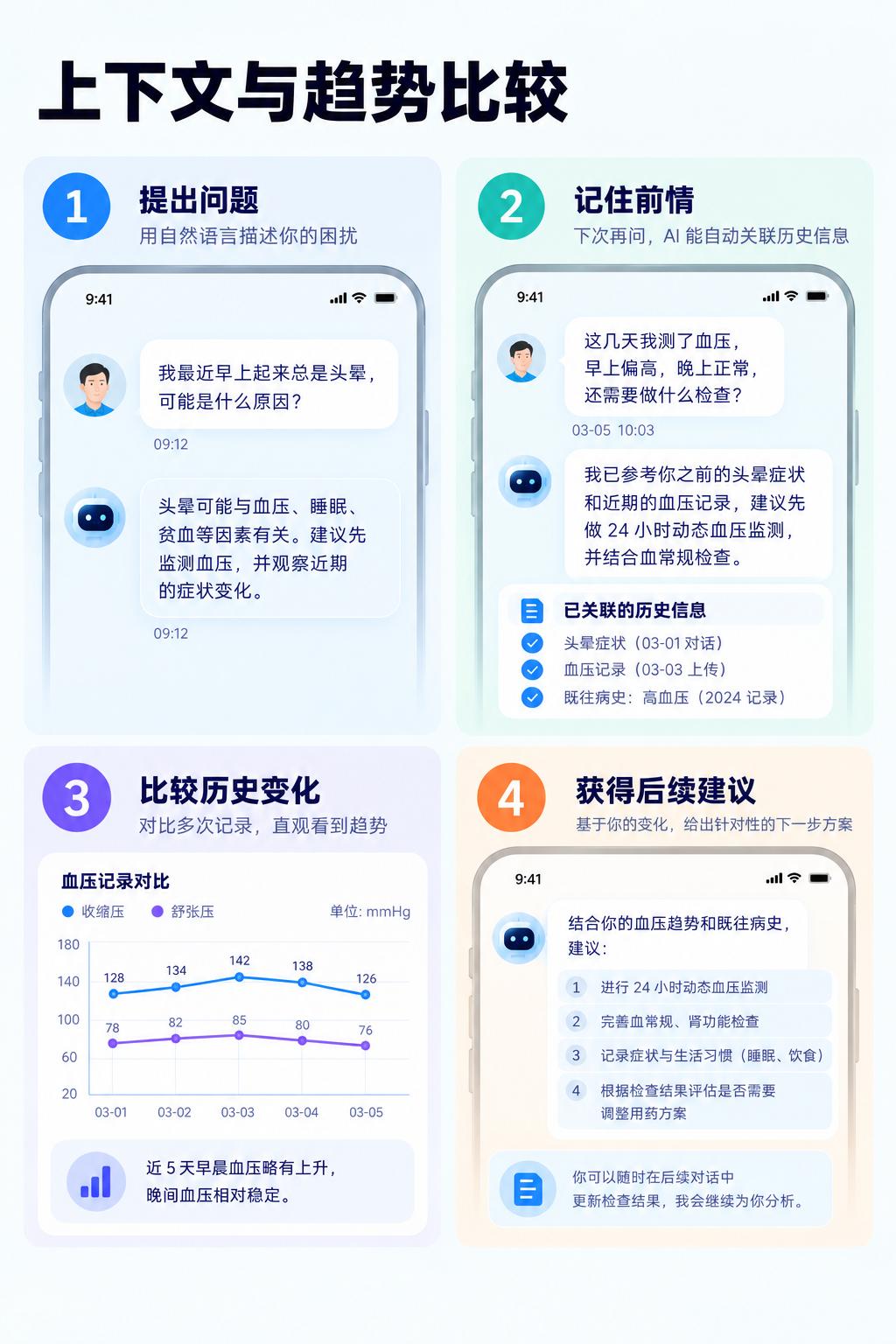
Schematic diagram of context and trend comparison: from single question to long-term data change
In the past, internet medical services solved the problem of "moving part of medical care online". Now AI is making the data and services scattered among devices, users, doctors, hospitals and platforms really start to flow — the competition in the medical industry will not focus on chatbots that are more like doctors, but on who can organize these resources more effectively, so that people can discover problems earlier, find suitable services more easily, and make limited medical resources give full play to greater value.
This article is from the WeChat official account "Feng Wei Feng Dabai", author: Feng Dabai, published with authorization from 36Kr.