200 videos produced daily at a cost of less than 10 yuan per video: The first-hand frontline cost ledger of small and medium-sized enterprises deploying AI is now available.
The fourth session of the Jianshi FDE series of live broadcasts focused on one core topic: how AI can be integrated into real business scenarios, and what role FDE should play in this process.
Long Fei, the guest of this session, gave a more straightforward answer: when building Agents for small and medium-sized enterprises, do not dwell on concepts first, but calculate the practical accounts first.
He played several newly delivered videos during the live broadcast. A travel agency only provided some self-shot materials, and received 200 completely distinct finished videos a few hours later.
After deducting necessary costs and profit margins, the quotation for one video is only 8-10 yuan. A monthly total marketing video production expenditure of 600-800 yuan (less than 1000 yuan) can ensure that at least two accounts have fresh content to publish every day.
The first version of this batch of videos was actually rejected, as there were unauthorized words in the subtitles that the platform prohibited from being published. The entire revision process was completed by AI automatic re-editing: transitions, dubbing, B-roll and A-roll were all finished automatically, and hundreds to thousands of videos could be edited in one continuous workflow.
None of these tasks were completed by outsourced teams. Long Fei embedded the entire process of material labeling, copywriting, review, production and delivery into the code to build a dedicated workbench, which team members can use directly by clicking the button.
In the past two years, many concepts in the AI industry have entered the public vision, but very few have been truly implemented. According to data previously released by Jianshi, 70% to 80% of enterprises are still in a wait-and-see state for AI deployment. In this live broadcast, Long Fei did not talk about empty concepts, but shared judgments, practical cases and cost calculation throughout the session. The following is his first-person account.

01
Launch the stable Agent workflow first,
avoid repeated custom development
Let's first clarify the target of our discussion today:
Small and medium-sized enterprises with an annual total profit of no more than 10 million yuan and no more than 100 employees. For such enterprises to deploy FDE, there is only one core proposition: can it make money?
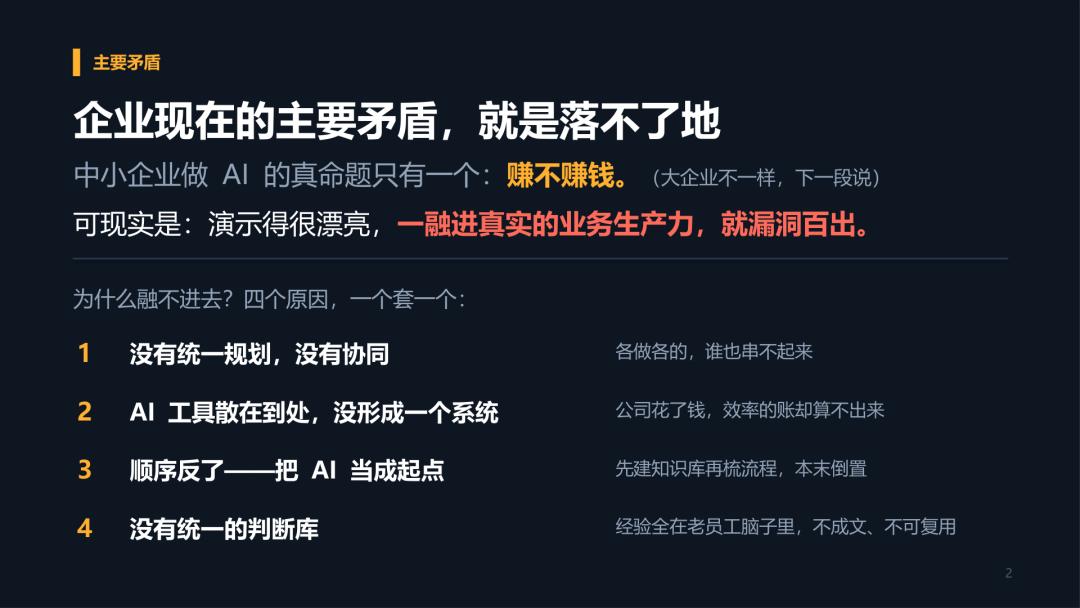
Around this proposition, my suggestion is very direct: launch the already stable Agent workflow first, and do not start with repeated custom development.
The implementation path can be split into four steps, each step solving one specific problem:
The first step is to launch the mature and stable Agent workflow to solve the problem of "what to use"; the second step is to select the first order from five categories of Agents to solve the problem of "what to do"; the third step is to build the judgment library and let the human workflow run through first to solve the problem of "how to implement"; the fourth step is to calculate the cost clearly and then set the direction to solve the problem of "whether it is worth it and where to go". The following content will be expanded in this order.
First, let's talk about why the path for small and medium-sized enterprises must be different from that of large enterprises. Large enterprises focus on efficiency, with the budget of a single project often reaching millions or tens of millions of yuan, and they only select top service providers such as iFlytek and Huawei, with strict supply chain qualification review. Small and medium-sized enterprises only care about "can it make money and can we see the effect immediately", and make decisions based on efficiency indicators, the business owners only recognize actual results. The two paths have completely different logic for selecting service providers.

The first type of common mistake is to regard "buying a set of system" as "successful implementation". Many companies sell very expensive systems to small and medium-sized enterprises, but the employees still use WeChat groups to transfer files and make reports in traditional ways, and the purchased systems are left unused after being bought. This is a common dilemma in the SaaS industry, and even the tools I bought myself are left idle. Buying a system does not mean purchasing actual capabilities, the real implementation means that employees are willing to use it and it can bring practical value.
Therefore, the first step of deploying FDE is to directly start with the already stable Agent workflow. Current AI programming technology is mature, and mature Agents and components can be used directly; products such as invoice Agents and digital human live broadcast Agents can directly meet the needs of business owners.
There is a commonly overlooked general opportunity here: the emerging "AI product supermarkets" on the market gather and sell basic Agents that can make PPTs, edit pictures, and convert black-and-white photos to color.
Senior technical teams may look down on such products, but they are real productivity improvements for third- and fourth-tier cities. Local teams do not know how to edit pictures or select appropriate titles, and such products priced at several hundred yuan to one or two thousand yuan have very considerable sales volume.
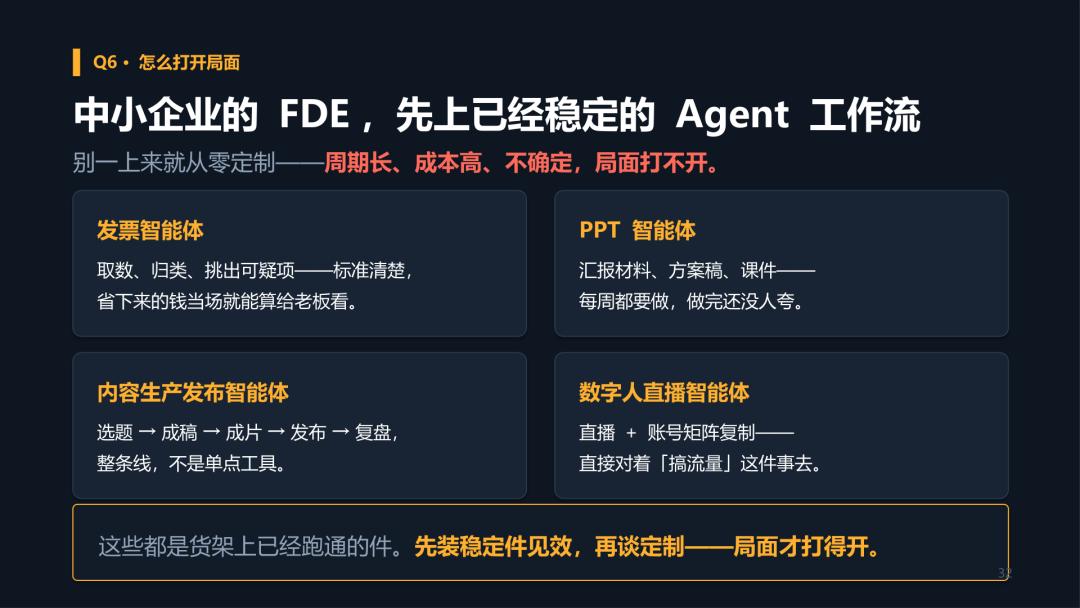
How to judge whether a product is a mature commercial component or just a toy? I have four criteria.
First, look at the form: if the product still relies on dialog boxes for scheduling, it is unqualified. Users need to continuously command it, and the user's command ability determines the upper limit of the output quality.
Some people build an "AI employee middle platform" that puts multiple Agents into Lark groups, which looks like a group of employees are working, but the user's time is still consumed in chatting and giving commands.
Second, look at stability: A single successfully run case does not mean that it can support mass production. When our cloud editing tool expanded from editing one video to ten or twenty videos, problems multiplied exponentially; only large-scale stable production can be regarded as a qualified Agent.
Third, look at portability: Can it be redeployed on another machine or in another environment? Commercial products should achieve zero installation on the client side, with all dependencies retained on the server side.
Fourth, look at production capacity: To produce 1000 videos per day, a single local machine cannot support such volume, and it is necessary to rent servers, use concurrency and clusters to expand production capacity, which tests the basic architecture capability.

02
Select your first order from these five categories of Agents
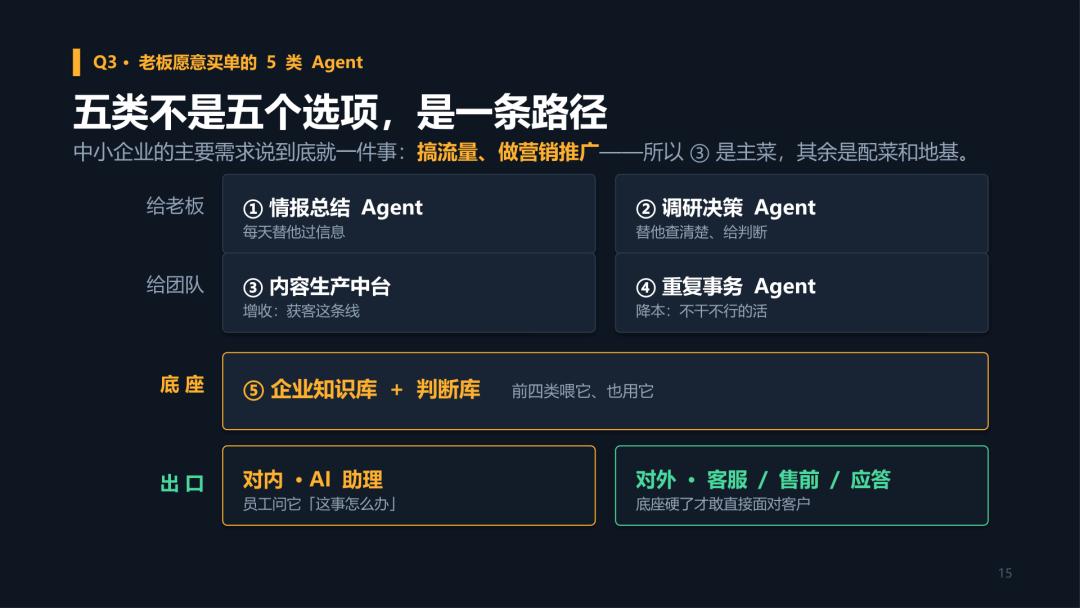
"What to use" and "what to do" are two different questions: the four criteria mentioned above answer the question of "what to use"; what business owners are willing to pay for answers the question of "what to do".
I summarize the answers into five categories: intelligence summarization, research and decision support, content middle platform, repetitive transaction processing, knowledge base plus judgment base. These five categories are not five independent options, but a progressive path.
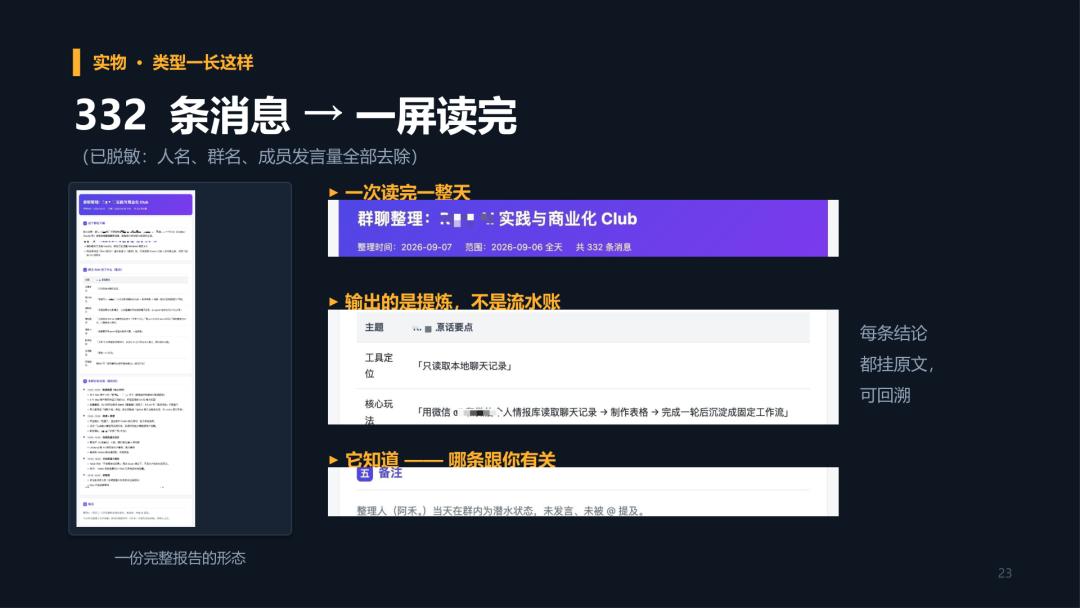
The first category: intelligence summarization. Many business owners are keen to join various industry circles, rarely speak after entering the groups, and spend a small amount of time every day browsing group messages to judge which information is related to their own business. What they want is not the knowledge itself, but the sorted information channels organized by others, so that they do not need to be present in person, and can make judgments after reading the summarized content.
Following this demand, we independently developed WeChat community content sorting function: for WeChat personal app version 4.1 and above, it can automatically sort all chat records in the group, extract what each person said and which content is related to the business, each piece of information can be attached with conclusions and original text, and can be traced back.
The second category: research and decision support. Manus is essentially a research tool: it collects industry progress and cutting-edge information through crawlers, and organizes them into actionable reports. When the industry is sufficiently vertical, or brokerage-level professional information is required, general conversation tools cannot complete such tasks.
In the past, business owners relied on reports from their subordinates to make decisions, which was inefficient and inaccurate; research and decision-making Agents directly generate reports to assist decision-making. Helping business owners make decisions is a huge market, many business owners are not clear about what they exactly need, and they need guidance.
The third category: content middle platform, which is the field I have invested the most energy in. For small and medium-sized enterprise owners, the essence of traffic operation is content production, and the key is to automate and standardize content production while ensuring quality.
Our production line can produce 1000 finished videos of 1 to 2 minutes per day, which are not short low-quality videos of a few seconds, nor are they mixed-cut electronic garbage. The videos are completely different every day, with different images and designs, and are produced according to the tonality of different platforms, with dedicated versions for WeChat Official Account, Xiaohongshu, WeChat Channels and Douyin respectively.
The operation process is fixed: first judge which platform the content will be released on, then confirm where the business information comes from and how to match the materials; select topics, set titles, generate copywriting, the copywriting will go through title inspection, and then automatically match pictures for delivery after confirmation.
The image matching process has accumulated more than 30 methods and 29 painting styles, which are automatically matched according to platforms and tracks. Each style is a well-tuned skill that can be directly installed for new clients.
There is also huge opportunity in B-end content services: many advertising companies are most short of materials, and it is very expensive for them to hire full-time editors, so we often produce hundreds to thousands of advertising materials for them every day.
The fourth category: repetitive transaction processing. Writing copywriting, making PPTs, making statistical tables, checking invoices, these tasks seem trivial but must be completed every day.
Such Agents are divided into three types: the transfer type, which moves data from one place to another; the production type, which only needs minor modification when errors occur; the verification type, such as statistical tables, invoices and orders, any error will cause serious accidents, which must be checked by AI, as manual verification by human eyes is extremely inefficient.
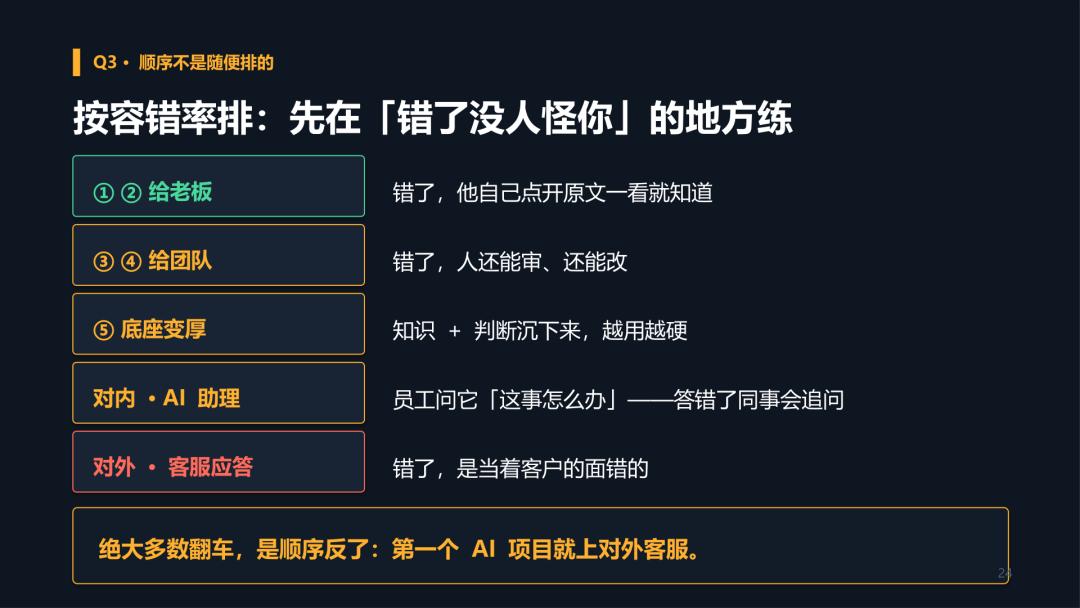
The fifth category: knowledge base plus judgment base, which is the underlying infrastructure. Internally, it serves as an AI assistant, which can be imported with new employee training materials, system learning content and product knowledge; externally, it serves as customer service response system.
What is the order of these five categories? The first two categories are for business owners, the middle two categories are for internal teams, and the fifth category is the underlying infrastructure. The vast majority of people fail in FDE deployment because they reverse the order, thinking that the first step of AI project is to launch external customer service, which is actually putting the cart before the horse.
03
Build the judgment base first, then talk about the knowledge base
The fifth category in the five categories is the top priority: knowledge base plus judgment base.
Almost all people engaged in FDE, AI programming and AI marketing are talking about knowledge base, and few people mention judgment base. The difference between these two concepts determines whether the project can be successfully implemented.
The knowledge base answers the question of "what it is": the enterprise imports materials, reports, systems and manuals into it, and the AI gives a corresponding answer. The judgment base solves the problem of "how should I choose and what standards should I use to do this thing well".
Most enterprises only complete the first half of the work: the knowledge base is filled with a large amount of content, but the output of AI is still unprofessional. The AI may give the correct answer today, but when you ask the same question for the second or third time, the answer will change. The lack of long-term stable judgment standards as context support is the main source of AI hallucinations.
The real judgment logic of the enterprise does not exist in the documents. Once a production line broke down, a professional debugging company spent more than two months without solving the problem, but an experienced veteran worker fixed it in three minutes and charged 10,000 yuan. What he relied on was not the manual, but the experience and subjective judgment accumulated over years.
A large number of business links are essentially experience judgment and logical judgment, which cannot be standardized into documents, and are deeply bound to people's cognition and judgment standards. Without combining people's subjective judgment, a unified judgment base cannot be formed.
How to build the judgment base? The first step of FDE implementation is to communicate thoroughly with the most experienced people in the enterprise, and finalize and run through the smallest SOP closed loop. The judgment base is not built at one time, but grows gradually from one business point to another, one rule at a time.
There are also clear standards for building a knowledge base, you need to check what materials you have first. Many enterprises say they want to build a knowledge base, but the total number of all documents is no more than 20, and most of the rules and regulations are patchwork.
Their really valuable assets are the script sheets and the experience base of top salespeople: