Lyu Cheng, founder of Rabbit: Humans should not change their way of thinking for Agent
By Li Zhaofeng
Edited by Zhang Yuxin
"And God said, Let there be light, and there was light." When talking about the ultimate vision of personal Agent, Lyu Cheng, founder of Rabbit, replaced the "God" in that ancient proverb with "human": in his vision, people only need to state the tasks they want to accomplish, and the Agent will find solutions on its own.
Speaking of Rabbit, many people first think of the orange handheld device r1 — a palm-sized AI device running Rabbit's self-developed system. Rabbit originally hoped that users only need to speak out their tasks, and it could operate apps on behalf of users and complete the tasks. R1 quickly attracted attention after its debut, but the actual user experience after its launch received some critical feedback. Lyu Cheng later admitted that there was a gap between users' high expectations and the initial software experience.
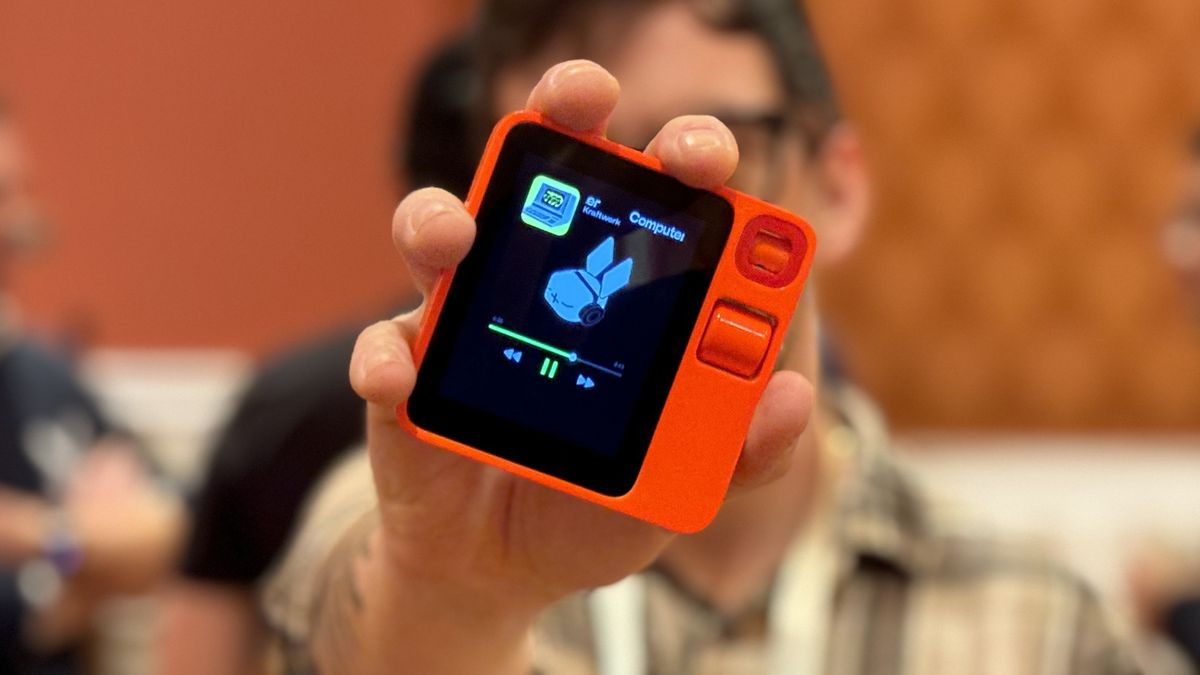
Rabbit R1
Last month, Rabbit launched its new-generation Agent operating system OS3: users assign tasks via web pages or Telegram, and the system calls the AI model selected by users to let the computer search for files, operate software, browse web pages or write code.
"You shouldn't bet that users will only have one device in the end, which is unrealistic." When talking about the reason for developing cross-device functions, Lyu Cheng counted the computers he usually uses: a private PC, a work Mac, and an office computer that can access the company's intranet. In his view, users often switch between multiple devices, and a user-friendly Agent should allow people to assign a task only once, then find the corresponding device and solution on its own.
At 2024 CES (International Consumer Electronics Show), Rabbit made its debut with r1. However, the actual experience of this product quickly sparked controversy, and tech media *Wired* gave the early product a score of 3 out of 10. A few weeks ago, Lyu Cheng said in an interview with *Wired* that more than 100,000 units of r1 have been delivered worldwide, with a return rate of less than 5%. Facing the criticism from back then, he said: "From an engineering perspective, we didn't bet on the wrong direction."
In the communication with Intelligent Emergence, Lyu Cheng further explained the gap faced by r1: "We said at the press conference that it can do four things, but users will try to do six things." Early Agent products are difficult to keep up with users' expanding expectations, but in Lyu Cheng's view, this "avant-garde" feature of entering the industry in the early stage is the underlying gene of Rabbit. At least r1 allowed Rabbit to participate in the discussion of the early form of AI hardware, and when people talk about this category later, they will still mention that orange device. From r1 to OS3, what Rabbit has been striving for is always the right to define Agent products.
In the past year, Agent has gradually expanded from writing code and handling work to people's daily affairs. Since September this year, competition in this track has obviously heated up.
Around the release of OS3, Meta launched its personal Agent product Muse. According to estimates from Sensor Tower, Muse was downloaded about 2.8 million times in two weeks after its launch. Manus, which announced its return to independent operation in early September, subsequently launched its personal Agent product Cue. In China, Alibaba's Qwen has been connected to Taobao for shopping, and ByteDance's Doubao has launched the in-conversation taxi-hailing function. Several companies have different paths, but they are all trying to integrate AI into daily affairs.
Talking about the successive launches of personal Agent products, Lyu Cheng said that models are better at writing code, making Agents easier to build; but whether ordinary people will use them for a long time is still unknown. Making Agents easy to understand and use for a long time is the next challenge.
This also explains the simple operation logic of OS3. In terms of interaction, different from the workbench mode of many Agents, OS3 only has one continuous dialogue window. When users come up with demands in work or life, they can speak out directly, without creating new projects first, or classifying their task demands by work or life. At the execution level, OS3 can connect up to 5 existing computers of users, use the files and software on each device, and decide which machine to complete the task on.
Lyu Cheng believes that for personal Agent to enter the lives of ordinary people, the first step is to lower the threshold of use. "The way humans think is not file-based." This is a judgment Rabbit made when designing OS3: users do not need to categorize work and private matters first, they can state whatever comes to their mind in the same dialogue window.
01|What Kind of Personal Agent Do Ordinary People Need
After Meta's Muse was launched, Lyu Cheng also tried this product. He asked Muse to buy a case of cola, and Muse had to log in to the shopping website on a remote computer, but because it forgot the password, it had to open the password manager to look it up. This process made him wonder: has the demand for personal Agent been verified?
"Which is more convenient, asking Agent to buy a case of cola for you on Amazon, or clicking twice on the computer to buy a case of cola directly?" Talking about this wave of product boom, Lyu Cheng said: "I don't think this demand has been verified."
He used the relationship between "boss and executive assistant" to explain Rabbit's vision: "I have a problem to solve, you help me solve it." In reality, the boss will not specify in advance which store the assistant goes to or which payment method to use; what he wants is the result. Lyu Cheng hopes that users can use personal Agent in this way: simple interaction logic, with local system permissions, and capable of operating across multiple devices.
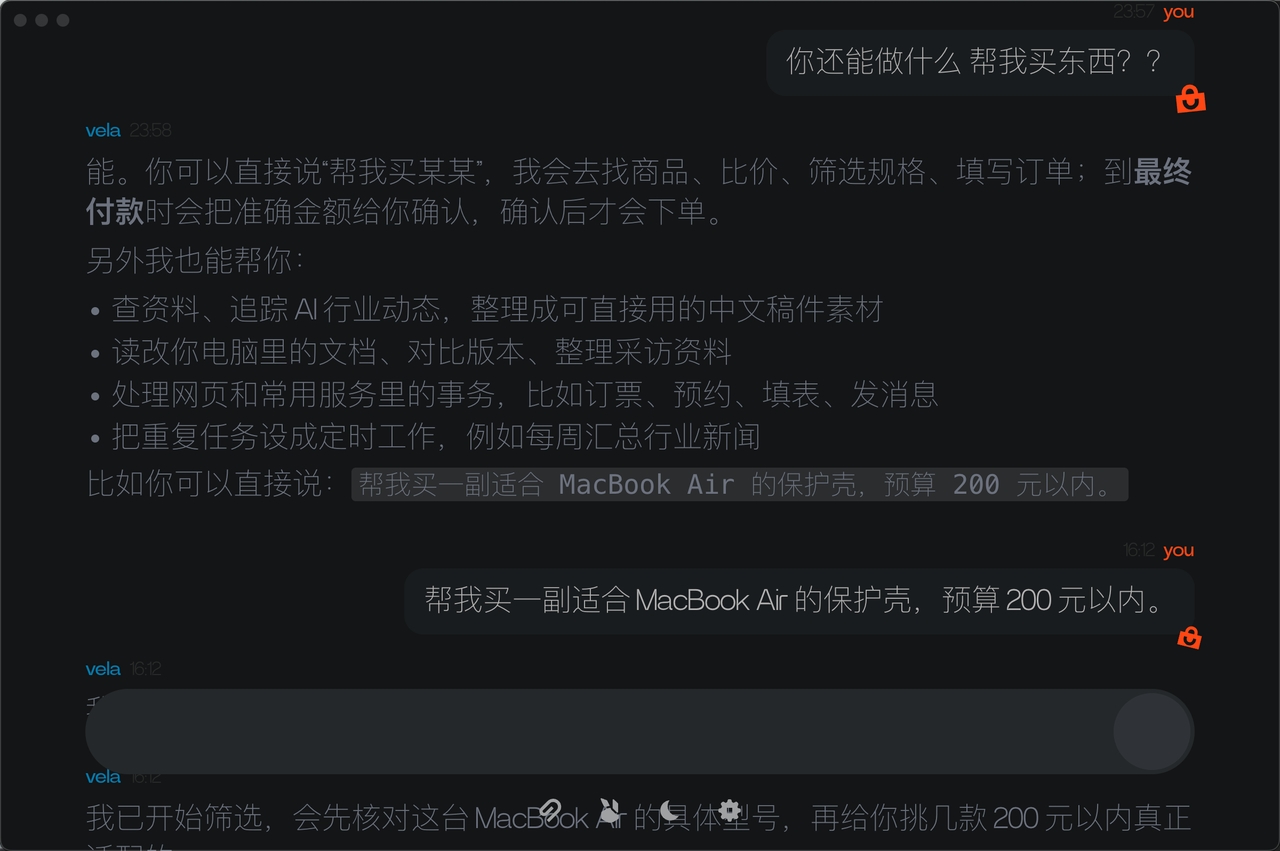
OS3 Operation Page
When you open OS3, what you mainly see is the continuous dialogue and input box, there are no task entrances separated by work and life. This design is simple enough, but it may also leave new users at a loss. Lyu Cheng believes that pre-classifying for people will force them to organize their thoughts in the way required by the software.
Lyu Cheng said that human thinking is fluid: when talking about a work task, you may suddenly remember a private matter that you didn't finish yesterday. He calls this state "brain dump", which means to speak out all the things popping up in your mind. He said that OS3 relies on memory and task scheduling to catch these jumping ideas, then decide what tools to call and which computer to execute the task on. The simpler the input box is, the more complex judgments the system behind it needs to make.
Once the Agent starts to work, simply understanding the instructions is not enough, it also needs to enter the environment where the task can be executed. Lyu Cheng said that Rabbit's early solution once tried a scheme similar to Muse, but found that remote login easily triggers website verification, or even gets blocked. Therefore, for OS3, although cloud model access is still required, OS3 can install the execution program on the selected computer, and use the existing files, software and working environment on that machine. Lyu Cheng also regards local execution as a privacy boundary: "As long as the files are local, there is no need to upload them, and the tasks are executed directly on the local computer."
Usage cost is also a threshold. Some users feedback that when using the same model, the Token consumption of OS3 may be higher than that of OpenClaw, which made Lyu Cheng alert: "We will definitely carry out a round of in-depth optimization to reduce the token consumption."
Token consumption is only one aspect. Lyu Cheng mentioned that after connecting OpenClaw to r1 at the beginning of this year, the most frequent help requests he received were about "how to install OpenClaw". At first he thought that users could just follow the steps on the official website; but later he found that many ordinary users have never opened the computer terminal, let alone familiar with GitHub and skill configuration. In other words, to make personal Agent oriented at ordinary users, it must be as simple as possible with a very low threshold.
Rabbit put the initial setup of OS3 on the web side, users answer questions according to the prompts, then fill in the model API key they applied for to start using; if they want the Agent to operate their own computer, they still need to install the local program and grant permissions. He described the web setup as a "visible improvement", but there is still a long way to go before ordinary users can use it right after getting it. "The top priority I'm grasping in product development now is how to lower the threshold for users."
Talking about why OS3 adopts the Bring Your Own Key mode (users bring their own model keys), Lyu Cheng said: "I don't think any big manufacturer can be certain that their own model will win in their closed system. In the model competition, no manufacturer has absolute advantage, and it is difficult to decide the winner in the short term." In his view, this is also an advantage of Rabbit compared with big manufacturers: the improvement of any model's capability can become a boost to Rabbit's Agent products.
Lyu Cheng hopes that Rabbit can build a product that people are willing to support for a long time. He said that large companies are good at "quickly killing niche and user-friendly products", but "it is difficult to kill a product with faith". He took Linux (an open source operating system) as an example: the number of people using Linux may not be large, but people who are used to it can hardly be persuaded to switch to other systems.
But when asked if Rabbit is willing to become "Linux in the Agent era", Lyu Cheng said: "It is not enough to just become Linux." In his view, after the technical base is built, it is necessary to provide ordinary people with a "plug and play solution" on top of the complex system.
02|Rabbit Strives for the Right to Define Agent
"OS3 is the operating system we initially developed for Cyberdeck." Lyu Cheng said. Cyberdeck is the second hardware product developed by Rabbit after r1: a small computer that has not yet been launched, which is planned to be equipped with a screen and a mechanical keyboard for users to use Agent and programming tools.
In January this year, Rabbit first unveiled the Cyberdeck project. Lyu Cheng announced the product concept on social media at that time: small-sized body, replaceable mechanical keyboard, and an environment for users to freely choose models and Agents. He once revealed to the media that the target price of Cyberdeck is 500 US dollars.
In this conversation, Lyu Cheng gave it a more daily definition: a portable task entry. "This portable device acts as your input box, no matter you use voice input or typing." People can assign tasks from here, and then OS3 will call the connected computers at home or in the office.
Cyberdeck is still under development, and Rabbit chose to open OS3 to ordinary computer users first. Lyu Cheng explained that he hopes the team can find problems from real usage before the new device is completed, and continue to adjust the coordination between software and hardware.
Previously, *Wired* called OS3 a shift for Rabbit. Lyu Cheng clarified in this interview: "It does not mean that we have transformed from hardware to software." He said that many media misunderstood Rabbit as a hardware company, but in fact, "hardware is just something we have to do."
In his view, the key lies in how large the system environment the Agent can access. "If you only make an App, your boundary is the boundary that the App can give you." Developing self-owned devices allows you to design the operating environment of Agent from the system layer.
However, since OS3 can already connect to ordinary computers, why do users still need Cyberdeck? Lyu Cheng believes that the portable unified entry can call multiple devices, and also allow tasks to remain in the user's existing working environment.
This design is related to the restrictions encountered when Agent executes tasks. Lyu Cheng took Amazon shopping as an example to illustrate the trouble of execution environment: he usually logs in from Los Angeles, but the cloud Agent may access the same account from a virtual computer in Minnesota. When the website sees a login from an unfamiliar location, it may require additional verification, or even block the operation. Therefore, he believes that whether the Agent can use the login status and working environment on the user's existing devices is very important.
Lyu Cheng does not deny the fierce competition in the Agent track. Recalling the launch of r1, he mentioned that the team only had seven people at that time, and they wanted to deliver the product before competitors: "It took us a total of 91 days from drawing the draft to the day r1 was released." Nowadays, the iteration of AI products is faster. He believes that if a startup cannot launch new products or make new changes within one or two months, it may be eliminated.
"Everyone thought we were finished, but we just couldn't die." Lyu Cheng attributed Rabbit's resilience to the team's judgment on the Agent technology route. "Not only are we not dead, we have always represented the latest technological innovation and exploration in the Agent field, and at the same time, we have delivered leading Agent products comparable to those of large companies."
Ten years ago, 26-year-old Lyu Cheng sold his founded Raven Tech to Baidu. Now starting a business for the second time, he hopes to fully enjoy the process of creating a product. "Don't kill the joy of a builder." Lyu Cheng said. Builder refers to people who turn ideas into products with their own hands. He said that he "chooses to do more arduous and difficult things, because it is very interesting."