AI earbuds are building momentum, and chip manufacturers are poised for takeoff.
Traditional headphones, are they obsolete?
AI headphones are becoming the mainstream in the wireless headphone market. According to estimates from Research and Markets, the global AI headphone market size was approximately 5.99 billion USD in 2025, and is expected to climb to 7.42 billion USD by 2026, reaching 17.34 billion USD by 2030.
One judgment that is most frequently repeated in the consumer electronics industry is: All hardware products are worth remaking with AI technology.
Since the start of this year, AI-related functions in headphone products have become increasingly abundant: voice wake-up, call noise reduction, audio recording transcription, real-time translation and smart assistants have all been included in the narrative of "AI headphones". The AI headphone category does not yet have a clear boundary, but chip manufacturers have already started preparing the next-generation platform for it.
What kind of new species are AI headphones?
If we only look at new products released in the past year, AI has become a key support for headphones to enter the thousand-yuan price range.
In September 2025, Huawei launched the open-ear headphone FreeClip 2, with a price tag of 1299 yuan. Compared with the previous generation, this product is equipped with an independent NPU AI processor for the first time, and its AI computing power is about 10 times higher than that of the previous generation, which is mainly used for tasks such as voice enhancement, call processing and interaction.
In August this year, Shokz launched the OpenFit 2 AI priced at 1398 yuan, which is connected to Alibaba's Tongyi Qianwen large model, focusing on long-duration recording, voice transcription, meeting summary and multilingual translation. This turns headphones from "playback devices" into portable voice entry points.
iFlytek's development path is closer to that of task-specific terminals. Its AI translation headphones opened for pre-sale in November 2025 at a price of 2499 yuan, covering scenarios such as face-to-face translation, call translation, online simultaneous interpretation and side-listening simultaneous interpretation. Disassembly results in May 2026 show that this type of product is more complex than ordinary TWS headphones in terms of main control unit, microphone array and local storage. Similarly, in 2026, AI headphone solutions with eSIM-connected charging cases appeared in the global market. Plaud connected headphones to AI Agent, trying to reduce dependence on mobile phones.
OpenAI acquired LoveFrom, the design firm co-founded by former Apple chief designer Jony Ive, for about 6.5 billion USD. According to multiple supply chain sources, the product co-developed by the two parties has the code name "Sweet Pea", which is most likely a smart headphone focused on AI interaction, equipped with a custom 2nm process chip, aiming to realize local processing of AI tasks on the headphone body, and is scheduled to be released in the second half of 2026.
Cameras are pushing AI headphones toward "full-perception" devices. In the spring of 2026, LightSail Tech launched the Lightwear camera-equipped AI headphone, with an announced starting price of 1799 yuan for the first release, and some versions are priced at 1999 yuan; the product adds a camera to the headphone, and completes the collaborative processing of images, sounds and positions through the cellular network and positioning capability of the charging case. It no longer only understands what the user says, but also tries to understand what the user sees. Apple's camera-equipped AirPods is still in the stage of rumors and supply chain preparation, and many media predict that its release time may be delayed to 2027.
At the current stage, AI headphones are roughly divided into three categories.
The first category is the mobile phone collaborative type. The headphones are responsible for collecting sounds, playing results and triggering commands, and complex calculations such as speech recognition, real-time translation and open-ended Q&A are completed by the mobile phone or the cloud. The real-time translation function of AirPods Pro 3 is a typical case, which requires connection to an iPhone compatible with Apple Intelligence. Its advantage is that there are limited changes to the headphone hardware, and functions can be upgraded with the mobile phone system; its limitation is that the headphones have almost no independent AI capability after leaving the mobile phone.
The second category is the end-side enhanced type. Low-latency tasks such as voice activity detection, keyword wake-up, echo cancellation, call noise reduction, human voice separation and environment recognition are completed on the headphone side, while complex recognition and large model Q&A are still handed over to the mobile phone or the cloud. The "AI hands-free conversation" function of Samsung Galaxy Buds3 Pro and Huawei FreeBuds Pro 5 both belong to this direction. Whether the headphones can stably collect sound in noisy environments and switch the transparency mode in time depends on the end-side algorithm and main control chip, not just the capability of the cloud model.
The third category is the task-specific AI terminal. It remakes the software and hardware division of labor of headphones around recording, transcription, translation and meeting minutes, which requires longer monitoring duration, larger data cache and more stable connection. This forms a distributed computing system among headphones, mobile phones and the cloud: wake-up and noise reduction are completed in real time near the ear, transcription can run on the headphone or mobile phone, and translation, summary and open-ended Q&A rely more on the cloud.
Once computing tasks are migrated to the headphone side, the problem changes from "adding a software function" to a systematic project involving main control unit, memory, storage and power management. With a weight of only a few grams and a battery of tens of mAh, the headphone needs to maintain Bluetooth connection, audio playback, active noise reduction, sensor collection and neural network inference at the same time, making chips a problem that the industrial chain must address.
AI Headphones: Chips Come First
The competition of AI headphones does not start with large models in the first place, but with main control chips.
The main control SoC of traditional Bluetooth headphones is mainly responsible for Bluetooth connection, audio codec, active noise reduction, microphone collection, touch interaction and low power consumption management. After the addition of AI capabilities, chips also need to undertake tasks such as voice activity detection, keyword wake-up, human voice separation, environment recognition and partial neural network inference. Therefore, the main control chips of AI headphones usually follow two paths: one is to add NPU or AI acceleration units inside the traditional audio SoC; the other is to add an independent AI audio chip that works collaboratively with the original Bluetooth main control unit.
Bestechnic BES2800 is one of the most representative models among the current main control chips for AI headphones. When Samsung launched the Galaxy Buds3 series earlier, Bestechnic confirmed that this series was the first to be equipped with BES2800. This chip adopts the 6nm FinFET process, integrates multi-core CPU, GPU, NPU, RAM, low-power Wi-Fi and dual-mode Bluetooth, and is no longer a simple Bluetooth audio chip in the traditional sense. Compared with the previous generation BES2700, the CPU performance of BES2800 is about doubled, and the NPU performance is increased by up to 4 times. Functions supported by Samsung Galaxy Buds3 Pro such as Galaxy AI real-time translation still require the participation of Galaxy mobile phones, but microphone collection, noise reduction, voice activity detection and audio transmission on the headphone side all need to be completed by the main control chip.
Qualcomm merged AI, Wi-Fi and high-end audio, and launched the Snapdragon S7 and S7 Pro Sound Platform. The Xiaomi Buds 5 Pro Wi-Fi version adopts the Qualcomm S7 series audio platform. The S7 platform integrates multi-core DSP, sensor center, micro-power AI engine and Bluetooth connection capability, and the S7 Pro also adds micro-power Wi-Fi and XPAN technology.
Google Pixel Buds Pro 2 adopts the Tensor A1 chip self-developed by Google. Tensor A1 is a custom chip specially designed for headphone audio processing, which can process ambient sounds at a frequency of about 3 million times per second for active noise reduction and voice enhancement. Pixel Buds Pro 2 is also Google's first headphone product designed around Gemini. The Pixel Buds 2a launched in 2025 also uses the Tensor A1, and brings active noise reduction to the Pixel A series headphones for the first time.
Willus WQ7036AX is a high-performance, low-power Bluetooth audio SoC launched by Willus Microelectronics, which is mainly positioned as the audio main control for smart audio glasses and high-end wireless audio devices. Adopting the dual-core architecture of "RISC-V + high-performance DSP", the disassembly report of Huawei's first-generation FreeClip shows that this headphone uses the Willus WQ7036AX audio main control chip. The disassembly of iFlytek's AI translation headphones also shows that it uses the same series of main control unit for wireless connection, audio data processing, complex audio algorithms, AI noise reduction and multi-microphone ENC.
The Thus A1, jointly developed by Anker and CIX Technology over three years, is called the world's first neural network computing-in-memory AI audio chip by the two parties. According to the disclosed information, the overall computing power of traditional Bluetooth audio chips is about 30M FLOPS, while Thus A1 reaches 5G FLOPS, with a theoretical computing power improvement of about 150 times; at the same time, the chip does not take a significant increase in power consumption as the cost.
Storage Is Another Threshold for AI Headphones
The next threshold for AI headphones is not only the main control chip, but also storage. After all, an ordinary TWS headphone is equipped with a single 32M or 64M NOR Flash chip. Taking the Doubao AI headphone as an example, with a thousand-yuan price tag, 2 large-capacity 128M NOR Flash chips for each single headphone and 4 for the pair, the ASP increase brought by AI headphones can reach 3 to 5 times.
Judging from the product roadmap of storage enterprises, the storage upgrade of AI headphones mainly has four directions.
First, the capacity continues to increase. NOR Flash will expand from 32Mbit and 64Mbit to 128Mbit, 256Mbit and 512Mbit, and SPI NAND will take charge of storing larger-capacity data such as recordings, meeting files and voice caches.
Second, the distance between the memory and the main control unit is shortened. Model inference is more sensitive to bandwidth and latency. On-chip SRAM, external PSRAM and high-integration ePOP can reduce data movement and improve end-side processing efficiency.
Third, the packaging is developing toward miniaturization. BGA, WLCSP, KGD, ultra-thin packaging and multi-chip co-packaging will become important directions for headphones and other wearable terminals. Memory should not only be measured by capacity, but also meet the requirements of the headphone motherboard for thickness, area and heat dissipation.
Fourth, the importance of low power consumption and data security is rising. AI models need to reside for a long time, and recording data also involves privacy. Memory needs to reduce power consumption during standby, reading and writing, and also support secure boot, firmware protection, data encryption and reliable OTA upgrade.
The product layout of storage manufacturers is also changing accordingly. Puyuan's P25Q series covers low-voltage NOR Flash, and the P25Q128SN has a capacity of 128Mbit with a working voltage as low as 1.1-2.0V; the company lists AI headphones, AI glasses and AR/VR as key directions in consumer electronics, and discloses that related NOR products have achieved mass shipment. Hengshu Semiconductor has launched 256Mbit NOR and is promoting 512Mbit products, whose application scenarios cover smart wearables and IoT terminals. Wuhan Xinxin's XM25Q series covers 16-256Mbit, targeting wearable devices that require larger firmware and algorithm space.
When model weights and audio caches require higher bandwidth, PSRAM becomes another alternative. GigaDevice launched 32Mbit, 64Mbit and 128Mbit PSRAM products in 2025, which are compatible with the Xccela interface, adopt BGA24L ultra-thin packaging, and support the KGD form. AP Memory's APS6404L provides 64Mbit QSPI PSRAM, and Winbond also provides PSRAM and HyperRAM for low-power terminals. The advantages of PSRAM are high read-write speed and high random access efficiency, which are suitable for runtime caching, but it requires additional packaging and power supply, so designers must make trade-offs among bandwidth, standby power consumption and motherboard area.
BIWIN Storage takes a path that leans more toward high-integration storage. The company's products cover SPI NOR Flash, SPI NAND, eMMC, UFS, ePOP and LPDDR, and lists smart wearables as an application direction. Its 144-ball ePOP based on LPDDR4X co-packages eMMC 5.1 and LPDDR4X, with a chip size of 8.0×9.5×0.8mm, and the maximum capacity can reach 32GB+16Gb. BIWIN has also launched ePOP5X to expand the lightweight storage capability of AI wearable devices.
ePOP is not the standard configuration of traditional TWS headphones, but it represents another possibility: when the form of headphones develops toward recording headphones, meeting headphones and task-specific terminals with independent computing capabilities, a single NOR Flash can no longer meet the demand, and memory needs to achieve a higher degree of integration with RAM. Through the combination of ePOP, LPDDR and embedded storage, terminals can obtain larger capacity and higher bandwidth in a limited space.
Camera-Equipped AI Headphones Are Also Coming?
It is worth mentioning that some AI headphones are also equipped with cameras.
In addition to the AI headphones of LightSail Tech mentioned earlier, the MusicCam headphones previously launched by Shenzhen VibeLens are the world's first AI camera-equipped headphones that successfully raised funds on Kickstarter. This product focuses on outdoor sports scenarios, so it has high requirements for camera performance, and is equipped with the Sony IMX219 sensor, with 32 million pixels (32MP) and support for 1080P video recording. It is worth mentioning that the camera is rotatable, with an adjustable angle of ±30° (left or right) and a 73° field of view width.
Camera-equipped AI headphones are not a brand new concept. As early as 2023, Apple and Huawei submitted a number of related patents, describing a head-mounted device integrating cameras and microphones, which can capture the user's field of view and perform situational awareness, and is suitable for scenarios such as assisted navigation.
For environment-aware headphones (camera headphones), Chinese chip enterprise Beijing Junzheng has also launched one of the industry's smallest wearable ISP solutions. The CW020 series adopts an extremely small 2×5.5mm (11mm²) package and DDR-less architecture. With an area of only 11mm² (about the size of a grain of rice), it can be easily deployed in spaces that traditional ISPs cannot enter, such as headphone stems and temple arms of glasses, and does not require DDR/PSRAM, only SPI NOR Flash.
Conclusion
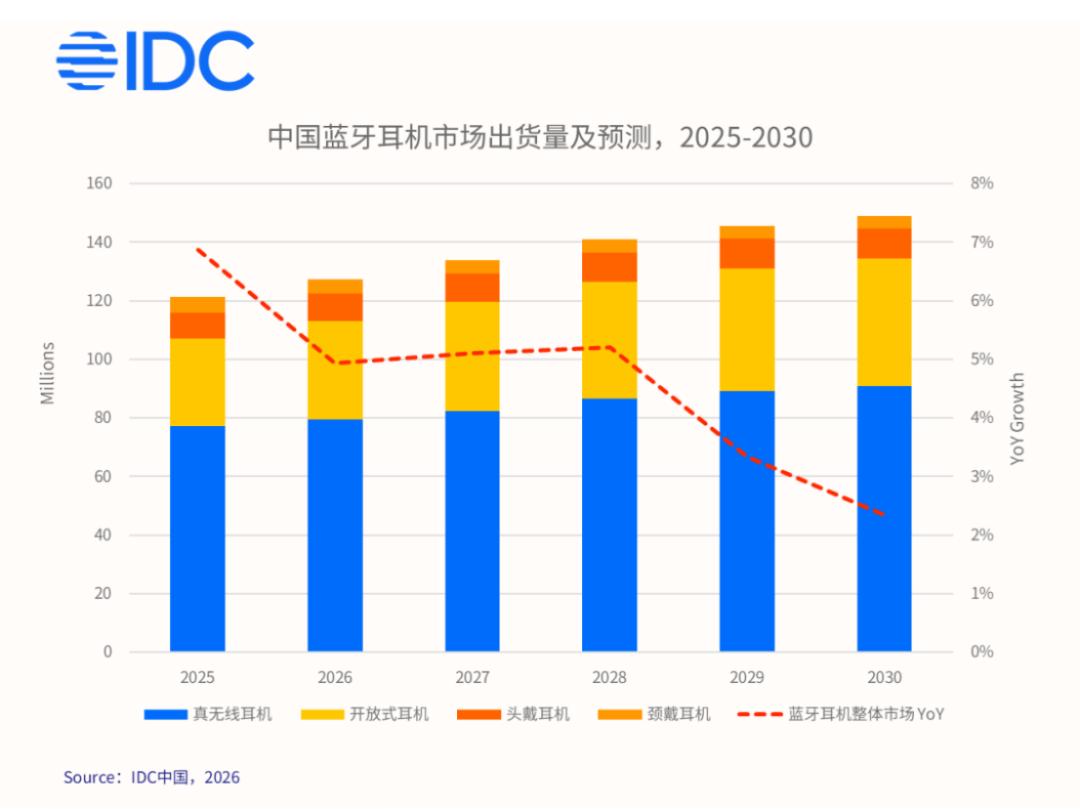
According to IDC data, in the 2025 Chinese Bluetooth headphone market, the shipment of true wireless products reached 77.21 million units, a year-on-year increase of 6.7%, driven by entry-level products and shipment policies tied to mobile phones. The shipment of open-ear products reached 29.96 million units, a year-on-year increase of 20.2%. The open-ear headphone segment has gradually shifted from the rapid outbreak stage to the steady growth stage, with different development structures presented in its subdivided markets.
The headphone track is getting increasingly hot, with the support of large models, smart wearables are expected to change people's habit of scrolling through mobile phones. The 2026 AI headphone market has not yet formed a unified product boundary, but changes in the supply chain have already been surging under the surface.
The main control unit of headphones has expanded from Bluetooth connection and audio codec to NPU, sensor fusion, secure boot and model update; storage has expanded from a single firmware Flash to the combination of NOR, NAND, PSRAM and ePOP; cameras, cellular communication and positioning have pushed some products toward wearable computing terminals. In the future, with the continuous upgrading of AI, connection and low-power technologies, headphones will become one