Even while driving, the business owner still has to worry about whether the inventory is sufficient. After returning to the office, they spend a long time fiddling with Excel spreadsheets. The AI system for the commercial wholesale industry aims to turn a single-sentence query directly into actionable stock preparation and market deployment operations.
Turn ERP Data into Operational Actions with AI
The AI business decision-making system for commercial wholesale is a set of business decision-making system oriented to casual snack wholesale enterprises. Such enterprises usually have used Guanjiapo ERP to accumulate sales, inventory, procurement and customer data, but the traditional mode is still dominated by "people looking for data": managers first open multiple reports on the computer end, then export sales, inventory and customer data to Excel, followed by manual screening, pivoting and cross-comparison. A large proportion of managers' time is occupied by field work, meetings or driving scenarios, making it difficult to complete this process on site; even after returning to the office, different business issues are scattered on multiple pages, and manual verification of commodity, customer, salesperson, inventory and financial data is still required, which easily leads to lagging decisions on stock preparation, market coverage, return visits and promotion. The core problem the project tries to solve is to enable the existing ERP data to be called immediately in front-line scenarios and further converted into executable operational actions.
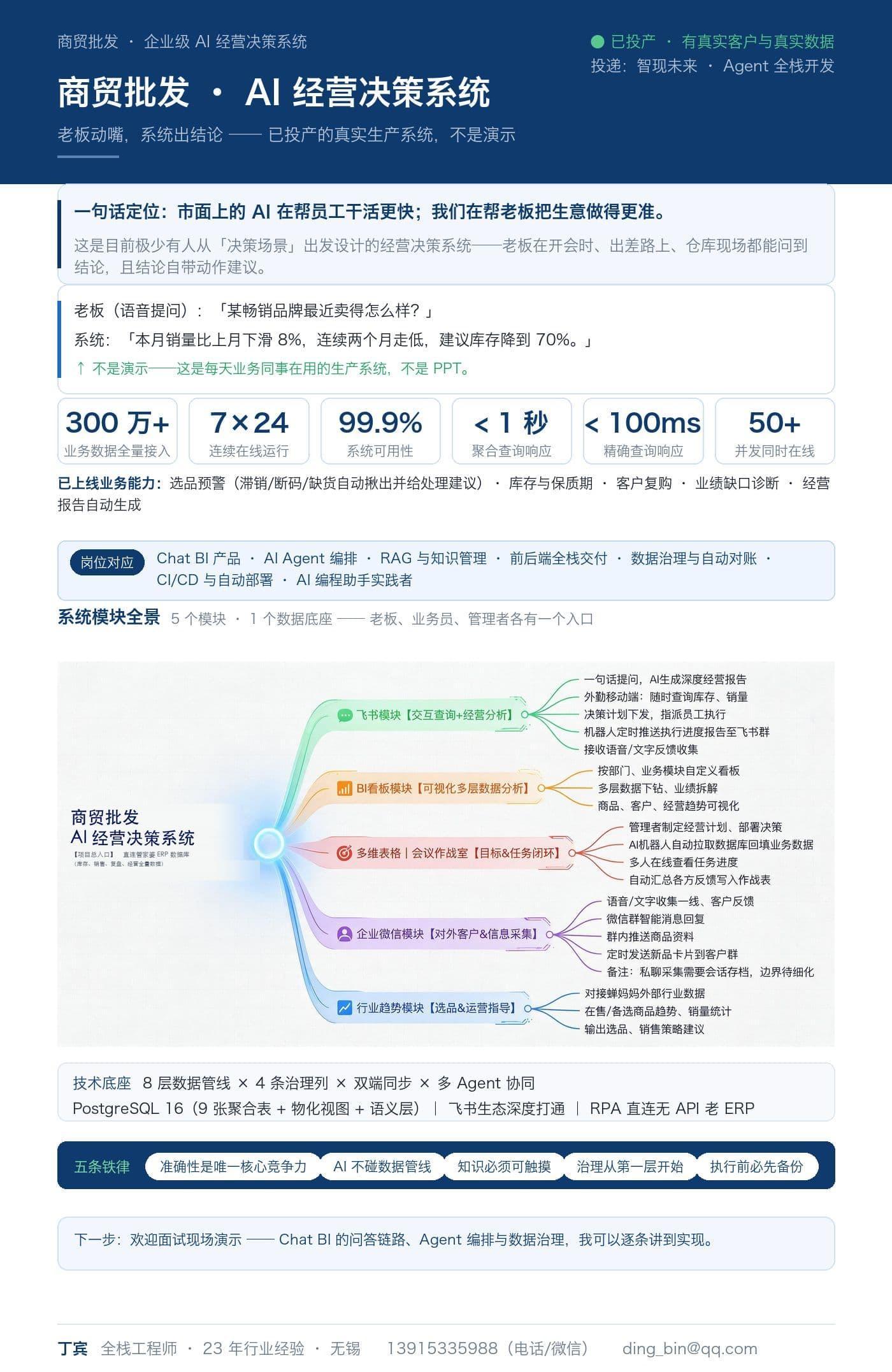
The product takes Guanjiapo ERP data as the base, connects ERP data, external industry data, multidimensional tables, Feishu and WeCom feedback to form a workflow of "interactive query - business analysis - task closed loop". The system consists of five modules: the Feishu module undertakes interactive query and business analysis, the BI dashboard module undertakes visual multi-layer data analysis, the multidimensional table and combat meeting room undertake the closed loop of objectives and tasks, the WeCom module is responsible for external customer and information collection, and the industry trend module introduces external data such as ChanMama to assist product selection judgment for on-sale and alternative commodities. Traditional wholesale relies more on experienced purchasers to repeatedly select goods in the market. The project accesses ChanMama's market category data into the decision-making link, prompts purchasers to intervene when the category is in the rising period, and strives for the incremental dividend brought by trend rules, instead of relying on price competition after similar products gain widespread popularity. The project does not change the original ERP accounting process of the enterprise, but establishes a unified cleaning, aggregation and authorized access layer on the data side, which moves the screening and pivoting that used to rely on post-export operations to the front of the system, so that the same data caliber can be reused among Q&A, dashboard and task distribution.
At the execution layer, the multidimensional table plays the role of "combat command room", where managers arrange business objectives, customer return visits, market coverage promotion and promotion tasks; front-line personnel feed back on-site information through voice or text via WeCom, and the system automatically writes task records and retains execution traces. According to the established assessment requirements, AI regularly queries system data, automatically generates personal progress reports and improvement suggestions, and pushes them to corresponding personnel. The regular task execution reports that used to require managers to urge reports one by one, summarize Excel files and hold review meetings are converted into an automated closed loop. Managers only need to define tasks and objectives, and the front line is responsible for rapid feedback, so that information can be kept synchronized among task distribution, on-site feedback, progress tracking and improvement suggestions.
On the customer operation side, the project will later implant customer service robots into customer WeChat groups and private domain WeChat groups, and regularly send new product introductions, usage scenarios and sales points in the form of images and texts according to the established rhythm. When customers in the group put forward demands, the robot first retrieves the knowledge base and answers combined with customer portraits; when encountering new problems that cannot be covered by the knowledge base, it automatically calls the person in charge to participate in the reply. This can not only reduce the repetitive customer service work of sales personnel, but also continuously collect messages in the group, record the activity level, demanding customers and follow-up status of each group, and provide a basis for subsequent new product push and customer maintenance.
Ensure AI Conclusions Are Verifiable With Deterministic Data Pipelines
In terms of technical route, the project separates the deterministic data pipeline from AI analysis. The original data such as sales, inventory and procurement exported by Guanjiapo first goes through standardized cleaning, unit conversion, contact person correction and change audit, and then enters the PostgreSQL database to form data assets such as monthly aggregation, ten-day aggregation, SKU health status, intelligent stock preparation, shelf life, repurchase rate, brand ranking, store ranking and store portrait. On the AI side, the GLM model is used for intent recognition, task routing and report generation, and access is controlled through security gateway, semantic layer, permission filtering and exit review. Data calculation is not left to the model to operate freely, and the model conclusion needs to be based on predefined indicators and traceable data.
The system is deployed with Flask, Gunicorn, Nginx and Alibaba Cloud, and has accessed more than 960,000 sales details and master data. Project materials show that the target response time of aggregate table query is less than 1 second, which can support more than 50 concurrent users. At present, the product has the capabilities of AI Q&A, decision suggestion, business dashboard, procurement decision sandbox, new product market coverage analysis, inventory health monitoring, customer RFM analysis, financial profit analysis, etc. The Web end supports multi-layer drill-down, performance decomposition and four-quadrant diagnosis; the Feishu end supports querying inventory and sales volume at any time, issuing decision plans, pushing to groups and collecting execution feedback. The procurement decision sandbox calculates the suggested procurement volume by integrating factors such as the average monthly sales volume in the past 3 months, repurchase coefficient, current inventory, promotion plan, in-transit stock, season coefficient and minimum order quantity, helping managers to convert stock preparation judgment from empirical estimation to parametric deduction.
Move From Self-owned Scenario Verification To Channel Replication
The target users are business owners of small and medium-sized snack wholesale enterprises, as well as heads of procurement, sales, marketing, finance and warehouse management. The common feature of these teams is not the lack of ERP, but the lack of an intermediate layer that converts ERP data into decision conclusions and task assignments. The project's business model adopts annual fee charging by version. The basic version covers voice query and basic reports, and the advanced version covers business analysis, task automation, industry trends and customized services. The specific price will be confirmed separately according to customer scale and access scope. The project plans to collect cases and data through free trial for seed customers first, then reach more wholesale enterprises through channels related to Guanjiapo, and at the same time hopes to introduce service teams familiar with software sales and ERP implementation to jointly develop this niche category. Partners can split customer demands in more detail based on the real usage differences of positions such as procurement, sales, inventory and finance, and continuously implement new AI capabilities into the production process, so that customers can obtain verifiable efficiency improvements.
In terms of current progress, the project is incubated from the real snack wholesale business, and the base has covered about 3 million procurement and inventory data, and has continuously accumulated sales details and master data since October 2025. The system has been running in the production environment, forming modules such as AI decision assistance, multi-dimensional dashboard, commodities, personnel, stores, warehousing, finance and data upload, and supporting page solutions such as business weekly report, new product market coverage, seasonal analysis, profit analysis, inventory turnover, customer RFM, supply chain analysis and four-quadrant diagnosis. The focus of the current stage is not to continue to superimpose functions, but to verify the data access efficiency of external customers, complex query stability, permission governance effect and willingness to pay.
This round of project is seeking seed round financing, and the funds are expected to be used for product engineering, multi-tenant data access, industry analysis model optimization, customer case verification and channel cooperation construction. Compared with general BI tools, the AI business decision-making system for commercial wholesale focuses on the high-frequency decision-making scenarios of wholesale enterprise managers: managers do not need to be familiar with the report system first, they can get conclusions through a single sentence, and then assign the conclusions to corresponding personnel for execution. The value that the project wants to prove is that under the same human resource conditions, the enterprise can find out unsalable risk, market coverage opportunity, stock preparation gap and category rising window faster, and shorten the cycle from data discovery of problems to implementation of business actions.