89 years old, a venture capital dream team has emerged from Renmin University of China.
The venerable Renmin University of China (RUC) is celebrating its 89th birthday.
Turning back the clock to 1937, Shanbei Public School, the predecessor of Renmin University of China, was born amid the flames of the War of Resistance Against Japanese Aggression. "China will not perish, for we have Shanbei Public School" — this line fully demonstrates the high level of importance attached to Shanbei Public School at that time.
Through 89 years of extraordinary years, this highly anticipated institution has come a long way. From being "the first new-style university established by the People's Republic of China", to forming three core school-running characteristics as the cradle of "builders of the People's Republic of China", the key base for higher education in humanities and social sciences, and the high ground for Marxist teaching and research, to being praised as "a unique institution in the field of humanities and social sciences in China", generations of RUC people have written the chapters of this university with their youth and wisdom. The status of RUC in the field of humanities and social sciences is self-evident.
As a university renowned for its humanities and social sciences disciplines, finance is one of the most advantageous subjects of RUC. Today, a large number of RUC alumni are also active in the venture capital circle. Liu Qiangdong, founder of JD.com, Zhang Lei, founder of GL Ventures, Qiu Guogen, founder of Chongyang Investment... The outstanding talents from all walks of life are too numerous to list.
The "RUC Force" in the venture capital circle is endless and ever-growing.
The Strongest Branch of the "RUC Faction"
Looking at this list of the "RUC Force" specifically, Liu Qiangdong is the most quantifiable sample, after all, he holds 6 IPOs. And to understand the matter of "RUC-faction IPOs", JD.com is an unavoidable starting point.
The latest development took place in December 2025, when JD Industrial, controlled by JD.com, was successfully listed in Hong Kong. In the huge "JD Faction", JD Industrial is a relatively low-profile member.
JD Industrial was originally part of JD's enterprise business, became an independent business unit of JD Group in July 2017, and was officially launched in the form of a first-level category of JD in 2018, obtaining the home page entry of JD Mall. With the increasing demand for professional procurement from industrial enterprises and the optimistic outlook for the digitalization of China's industry, JD Group officially announced the JD Industrial Products strategy for the first time in March 2019.
In the development process of JD Industrial, it has always been regarded by the outside world as JD's "most hidden unicorn", and has won multiple rounds of financing before listing, which is widely favored by well-known investment institutions.
Data shows that in 2020, JD Industrial completed a $230 million Series A financing led by GGV Capital, with HSG, CPE and other institutions participating in the investment; later in 2021, it obtained $105 million Series A-1 preferred stock financing including Domking and GGV Capital; in 2023, JD Industrial completed Series B preferred stock financing with a total amount of $300 million, corresponding to a valuation of $6.7 billion. This round of financing was jointly led by Mubadala, the Abu Dhabi sovereign fund, and 42XFund, the Abu Dhabi investment fund, with large asset management group M&G, BPEA EQT, the Asian platform under the global private equity giant EQT, and old shareholder HSG participating in the investment.
With the successful IPO of this "hidden unicorn", the JD territory built by Liu Qiangdong is slowly unfolding.
The largest entity under his name, JD Group, landed on Nasdaq in 2014, but 2020 was the year when Liu Qiangdong reaped the most IPO gains.
In June of that year, JD Group completed its secondary listing on the Hong Kong Stock Exchange; in the same June, Dada Group landed on Nasdaq in the United States. At that time, JD was the largest shareholder and IPO cornerstone investor of Dada Group. Later in June 2025, Dada Group announced the completion of the privatization transaction and was fully integrated into the JD system; in December of the same year, JD Health was listed on the Hong Kong Stock Exchange. A year later, JD Logistics made its IPO on the Hong Kong Stock Exchange in May 2021. Shortly afterwards, Liu Qiangdong acquired the listed company Deppon Logistics.
Including JD Industrial, which was listed at the end of last year, Liu Qiangdong has now gathered 6 IPOs in total.
In addition, Liu Qiangdong also holds two more unicorns. Among them, JD Smart Industry Development Co., Ltd. (hereinafter referred to as "JD Industrial Development") previously obtained hundreds of millions of dollars in financing, and also submitted its listing application to the Hong Kong Stock Exchange in January this year, but the application materials have expired. The other unicorn, JD Technology (formerly known as JD Digits), also applied for listing on the Sci-Tech Innovation Board of the Shanghai Stock Exchange in 2020 and was accepted, but withdrew the application in 2021. After that, there were many rumors in the market that it would go to Hong Kong for listing, but no new progress has been seen so far.

Although these two unicorns have not yet reached the step of ringing the listing bell, they are enough to show that the "RUC Faction" IPO reserve pool contains far more companies than those already listed and those queuing for listing.
The "RUC Faction" Venture Capital All-Star Team
Compared with starting a business and ringing the listing bell in person, the presence of RUC alumni in China's venture capital circle is, to some extent, more profound.
Zhang Lei is the most well-known name in this "venture capital all-star team". Zhang Lei was admitted to the Department of Finance and Banking of Renmin University of China in 1990, and founded GL Ventures in 2005. Over the past 20 years, he has invested in a long list of companies including Tencent, JD.com, ByteDance, Meituan, and Liby, and has become a recognized head of top-tier institutions in China's primary market.
In 2017, Zhang Lei donated 300 million yuan to his alma mater for the construction of the GL Ventures School of Artificial Intelligence, which is also one of the most representative cases of RUC alumni giving back to their alma mater.
There are frequent intersections between the school and institutions. On September 16 this year, the GL Ventures School of Artificial Intelligence of Renmin University of China joined hands with GL Ventures to hold the 2nd "AI Future Exploration Day" technical salon event. At the event, Fang Jingyi, Executive Director of GL Ventures, shared the investment logic and industrial experience in the cutting-edge technology field from the perspective of investors. She said that the technology wave continues to reshape the talent structure of the industry. Entering the market during the window period when the industrial structure has not yet been solidified can achieve faster growth and obtain higher-quality industrial resources. She encouraged students to seize the opportunity of technology implementation, actively participate in high-quality science and innovation platforms, firmly focus on the science and innovation track, dare to make innovations and breakthroughs, and achieve long-term development.
If Zhang Lei represents the lineage of US dollar funds, Qiu Guogen represents another line of local private equity securities investment.
As the founder of Chongyang Investment, Qiu Guogen has continued to give back to his alma mater for many years. It is worth mentioning that the Chongyang Institute for Financial Studies of Renmin University of China (RUC Chongyang), established on January 19, 2013, is the main funded project operated by the education fund donated and established by Chongyang Investment to Renmin University of China.
The case of the "Chongyang Investment Education Fund" of Renmin University of China included in the "2024 Observation Report on Large Donations of Chinese University Foundations" writes that as the donor, alumnus Qiu Guogen not only invested 200 million yuan in funds, but also provided free asset value preservation and appreciation consulting services. By the end of 2021, the fund had accumulated a total contribution of 534 million yuan. The principal was not consumed at all, but doubled in growth, becoming a typical sample of successful endowment operation with perpetual principal retention.
Around these outstanding alumni investors, there is also a group of RUC alumni who are equally active in the capital market: Xiao Bing, Executive Partner of Dachen Venture Capital, Li Hui, Founding Partner of Dazheng Capital, Liu Lefe, Chairman of CPE Yuanfeng, Yang Ge, Chairman and Partner of Kunyu Capital, Chen Wenjiang, Founding Partner of YI Capital, Xiao Jiancong, Founder of Longmashan Venture Capital... A large group of RUC alumni are shining brightly in the investment circle.
The existence of this "venture capital all-star team" also reinforces the phenomenon of "RUC Faction IPOs" in a sense. On the one hand, these alumni investors naturally find it easier to build trust in the entrepreneurial projects of their younger schoolmates from their alma mater. On the other hand, when a company founded by RUC alumni reaches the IPO stage, familiar alumni figures are often more likely to be found in the list of cornerstone investors and sponsor institutions.
This alumni network of "investors know entrepreneurs, and entrepreneurs know investors" objectively reduces information asymmetry and shortens the distance from an idea to a listing bell-ringing ceremony.
Why is it RUC?
Interestingly, in addition to alumni being active in the venture capital circle, RUC itself has also entered the market as an LP (Limited Partner).
The latest development took place in June this year, when the name of "Beijing Renmin University of China Education Foundation" appeared in the partner information of "Shenzhen Chongtou No.1 Major Industrial Ecological Development Private Equity Investment Fund Partnership (Limited Partnership)", with a subscribed capital contribution of 20 million yuan in the fund.
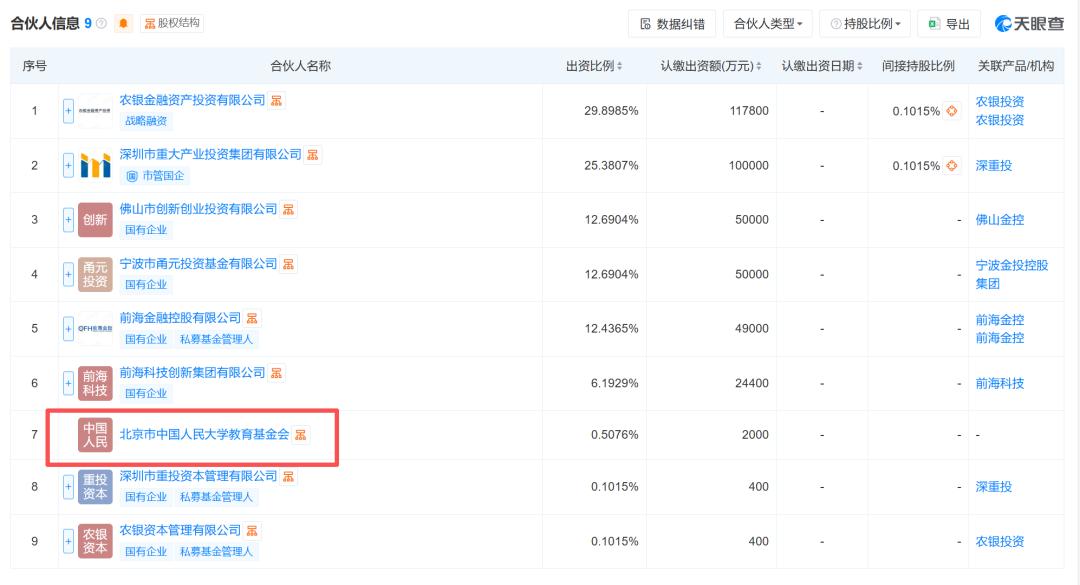
According to public information, the Beijing Renmin University of China Education Foundation was established in 2004, with the purpose of "carrying out charitable activities and not aiming at profit. It raises, accepts and manages donated funds to promote the development of the university's education and scientific research undertakings".
Looking at the latest disclosed "2025 Annual Donation List" of the foundation, the GL Ventures Gaoli Education Development Fund, JD Fund, and Chongyang Investment Education Fund all correspond to the aforementioned alumni Zhang Lei, Liu Qiangdong, and Qiu Guogen. The "Ye Chenghai Fund" mentioned in the figure below belongs to Ye Chenghai, founder of Shenzhen Salubris Pharmaceuticals Co., Ltd., who is an undergraduate alumnus of the RUC 1963 class of the Department of International Politics.
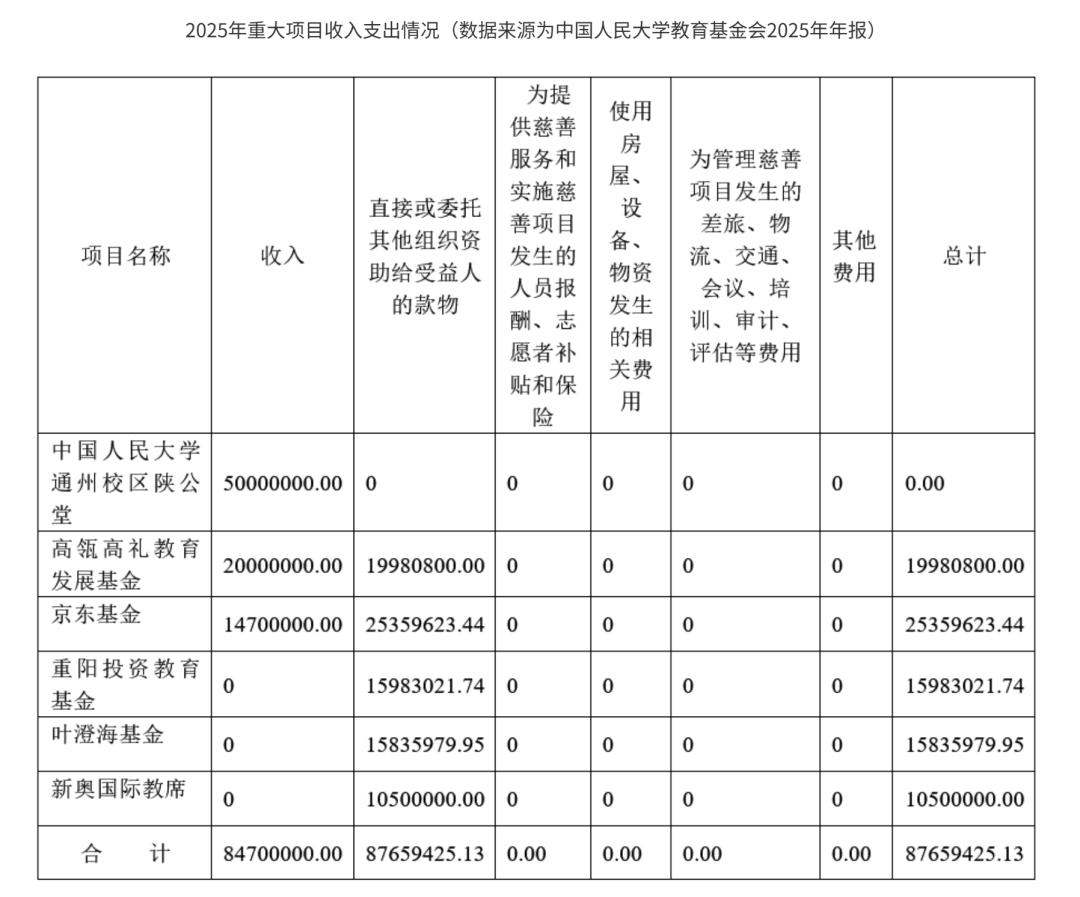
Figure / 2025 Annual Donation List of the Foundation
Combined with RUC's move to act as an LP, to a certain extent, what RUC has accumulated in the capital market is far more than alumni connections, but also a complete set of funds and channels that can directly participate in capital operations.
But why is it RUC?
After all, it is not a "strong science and engineering university" in the traditional sense. In the current wave of new quality productive forces development, the "RUC Faction" is indeed an easily overlooked part. However, this university that started with humanities and social sciences without the aura of science and engineering programs can still continuously produce founders and investors.
The inherent disciplinary foundation of RUC cannot be ignored first. The predecessor of Renmin University of China can be traced back to Shanbei Public School founded in Yan'an in 1937, and was officially established in Beijing on October 3, 1950. It is known as the first new formal university of the People's Republic of China. At the beginning of its establishment, the university set up majors such as the Department of Finance, Credit and Lending to cultivate management cadres for the national finance and financial system in the planned economy period, which also gave disciplines such as finance, statistics and economics at RUC an earlier starting point than other comprehensive universities.
In the fourth round of discipline evaluation by the Ministry of Education, RUC won a total of 9 A+ disciplines, including theoretical economics, applied economics, statistics, and business administration, which are exactly the most mainstream source majors for the finance and venture capital industry. In other words, while other universities are training engineers, RUC is also systematically training talents who understand finance, macroeconomics, and these people later go to start enterprises and make investments, which is not unexpected in terms of path selection.
In addition, the self-reinforcement of the alumni network is also a very important reason.
As mentioned above, it is not difficult to see that a group of successful RUC alumni have continued to feed back resources and funds to their alma mater and younger schoolmates over the years. This kind of feedback is not just about donating money to build buildings, but also includes discipline construction that directly connects to industrial directions such as the GL Ventures School of Artificial Intelligence, as well as the implicit support from alumni funds and alumni venture capital networks for entrepreneurial projects of current students and young alumni.
In the future, this "RUC Faction" legion in the capital market will surely continue to grow.
This article is from the WeChat public account "thecapital" (ID: thecapital), written by Feng Xiaoting, and authorized by 36Kr for release.